短视频

Search documents
快手遭黑灰产攻击致网络安全板块异动
Cai Jing Wang· 2025-12-23 03:37
Core Viewpoint - The A-share cybersecurity sector experienced significant movement following a large-scale attack on the short video platform Kuaishou, leading to a collective rise in stock prices of key companies in the sector [1] Group 1: Market Reaction - The cybersecurity sector in A-shares opened strongly and saw a collective increase, with multiple core stocks rising [1] - Jida Zhengyuan's stock rose by over 7% at one point, currently up by 3.65% [1] - Other companies such as Qiming Star, Qi Anxin, Green Alliance Technology, Guotou Intelligent, and Yongxin Zhicheng also experienced varying degrees of price increases [1]



奇安信专家谈“快手被攻击”
Mei Ri Jing Ji Xin Wen· 2025-12-23 02:40
Core Viewpoint - Kuaishou, a well-known domestic short video platform, experienced a severe cyber attack on December 22, leading to a complete breakdown of its security system due to automated attacks by hackers [1] Group 1: Attack Details - The cyber attack occurred between 10 PM and 11 PM on December 22, resulting in significant disruption to Kuaishou's platform [1] - Hackers utilized automated tools to register and control zombie accounts, enabling the rapid publication and dissemination of illegal content [1] Group 2: Implications for Cybersecurity - The attack highlights the transition of cybercriminal activities into an "automated attack" era, which poses challenges beyond the capacity of manual review systems [1] - The scale of the attack exceeded the limits of traditional content moderation, indicating a need for enhanced security measures in the industry [1]

快手遭黑产攻击瘫痪,“自动化攻击” 时代网络安全怎么做?
Tai Mei Ti A P P· 2025-12-23 02:35
12月22日22时许,国内知名短视频平台快手遭遇黑灰产猛烈攻击。在短短60到90分钟内,黑客组织通过 技术手段侵入快手系统,导致整个平台安全体系陷入瘫痪。攻击者利用约1.7万个僵尸账号开设直播 间,大量播放包含色情、暴力、恐怖等违规内容,有的直播间单场观看量甚至逼近10万人。 值得注意的是,这些直播中还隐藏着病毒链接。许多用户点入后,微信账号即被盗取,不法分子随即向 账号好友发送借款请求,实施诈骗。目前快手平台已紧急关闭和下架绝大多数直播内容,但事件造成的 用户隐私泄露和财产损失已难以挽回。平台方提醒用户保持警惕,切勿轻信异常链接,防止上当受骗。 从22时左右异常初现,到大量违规内容刷屏直播间,再到平台紧急启动最高级别应急响应,这场持续近 两小时的网络攻防战,不仅短暂打乱了平台的正常运营节奏,更将短视频行业的安全防御困境再次推向 公众视野。 事件还原 不同于传统网络攻击的"瞬间瘫痪",此次针对快手的攻击呈现出"精准突袭、梯次推进"的特征,从用户 感知异常到平台完成核心防御,形成了清晰的时间线脉络。结合快手官方通报、用户反馈及行业监测数 据,此次事件的关键节点可精准梳理为四个阶段。 第一阶段为预警潜伏期(大概在 ...
奇安信专家解析快手遭黑客攻击,自动化攻击致平台瘫痪
Xin Lang Ke Ji· 2025-12-23 02:30
Core Viewpoint - Kuaishou, a well-known short video platform, has faced severe attacks from black and gray industries, leading to a significant security breach that paralyzed its system within 60 to 90 minutes [1][2]. Group 1: Attack Details - The attack on Kuaishou was characterized by the use of automated tools by hackers to register and manipulate zombie accounts, allowing for the rapid dissemination of illegal content [1]. - Traditional manual review processes are inadequate against the scale of automated attacks, resulting in a situation where the platform is overwhelmed by a flood of violations [1]. Group 2: Security Insights - Experts emphasize that network security upgrades should not only focus on external threats but also address internal vulnerabilities, as incidents involving insider threats have become increasingly common [2]. - The current landscape of network security is described as asymmetric warfare, where the automation of attacks outpaces traditional manual defenses, necessitating the integration of AI for automated security measures [2][3]. Group 3: Industry Implications - The Kuaishou incident serves as a warning for the entire industry, highlighting the need for a comprehensive security strategy that combines automated external defenses with robust internal safeguards [3]. - Companies are urged to adopt a zero-trust architecture and leverage AI to create a fully automated security system capable of responding to both external and internal threats effectively [3].

2025年中国短视频行业研究报告
Sou Hu Cai Jing· 2025-12-17 02:48
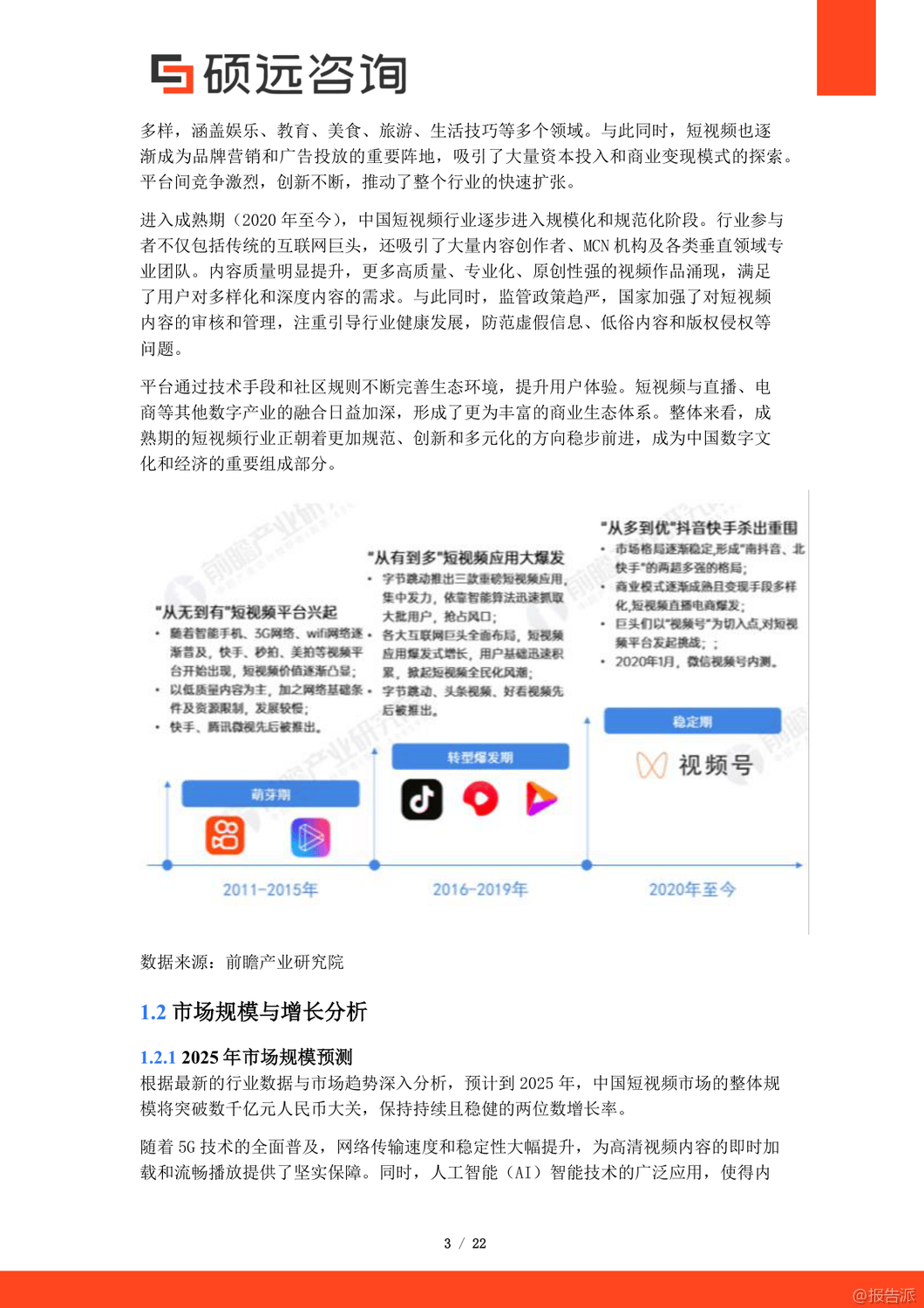
Core Insights - The Chinese short video industry is entering a critical development stage characterized by scale, intelligence, and diversification, projected to exceed thousands of billions of RMB by 2025 with sustained double-digit growth [3][19]. Market Growth and Drivers - The growth is driven by the widespread adoption of 5G technology, deep application of AI algorithms, and continuously evolving user demands [4][22]. - The user base is expanding rapidly, particularly in lower-tier cities and rural areas, where demand for practical and localized content is increasing [22][35]. - The content ecosystem is diversifying, with entertainment, food, education, and e-commerce as the four main sectors, and knowledge-based content is notably rising [7][8]. User Demographics and Behavior - Core users are primarily aged 18 to 35, with a balanced gender distribution, and significant growth in female users in sectors like beauty and fashion [6][35]. - Daily usage time has surpassed one hour, with users engaging during fragmented time periods such as commutes and breaks, indicating that short videos have become essential for information and entertainment [6][41]. Content and Creator Ecosystem - The creator ecosystem is characterized by a dual-driven model of leading creators and emerging talents, with major platforms like Douyin, Kuaishou, and Xigua Video dominating the market [10][11]. - New platforms like Bilibili and Weibo Video are focusing on niche markets, enhancing industry diversification [12][29]. Technological Innovations - Technologies such as VR and AR are reshaping user interaction experiences, enhancing e-commerce conversion rates through innovative applications [13][24]. - Platforms are leveraging deep learning and big data to create precise user profiles, enabling personalized content delivery and targeted advertising, which significantly boosts user engagement and monetization capabilities [14][20]. Regulatory Environment - The industry faces compliance challenges, including content homogenization and privacy concerns, prompting the government to strengthen regulations through laws like the Cybersecurity Law and Advertising Law [15][16]. - Overall, the industry is expected to advance towards a healthier and more sustainable development phase, becoming a vibrant content ecosystem in the digital economy era [16].
中国移动互联网流量季度报告
Ai Rui Zi Xun· 2025-12-12 09:17
Investment Rating - The report does not explicitly provide an investment rating for the mobile internet industry in China. Core Insights - The mobile internet traffic in China has shown steady growth, with the number of monthly active devices reaching 1.452 billion by the end of Q3 2025. User engagement metrics indicate a shift from "high-frequency shallow use" to "low-frequency deep use," with daily effective usage time per device increasing from 272.4 minutes to 282.9 minutes, while the number of daily usage instances decreased from 65.1 to 59.8 [10][14]. Summary by Sections 01 Overview - The mobile internet traffic in China has experienced slight growth, with a monthly active device count of 1.452 billion as of Q3 2025. User stickiness remains stable, with daily effective usage time per device increasing to 282.9 minutes, while the frequency of usage has decreased [10][14]. 02 Segmentation - The report highlights that the user demographics are stable, with unmarried users making up 32.7% of the mobile internet population, reflecting the influence of the single economy on traffic growth. Users aged 35 and below account for 49.1%, and there is a notable increase in users from second-tier cities and above [17][18]. - Short video content continues to dominate user attention, with significant growth in daily usage time for travel and communication services, indicating a strong demand for immersive and personalized digital experiences [20][21]. - The top sectors in the mobile internet include communication and chat services, e-commerce, and aggregated information, with communication services achieving a penetration rate of 89.0%. The artificial intelligence sector has shown remarkable growth at 59.3% year-on-year [26][28]. - User engagement in high-frequency applications such as communication and short video services has increased, while sectors like social networking and aggregated information have seen declines, indicating a shift in user preferences towards high-quality content and innovative services [31][32]. 03 Value Rankings - The report does not provide a specific value ranking for the mobile internet industry in China.
一只兔子狐狸卖49.9元,人们为何乐此不疲地为流量IP埋单?
Sou Hu Cai Jing· 2025-12-07 20:13
Core Insights - The rise of IP marketing has significantly influenced consumer behavior, with its share in brand marketing events reaching 71.6% by Q1 2025, driven by emotional connections to popular characters and stories [3][18] - The success of films like "Ne Zha" and "Zootopia" has led to a surge in related merchandise, creating a scale effect in the market [3][18] - Consumers are willing to pay for products associated with beloved IPs, reflecting a deeper emotional recognition and community belonging [5][18] Group 1: IP Marketing Trends - IP marketing has become a primary battleground for brands, with significant engagement seen during the release of "Ne Zha," which generated 686 million interactions online during the Spring Festival [3] - The influence of IPs is evident in the rapid sales of merchandise, such as toys and themed products, following the release of "Zootopia 2" [3][18] - Emotional resonance with characters leads to consumer spending beyond just ticket purchases, as seen in the case of "Ne Zha" [5] Group 2: Content Creation and Monetization - Content platforms are enhancing monetization strategies for creators, with a notable increase in creators earning over 1,000 yuan monthly on platforms like Kuaishou, which saw a 12% year-on-year growth [8][10] - The coupling of algorithms, emotional engagement, and commercial monetization is reshaping the global information consumption chain [7] - Video platforms are exploring diverse IP monetization models to extend the lifecycle of IPs, with iQIYI actively developing IP consumer products and experiential businesses [14][16] Group 3: Globalization of IP - The globalization of IP has emerged as a new growth engine for content platforms, with initiatives like the "Inspiration China" program aimed at fostering international collaboration [16] - iQIYI's international business has become a significant growth driver, achieving its highest revenue growth in nearly two years in Q3 [16]

被“愤怒诱饵”套牢的打工人:那些让你越刷越气的视频,谁在赚钱?
3 6 Ke· 2025-12-05 07:11
Core Viewpoint - The article discusses the phenomenon of "rage bait," a content strategy designed to provoke anger and engagement among viewers, particularly in the workplace context, highlighting how it exploits emotions for profit [2][5][18]. Group 1: Definition and Characteristics of Rage Bait - Rage bait is not merely about venting frustrations; it is a deliberately crafted content form aimed at inciting anger and maximizing viewer interaction [2][5]. - Unlike simple complaints or clickbait, rage bait focuses on emotional manipulation to drive engagement rather than conveying the truth [5][12]. Group 2: Reasons Why Workers Are Most Vulnerable - Workers often experience heightened emotions after a long day, making them susceptible to content that portrays workplace injustices [7][10]. - The inherent competition and perceived unfairness in the workplace amplify feelings of resentment, making individuals more likely to engage with content that resonates with their experiences [8][10]. - Platforms prioritize content that generates high interaction, leading to a cycle where angry viewers are shown more rage-inducing content [11][12]. Group 3: Common Tactics of Workplace Rage Bait - Tactic 1: "Outrageous Boss Universe" - Content that highlights extreme and shocking behavior from employers, often lacking context [14]. - Tactic 2: "Using Isolated Incidents as Industry Truths" - Videos that generalize extreme cases to suggest widespread issues within an industry, fostering a sense of hopelessness among viewers [15][16]. - Tactic 3: "Anger-Packed Selling" - Content that first incites anger and then offers solutions, such as courses or products, capitalizing on the viewer's emotional state [17][19]. Group 4: Monetization of Viewer Anger - The emotional engagement from viewers translates into increased content visibility and interaction, benefiting both platforms and content creators through advertising and monetization opportunities [18][19]. - Viewers contribute their time and attention, which could be better spent on personal development, while inadvertently boosting the performance metrics of content creators [19][20].
字节跳动豪掷2664亿,TikTok将在巴西建拉美首个数据中心
Xin Lang Cai Jing· 2025-12-04 11:25
Core Insights - TikTok plans to invest over 200 billion Brazilian Reais (approximately 266.4 billion RMB) to build its first data center in Latin America, located in Ceará, Brazil, marking a significant strategic move in the region [1][3] - The investment will be in collaboration with data center developer Omnia and renewable energy supplier Casa dos Ventos, utilizing clean energy sources for the data center's operations [1][3] - This initiative aligns with Brazilian President Lula da Silva's vision of making Brazil a regional AI powerhouse, supported by government incentives for data center investments [1][3] Investment Details and Economic Impact - The investment will be phased until 2046, with the first phase expected to start operations in 2027, targeting an IT load of 200 megawatts and an investment of approximately 50 billion Brazilian Reais [2][4] - The project is anticipated to create over 4,000 direct and indirect jobs during the first phase, significantly boosting the local economy [2][4][5] - TikTok's investment reflects its commitment to Brazil as a vibrant digital market and highlights the country's potential as a new growth destination for global tech capital due to its renewable energy resources and strategic location [5]
好公司本身就是安全边际,聊聊优质企业的六类核心护城河
雪球· 2025-12-03 08:37
Core Viewpoint - The article emphasizes the importance of a company's competitive advantages, referred to as "moats," in ensuring long-term profitability and investment safety, rather than merely focusing on stock prices [3][28]. Summary by Sections Concept of Moats - A moat is defined as a barrier that protects a company's profits from competitors, making it difficult for them to erode its market position [3][4]. - The essence of a moat is that it allows a company to provide products or services that others cannot replicate easily or at a high cost [4]. Types of Moats 1. **Brand** - Strong brands lead to customer willingness to pay a premium and foster long-term repurchase behavior [6]. - Examples include Moutai and Apple, where brand loyalty creates a "default choice" for consumers [6][7]. 2. **Patents** - Patents provide exclusive rights to produce a product, allowing for high profits during their effective period [8]. - The sustainability of a moat through patents depends on a company's ability to continuously innovate and secure new patents [9]. 3. **Scale and Cost Advantages** - Scale advantages arise when a company can reduce costs to levels that competitors cannot match, as seen with Fuyao Glass [10][12]. - Large-scale operations allow for better pricing power and efficiency, creating a self-reinforcing cycle of growth [12][14]. 4. **High Switching Costs** - High switching costs lock customers into a company's products or services, making it difficult for them to change suppliers [15][16]. - Examples include software systems and financial services where the cost and effort to switch are significant [16]. 5. **Network Effects** - Network effects enhance a product's value as more users join, creating a strong competitive advantage [17][18]. - Platforms like WeChat and Douyin illustrate how user growth leads to increased value and user retention [18][20]. 6. **Talent Attraction** - The ability to attract top talent is a crucial moat, as it leads to better products and innovation [21][22]. - Companies like Apple and Tencent benefit from having the best talent, which in turn enhances their competitive position [22]. Maintenance of Moats - Moats require ongoing maintenance and investment to remain effective; neglecting them can lead to erosion of competitive advantages [24][25]. - Companies that continuously invest in R&D and brand integrity, like Moutai and Apple, are examples of effective moat maintenance [24][25]. Investment Perspective - Investors should focus on companies with wide moats as they provide inherent safety margins due to their ability to maintain profitability over time [26][27]. - The article concludes that identifying companies with strong moats is essential for long-term investment success, as these companies are more likely to sustain high profits [28][29].