体育赛事

Search documents
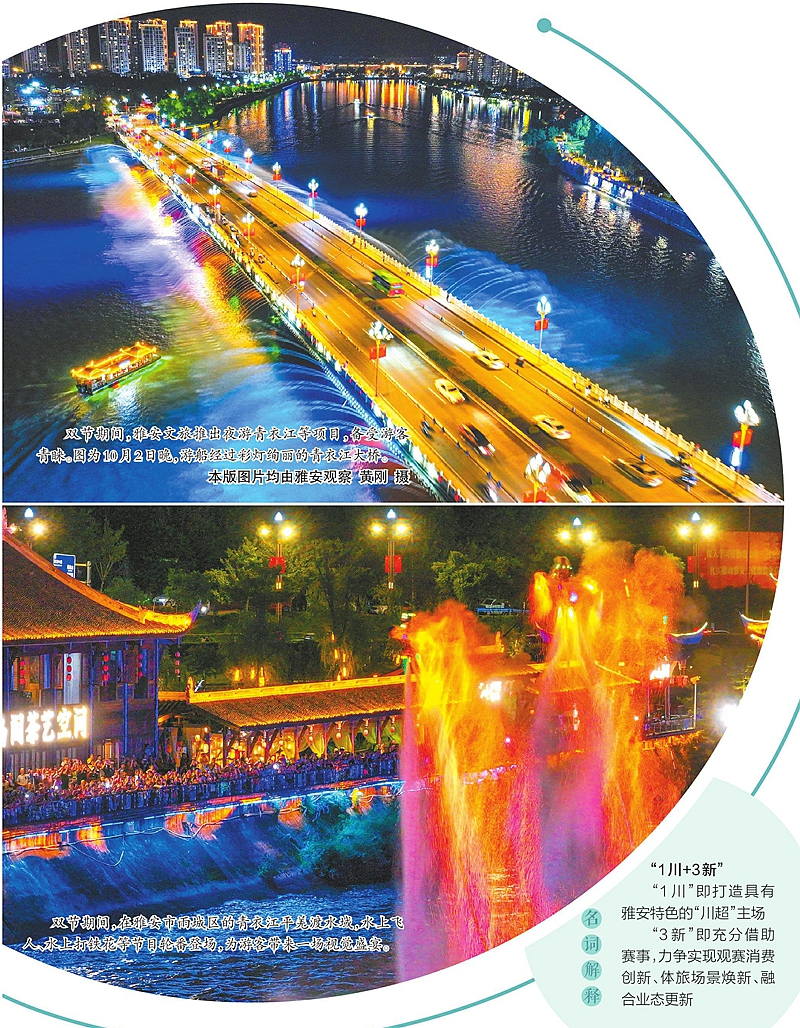
雅安提出构建“大川超”赛事体系 绿茵球场也是“文旅主场”
Si Chuan Ri Bao· 2025-10-10 06:47
Core Insights - The Sichuan Urban Football League ("Chuan Super") is being leveraged by the city of Ya'an to enhance local tourism and cultural engagement, with initiatives aimed at promoting local products and increasing visitor participation [2][3][4] Group 1: Event and Community Engagement - The "Chuan Super" matches serve as a platform for showcasing the city's cultural cohesion and economic vitality, with Ya'an aiming to create a comprehensive event system that promotes public fitness and community involvement [3][6] - A significant turnout of approximately 12,000 spectators was recorded for a recent match, leading to a year-on-year revenue increase of 22.6% in nearby restaurants and 28.9% in retail [5][6] Group 2: Tourism and Economic Impact - The introduction of "blind box" giveaways and ticket stubs as "city travel passes" has been implemented to encourage tourism, offering discounts at 158 local businesses and attractions [5][6] - The local government has launched a 10 million yuan consumer package to stimulate tourism during the National Day and Mid-Autumn Festival, aiming to enhance visitor experiences and extend their stay in Ya'an [6][7] Group 3: Product Promotion and Local Business Support - Local businesses have reported increased sales, with specific products like cured pork and local delicacies seeing significant demand during match days [5][6] - The "Chuan Super" initiative has led to the establishment of a marketplace at the Ya'an Sports Center, featuring over 100 local products and cultural performances to attract visitors [6][7]

接待游客超389万人次!中山“双节”文旅成绩单出炉
Nan Fang Du Shi Bao· 2025-10-10 03:23
Core Insights - The tourism market in Zhongshan is experiencing a strong recovery during the 2025 National Day and Mid-Autumn Festival holiday, with a total of 3.89 million visitors, a 13.89% increase compared to 2024 [1] - The city achieved a tourism revenue of 2.251 billion yuan, marking a 14.32% growth from the previous year [1] Tourism and Cultural Activities - Zhongshan's tourism strategy includes three core areas: Xiangshan Ancient City, Daya Red博城, and Zhongshan Film and Television City, creating a rich "3+N" cultural tourism activity system [1] - The "Qijiang Huancai" cultural tourism event at Xiangshan Ancient City featured various activities, making it a major cultural consumption hub in the Greater Bay Area [1] - The 2025 Guangdong-Hong Kong-Macao Greater Bay Area Music Week and the 17th China-Portuguese-speaking Countries Cultural Week were held at Xingzhong Square, featuring free entry and a mix of local and international performances [2] Sports and Community Engagement - The "Super Weekend·Zhongshan Town Super" football tournament was launched, combining sports with cultural tourism to stimulate holiday consumption [3] - Various community events, such as the "Cultural and Tourism Integration for Rural Revitalization" initiative, showcased local culture and modern art, attracting visitors to rural tourism [4] Non-Material Cultural Heritage - The Greater Bay Area Non-Material Cultural Heritage Carnival in Sanjiao Town featured traditional performances, promoting the integration of heritage with modern life [5] - Various food culture festivals and night markets across towns stimulated tourism consumption, emphasizing the importance of local culinary traditions [5] Public Cultural Services - Public cultural venues in Zhongshan provided high-quality cultural offerings during the holiday, including exhibitions and themed activities that attracted large audiences [6] - The Xiangshan Book House received 82,000 visitors during the holiday, highlighting its role as a popular leisure destination for residents [6]
小县城办大赛,激活“赛事+”新动能篮球“苏超”带动灌南文旅消费飙升28%
Xin Hua Ri Bao· 2025-10-10 00:10
Core Insights - The Jiangsu Province Men's Basketball Super League concluded in Guannan County, with Nanjing Haisheng team winning the 2025 season championship, showcasing the innovative concept of "small county hosting big events" [1] - Guannan County's successful hosting of various provincial-level sports events has significantly improved its event organization capabilities and urban management [2] - The "event+" model has been implemented to stimulate local tourism and consumption, with significant economic benefits observed during the tournament [3] - The growing popularity of basketball in Guannan County has led to increased community engagement and the establishment of a comprehensive basketball development plan [4] Group 1 - The Jiangsu Province Men's Basketball Super League was successfully held in Guannan County, highlighting the county's ability to host large-scale events [1] - Guannan County has formed a multi-departmental preparation team to ensure the smooth execution of the event, utilizing a modern sports center with upgraded facilities [1] - The event attracted over 80% venue occupancy, with an average of nearly 3,000 spectators per game [1] Group 2 - Guannan County has hosted an average of five to six provincial-level sports events annually, enhancing its organizational capabilities through practical experience [2] - The county's tourism bureau created a "watching basketball" travel package, leading to increased local consumption during the event [3] - The tournament generated approximately 3.042 million yuan in consumption, with a total of 11,000 attendees over three days [3] Group 3 - The county has hosted over 100 basketball events this year, reflecting a growing trend in community engagement with the sport [4] - Investments in basketball facilities have increased, with 28 new or renovated courts added in 2024, bringing the total to 485 [4] - The local basketball culture is evolving, with initiatives aimed at integrating basketball into daily life and promoting youth development [4]
赛事IP、演唱会:引爆国庆文旅市场新动力
2 1 Shi Ji Jing Ji Bao Dao· 2025-10-09 23:13
Core Insights - Major events like concerts and sports competitions have become key drivers of tourism consumption during the National Day holiday, transforming from isolated entertainment activities to core attractions for travel [1][4] - The overall travel market has seen a significant increase in both volume and pricing, with average spending per trip rising by 14.6% year-on-year during the holiday [1][2] - The integration of sports events with tourism has created a complete consumption chain, enhancing the economic vitality of cities and extending the holiday consumption cycle [7][8] Travel and Tourism Trends - The National Day holiday saw a more than 30% increase in travel orders on Meituan compared to the previous year, with a trend towards staggered travel patterns [2] - Young consumers, particularly students, have shown a strong presence in domestic air travel, making up nearly 40% of the market during the holiday [2][3] - The number of users purchasing their first international flight tickets increased by 30%, with significant growth among younger demographics [3] Event Impact on Consumption - The China Open and WTT China Grand Slam held during the holiday attracted over 360,000 attendees, with ticket sales reaching 88 million yuan, a 10% increase from last year [4][5] - The Shanghai Rolex Masters saw record ticket sales, with night session tickets selling out in just 36 hours, indicating a surge in spectator interest [5] - Events in cities like Chengdu and Guangzhou have also driven local tourism, with significant increases in hotel bookings and overall consumption [6] Long-term Economic Implications - The relationship between sports events and tourism requires careful balance, as events can both attract visitors and potentially divert them from other attractions [8] - The challenge for non-first-tier cities is to maintain the momentum generated by events, transforming short-term ticket sales into long-term economic benefits [8] - The integration of sports and tourism is seen as a growing market, with opportunities for enhancing visitor experiences through comprehensive cultural and entertainment activities [8]

北京“双节”消费复盘:体验式消费火热 小众目的地崛起
Sou Hu Cai Jing· 2025-10-09 18:54
Core Insights - The consumption market in Beijing showed significant growth during the National Day and Mid-Autumn Festival holiday, with key enterprises achieving sales of 9.51 billion yuan and foot traffic in 60 key business districts reaching 59.668 million, a year-on-year increase of 13.9% [1][7] - There is a notable shift from traditional physical goods consumption to experiential consumption, with services like dining, tourism, and entertainment outperforming traditional retail categories [3][4] - New commercial projects are emerging, characterized by smaller, themed, and unique offerings that cater to diverse consumer groups, breaking away from traditional shopping center models [5][6] Consumption Trends - Experiential consumption has overtaken physical goods consumption, with significant growth in dining, tourism, and entertainment sectors, while traditional categories like home appliances and clothing are experiencing slower growth [3][4] - The holiday period saw the launch of 364 commercial performances and over 2,100 shows, with box office revenues exceeding 58 million yuan, indicating a strong demand for cultural and entertainment experiences [3][4] - The rise of niche destinations and themed commercial projects reflects a consumer preference for unique experiences over mere product ownership [5][6] Night Economy and Cross-Industry Integration - Nighttime consumption has become a highlight, with foot traffic in 60 key business districts reaching 28.116 million, a year-on-year increase of 23.3% [6][8] - Events like light shows and music festivals have successfully created all-day consumption scenarios, integrating culture, technology, and art [6][8] Market Challenges and Opportunities - Traditional shopping centers face challenges such as stagnant growth and difficulty in converting foot traffic into sales due to a lack of innovation and engaging experiences [6][8] - Experts suggest that the future of commercial competition will focus on understanding consumer needs and creating engaging environments rather than merely expanding size or variety [9] - The current market presents both opportunities and challenges for commercial entities, with those embracing experiential and cross-industry trends likely to emerge as winners [9]
解锁“China Travel”新玩法:为一场球,赴一座城
2 1 Shi Ji Jing Ji Bao Dao· 2025-10-09 15:15
Core Insights - The article highlights the growing trend of "China Travel" driven by major sporting events and music festivals, attracting international visitors to cities like Shanghai for experiences such as the ATP Shanghai Masters [1] Group 1: Event Impact - The ATP Shanghai Masters, held during the National Day and Mid-Autumn Festival holiday, has seen significant attendance from overseas fans, indicating a strong international interest in sporting events in China [1] - The presence of foreign fans at the event, including notable athletes like Sinner, Medvedev, and Djokovic, showcases the appeal of high-profile sports competitions in enhancing tourism [1] Group 2: Policy Influence - The optimization of policies such as visa exemptions, tax refunds, and payment facilitation is contributing to the rise of "China Travel," making it easier for international visitors to attend events [1] - These policy measures are part of a broader strategy to promote tourism through major sporting events, reflecting a shift in travel trends towards attending specific events in different cities [1]
费德勒重返上海大师赛,与郑洁、甄子丹、吴磊约战双打
Di Yi Cai Jing· 2025-10-09 14:58
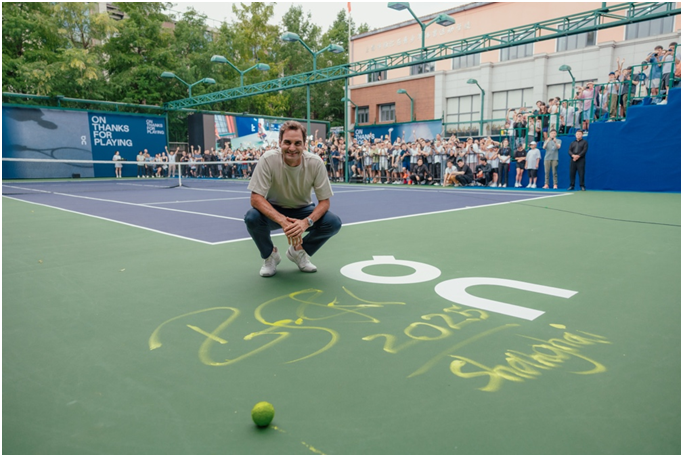
Core Viewpoint - The upcoming "Federer Super Friends Night" at the Shanghai Masters is highly anticipated, showcasing Roger Federer's transition from a professional athlete to a family man and his ongoing involvement in promoting tennis at grassroots levels [1][3]. Group 1: Event Highlights - The "Federer Super Friends Night" will take place on October 10, featuring Federer alongside tennis legends and celebrities in a doubles exhibition match [1][3]. - Federer expressed his excitement about returning to Shanghai, a city significant to his career, where he has played 47 matches with a record of 37 wins and 10 losses [10]. Group 2: Personal Insights - Federer shared his current activities, including playing golf and spending quality time with his children, indicating a positive recovery from his knee issues [3]. - He emphasized the importance of community sports facilities, advocating for more accessible tennis courts to foster youth participation in the sport [10]. Group 3: Historical Context - The Shanghai Masters has evolved significantly since its inception, with Federer being a key figure in its history, having participated in its opening in 2005 [3][10]. - The event has contributed to the growth of tennis in China, with Federer highlighting the need for continued investment in sports infrastructure [10]. Group 4: Contributions to Tennis - Federer has established a foundation aimed at encouraging youth participation in tennis and has been involved in community initiatives to promote the sport [10]. - The renovation of the tennis courts at Xuhui Sports School, where Federer unveiled a new facility, reflects ongoing efforts to improve training environments for young athletes [6][7].
假日经济|黄金周全国体育赛事扎堆 “观赛+消费”成为新时尚
Di Yi Cai Jing· 2025-10-09 14:08
Core Insights - The "watching and consuming" trend has emerged as a new fashion during the National Day holiday, with various high-level sports events driving economic growth across cities in China [1] Group 1: Event Impact on Local Economy - Major sports events like the Shanghai Rolex Masters and the China Open have significantly boosted local tourism and consumption, transforming transient visitor traffic into sustained economic activity [1][4] - The Shanghai Rolex Masters is expected to attract over 240,000 attendees, with more than 70% coming from outside Shanghai, and around 11% being international visitors, surpassing last year's figures [2][3] Group 2: Financial Performance of Events - The China Open has achieved record ticket sales of over 88 million yuan, a 10% increase from last year, with total consumption during the event reaching 36 million yuan, up 44% year-on-year [4] - The WTT China Grand Slam in Beijing reported direct revenues of approximately 154 million yuan, with ticket sales alone reaching 88 million yuan, marking a 54.3% increase compared to previous events [4] Group 3: Broader Economic Effects - Sports events are not limited to first-tier cities; cities like Chengdu and Hainan are leveraging various competitions to enhance tourism and local consumption through partnerships with attractions and businesses [5][6] - The Chinese government is promoting sports consumption and event-driven economic growth, encouraging cities to host events that can be converted into commercial and tourism opportunities [7]
“双节”旅游热将持续至本周末 县城成“追秋”热门地
Xin Hua She· 2025-10-09 13:36
Group 1 - The cultural and tourism market in China is experiencing a surge during the National Day and Mid-Autumn Festival, with 888 million domestic trips taken over the 8-day holiday, an increase of 123 million trips compared to the previous year [1] - Total domestic travel expenditure reached 809 billion yuan, up by 108.2 billion yuan from the previous year [1] - The peak travel period is expected to last from September 27 to October 12, with over 30% of office workers opting for "early leave and late return" strategies [1][4] Group 2 - Family travel has become a major trend, with over 40% of air travelers during the holiday being families, and first-tier and new first-tier cities being the most popular destinations [2] - Hotel bookings in popular cities like Beijing, Chongqing, and Chengdu have seen significant increases, with surrounding county destinations experiencing a 51% rise in bookings compared to last year [2] - Emerging tourist cities have gained attention, with some destinations seeing over 100% growth in travel orders compared to the previous year [2] Group 3 - The holiday period has also become a peak time for music festivals and sports events, contributing to a diverse consumption ecosystem [3] - Ticket stubs are being utilized as "universal tickets" for various attractions, enhancing the overall tourism experience [3] - Collaborative events such as "movie + traditional music performance" are being introduced, benefiting both cinemas and cultural heritage [3] Group 4 - The trend of "taking 3 days off for 12 days of travel" is becoming popular, with a nearly 60% increase in travel orders expected from October 9 to 12 [4] - International travel interest has surged, with hotel bookings in 4,588 cities abroad, particularly in Egypt and Norway, seeing significant increases [4] Group 5 - The number of foreign visitors celebrating the holidays in China has increased, with 16.34 million people crossing borders during the holiday, an 11.5% rise from last year [5] - Popular domestic cities for foreign tourists include Shanghai, Beijing, and Guangzhou, with significant booking increases in cities like Datong and Lijiang [6]
六个关键词,看国内城市“双节”文旅发展新趋势
2 1 Shi Ji Jing Ji Bao Dao· 2025-10-09 13:17
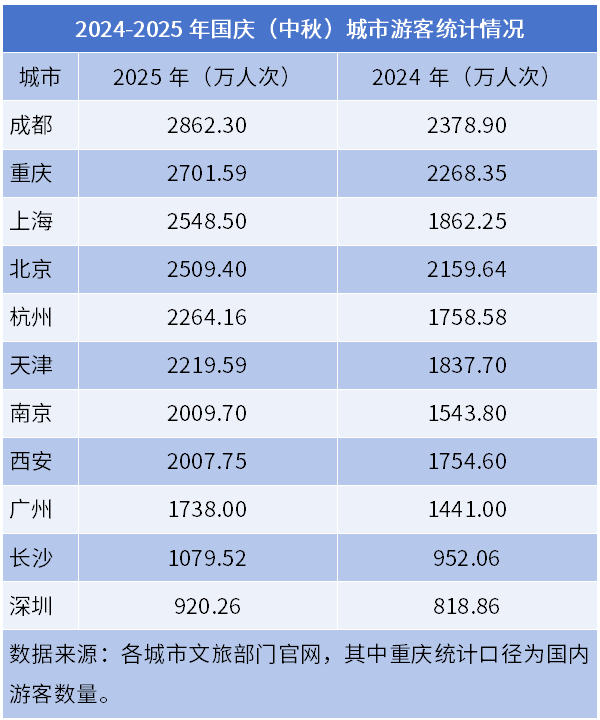
Core Insights - The article emphasizes the need for a more comprehensive analysis of holiday consumption in domestic cities, moving beyond just total tourist numbers and spending to include various dimensions of consumer attraction and competitiveness [1] Group 1: Tourist Volume - In the 11 cities analyzed, 8 cities are expected to exceed 20 million tourists during the 2025 National Day and Mid-Autumn Festival holidays, with Chengdu leading for two consecutive years [1][2] - The total number of tourists in these cities has increased compared to 2024, with Shanghai seeing the largest increase of nearly 7 million tourists [2][3] Group 2: Tourist Spending - In 9 cities that reported tourist spending data, the number of cities with an average spending exceeding 1,000 yuan increased from 2 in 2024 to 3 in 2025, indicating a general rise in per capita spending across all cities [4][5] - Chengdu's average spending reached 1,025.40 yuan in 2025, up from 952.12 yuan in 2024, reflecting enhanced consumption capabilities [5] Group 3: Group Travel Development - The integration of urban transportation has led to increased movement of tourists within urban clusters, with a notable rise in car rental orders during the holiday period [6] - Chengdu's popularity as a rental car destination is attributed to its proximity to numerous attractive tourist sites [6] Group 4: Technological Empowerment - The integration of technology in holiday consumption is becoming more pronounced, with drone shows replacing traditional fireworks as a key nighttime economic activity [6][7] - In Xi'an, technology is enhancing cultural experiences, leading to significant increases in visitor numbers at local attractions [7] Group 5: Integration of Culture, Commerce, and Sports - The trend of integrating cultural, commercial, and sports events is gaining traction, with cities like Chongqing and Guangzhou hosting large-scale events that attract significant attendance and spending [8] - Shanghai's sports events during the holiday period have also contributed to increased tourism and local spending [8] Group 6: Cross-Border Consumption - The 2025 holiday period saw a surge in inbound tourism, with Beijing receiving 119,000 international visitors, marking a 48% increase year-on-year [8] - Shenzhen also experienced a significant rise in foreign visitors, with a 145.2% increase, highlighting the growing appeal of cross-border travel [8] Group 7: Conclusion and Future Directions - The article notes discrepancies in statistical methodologies across cities, which can lead to inaccurate comparisons [9] - It suggests that cities should standardize their statistical approaches and enhance transparency regarding urban cluster consumption data to better reflect holiday market performance [9]