工业

Search documents
近四年来新高!东莞虎门上半年GDP同比增长4.4%
Nan Fang Du Shi Bao· 2025-08-20 08:59
Core Insights - The core viewpoint of the news is that Humen Town has achieved significant economic growth in the first half of 2025, with a GDP increase of 4.4%, marking the highest growth rate in four years [1][2]. Economic Performance - Humen Town's GDP for the first half of 2025 reached 351.29 billion, reflecting a year-on-year growth of 4.4% [2]. - The industrial added value for large-scale enterprises increased by 5.4% year-on-year [2]. - Total fixed asset investment approached 5.5 billion, with industrial technological transformation investment surging by 72.9% [2]. - The total import and export volume rose by 24.7% year-on-year [2]. - Retail sales of consumer goods grew by 2.1% year-on-year [2]. - The number of market entities in Humen Town reached 160,000 [2]. Historical Context - In comparison, the GDP growth rates for previous years were as follows: 1.1% in the first half of 2022, a decline of 2.2% in the first half of 2023, and a growth of 1% in the first half of 2024 [2]. Future Outlook - The local government plans to implement the provincial "1310" deployment and work arrangements to balance high-quality development with high-level safety, aiming for more sustainable economic growth [2].


中泰国际:港美利差收窄预期下 资金面有望持续利好港股表现
智通财经网· 2025-08-20 07:38
Group 1: Hong Kong Stock Market - Current valuation of Hong Kong stocks has significantly recovered, with the Hang Seng Index's forecast PE at approximately 11 times, returning to the peak levels of 2018-2019 [1][2] - Risk premium is at a historical low, and the AH premium has reached a six-year low, indicating a favorable market environment [1][2] - The market is entering a seasonal lull in August, with mid-year earnings reports expected to validate the fundamentals, and some stocks may experience profit-taking from "good news" [1][2] - Despite potential technical corrections, the ample liquidity in the Hong Kong market suggests that any adjustments will likely be limited in scope [1][2] Group 2: U.S. Stock Market - In July, U.S. retail sales growth has shown a steady slowdown, while PPI exceeded expectations, leading to a shift in interest rate cut expectations [3] - The S&P 500 index reported an 11.2% growth in corporate earnings for the second quarter, indicating robust earnings growth [3] - The U.S. Treasury is replenishing the TGA account, with ONRRP balances dropping to $57.2 billion, which may lead to decreased liquidity in the financial system in the coming weeks [3] Group 3: U.S. Treasury Bonds - The ten-year U.S. Treasury yield is fluctuating around 4.30%, influenced by mixed inflation data and the need for fiscal policy adjustments [4] - Short-term yields may face upward pressure due to concerns over persistent inflation and the impact of Treasury bond issuance [4] - The focus remains on key data such as the core PCE to further assess the impact of tariffs on inflation [4] Group 4: Currency and Trade - The offshore RMB has shown slight volatility but remains around the 7.18 level, indicating a stable and strong central parity [5] - The extension of the U.S.-China trade truce for an additional 90 days suggests ongoing negotiations, which may lead to fluctuations in the exchange rate [5]
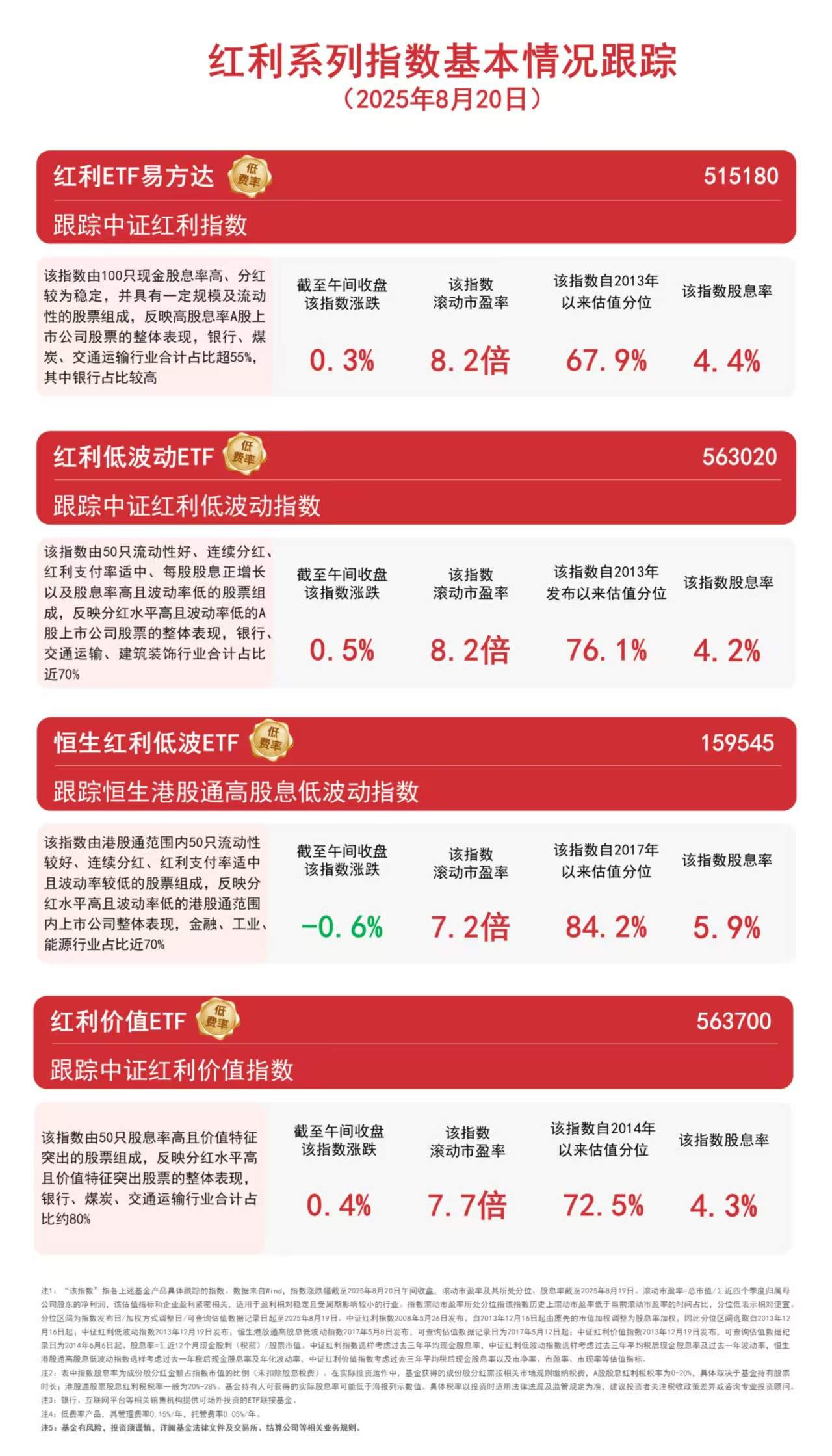
A股红利板块逆势走强,关注红利低波动ETF(563020)、红利ETF易方达(515180)等投资价值
Mei Ri Jing Ji Xin Wen· 2025-08-20 05:17
Group 1: Core Insights - The article discusses various dividend ETFs, including E Fund's dividend ETF, which tracks the China Securities Dividend Index composed of 100 high cash dividend yield stocks, primarily from the banking, coal, and transportation sectors, accounting for over 55% of the index [2] - The E Fund's low volatility dividend ETF tracks the China Securities Low Volatility Dividend Index, consisting of 50 stocks with good liquidity and stable dividend payments, with a sector concentration of over 70% in banking, transportation, and construction [2] - The Hang Seng Low Volatility Dividend ETF tracks the Hang Seng High Dividend Low Volatility Index, made up of 50 stocks within the Hong Kong Stock Connect that have low volatility and stable dividends, with significant representation from the financial and industrial sectors [2] Group 2: Performance Metrics - As of the latest trading session, the China Securities Dividend Index showed a change of 0.3% with a rolling P/E ratio of 8.2 times and a valuation percentile of 67.9% since its inception in 2013 [2] - The China Securities Low Volatility Dividend Index experienced a change of 0.5% with a rolling P/E ratio of 8.2 times and a valuation percentile of 76.1% since its launch in 2013 [2] - The Hang Seng High Dividend Low Volatility Index reported a change of -0.6% with a rolling P/E ratio of 7.2 times and a valuation percentile of 84.2% since its introduction in 2017 [2]
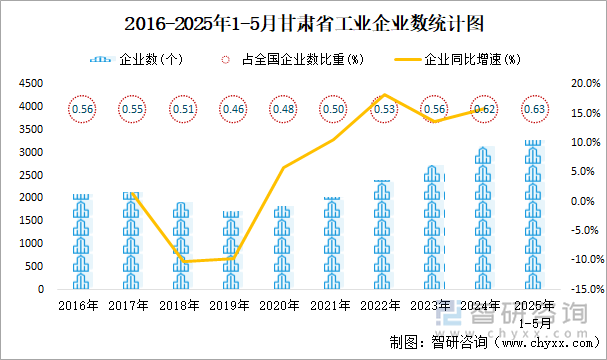
2025年1-5月甘肃省工业企业有3291个,同比增长9.3%
Chan Ye Xin Xi Wang· 2025-08-20 01:12
Group 1 - The core viewpoint of the article highlights the growth of industrial enterprises in Gansu Province, with a total of 3,291 enterprises reported in the first five months of 2025, marking an increase of 280 enterprises compared to the same period last year, representing a year-on-year growth of 9.3% [1] - The report indicates that the number of industrial enterprises in Gansu accounts for 0.63% of the national total [1] - The data referenced in the article is sourced from the National Bureau of Statistics and organized by Zhiyan Consulting [3] Group 2 - The article mentions several listed companies related to the industrial sector, including Baiyin Nonferrous Metals (601212), Jinhui Co., Ltd. (603132), Gansu Energy Chemical (000552), and others [1] - Zhiyan Consulting is identified as a leading industry consulting firm in China, specializing in in-depth industry research reports and providing comprehensive industry solutions [2]
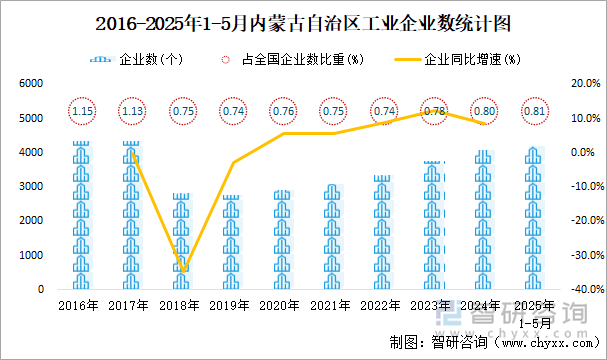
2025年1-5月内蒙古自治区工业企业有4194个,同比增长7.29%
Chan Ye Xin Xi Wang· 2025-08-20 01:12
上市公司:兴业银锡(000426),电投能源(002128),银泰黄金(000975),北方稀土(600111), 赤峰黄金(600988),伊利股份(600887),骑士乳业(832786),大唐药业(836433),北方股份 (600262),内蒙华电(600863) 相关报告:智研咨询发布的《2025-2031年中国工业云行业市场深度评估及投资机会预测报告》 知前沿,问智研。智研咨询是中国一流产业咨询机构,十数年持续深耕产业研究领域,提供深度产业研 究报告、商业计划书、可行性研究报告及定制服务等一站式产业咨询服务。专业的角度、品质化的服 务、敏锐的市场洞察力,专注于提供完善的产业解决方案,为您的投资决策赋能。 数据来源:国家统计局,智研咨询整理 2025年1-5月,内蒙古自治区工业企业数(以下数据涉及的工业企业,均为规模以上工业企业,从2011 年起,规模以上工业企业起点标准由原来的年主营业务收入500万元提高到年主营业务收入2000万元) 为4194个,和上年同期相比,增加了285个,同比增长7.29%,占全国的比重为0.81%。 ...
一年来,南京纵深推进各领域改革,形成一批高质量改革成果
Nan Jing Ri Bao· 2025-08-19 01:47
Group 1 - The core viewpoint emphasizes that reform is the driving force for high-quality development and is crucial for enhancing people's sense of happiness [1] - Nanjing has implemented various reforms focusing on key areas, such as the AEO system in the industrial sector and support for veterans' entrepreneurship, leading to over 26,000 businesses established by veterans and a VAT revenue exceeding 3 billion [1][5] - The city has developed a sustainable urban renewal model and innovative services like "elderly consultant" stations to integrate elderly care resources [1] Group 2 - Nanjing has created a comprehensive reform plan for 2024-2028, outlining 37 reform tasks across nine major areas, aiming to deepen reforms and promote modernization [2] - The establishment of the first physical "Enterprise Comprehensive Research and Inspection Service Center" in Nanjing aims to streamline inspections and reduce redundancy for businesses [2][3] - The city has focused on economic system reforms, launching the AEO system to enhance administrative efficiency and reduce burdens on enterprises, with 726 industrial companies qualifying for the pilot program [5][6] Group 3 - Nanjing's reforms have led to a significant reduction in enterprise inspection frequency by 34.71% in the first half of the year, indicating improved regulatory efficiency [6] - The city has actively promoted collaborative development in key areas, with all industrial parks in Jiangning showing service industry revenue growth exceeding 10% compared to the city average [6] - Nanjing has established a robust mechanism for trial reforms, with 13 pilot projects initiated since 2018, focusing on areas like smart connected vehicles and digital transformation for SMEs [7][8] Group 4 - The city has developed a multi-dimensional publicity strategy to promote successful reform cases, with 12 cases recognized as national reform models [9] - Nanjing is preparing for the "14th Five-Year Plan" completion and is proactively aligning major reform initiatives with future development strategies to enhance institutional efficiency and competitive advantages [9]
沪指创近十年新高,A股总市值首超百万亿!这个板块成最大功臣,还有多少资金在路上?
Mei Ri Jing Ji Xin Wen· 2025-08-18 10:13
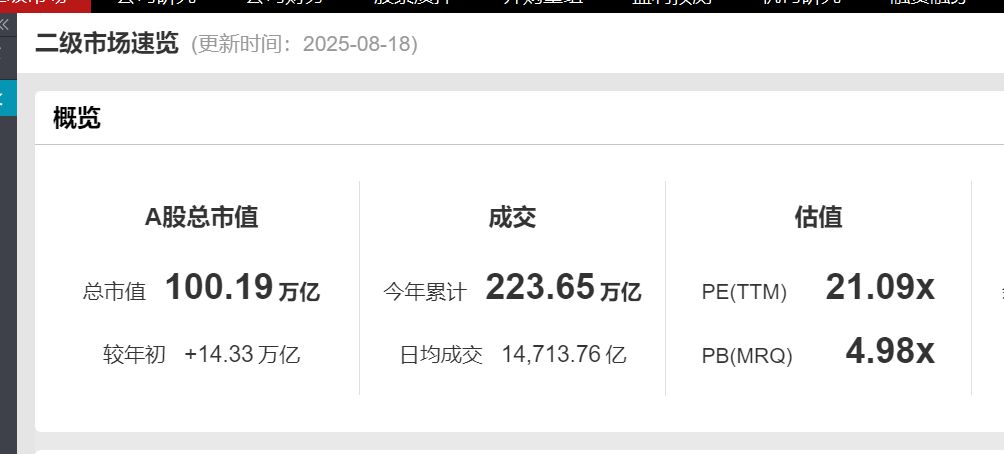
Core Viewpoint - The A-share market has reached a historic milestone, with the total market capitalization surpassing 100 trillion yuan for the first time, driven by significant increases in various sectors, particularly the information technology sector [1][8]. Market Performance - On August 18, the Shanghai Composite Index opened high and broke through the previous high of 3731.69 points, marking a ten-year high since August 2015 [1]. - The total market capitalization of A-shares reached 100.19 trillion yuan, an increase of 14.33 trillion yuan since the beginning of the year [1]. - The total trading volume for the year has reached 223.65 trillion yuan, with an average daily trading volume of 1.47 trillion yuan [1]. Sector Performance - The information technology sector has seen a market capitalization increase of 11.55% since August, making it the largest contributor to the overall market capitalization growth [7]. - Other sectors such as materials and industrials also experienced significant growth, with market capitalization increases of 7.10% and 6.54%, respectively [7]. - The financial sector maintained a strong position with a market capitalization of 177.02 trillion yuan, reflecting a 3.39% increase [7]. Investor Behavior - There is a notable influx of retail investors into the market, although their overall participation remains cautious due to a prevailing "fear of heights" sentiment [8][9]. - New individual investor accounts have shown marginal improvement since May, but the absolute numbers remain low, indicating a lack of significant capital inflow from retail investors [8][9]. - The trend of "capital migration" among residents is expected to continue, with a decrease in the attractiveness of low-interest savings and financial products, potentially leading to increased investment in the stock market [10]. Future Outlook - Institutional funds are anticipated to continue flowing into A-shares, with foreign capital shifting from net selling to net buying [10]. - The report suggests focusing on three investment directions: technology sectors such as consumer electronics and AI software, new consumption trends, and thematic investments like commercial aerospace and brain-computer interfaces [10].
中证消费服务领先指数上涨1.12%,前十大权重包含科大讯飞等
Jin Rong Jie· 2025-08-18 10:06
Core Viewpoint - The China Securities Consumer Services Leading Index has shown positive performance, with a year-to-date increase of 7.51% and a recent monthly rise of 5.11% [1][2] Group 1: Index Performance - The China Securities Consumer Services Leading Index rose by 1.12%, closing at 8689.98 points, with a trading volume of 222.535 billion yuan [1] - The index has increased by 5.11% over the past month and 5.97% over the last three months [1] Group 2: Index Composition - The index comprises 100 listed companies in sectors such as food and beverage, clothing, education and sports, pharmaceuticals, finance, cultural communication, and household goods [1] - The top ten weighted companies in the index include: - Heng Rui Medicine (5.5%) - WuXi AppTec (5.15%) - Kweichow Moutai (4.52%) - Cambricon Technologies (4.06%) - Ping An Insurance (3.32%) - Wuliangye (3.17%) - China Merchants Bank (2.76%) - China Telecom (2.39%) - iFlytek (2.39%) - SF Holding (2.36%) [1] Group 3: Market Distribution - The index's holdings are primarily listed on the Shanghai Stock Exchange (67.06%) and the Shenzhen Stock Exchange (32.94%) [1] Group 4: Industry Breakdown - The industry composition of the index includes: - Healthcare: 27.01% - Finance: 20.29% - Consumer Staples: 18.31% - Information Technology: 13.58% - Communication Services: 11.20% - Industrials: 7.41% - Consumer Discretionary: 2.20% [2] Group 5: Index Adjustment Mechanism - The index samples are adjusted biannually, with changes implemented on the next trading day after the second Friday of June and December [2] - Sample adjustments generally do not exceed 10%, with new samples prioritized based on rankings [2]

20cm速递|科创创业ETF(588360)涨超2.7%,政策与流动性双轮驱动科技创新领域
Mei Ri Jing Ji Xin Wen· 2025-08-18 04:44
Group 1 - The core viewpoint emphasizes that developing new productive forces is a crucial policy direction for the domestic economy, with a focus on excess returns for technology and innovation companies under a backdrop of liquidity easing [1] - Key sectors identified for growth include artificial intelligence, innovative pharmaceuticals, robotics, low-altitude economy, deep-sea technology, and controllable nuclear fusion [1] - The transformation and upgrading of industries are driving a year-on-year price recovery in related sectors, with positive price changes observed in emerging fields such as caustic soda, aircraft manufacturing, wearable smart devices, microwave communication equipment, and servers [1] Group 2 - The expansion of overseas AI data center construction is driving demand for high-speed optical modules, with global tech giants increasing their computing power layout, which is expected to boost the optical communication equipment market [1] - The demand for 800G Ethernet optical modules is strong, and 1.6T products are beginning to emerge, with an anticipated growth rate of around 50% for the global Ethernet optical module market by 2025 [1] - The Science and Technology Innovation and Entrepreneurship ETF (588360) tracks the Science and Technology Innovation 50 Index (931643), which selects 50 large-cap emerging industry companies from the Sci-Tech Board and the ChiNext to reflect the overall performance of representative emerging industries [1]

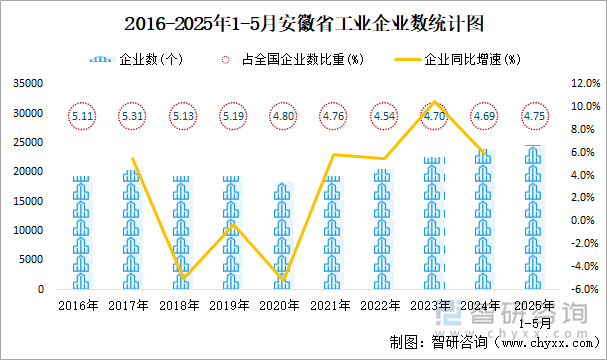
2025年1-5月安徽省工业企业有24665个,同比增长6.44%
Chan Ye Xin Xi Wang· 2025-08-18 03:03
Core Insights - The article discusses the growth of industrial enterprises in Anhui Province, highlighting a year-on-year increase in the number of enterprises and their contribution to the national total [1]. Group 1: Company Information - Listed companies mentioned include Tongling Nonferrous Metals (000630), Chuangjiang New Materials (002171), Xinbo Co., Ltd. (003038), and others, indicating a diverse range of sectors involved in the industrial landscape [1]. - The report by Zhiyan Consulting provides a deep assessment of the industrial cloud market in China from 2025 to 2031, suggesting potential investment opportunities [1]. Group 2: Industry Data - As of January to May 2025, the number of industrial enterprises in Anhui Province reached 24,665, an increase of 1,492 compared to the same period last year, representing a growth rate of 6.44% [1]. - The industrial enterprises in Anhui account for 4.75% of the national total, indicating the province's significant role in the overall industrial sector [1].