
软件和信息技术服务

Search documents
上海三大先导产业成绩突出,人工智能制造业增长12.3%
Di Yi Cai Jing Zi Xun· 2025-07-25 09:04
Core Insights - Shanghai's industrial value added increased by 5.0% year-on-year in the first half of 2025, with total industrial output value growing by 5.6%, accelerating by 2.1 percentage points compared to the first quarter [1] - The three leading industries in Shanghai saw a manufacturing output growth of 9.1%, with artificial intelligence manufacturing growing by 12.3%, integrated circuit manufacturing by 11.7%, and biomedicine manufacturing by 4.4% [1] - The software and information technology service industry revenue grew by 27.1% year-on-year, driven by high-performance chip demand and the booming AI sector, with AI-related IT consulting services revenue increasing by 130% [1] Industry Developments - As of the first quarter of 2025, Shanghai had 394 large-scale AI enterprises, generating over 118 billion yuan in revenue, a 29% year-on-year increase, and a profit growth of 65% [3] - The upcoming World Artificial Intelligence Conference from July 26 to 28, 2025, will feature over 800 participating companies and showcase more than 3,000 cutting-edge exhibits, marking the largest scale in history [3] Strategic Initiatives - Shanghai is focusing on a "three-fold increase" in innovative enterprises, industry scale, and talent quantity, aiming to establish five key highlands for AI development [4] - The city is enhancing its AI talent pool, with nearly 300,000 AI professionals, accounting for about one-third of the national total, and is promoting the establishment of AI research institutes in 14 universities [4] - Shanghai is accelerating the development of AI applications in various manufacturing sectors, including electronics, automotive, and aerospace, and is formulating an "AI + manufacturing" action plan [4]


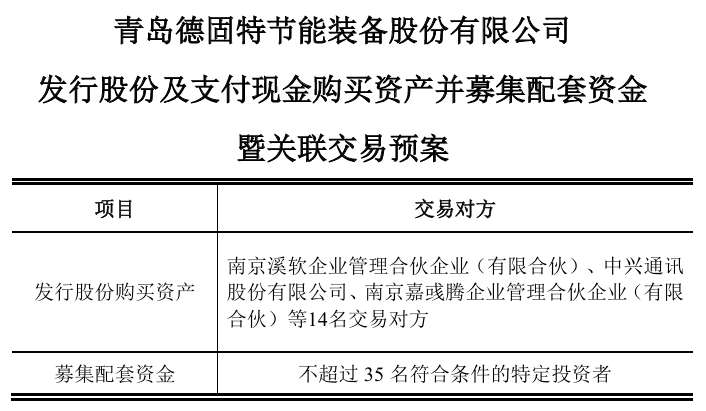
透视德固特跨界并购浩鲸科技:“以小并大”背后的双向破局
Da Zhong Ri Bao· 2025-07-24 01:54
Core Viewpoint - Qingdao Deguote Energy Saving Equipment Co., Ltd. (Deguote) has announced a plan to acquire control of Haowei Cloud Computing Technology Co., Ltd. (Haowei Technology), which has attracted significant attention due to the disparity in size and business focus between the two companies [1][4]. Group 1: Acquisition Details - The acquisition involves issuing shares to purchase assets from 14 parties, including Nanjing Xiruan Enterprise Management Partnership and ZTE Corporation [3]. - Deguote, a manufacturer of energy-saving and environmental protection equipment, has approximately 566 employees and projected revenue of about 509 million yuan, while Haowei Technology, a software and IT service provider, has over 3,500 employees and projected revenue of approximately 3.654 billion yuan, making it seven times larger than Deguote [3][4]. Group 2: Strategic Rationale - The acquisition is seen as a strategic move for Deguote to break through traditional manufacturing growth bottlenecks and transition towards new productive forces, responding to the accelerating global carbon neutrality process [4]. - Deguote's revenue is projected to grow by 64.21% year-on-year, and net profit by 150.15% in 2024, partly due to the release of delayed orders from 2023 [4]. Group 3: Business Transformation - Post-acquisition, Deguote plans to expand its main business from solely manufacturing energy-saving equipment to include three digital service areas: telecom software development, cloud and AI software development, and industry digital solutions [5]. - This transformation aims to create a "second growth curve" for Deguote and accelerate its transition to new productive forces [5]. Group 4: Financial Impact - Following the acquisition, Haowei Technology will be consolidated as a wholly-owned subsidiary of Deguote, significantly enhancing Deguote's total assets, net assets, operating income, and net profit [6]. - Deguote's international revenue accounted for 59% of its total revenue as of 2024, providing a strong platform for Haowei Technology to expand into the industrial market [6]. Group 5: Synergy Expectations - Deguote's Secretary of the Board expressed that the acquisition will leverage the complementary nature of the two companies' technologies, focusing on areas such as intelligent equipment upgrades and production process optimization [7].

数商云CEO专访:B2B行业未来三年将迎来哪些技术变革?
Sou Hu Cai Jing· 2025-07-23 03:21
Core Insights - The B2B industry is undergoing unprecedented technological reconstruction and ecological transformation driven by digital economy trends. The company, Shushangyun, is a leader in China's B2B system development, leveraging innovative technologies such as microservices architecture, AI platforms, and blockchain to serve over 1,500 enterprise clients across 38 sectors [2][3]. Group 1: AI-Driven Innovations - AI-native architecture is shifting from tool empowerment to system reconstruction, with intelligent recommendation engines significantly reducing supplier selection time from weeks to days [2]. - The company plans to launch a third-generation AI platform by 2025, integrating multimodal large models and industry knowledge graphs to enhance decision-making capabilities [2]. - Automation in transaction processes has evolved to achieve full-chain order processing without human intervention, reducing manual involvement by 70% [3]. Group 2: Blockchain Advancements - Blockchain technology is moving beyond basic traceability to facilitate value flow, exemplified by a project that reduced financing costs for gas stations by 18% through real-time data collection [3][4]. - The company is developing a "cross-chain technology" system that allows different B2B platforms to share credit data, significantly lowering due diligence costs [4]. - A carbon footprint tracking system developed for a paper company has enabled compliance with EU carbon tax exemptions, saving over 10 million yuan annually [5]. Group 3: IoT and 5G Integration - The deployment of 5G and IoT systems in smart factories has achieved millisecond-level response times, reducing defect rates from 2.3% to 0.7% [6]. - A logistics project in Southeast Asia demonstrated a 120% increase in cross-border order processing capacity, with daily handling exceeding 2 million orders [7]. - The combination of blockchain and IoT is expected to eliminate 90% of B2B logistics disputes in the next three years [7]. Group 4: Privacy Computing - Federated learning technology is being utilized to analyze sales data from 3,000 distributors without sharing raw data, improving overall gross margins by 2.1 percentage points [8]. - Zero-knowledge proof technology is simplifying compliance processes in cross-border trade, reducing customs clearance time from 72 hours to 4 hours [9]. Group 5: Ecosystem Development - Vertical platforms are creating irreplaceable competitive barriers, with examples showing significant efficiency improvements in industrial and agricultural sectors [10]. - The integration of cross-industry resources is exemplified by a platform that reduced customer order delivery times from 45 days to 15 days [10]. Group 6: Organizational Evolution - The company is transitioning from a "system developer" to an "industry digital partner," with a dual-track structure focusing on foundational technologies and industry-specific innovations [11]. - A customer success system has been established to ensure effective technology implementation, reducing system launch cycles by 40% and training time by 50% [11]. Group 7: Future Outlook - The company emphasizes the balance between technology and human involvement, aiming for a future where B2B platforms enhance human decision-making rather than replace it [12]. - The vision for 2027 includes B2B platforms as "enhanced intelligence" systems, allowing for efficient and transparent business operations [12].

腾讯申请集群分配方法、装置、设备、存储介质及程序产品专利,提高数据处理效率
Jin Rong Jie· 2025-07-23 00:54
Group 1 - The core point of the article is that Tencent Technology (Shenzhen) Co., Ltd. has applied for a patent related to a cluster allocation method, which aims to improve data processing efficiency in various fields such as cloud technology, artificial intelligence, and smart transportation [1][3]. Group 2 - Tencent Technology (Shenzhen) Co., Ltd. was established in 2000 and is primarily engaged in software and information technology services, with a registered capital of 2 million USD [2]. - The company has made investments in 15 enterprises and participated in 260 bidding projects, holding 5000 trademark records and 5000 patent records, along with 501 administrative licenses [2].

腾讯申请资源交互业务处理相关专利,可减少资源浪费
Jin Rong Jie· 2025-07-22 09:26
Group 1 - The core point of the article is that Tencent Technology (Shenzhen) Co., Ltd. has applied for a patent related to a resource interaction business processing method, which aims to improve resource conversion rates and reduce resource waste [1][3]. Group 2 - The patent application, published as CN120353564A, was filed on January 2024 and involves a method that includes obtaining the type of interaction resources, triggering resource interaction detection requests, and determining target resource conversion ratios [1]. - The company was established in 2000 and is primarily engaged in software and information technology services, with a registered capital of 2 million USD [2]. - Tencent Technology has invested in 15 companies, participated in 260 bidding projects, and holds 5000 trademark and patent records, along with 501 administrative licenses [2].
苏浙皖齐发上半年“成绩单”
Guo Ji Jin Rong Bao· 2025-07-21 10:37
Economic Overview - The GDP of Jiangsu, Zhejiang, and Anhui provinces for the first half of the year reached 66,967.8 billion, 45,004 billion, and 25,723 billion respectively, with year-on-year growth rates of 5.7%, 5.8%, and 5.6% [1] Industrial Production - Jiangsu's industrial output value increased by 7.4% year-on-year, with private enterprises growing by 8.7%. High-tech industries accounted for 51.8% of the total industrial output [2] - Zhejiang's industrial output value grew by 7.6%, with private enterprises contributing 77.9% to this growth. Key sectors like high-tech manufacturing and digital economy saw increases of 12.7% and 12.0% respectively [2] - Anhui's industrial output value rose by 8.4%, driven by a 16.7% increase in equipment manufacturing and a 23.6% rise in high-tech manufacturing [2] Service Sector Growth - Jiangsu's tertiary industry grew by 5.9%, with internet and software services increasing by 16.8% and 14.3% respectively [3] - Zhejiang's service sector saw a 6.0% increase, with significant growth in information technology services (9.3%) and financial services (8.4%) [3] - Anhui's service sector increased by 5.3%, with notable growth in software services (13.1%) and rental services (18.3%) [4] Investment Trends - Jiangsu's fixed asset investment decreased by 3.9%, with infrastructure investment rising by 6.9% and manufacturing investment growing by 0.5% [5] - Zhejiang's fixed asset investment increased by 1.4%, with manufacturing and infrastructure investments growing by 10.1% and 13.0% respectively [6] - Anhui's fixed asset investment fell by 2.8%, but high-tech service investments surged by 21.2%, particularly in information services and R&D [6]
上半年电信业务总量同比增长9.3% 信息通信业总体运行平稳
Jing Ji Ri Bao· 2025-07-20 00:49
Group 1 - The total telecommunications business volume in China increased by 9.3% year-on-year in the first half of the year, with total telecommunications revenue reaching 905.5 billion yuan [1] - Emerging businesses such as 5G new calls, live short videos, and cloud gaming have seen significant growth, with mobile internet traffic increasing by double digits for six consecutive months [1] - As of the end of June, China had built over 1.85 million "5G + industrial internet" projects, with 5G base stations totaling 4.55 million and 5G mobile phone users reaching 1.118 billion, resulting in a user penetration rate exceeding 79% [1] Group 2 - The electronic information manufacturing industry demonstrated strong resilience, with the added value of the computer, communication, and other electronic equipment manufacturing industries increasing by 11.1% year-on-year [2] - The software and information technology service industry has made solid progress in high-quality development, with software business revenue reaching 557.88 billion yuan in the first five months, a year-on-year increase of 11.2% [2] - Cloud computing and big data services generated revenue of 585.5 billion yuan, also reflecting a year-on-year growth of 11.2% [2]
信雅达和长沙银行申请基于共享作业系统的银行智能授权专利,提升业务授权的效率和准确性
Jin Rong Jie· 2025-07-19 06:52
Group 1 - The core viewpoint of the news is the application for a patent by Xinyada Technology Co., Ltd. and Changsha Bank for a method and system of intelligent authorization based on a shared job system, aimed at improving efficiency and accuracy in business authorization processes [1] - The patent application was filed on June 2025, with the publication number CN120338937A, indicating a focus on enhancing risk assessment and authorization strategies in banking operations [1] - The proposed method includes risk level assessment, risk profiling, and quality inspection of authorization results, which collectively aim to reduce the risk of erroneous authorizations [1] Group 2 - Xinyada Technology Co., Ltd. was established in 1996 in Hangzhou, primarily engaged in software and information technology services, with a registered capital of approximately 466.32 million RMB [2] - The company has invested in 30 enterprises, participated in 2508 bidding projects, and holds 131 patents and 65 trademarks [2] - Changsha Bank Co., Ltd. was founded in 1997 in Changsha, focusing on monetary financial services, with a registered capital of approximately 4021.55 million RMB [2] - The bank has invested in 10 enterprises, participated in 5000 bidding projects, and holds 10 patents and 225 trademarks [2]


汇聚澎湃力量 高质量发展蹄疾步稳 | 透视重磅数据 深度看中国经济“答卷”
Yang Shi Wang· 2025-07-19 03:37
Core Viewpoint - The industrial and information technology sectors in China are expected to see steady growth in key economic indicators by the first half of 2025, with significant advancements in manufacturing and digital technologies [1][13]. Industrial Growth - In the first half of 2025, the industrial added value above designated size increased by 6.4% year-on-year, demonstrating strong resilience following a good start in the first quarter [3][14]. - The manufacturing value added accounted for 25.7% of GDP, remaining stable [3][14]. - Manufacturing investment grew by 7.5% year-on-year, supported by major engineering projects under the 14th Five-Year Plan [14]. Equipment Manufacturing - The equipment manufacturing sector continued to show robust growth, contributing 35.5% to the total industrial added value [16]. - The added value of the equipment manufacturing industry increased by 10.2% year-on-year, driving a 3.4 percentage point increase in overall industrial growth [18]. - Key products in the equipment manufacturing sector saw significant production and sales increases, with shipbuilding metrics indicating a global market share of 51.7% for completed orders, 68.3% for new orders, and 64.9% for hand-held orders [20]. Digital Technology Development - Digital technologies, including 5G and AI, are rapidly advancing, with the digital industry achieving a business revenue growth of 9.3% year-on-year, an increase of 3.4 percentage points compared to the previous year [11][16]. - The number of mobile internet users has shown double-digit growth for six consecutive months, with 5G applications integrated into 86 out of 97 major categories of the national economy [45]. Green Transformation - The deep green transformation of traditional industries is a primary task for low-carbon industrial development, focusing on steel, non-ferrous metals, petrochemicals, and building materials [24]. - The goal is to increase the proportion of recycled materials in raw materials by 2027, targeting 22% for scrap steel, 30% for scrap copper, and 25% for scrap aluminum [26]. Financial Support for Manufacturing - The national financial cooperation platform has facilitated over 1.2 trillion yuan in financing for manufacturing enterprises, with an average of nearly 34 million yuan in support per company [37]. - The A-share market raised 148.8 billion yuan for industrial enterprises through various financial instruments, marking a year-on-year increase of 51.6% [41]. Telecommunications Sector - The telecommunications sector maintained stable operations, with a 9.3% year-on-year growth in total telecom business volume, reaching 905.5 billion yuan in revenue [40][44]. - By the end of June, the number of 5G base stations reached 4.55 million, with 5G mobile phone users totaling 1.118 billion, achieving a penetration rate of over 79% [44].
腾讯申请一种风险识别方法以及相关设备专利,提升风险识别的准确率
Jin Rong Jie· 2025-07-18 09:49
Group 1 - Tencent Technology (Shenzhen) Co., Ltd. has applied for a patent titled "A Risk Identification Method and Related Equipment," with publication number CN120338793A, and the application date is January 2024 [1] - The patent application describes a risk identification method that utilizes a risk identification model to analyze trading data samples, resulting in a predicted risk probability distribution for the trading samples [1] - The method aims to enhance the accuracy of risk identification and can be applied in various scenarios, including cloud technology, artificial intelligence, smart transportation, and assisted driving [1] Group 2 - Tencent Technology (Shenzhen) Co., Ltd. was established in 2000 and is primarily engaged in software and information technology services, with a registered capital of 2 million USD [2] - The company has made investments in 15 enterprises and participated in 260 bidding projects, holding 5000 trademark records and 5000 patent records [2] - Additionally, the company possesses 472 administrative licenses [2]