建筑

Search documents
29岁的她任董事长
Sou Hu Cai Jing· 2025-11-05 06:49
Core Viewpoint - Chengdu Road and Bridge has elected Lin Xiaoqing as the chairman of its eighth board of directors, marking her as the youngest chairman among A-share companies in Sichuan [1][3]. Company Overview - Chengdu Road and Bridge was established in 1988 and listed on the Shenzhen Stock Exchange in 2011, being the only privately-owned listed company in Sichuan focused on infrastructure construction [7]. - The company primarily engages in the construction of transportation infrastructure such as roads, bridges, tunnels, as well as housing construction and decoration [7]. - As of November 5, the company's market capitalization is 3.437 billion yuan [5][7]. Leadership Changes - Lin Xiaoqing, born in 1996, was appointed as the vice general manager in August 2023 and succeeded Wang Peili as chairman in May 2024 [3]. - Lin Xiaoqing holds 420,000 shares of the listed company and received a salary of 925,700 yuan last year [3]. - She is recognized as the only "post-95" chairman among A-share companies in Sichuan, with the next youngest chairmen born in 1990 [3]. Recent Developments - During Lin Xiaoqing's tenure as chairman, Chengdu Road and Bridge has undertaken a series of asset integrations [4].



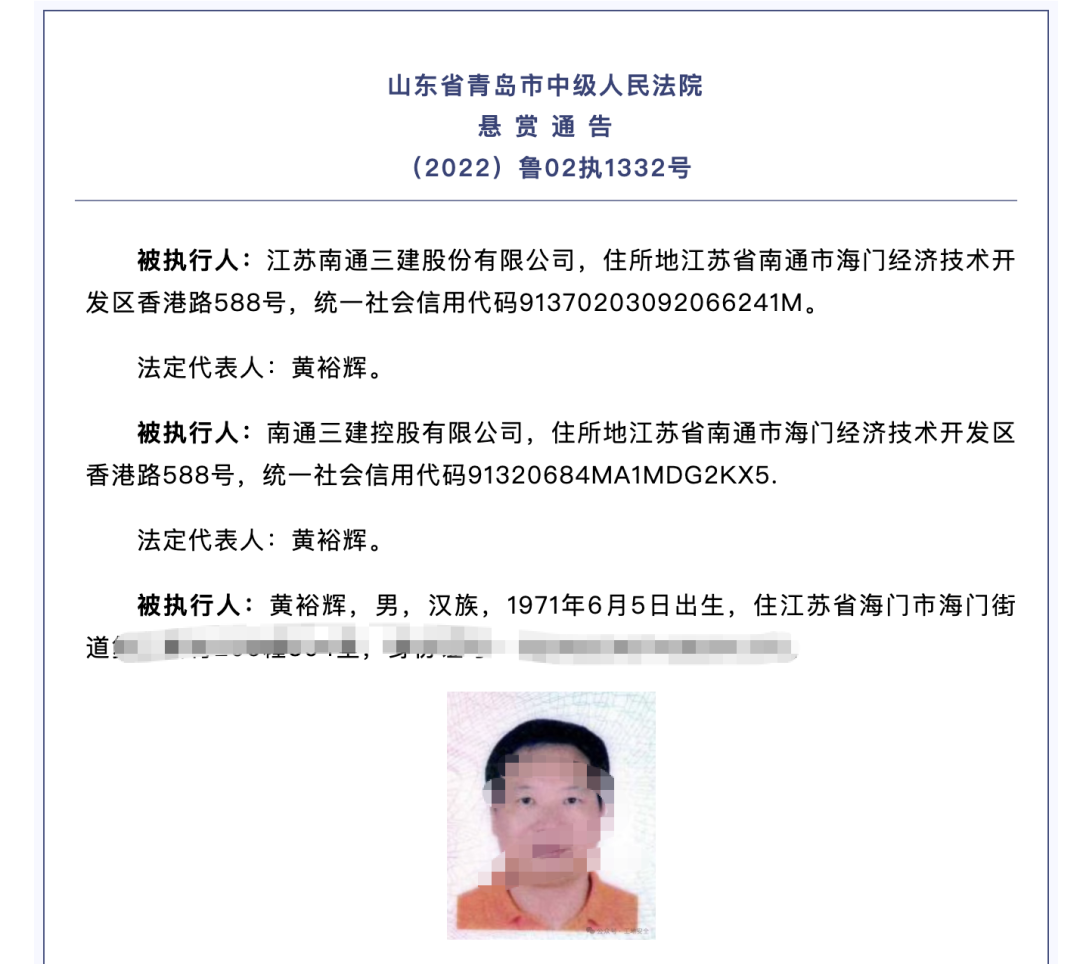
被许家印拖累,建工大佬黄裕辉遭“天价悬赏”:最高可达2500万
Mei Ri Jing Ji Xin Wen· 2025-11-04 22:26
Core Points - The announcement of a bounty for information on the assets of Nantong Sanjian and its executives highlights the severe impact of the industry adjustment cycle on the company [1][8] - Nantong Sanjian is facing a civil judgment of 253.5 million yuan due to non-compliance with legal obligations [2][4] - The company has reported a significant decline in revenue and is currently in a negative net asset position [5][6] Company Overview - Nantong Sanjian was once a leading player in the construction industry, with annual revenues exceeding 100 billion yuan and notable projects including the Oriental Pearl Tower and Shanghai Tower [5] - As of the first half of this year, the company's revenue was only 9.5 million yuan, with a net loss of 1.7 million yuan [5] - The company has outstanding debts totaling approximately 1.949 billion yuan, including both domestic and offshore bonds [5][6] Legal and Financial Issues - The Qingdao Intermediate People's Court has issued a bounty of up to 25 million yuan for information leading to the recovery of Nantong Sanjian's assets [4][8] - Nantong Sanjian has been involved in numerous legal disputes, with 422 records of being an untrustworthy executor amounting to 1.063 billion yuan [6] - The chairman, Huang Yuhui, is also facing personal financial difficulties, with multiple execution records totaling 581 million yuan [6] Industry Context - The bounty system for asset recovery is becoming more common in the real estate sector, reflecting the challenges courts face in executing judgments against companies with complex asset structures [7][8] - Other courts have also issued similar bounties for different real estate companies, indicating a broader trend in the industry [7][8]
国内高频 | 港口货运量大幅上行(申万宏观·赵伟团队)
赵伟宏观探索· 2025-11-04 16:21
Core Viewpoint - The article discusses the current state of industrial production, construction, and demand trends in China, highlighting a mixed performance across various sectors, with some showing signs of recovery while others remain weak. Industrial Production Tracking - The operating rate of blast furnaces has significantly declined, with a week-on-week decrease of 3% to 81.7%, and a year-on-year drop of 3.3 percentage points to -0.7% [2][6] - Steel apparent consumption has increased by 2.7% week-on-week and returned to positive territory year-on-year, rising by 2.9 percentage points to 2.8% [2][8] - Social inventory continues to decline, down 2.1% week-on-week [2] Construction Industry Insights - Cement production and demand have shown some recovery but remain weaker than the same period last year, with a grinding operating rate up 1% to 46.3% week-on-week and a year-on-year increase of 2.8 percentage points to -2% [24][25] - Cement shipment rates have improved slightly, increasing by 0.8% week-on-week to 45.6%, but down 8.8% year-on-year [24][28] - The cement inventory ratio continues to rise, up 2.3% week-on-week and 1.3 percentage points year-on-year to 1.9% [24][31] Demand Tracking - The average daily transaction area of commercial housing in 30 major cities has decreased by 11.3% week-on-week and 4.3 percentage points year-on-year to -25% [47][48] - The transaction volume in first-tier cities has dropped significantly, with year-on-year declines of 20.1 percentage points to -49.6% [47][51] - Port cargo throughput has rebounded significantly, with a year-on-year increase of 16.5% to 13% [57][64] Price Trends - Agricultural product prices are showing a mixed performance, with vegetable prices rising by 8.1% week-on-week, while pork and egg prices have decreased by 0.8% and 0.5%, respectively [99][100][106] - The overall industrial product prices are on the rise, with the Nanhua Industrial Price Index increasing by 1.8% week-on-week [111][112]
浩柏国际(08431)与胡建勇订立谅解备忘录以成立合营企业
智通财经网· 2025-11-04 14:37
Core Viewpoint - The company, Haobo International, has entered into a non-binding memorandum of understanding with Mr. Hu Jian Yong to focus on developing advanced technologies in China, including IT services, artificial intelligence, cloud computing, digital currency, and digital product development [1] Group 1: Partnership and Collaboration - The memorandum outlines plans to establish a joint venture named Hu Zhong Zhi Suan Group Limited [1] - The parties intend to sign a formal joint venture agreement based on the terms of the memorandum and the actual development of the project [1] - The collaboration aims to leverage each party's resources, expertise, and experience to develop IT and AI services [1] Group 2: Business Expansion and Diversification - The company primarily provides design, procurement, and installation services for water circulation systems, including pools, fountains, and water curtain walls [1] - The company has been actively seeking investment opportunities in the construction industry to enhance its influence and increase market share [1] - The board believes that the joint venture agreement will facilitate the company's collaboration with Mr. Hu and expand its business scope in construction, contributing to business diversification [1]
建筑装饰 2025Q1-3 财报综述:收入降幅收窄,现金流改善明显
Shenwan Hongyuan Securities· 2025-11-04 09:15
Investment Rating - The report maintains an "Optimistic" rating for the construction industry [2][3]. Core Insights - The construction industry faced revenue and profit pressures in Q1-Q3 2025, with total revenue of 5.52 trillion, down 5.2% year-on-year, and net profit of 118.9 billion, down 9.0% year-on-year [2][3]. - The decline in revenue has narrowed, and cash flow has shown significant improvement, attributed to local government debt resolution policies and enhanced cash flow management by companies [2][5]. - The industry’s gross margin remained stable at 9.8%, with a net margin of 2.16%, indicating effective cost control despite external pressures [2][10]. Summary by Sections 1. Financial Overview of the Construction Industry - In Q1-Q3 2025, major listed companies in the construction sector reported a total revenue of 5.52 trillion, reflecting a year-on-year decrease of 5.2%, and a net profit of 118.9 billion, down 9.0% [3][9]. - Quarterly revenues were 1.84 trillion, 1.91 trillion, and 1.76 trillion, with respective year-on-year declines of 6.2%, 5.2%, and 4.3% [3][9]. 2. ROE Analysis - The overall Return on Equity (ROE) for the industry in Q1-Q3 2025 was 3.36%, a decrease of 0.53 percentage points year-on-year [17]. - The decline in ROE is attributed to reduced investment and increased cost pressures, impacting profitability [17][28]. 3. Cash Flow Improvement - The industry’s operating cash flow showed improvement, with a net outflow of 404.7 billion, which is 70.7 billion less than the previous year [4][14]. - The cash collection ratio improved to 103%, 87%, and 108% across the three quarters, indicating better cash management [4][14]. 4. Investment and Profitability Trends - The construction sector is experiencing a shift towards cash management and asset quality improvement, with companies focusing on reducing ineffective assets [5][26]. - Investment net income in Q3 2025 decreased by 39.4 billion year-on-year, reflecting the ongoing challenges in the sector [26]. 5. Market Perception and Opportunities - The report suggests that the market underestimates the potential for investment in the construction and real estate sectors, which remain crucial to the economy [6]. - The emphasis on quality over growth by state-owned enterprises is expected to create new opportunities for sustainable growth [6].





改造升级17个体育场馆,广州国企交出全运保障成绩单
Nan Fang Du Shi Bao· 2025-11-04 08:25
Core Points - Guangzhou's state-owned enterprises have formed specialized teams to support the 15th National Games, with 41,000 participants providing services such as event support, hotel reception, and public transportation, contributing over 100 million yuan in sponsorships [1][2] Event Support - The renovation and upgrade of 17 venues for the National Games cover an area of 280,000 square meters, completed on time and with quality assurance [2] - The Pearl River Industrial Group led the operational design and flow optimization for 30 venues, producing over 13,000 design drawings, with the Guangzhou Sports Center being the first to start and complete renovations [2] - Guangzhou Double Fish Company established a service team for table tennis equipment, ensuring 24/7 communication for equipment adjustments and emergency responses [2][3] Digital Integration - Smart technologies are integrated into venue construction, including cashless payment systems and real-time traffic monitoring, improving traffic capacity by 49% [4] - The Guangzhou Digital Technology Group implemented smart upgrades at key venues, utilizing AIoT technology for efficient management and real-time data collection [4][5] Cultural and Tourism Integration - State-owned enterprises operate over 40,000 electronic screens promoting the National Games, with themed public transport options serving as mobile promotional platforms [7] - The Lingnan Group's travel agency has created over 100 themed travel routes, linking event tickets with local attractions and cultural experiences, attracting over 18,000 visitors [8]
2026年全球展望报告-审慎缘由探析(英文版)-EIU
Sou Hu Cai Jing· 2025-11-04 07:51
《2026年全球展望报告-审慎缘由探析》(EIU)指出,2026年全球经济需保持审慎,虽存在政策明晰与增长亮点,但贸易摩擦、地缘风险等多重压力将导致 增长放缓,全球GDP预计增速降至2.4%。报告围绕核心风险与潜在机遇,结合地缘政治与经济政策动态,勾勒出2026年全球发展图景。 一、核心风险:增长放缓与不确定性凸显 全球增长将受多重因素拖累。美国政策波动的滞后效应逐步显现,2025年关税快速攀升至近代高位(加权平均关税接近1930年代斯穆特-霍利关税法时期水 平),虽当前政策不确定性指标从4月高点回落,但关税对经济的负面影响仍处于初期阶段,且行业层面关税走向仍存变数。美国经济面临滞胀延续风险, AI投资热潮放缓,个人消费动力减弱,住房投资下滑,非AI领域投资疲软与关税引发的商品通胀将拖累增长。 贸易领域将遭遇"报复性回调",2025年初亚洲国家为应对关税提前向美出口,这种需求前移而非根本性增长将导致2026年全球货物贸易增速低于趋势水平, 对高度依赖美国市场的出口国冲击显著。此外,地缘政治风险居高不下,美国不再追求以全球合作为基础的世界秩序,若特朗普政府干预美联储独立性,可 能引发金融市场动荡、借贷成本上升与 ...

建筑装饰2025Q1-3财报综述:收入降幅收窄,现金流改善明显
Shenwan Hongyuan Securities· 2025-11-04 07:45
Investment Rating - The report maintains a "Positive" rating for the construction and decoration industry [3][4]. Core Viewpoints - The construction industry experienced a revenue decline of 5.2% year-on-year in the first three quarters of 2025, with total revenue reaching 5.52 trillion [3][4]. - The net profit attributable to shareholders decreased by 9.0% year-on-year, totaling 118.9 billion [3][4]. - The industry is focusing on improving asset quality and cash flow management due to pressures from local government debt and the downturn in the real estate sector [3][4][6]. Summary by Sections 1. Overall Financial Situation of the Construction Industry - The construction industry faced revenue and profit pressures in Q1-Q3 2025, with quarterly revenues of 1.84 trillion, 1.91 trillion, and 1.76 trillion, reflecting year-on-year declines of 6.2%, 5.2%, and 4.3% respectively [3][4][12]. - The net profits for the same quarters were 444 billion, 431 billion, and 314 billion, with year-on-year declines of 8.8%, 3.9%, and 15.3% respectively [3][4][12]. 2. ROE Analysis - The industry’s Return on Equity (ROE) decreased by 0.53 percentage points year-on-year to 3.36% in Q1-Q3 2025 [21]. - The decline in ROE is attributed to reduced investment and profitability pressures across various sectors within the industry [21][22]. 3. Cash Flow Improvement - The operating cash flow for the industry showed improvement, with a net outflow of 404.7 billion, which is 70.7 billion less than the previous year [5][17]. - The cash collection ratios for Q1, Q2, and Q3 were 103%, 87%, and 108%, indicating a positive trend in cash management [5][17]. 4. Investment and Profitability Trends - The industry is witnessing a shift towards cash management and asset quality improvement, with a focus on reducing ineffective and low-efficiency assets [30]. - The net investment income for Q3 2025 decreased by 39.4 billion year-on-year, reflecting the industry's strategic pivot towards cash flow management [30]. 5. Market Perception and Opportunities - The report suggests that the market underestimates the potential for investment in the construction and real estate sectors, which remain critical to the economy [7]. - There is an expectation for increased investment opportunities in renovation and infrastructure projects, driven by government policies aimed at stimulating the economy [7].
调仓风向标|中泰资管姜诚:加仓银行股,以“简单决策”应对市场
Zhong Guo Ji Jin Bao· 2025-11-04 04:01
Core Insights - The article discusses the third-quarter report of Jiang Cheng, a well-known fund manager at Zhongtai Asset Management, highlighting his investment strategies and portfolio adjustments in response to market conditions [1][3][12]. Fund Performance and Adjustments - Jiang Cheng's funds maintained a high level of stability with passive adjustments, showing no new stocks added to the heavy positions during the quarter [3][4]. - Despite the A-share market reaching a 10-year high, Jiang Cheng's performance slightly lagged behind the benchmark, indicating a conservative approach amidst a market driven by emerging industries [3][5]. - The total assets under Jiang Cheng's management decreased by nearly 400 million yuan, reaching 12.219 billion yuan by the end of the third quarter of 2025 [4]. Investment Strategy - Jiang Cheng's strategy involved a "buy low, sell high" approach, where he reduced positions in stocks that had appreciated significantly while increasing holdings in those that had declined [6][12]. - In the third quarter, Jiang Cheng increased his positions in bank stocks significantly, with a 46.23% increase in Hong Kong's Industrial and Commercial Bank and a 25.06% increase in A-share's China Merchants Bank [9][10]. - The focus remained on sectors like construction, real estate, and banking, with a notable lack of engagement in high-growth technology stocks [5][12]. Portfolio Composition - The concentration of holdings in Jiang Cheng's funds slightly increased, with Zhongtai Xingyuan and Zhongtai Yuheng reaching 72.12% and 72.40% respectively [8]. - Jiang Cheng's funds saw net redemptions, prompting adjustments in heavy positions to comply with regulatory limits [6][7]. Market Outlook - Jiang Cheng emphasized a long-term investment perspective, focusing on the overall potential of assets rather than short-term fluctuations [12][13]. - He acknowledged the rapid demand growth in sectors like artificial intelligence and new energy, while maintaining a cautious stance on the current market dynamics [12].






社保基金连续持有66股 最长已持有58个季度
Zheng Quan Shi Bao Wang· 2025-11-04 03:45
Core Insights - The Social Security Fund has invested in 616 stocks as of the end of Q3, with 66 stocks held for over 20 consecutive quarters, indicating a focus on long-term investments [1][2] Group 1: Investment Trends - The Social Security Fund's long-term holdings include 304 stocks held for more than four quarters, with 203 stocks held for over two years [1] - Notable long-term holdings include China Overseas Land & Investment, Central South Media, and Huazhong Science and Technology, with 66 stocks held for over five years [1][2] - The stock with the longest holding period is Huazhong Science and Technology, held since Q2 2011, with a total of 58 quarters [1] Group 2: Stock Performance - Among the 66 stocks held for over five years, the top holdings by quantity include Changshu Bank (211 million shares), China State Construction (205 million shares), and Sany Heavy Industry (178 million shares) [2] - The highest holding percentages are seen in Hualu Hengsheng (6.52%), Changshu Bank (6.36%), and Iwubio (5.39%) [2] - In Q3, 24 of the 66 stocks saw an increase in holdings, with significant increases in Zhongyuan Media (101.65%), Hongfa Technology (70.82%), and Jianfa Holdings (58.68%) [2] Group 3: Industry Distribution - The 66 stocks are concentrated in the basic chemicals, pharmaceutical biology, and electronics sectors, with 7 stocks each in the first two sectors and 5 in electronics [3] - The majority of these stocks are listed on the main board (48 stocks), followed by the ChiNext (16 stocks) and the Sci-Tech Innovation Board (2 stocks) [3] Group 4: Financial Performance - Among the 66 stocks, 42 reported year-on-year profit growth, with notable increases from Wanbangda (390.47%), Jieput (97.30%), and Xiamen Xiangyu (83.57%) [3] - Conversely, 23 stocks experienced a decline in net profit, with the largest decreases from Zhongqi Co. (622.16%), Huazhong Science and Technology (85.76%), and Sanyou Chemical (69.18%) [3]