酒店业

Search documents
首旅酒店(600258.SH)上半年净利润3.97亿元,同比增长11.08%
Ge Long Hui A P P· 2025-08-28 15:37
格隆汇8月28日丨首旅酒店(600258.SH)发布2025半年度报告,公司上半年实现营业收入36.61亿元,同比 下滑1.93%;归母净利润3.97亿元,同比增长11.08%;扣非归母净利润3.36亿元,同比增长3.81%。 ...

首旅酒店:2025年上半年净利润3.97亿元,同比增长11.08%
Xin Lang Cai Jing· 2025-08-28 11:52
Core Viewpoint - The company reported a slight decline in revenue for the first half of 2025, while net profit showed a significant increase, indicating a focus on operational efficiency and strategic development [1] Financial Performance - Revenue for the first half of 2025 was 3.661 billion yuan, a year-on-year decrease of 1.93% [1] - Net profit reached 397 million yuan, reflecting a year-on-year growth of 11.08% [1] Strategic Focus - The company will continue to implement its core strategies, which include prioritizing development, product quality, member engagement, and operational excellence [1] - Emphasis will be placed on enhancing service experience and digital efficiency to improve operational performance during the peak summer season [1]
日元一路涨,住宿按人收税,去日本旅游还划算吗?
Hu Xiu· 2025-08-28 10:04
Group 1 - The core viewpoint of the articles highlights that Japan is implementing or planning to implement an "accommodation tax" in response to the surge in foreign tourists, which is putting pressure on local infrastructure [1][2][3] - Currently, 42 local governments in Japan have started or are planning to impose this accommodation tax, with over 90 local governments seriously considering it [2] - The tax rates are set at approximately 200 yen (about 10 RMB) per person per night for many areas, while some high-end accommodations may charge up to 1000 yen (about 49 RMB) or more per person per night [3] Group 2 - The increase in accommodation costs due to the new tax is leading some potential tourists, like a family from Guangzhou, to reconsider their travel plans to Japan in favor of domestic travel [3] - The Japanese government has already taken various measures to address issues related to overtourism, including considering the cancellation of tax-free shopping for foreign tourists and increasing departure taxes [3][16] - The rise in the yen's exchange rate has made purchasing luxury goods like LV less advantageous for tourists compared to previous years, with a 9% increase in the yen against the dollar since early 2025 [5][6] Group 3 - Japan's core Consumer Price Index (CPI) excluding fresh food rose by 3.1% year-on-year in July, marking an increase for eight consecutive months, with significant price hikes in food and accommodation [7] - Specific examples of price increases include a 30 yen rise in the price of a common rice product and a 400 yen increase for canned coffee, indicating a broader trend of rising living costs in Japan [8][9] - Despite the rising costs, the number of foreign tourists visiting Japan continues to grow, with 2024 projected to see 36.86 million visitors, a record high [11][13] Group 4 - The Japanese government is considering increasing the "International Tourist Tax" from 1000 yen (about 48.5 RMB) to between 3000 and 5000 yen (about 145.6 RMB to 242.7 RMB) per person [19] - A proposal suggests that increasing the departure tax could raise government revenue from 49 billion yen to approximately 250 billion yen (about 121.4 million RMB) [20] - While these measures aim to alleviate overtourism issues, there are concerns among local businesses that such policies could negatively impact Japan's tourism and retail sectors [20]
上半年净利润大跌56% 锦江酒店向东南亚市场要“增量”
2 1 Shi Ji Jing Ji Bao Dao· 2025-08-28 09:28
Core Viewpoint - Jinjiang Hotels reported a decline in revenue and net profit for the first half of 2025, attributing the downturn to weakened market demand and strategic exits from certain hotel properties [1][3]. Financial Performance - The company achieved operating revenue of 6.53 billion yuan, a year-on-year decrease of 5.3% [1] - Net profit attributable to shareholders was 371 million yuan, down 56.3% year-on-year [1] - Excluding non-recurring items, net profit was 409 million yuan, an increase of 5.2% [1] - Operating cash flow net amount was 1.331 billion yuan, a decline of 35.1% year-on-year [1] - In Q2, operating revenue was 3.58 billion yuan, down 2.7% year-on-year, and net profit was 335 million yuan, down 49.1% [1] Hotel Business Performance - The hotel business generated approximately 6.423 billion yuan in revenue, a decrease of 5.14% year-on-year [3] - Net profit from the hotel business was about 240 million yuan, down 66.16% [3] - Domestic hotel revenue was approximately 4.575 billion yuan, down 4.25%, while overseas revenue was about 1.848 billion yuan, down 7.27% [3] - RevPAR for full-service hotels was 215.67 yuan, down 10.23%, and for limited-service hotels was 145.99 yuan, down 5.1% [3] Expansion and Strategic Partnerships - Jinjiang Hotels announced a strategic partnership with Malaysia's RIYAZ Group to expand over 180 hotel projects in Southeast Asia over the next five years [2][5] - The company aims to enhance hotel operational efficiency and management efficiency while expanding into lower-tier markets [1] - As of June 30, 2025, Jinjiang Hotels had a total of 13,796 operating hotels and 1,332,853 guest rooms [4] Southeast Asia Market Strategy - The company is focusing on penetrating high-growth markets in Southeast Asia, including Malaysia, Indonesia, Vietnam, Laos, Cambodia, and the Philippines [5][6] - Jinjiang Hotels plans to establish a self-circulating management mechanism in Southeast Asia, combining local and Chinese teams to enhance operational capabilities [6]

锦江酒店:上半年扣非归母净利润同比增长5.17%
Zhong Zheng Wang· 2025-08-28 06:57
Core Viewpoint - Jinjiang Hotels reported a revenue of 6.526 billion yuan and a net profit attributable to shareholders of 371 million yuan for the first half of 2025, with a year-on-year growth of 5.17% in net profit after deducting non-recurring items, despite a decline in net profit compared to the same period last year due to the absence of non-recurring gains from asset disposals [1] Group 1: Financial Performance - The company achieved an operating income of 6.526 billion yuan and a net profit of 371 million yuan in the first half of 2025 [1] - The net profit attributable to shareholders decreased year-on-year primarily due to the lack of non-recurring gains from the previous year's asset disposals, which amounted to 459 million yuan [1] - The net profit after deducting non-recurring items was 409 million yuan, reflecting a year-on-year growth of 5.17% [1] Group 2: Strategic Initiatives - Jinjiang Hotels is implementing a reform program focused on "refining, strengthening, and solidifying" its operations, which includes a significant restructuring of its organizational framework to enhance management efficiency [1] - The company has streamlined its domestic limited-service hotel segment from "7 major centers and 37 departments" to "13 departments and 2 business units," consolidating regional units into 6 for localized management [1] - The company is adopting a "12+3+1" brand strategy to strengthen its core brands, which is expected to enhance market presence and create a positive interaction between brand momentum and scale effects [1] Group 3: Digital Transformation - The WeHotel global hotel internet platform is facilitating the digital transformation of Jinjiang Hotels, with a focus on developing a member management system and comprehensive technical product matrix [2] - The company is enhancing its member system by breaking down data barriers and linking various online platforms to provide differentiated and scenario-based member experiences [2] - As of June 30, 2025, the total number of effective members reached 20.163 million, indicating a strong focus on member engagement and contribution [2] Group 4: Global Expansion - Jinjiang Hotels is accelerating its globalization strategy, particularly in Southeast Asia, by partnering with local hotel management groups and establishing localized teams for integrated management [3] - The company aims to achieve a target of opening 500 hotels in Southeast Asia within five years, emphasizing industry chain collaboration and the integration of tourism routes and supply chain systems [3] - In Europe, the company is revitalizing its operations by focusing on core businesses, disposing of non-core assets, and planning to issue H-shares for funding hotel upgrades and digital transformation [3]
锦江酒店上半年扣非净利润4.09亿元 同比增长5.17%
Zheng Quan Ri Bao Wang· 2025-08-28 05:39
Core Insights - The core viewpoint of the report indicates that Jin Jiang International Hotel Co., Ltd. experienced a decline in both revenue and net profit for the first half of 2025, attributed to weakened market demand and strategic exits from certain hotel properties [1][2] Financial Performance - In the first half of 2025, Jin Jiang Hotel achieved operating revenue of 6.526 billion yuan and a net profit attributable to shareholders of 371 million yuan, both showing a year-on-year decline [1] - The net profit excluding non-recurring gains was 409 million yuan, reflecting a year-on-year increase of 5.17% [1] - The decline in overall revenue was primarily due to reduced market demand and the strategic exit from several hotel properties [1] Strategic Developments - Jin Jiang Hotel is actively pursuing a digital transformation, with the WeHotel global hotel internet platform facilitating the upgrade from traditional business models [2] - The company has enhanced its membership system by breaking down data barriers, providing differentiated and scenario-based benefits to improve member engagement and contribution rates [2] - As of June 30, 2025, the total number of effective members reached 20.163 million [2] Business Segments - The full-service hotel segment in China reported a consolidated operating revenue of 122 million yuan, marking an 18.16% year-on-year increase [2] - In the limited-service hotel sector, 86% of newly opened hotels in the first half of 2025 belonged to the company's main brands, an increase of approximately 3 percentage points compared to the same period last year [2]
财面儿丨锦江酒店:上半年归母净利润 3.71亿元 同比下降 56.27%
Cai Jing Wang· 2025-08-28 02:09
Core Insights - The company reported a consolidated revenue of 6.526 billion yuan for the first half of 2025, representing a year-on-year decrease of 5.31% [1] - The net profit attributable to shareholders was 371 million yuan, down 56.27% compared to the same period last year [1] - The net cash flow from operating activities was 1.33 billion yuan, which is a decline of 35.11% year-on-year [1]
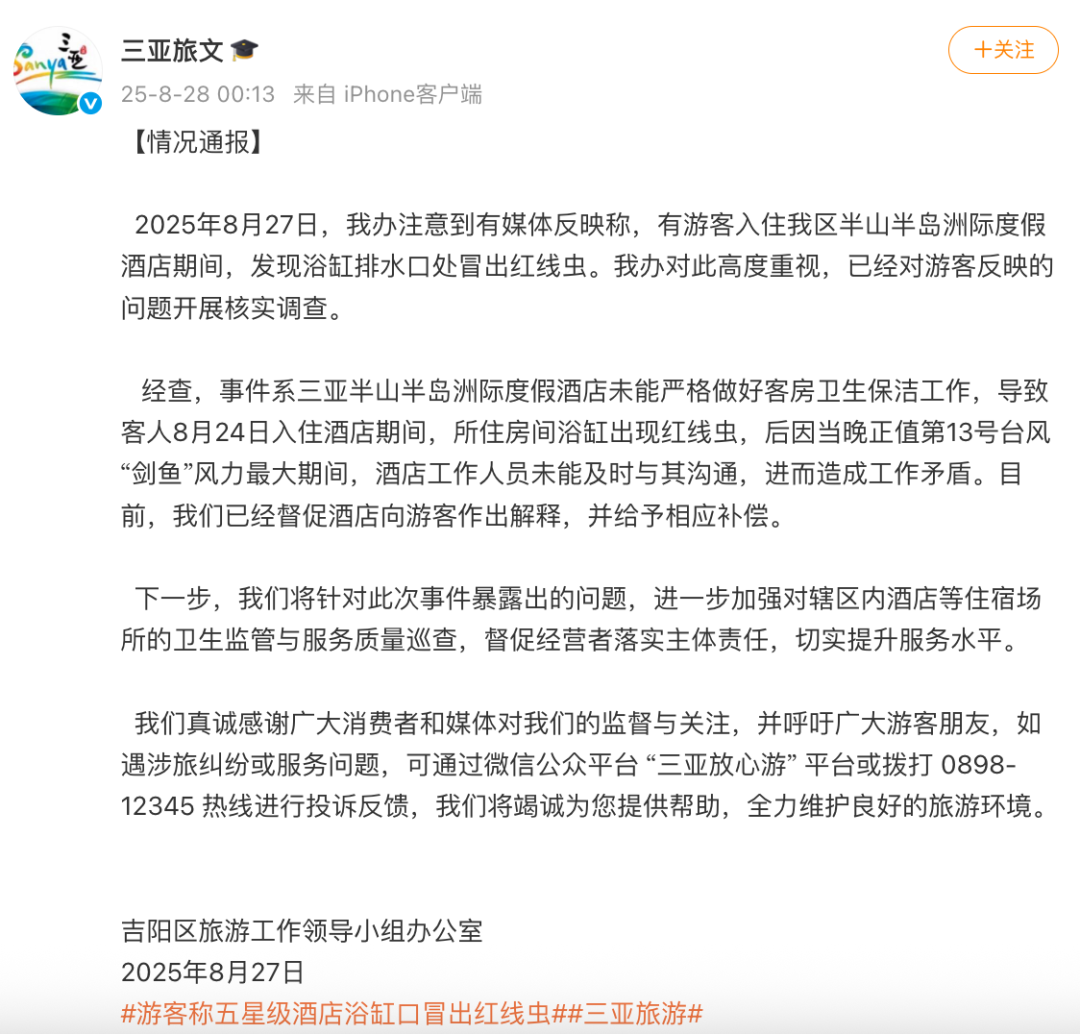
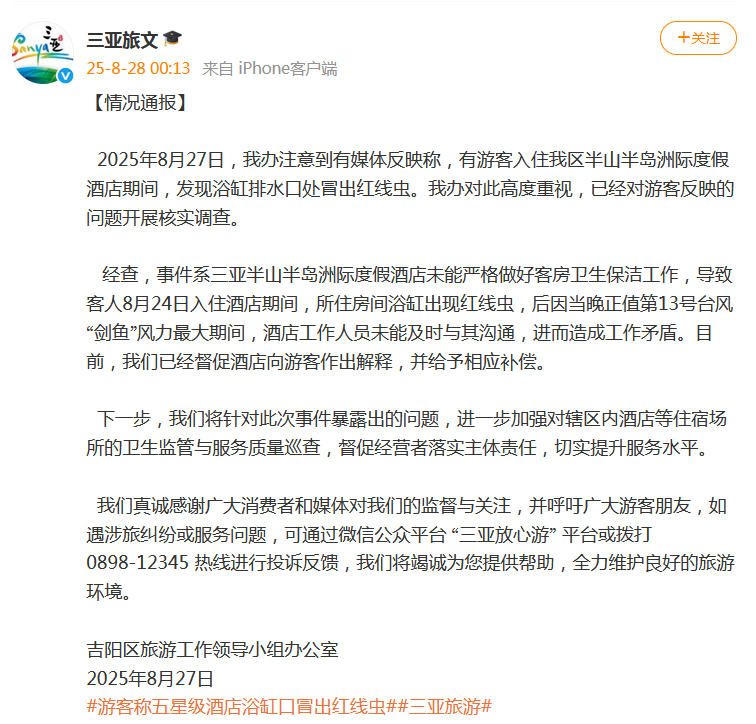
游客称“五星级酒店浴缸出现红线虫” 三亚官方回应
Zhong Guo Xin Wen Wang· 2025-08-28 01:35
Core Points - A tourist reported finding red line worms in the bathtub of the InterContinental Resort in Sanya, leading to an official investigation by the local tourism authority [1] - The incident was attributed to inadequate sanitation practices by the hotel, which failed to maintain proper cleanliness in guest rooms [1] - The local tourism authority has mandated the hotel to provide an explanation and compensation to the affected guests [1] - Moving forward, the authority plans to enhance hygiene supervision and service quality inspections for hotels in the area [1]

锦江酒店2025上半年核心业绩稳健增长 改革降费显效 出海与数字化转型打开新空间
Zhong Guo Jin Rong Xin Xi Wang· 2025-08-28 01:31
Core Viewpoint - Jinjiang Hotels reported a strong performance in the first half of 2025, with operating revenue of 6.526 billion yuan and a net profit of 409 million yuan, reflecting a year-on-year growth of 5.17%, despite a decline in net profit attributable to the parent company due to the absence of non-recurring gains from asset disposals in the previous year [1][2] Group 1: Financial Performance - The company achieved operating revenue of 6.526 billion yuan in the first half of 2025, with a net profit of 409 million yuan, marking a 5.17% increase year-on-year [1] - The decline in net profit attributable to the parent company was due to the absence of non-recurring gains from the sale of assets in the previous year, which had generated 459 million yuan [1] Group 2: Operational Efficiency and Management - Jinjiang Hotels streamlined its management structure from "7 major centers and 37 departments" to "13 departments and 2 business units," enhancing management efficiency and reducing management costs, with the management expense ratio dropping to 15.62%, a decrease of 2.66 percentage points year-on-year [2] - The company focused on brand development, with 86% of new hotel openings in the domestic limited-service hotel segment coming from its main brands, an increase of approximately 3 percentage points from the previous year [2] Group 3: Customer Engagement and Membership - The company enhanced its central client operations, with a 15% year-on-year increase in order night volume from central clients, contributing to revenue growth and risk resilience [3] - The "Jinjiang Hui" membership program surpassed 200 million members, with a central booking rate increase of 11.36 percentage points from January to June, and membership contribution rate exceeding 70% [3] Group 4: Digital Transformation - Jinjiang Hotels is building an efficient digital operation system through three core initiatives: integrating a "three-platform" system for brand, membership, and supply chain management, achieving unified membership systems, and promoting business-financial integration for improved operational efficiency [4] Group 5: Global Expansion Strategy - The company is accelerating its global expansion, focusing on Southeast Asia and Europe, with plans to develop over 180 hotel projects in collaboration with RJJ Hotels in countries like Malaysia, Indonesia, and Vietnam [5][6] - In Europe, Jinjiang Hotels is revitalizing its operations by focusing on core business development and asset upgrades, with 14 renovated hotels showing significant improvements in revenue and customer satisfaction [7] Group 6: Future Outlook - Jinjiang Hotels aims to strengthen its industry leadership through internal reforms and global expansion, contributing to the international influence of Chinese service brands and supporting high-quality economic development in China [7]
游客称“五星级酒店浴缸出现红线虫”,三亚凌晨通报
Mei Ri Jing Ji Xin Wen· 2025-08-28 00:34
Core Points - A situation report was released by the Sanya Tourism Work Leadership Group Office regarding a complaint from a guest at the InterContinental Sanya Resort about red line worms appearing in the bathtub drain [1] - The incident was attributed to inadequate room sanitation by the hotel, which led to the appearance of the worms during the guest's stay on August 24 [1] - The hotel staff failed to communicate effectively with the guest during the peak of Typhoon "Jianyu," exacerbating the situation [1] - The local authorities are taking steps to enhance hygiene supervision and service quality inspections for hotels in the area [1] - The authorities encouraged consumers to report any travel-related disputes or service issues through designated platforms [1] Summary by Sections Incident Details - A guest reported seeing moving red line worms in the bathtub drain of the InterContinental Sanya Resort [2] - The hotel only responded to the complaint the following afternoon, leading to dissatisfaction from the guest [2] Response and Actions - The hotel has been urged to provide an explanation and appropriate compensation to the affected guest [1] - Local authorities are committed to improving hygiene oversight and service quality in the hospitality sector [1] Consumer Communication - Authorities expressed gratitude for consumer and media oversight and provided contact information for reporting issues [1]