美妆

Search documents
来进博会看消费新风尚 世界大机遇
Xin Hua She· 2025-11-02 13:11
Group 1 - The eighth China International Import Expo (CIIE) will be held in Shanghai from November 5 to 10, showcasing global innovations and providing opportunities for companies to expand into the Chinese market [1][2] - Major companies like L'Oréal and Panasonic will present a range of global and China debuts of innovative products, highlighting the importance of the expo in fostering innovation and collaboration across industries [1][2] - The expo will feature new themes and trends, including a focus on the "silver economy" in the medical sector and a dedicated pet-themed exhibition area, reflecting the evolving consumer preferences in China [2][3] Group 2 - The CIIE is increasingly recognized as a global public good, with initiatives to support products from least developed countries, allowing them to benefit from zero-tariff treatment in the Chinese market [2] - Companies from Madagascar, such as the Madagascar Livestock Company, are participating for the first time, showcasing their products in China, which indicates the growing international interest in the Chinese market [3]
来进博会看消费新风尚、世界大机遇
Xin Hua Wang· 2025-11-02 12:57
Core Insights - The 8th China International Import Expo (CIIE) will be held from November 5 to 10 in Shanghai, showcasing global innovations and providing opportunities for companies to expand in the Chinese market [1][2] - The event will feature numerous global and China debuts of innovative products, highlighting the latest technological advancements across various industries [1][2] Group 1: Company Participation - L'Oréal will present its strongest lineup of debuts, including three new brands and 19 new products, emphasizing the importance of CIIE for global trends and innovation [1] - Panasonic will unveil its AI strategy for China and showcase globally innovative products, reflecting China's role as a hub for innovation and engineering [1][2] Group 2: Market Trends - The expo will highlight new consumer trends, including a focus on the "silver economy" with products for the elderly and a dedicated pet-themed area to showcase the pet economy [2] - The sports and fitness sector is gaining traction, with brands like Lululemon expressing confidence in the long-term potential of the Chinese market [2] Group 3: Global Collaboration - CIIE is increasingly recognized as a global public good, with new initiatives to support products from least developed countries, enhancing their access to the Chinese market [2] - Madagascar's participation marks a significant step, with the introduction of frozen goat meat products in Chinese supermarkets following their debut at the expo [3]
雅诗兰黛集团2026财年强势开局 第一季度有机净销售额同比增长3%
Zheng Quan Ri Bao· 2025-11-02 12:36
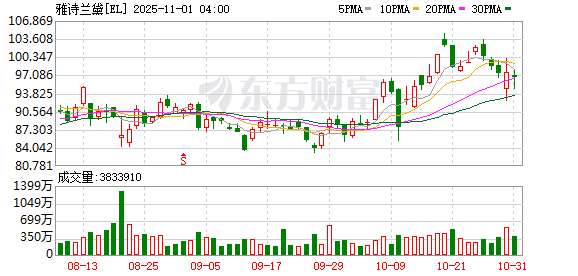
Core Insights - Estée Lauder Companies reported significant performance recovery in Q1 of FY2026, driven by the "Reimagining Beauty" strategy, aiming for sustainable sales growth and improved operational profitability [2] Financial Performance - The company achieved net sales of $3.5 billion, a year-over-year increase of 4%, with organic net sales growing by 3%, a notable recovery from a 13% decline in the previous fiscal quarter [2] - Gross margin increased by 100 basis points from 72.4% to 73.4%, while adjusted gross margin rose by 60 basis points from 72.7% to 73.3% [2] - Operating profit margin improved significantly to 4.9%, compared to -3.6% in the same period last year; adjusted operating profit margin surged from 4.3% to 7.3%, an increase of 300 basis points [2] Market Performance - The China mainland market emerged as a key highlight, contributing to a 9% organic net sales growth in the Asia-Pacific region, with double-digit growth in retail sales in the high-end beauty sector [2] - Seven brands under the company achieved double-digit growth, with Le Labo nearing triple-digit growth [2] Strategic Initiatives - The growth in the China mainland market is attributed to a dual approach of innovation and existing product expansion, targeted consumer outreach, and key marketing activities supporting online growth [3] - For the full FY2026, the company reaffirmed its outlook, expecting organic net sales to remain flat to grow by 3%, with adjusted operating profit margin projected between 9.4% and 9.9% [3] - The company is addressing external uncertainties, such as tariff policies, by optimizing regional production layouts and bringing production closer to consumer locations [3]


美妆行业周度市场观察:行业环境头部品牌动态投资运营产品技术营销活动-20251102
Ai Rui Zi Xun· 2025-11-02 09:04
Investment Rating - The report does not explicitly provide an investment rating for the beauty industry Core Insights - The domestic beauty industry is undergoing significant restructuring, with brands like Chao Di Shang Hui and Jing Sheng Zhi Yuan exiting the market, indicating a challenging environment for local brands aiming to become the "Chinese L'Oreal" [4] - The next-generation skincare products featuring sterile preservation and precise anti-aging properties are redefining effective skincare, with the market for single-use skincare expected to exceed 70 billion yuan by 2025 [5] - The Chinese beauty industry is accelerating its globalization, with leading companies enhancing international competitiveness through capital operations and mergers [6] - The domestic fragrance market is expanding, with local brands entering the high-end segment, although they still lag behind international brands in sales [6] - The beauty talent landscape is evolving, with cross-industry appointments driving innovation and strategic flexibility [7] - The Double 11 shopping festival is seeing a shift in brand ambassador strategies, focusing on younger idols and sports figures to engage new consumer demographics [8] - The "milk beauty" trend is gaining traction, emphasizing sensory experiences and self-care in skincare products [9] - The body care market is experiencing growth, with a projected online market size of 40.1 billion yuan by 2025, driven by consumer demand for personalized products [10] - Instant retail is rapidly expanding in the beauty sector, with a projected market size of 2 trillion yuan by 2030, emphasizing speed and emotional value [10] Industry Trends - The domestic beauty market is witnessing a shift towards high-end and personalized products, with brands leveraging technology and consumer insights to drive growth [4][5] - The capital market is increasingly favoring companies that can demonstrate a strong global strategy and innovative product offerings [6] - The rise of instant retail is reshaping consumer purchasing behaviors, with brands adapting their strategies to meet the demand for quick and convenient shopping experiences [10] Top Brand News - The launch of a new functional fragrance brand by the former CMO of Proya, focusing on integrating scent into daily life [11] - Yatsen Global's introduction of a new skincare brand, "Rui Ke Hu," which emphasizes scientific research and clinical validation [12] - The rapid growth of Sanjing Pharmaceutical in the beauty sector, achieving a 1000-fold increase in GMV within eight months through effective influencer marketing [12] - Naturals' application for a Hong Kong IPO reflects the growing importance of local brands in the global beauty market [13] - The emergence of brands targeting middle-aged consumers, such as Kawai Duo, which has achieved significant sales through targeted marketing strategies [14] - Coty Inc.'s strategic evaluation of its mass cosmetics division amid financial pressures, indicating a shift towards high-end products [15]

从快周期到稳增长,珀莱雅的结构性进化
Xin Lang Cai Jing· 2025-11-01 14:23
Core Insights - The company achieved a revenue of 7.098 billion yuan in the first three quarters of 2025, reflecting a year-on-year growth of 1.89%, and a net profit of 1.026 billion yuan, up 2.65% year-on-year, indicating a rational return to growth amidst a challenging consumer environment [1] - The improvement in gross margin to 73.69% from 70.07% and a net profit margin of 14.86% highlights the company's position as a leading player in the domestic beauty market [1] - The company is transitioning from a focus on rapid expansion to prioritizing quality and sustainability, as evidenced by a significant increase in operating cash flow by 196.65% year-on-year to 1.198 billion yuan [1] Financial Performance - Revenue for the first three quarters of 2025 reached 7.098 billion yuan, a 1.89% increase year-on-year [1] - Net profit was reported at 1.026 billion yuan, reflecting a 2.65% year-on-year growth [1] - Operating cash flow significantly improved to 1.198 billion yuan, marking a 196.65% increase year-on-year [1] Brand Strategy - The company is shifting its growth logic from reliance on single blockbuster products to a multi-brand collaboration approach, focusing on structural growth rather than just volume [2][3] - The main brand continues to serve as a core anchor for profit and reputation, with successful product lines validating the closed-loop model of "scientific ingredients - product efficacy - market conversion" [3] - The company is replicating its successful product validation model across other brands, enhancing their market presence and operational capabilities [4] Research and Development - The company maintains a stable R&D expense ratio of 2%, investing 142 million yuan in R&D in the first three quarters of 2025, which is crucial for long-term sustainable growth [8] - Recent collaborations with universities for research projects indicate a shift towards a more integrated research ecosystem, enhancing the company's innovation capabilities [8][12] - The establishment of multiple R&D centers in China and Europe supports a comprehensive research framework, focusing on anti-aging mechanisms and sustainable ingredient development [12] Organizational Changes - Recent management changes signal a transition from founder-led to a more professional governance structure, emphasizing collaboration and system thinking [14][15] - The new management team, with diverse backgrounds, aims to enhance organizational resilience and internal collaboration, aligning with the company's long-term strategic goals [15] - The company is positioning itself as an "enabler" in the beauty industry through strategic investments, such as in the domestic makeup brand Huazhixiao, to connect with younger consumers [16][17] International Expansion - The submission of an H-share listing application to the Hong Kong Stock Exchange marks a significant step towards international capital market entry, enhancing the company's governance and transparency [17][18] - The company aims to leverage its international presence to strengthen its research and innovation capabilities, creating a cycle of "domestic R&D + international innovation" [17][18] - The focus on long-term value creation reflects a shift in corporate strategy from immediate gains to sustainable growth, positioning the company for future success in the global beauty market [18]

行业报告显示:中国美妆行业迈向科技创新驱动新周期
Xin Hua Cai Jing· 2025-11-01 07:32
Core Viewpoint - The Chinese beauty industry is transitioning from "manufacturing" to "intelligent manufacturing," driven by innovation and participation in international competition, as highlighted in the recent beauty innovation report by Yatsen Group [1][2][3]. Group 1: Global Research and Development Trends - The global beauty industry is forming a new paradigm of "global co-research and localized results" due to rising consumer demand and the emergence of new market R&D capabilities. China's cosmetics export value reached 23.472 billion yuan in the first 11 months of 2024, covering major markets such as the Americas, Europe, and Southeast Asia. The compound annual growth rate (CAGR) for emerging markets is expected to exceed 10% by the end of 2025 [1]. Group 2: Consumer Demand and Scientific Beauty - Consumer demand is shifting from basic cosmetics to scientifically validated personalized solutions. The technology skincare market is projected to exceed 420 billion yuan by 2025, with a CAGR of 18%. A survey indicates that 72% of consumers prioritize efficacy, while 65% focus on efficacy verification data. Anti-aging, whitening, and repair are the three major skincare hotspots, with color cosmetics trending towards "makeup and skincare integration" [2]. Group 3: Integration of Makeup and Skincare - The concept of "makeup and skincare integration" is rapidly gaining traction globally, leading to a deep fusion of color cosmetics and skincare. A report shows that 91% of consumers are concerned about active ingredients in base makeup, and 76% recognize the skincare benefits of foundation. From 2019 to 2023, sales of tinted moisturizers in the U.S. grew by 59%, with similar demand for functional color cosmetics in Southeast Asia and the Asia-Pacific region [2]. Group 4: AI Technology Reshaping the Beauty Industry - Artificial intelligence is becoming a fundamental driver for systematic upgrades in the beauty industry. A McKinsey report predicts that generative AI could create $90 to $100 billion in value for the global beauty sector by 2025. AI technology accelerates active ingredient screening and new molecular design in R&D, enhances efficiency in manufacturing through flexible production and smart quality inspection, and drives personalized customization and precise delivery for consumers [3].
逸仙集团发布中国首份美妆创新白皮书
Xin Lang Ke Ji· 2025-11-01 07:22
Core Insights - Yatsen Group officially launched the "Yatsen Group Beauty Innovation White Paper," marking it as China's first beauty innovation white paper, showcasing the company's R&D achievements and future directions [1] Group 1: R&D Achievements - The white paper highlights the core technological achievements of DR.WU's PDRN Water Light Essence, developed in collaboration with Huazhong University of Science and Technology, utilizing Nobel Prize application-derived RNA vaccine nanolipid particle delivery technology [2] - The product features the proprietary 'Nanoxinfuse™' technology, enhancing the penetration and stability of active ingredients, and incorporates AI molecular docking technology for precise screening of PDRN enhancers [2] - Since its NYSE listing in 2020, Yatsen Group has invested over 600 million yuan in R&D, with R&D expenses exceeding 3% of total revenue for three consecutive years [2] Group 2: Innovation Infrastructure - Yatsen Group has established a comprehensive "end-to-end" innovation R&D system through self-built factories and three global R&D centers located in Shanghai, Guangzhou, and Toulouse, France [3] - The company has developed a global research network characterized by "1-3-4-6-20," which includes one advanced beauty factory, three independent R&D centers, four research directions, six co-built laboratories, and over 20 international research cooperation projects [3] - The Shanghai Jing'an global innovation R&D center serves as the research hub, with an initial investment exceeding 80 million yuan and equipped with over 300 high-end instruments, creating a complete research chain from raw material innovation to clinical validation [3]
珀莱雅(603605)2025年三季报点评:大促节奏前置致Q3收入利润增长承压 洗护品类延续高增
Xin Lang Cai Jing· 2025-11-01 00:29
Core Insights - The company reported its Q3 2025 financial results, showing a mixed performance with revenue and profit pressures due to advanced promotional activities [1][2]. Financial Performance - For Q1-Q3 2025, the company achieved operating revenue of 7.098 billion yuan, a year-on-year increase of 1.89%, and a net profit attributable to shareholders of 1.026 billion yuan, up 2.65% year-on-year [2]. - The gross margin for Q1-Q3 2025 was 73.69%, an increase of 3.62 percentage points year-on-year, while the net profit margin was 14.86%, up 0.19 percentage points year-on-year [2]. - In Q3 alone, the company reported revenue of 1.736 billion yuan, a decline of 11.63% year-on-year, and a net profit of 227 million yuan, down 23.64% year-on-year [2]. - The gross margin for Q3 was 74.68%, an increase of 3.96 percentage points year-on-year, but the net profit margin decreased by 2.01 percentage points to 13.19% [2]. Brand Performance - The main brand, Proya, maintains a solid industry position, while the Color Tang brand has been actively launching new products to expand its portfolio [3]. - In Q3 2025, skincare products generated revenue of 1.316 billion yuan, down 20.41% year-on-year; beauty makeup products remained stable at 236 million yuan; and hair care products saw a significant increase of 137.7%, reaching 179 million yuan [3]. - Proya ranked first in beauty category sales on Tmall during the first four hours of the Double Eleven sales event, and second in the beauty industry on Douyin during the first phase of the event [3]. Investment Outlook - The company is expected to continue steady growth in its main brand, with promising performance from its second and third-tier sub-brands, indicating a strong outlook for building a domestic beauty ecosystem [4]. - The earnings per share (EPS) forecasts for 2025-2027 are adjusted to 4.04, 4.52, and 5.02 yuan per share, with corresponding price-to-earnings (PE) ratios of 18, 16, and 15 times [4].
2025年第43周:美妆行业周度市场观察
艾瑞咨询· 2025-11-01 00:04
Group 1 - The domestic beauty market is undergoing significant changes, with brands like Chao Di Shang Hui and Jing Sheng Zhi Yuan exiting the market, indicating a tough competitive landscape ahead for domestic brands aiming to become the "Chinese L'Oreal" [3] - The "2024 China New Consumer Brand Growth Power White Paper" analyzes market trends based on over 8,000 consumer surveys and expert opinions, providing strategic guidance for companies to overcome growth bottlenecks [3] - The next few years are expected to be challenging for domestic beauty brands, with 2025 being particularly critical [3] Group 2 - The next-generation skincare market, particularly single-use skincare products, is projected to exceed 70 billion yuan by 2025, driven by technological advantages such as sterile packaging that maintains ingredient efficacy [5] - Domestic brands are leading this market, expanding into categories like sunscreen and color cosmetics, with recent product launches focusing on anti-aging and repair [5] Group 3 - The third quarter of 2025 saw accelerated globalization of the Chinese beauty industry, with competition evolving from "brand export" to "global ecosystem construction" [6] - Leading companies are enhancing international competitiveness through capital operations, cross-border mergers, and diversified strategies, such as Proya's investment in color cosmetics and Nature Hall's Hong Kong IPO application [6] - The influx of capital into upstream technology fields like synthetic biology indicates intensified competition and a new round of industry reshuffling [6] Group 4 - Domestic fragrance brands are rapidly entering the high-end market, with new stores opening in key locations ahead of the Golden Week, aiming to strengthen brand narratives and marketing [7] - The global fragrance market is expected to grow significantly, with the Chinese market showing a compound annual growth rate of 8% [7] Group 5 - The beauty industry is experiencing a talent war, with strategic cross-industry appointments driving research and development, as seen with Estée Lauder hiring FMCG executives to innovate their R&D systems [8] - The competition has shifted to a "boundary-less" capability war, emphasizing the need for diverse talent sources and global experience [8] Group 6 - The Double 11 shopping festival has seen beauty brands increasingly focus on younger consumers, with new-generation idols becoming preferred brand ambassadors [10] - Brands are adopting a more nuanced approach to endorsements, with specific roles for ambassadors to enhance product marketing [10] Group 7 - The body care market is experiencing a surge as temperatures drop, with online market size expected to reach 40.1 billion yuan by 2025, driven by consumer demand for personalized products [13] - Brands are innovating with ingredients that address both efficacy and emotional value, catering to the growing need for effective winter skincare solutions [13] Group 8 - Instant retail is rapidly expanding in the beauty sector, with the market expected to exceed 2 trillion yuan by 2030, driven by high consumer demand for quick and convenient shopping experiences [14] - Major platforms are competing fiercely in this space, with brands adjusting their strategies to capitalize on the instant retail trend [14] Group 9 - Proya's former CMO has launched a functional fragrance brand, emphasizing the integration of scent into daily life, with plans to expand into other fragrance categories [15] - The brand aims to combine aesthetics with functionality, targeting a mid-to-high-end market segment [15] Group 10 - The domestic beauty brand "Rui Ke Hu" has been launched by Yixian E-commerce, focusing on oxygenation skincare products developed in collaboration with a hospital, marking a shift towards self-owned brand incubation [16] - The brand's introduction reflects a broader trend of domestic companies diversifying their product offerings and enhancing their market presence [16] Group 11 - Sanjing Pharmaceutical has achieved explosive growth in the Douyin beauty sector, with a 1000-fold increase in GMV within eight months, primarily through influencer marketing [17] - The brand's strategy includes low pricing and simplified product offerings, but it faces challenges in maintaining long-term brand competitiveness [17] Group 12 - Nature Hall has submitted its IPO application to the Hong Kong Stock Exchange, highlighting the growth potential of the Chinese cosmetics market, which is expected to exceed 1 trillion yuan by 2026 [18] - The skincare category is projected to dominate the market, with domestic brands outpacing international competitors in growth [18] Group 13 - The brand "Kaweido" has rapidly gained traction in the middle-aged skincare market, achieving over 100 million yuan in monthly sales by targeting specific consumer needs [20] - The brand's success is attributed to its effective marketing strategies and product positioning, although it faces challenges related to brand reputation and regulatory scrutiny [20] Group 14 - Coty Group is evaluating its mass cosmetics division, which generates 8.5 billion yuan in revenue, in response to financial pressures and declining sales [21] - The company plans to focus on high-end fragrance and beauty segments, indicating a strategic shift in response to market dynamics [21] Group 15 - The launch of JD's first self-operated medical beauty store aims to address traditional industry issues by ensuring transparency and quality in services [25] - The store's model emphasizes customer satisfaction over sales targets, reflecting a shift towards consumer-centric business practices in the medical beauty sector [25] Group 16 - The rise of creative markets during the holiday season indicates a shift towards experiential consumption, with younger consumers willing to pay for immersive experiences [26] - These markets not only drive sales but also serve as platforms for cultural exchange and community engagement [26]

站上世界级科研舞台!逸仙集团发布中国首份美妆创新白皮书
Tai Mei Ti A P P· 2025-10-31 13:41
Core Insights - The Chinese cosmetics industry is currently in a critical phase of innovation-driven development, with a focus on the latest trends in beauty technology and future projections [2] - Yatsen Group has released the "Yatsen Group Beauty Innovation White Paper," marking it as China's first beauty innovation white paper and highlighting China's rising influence in global beauty technology research and development [2][8] - The white paper outlines Yatsen Group's systematic achievements in global research layout, technological innovation, efficacy verification, and sustainable development [2][5] Group 1: Innovation and Research - The white paper serves as a significant milestone in the history of China's beauty industry, showcasing the company's research capabilities and establishing a data-driven innovation model for the industry [2][4] - Yatsen Group revealed its core technology achievements related to the DR.WU PDRN essence, which allows consumers to experience "applicable water light" effects at home, breaking through traditional medical beauty efficacy [2][4] - The company has developed the "Nanoxinfuse™" technology in collaboration with Huazhong University of Science and Technology, enhancing the penetration and stability of active ingredients [4] Group 2: R&D Investment and Strategy - Since its listing on the NYSE in 2020, Yatsen Group has prioritized R&D as its core strategy, investing over 600 million yuan in R&D, with R&D expenses consistently exceeding 3% of total revenue for three consecutive years [5] - The company has established three global R&D centers in Shanghai, Guangzhou, and Toulouse, France, creating an "end-to-end" innovation research and development system [5] - Yatsen Group's skincare business now accounts for over 50% of its total revenue, positioning it among the top ten domestic beauty companies [5] Group 3: Collaborative Innovation - Yatsen Group promotes an open collaborative approach through the Open Lab model, partnering with various universities and hospitals to facilitate the rapid transformation of research outcomes into market applications [6] - The release of the beauty innovation white paper exemplifies the deep integration of industry, academia, and research, showcasing the company's commitment to scientific research and application-oriented development [8] - The founder and CEO of Yatsen Group expressed confidence that world-class beauty innovations can emerge from China, highlighting the potential of Chinese brands on the global stage [8]