
饲料

Search documents
禾丰股份(603609):公司信息更新报告:饲料销量稳步增长,成本改善驱动养殖利润回升
KAIYUAN SECURITIES· 2025-08-20 14:04
Investment Rating - The investment rating for the company is "Buy" (maintained) [1] Core Views - The company reported a steady growth in feed sales and improved cost management, leading to a recovery in breeding profits. The revenue for H1 2025 reached 17.407 billion yuan, a year-on-year increase of 16.27%, with a net profit of 233 million yuan, marking a return to profitability. The growth is attributed to increased sales in feed, poultry, and pig farming, alongside lower prices for key feed ingredients like soybean meal and corn, which helped reduce breeding costs [4][5] Summary by Sections Financial Performance - In H1 2025, the company achieved a revenue of 17.407 billion yuan, up 16.27% year-on-year. The net profit attributable to shareholders was 233 million yuan, a significant turnaround from losses in the previous year. Q2 2025 saw revenue of 9.699 billion yuan, a 25.17% increase year-on-year, with a net profit of 151 million yuan, reflecting a 68.23% growth [4][8] Feed Business - The company’s feed sales reached 2.1 million tons in H1 2025, a 15.70% increase year-on-year. The breakdown includes pig feed at 740,000 tons (up 23.54%), poultry feed at 940,000 tons (up 12.17%), and ruminant feed at 370,000 tons (up 15.99%). The company has effectively linked its pig feed and breeding operations, with bulk pig feed sales increasing by 34% [5] Poultry Business - The company raised 380 million white feather broilers in H1 2025, with an average weight of 2.9-3 kg and a survival rate of 96-97%. The slaughter volume for white feather broilers reached 460 million, a 9.52% increase year-on-year, with a target of 960 million for the year. The sales of chicken parts in high-value channels increased by 2.3 percentage points year-on-year, and the production of processed and cooked products rose by 40% [6] Pig Farming Business - The company had a breeding stock of 58,000 sows as of H1 2025, with 47,000 being productive sows. The company slaughtered 840,000 pigs in H1 2025, with 740,000 being fattened pigs. The expected slaughter volume for 2025 is projected to reach 1.8-2 million pigs, indicating potential for profit expansion [7] Financial Projections - The company forecasts net profits of 559 million yuan, 748 million yuan, and 812 million yuan for 2025, 2026, and 2027 respectively, with corresponding EPS of 0.61, 0.82, and 0.89 yuan. The current stock price corresponds to P/E ratios of 14.5, 10.8, and 10.0 for the next three years [4][8]

贤丰控股:8月19日召开董事会会议
Mei Ri Jing Ji Xin Wen· 2025-08-20 11:21
Group 1 - The core point of the article is that Xianfeng Holdings (SZ 002141) held its 20th meeting of the 8th board of directors on August 19, 2025, discussing the revision of certain company policies [1] - For the first half of 2025, Xianfeng Holdings reported that its revenue composition was as follows: electronic materials accounted for 57.48%, feed accounted for 35.4%, other products accounted for 3.92%, and bioproducts accounted for 3.2% [1] - As of the time of reporting, Xianfeng Holdings had a market capitalization of 4.8 billion yuan [2]

饲料板块8月20日涨0.56%,路德环境领涨,主力资金净流入1384.96万元
Zheng Xing Xing Ye Ri Bao· 2025-08-20 08:37
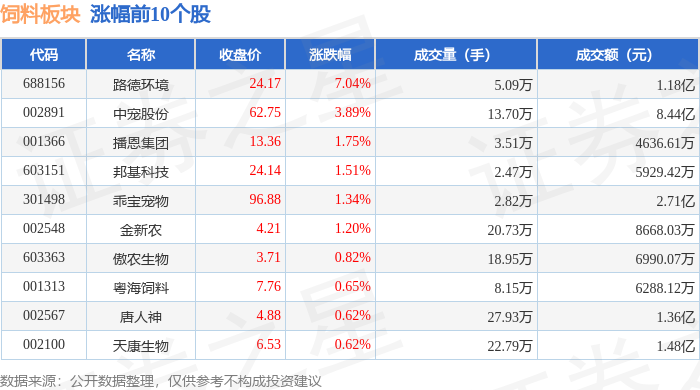
Market Overview - The feed sector increased by 0.56% on August 20, with Lude Environment leading the gains [1] - The Shanghai Composite Index closed at 3766.21, up 1.04%, while the Shenzhen Component Index closed at 11926.74, up 0.89% [1] Individual Stock Performance - Lude Environment (688156) closed at 24.17, up 7.04% with a trading volume of 50,900 shares and a turnover of 118 million yuan [1] - Zhongchong Co., Ltd. (002891) closed at 62.75, up 3.89% with a trading volume of 137,000 shares and a turnover of 844 million yuan [1] - Other notable performers include Boen Group (001366) up 1.75%, Bangji Technology (603151) up 1.51%, and Guai Bao Pet (301498) up 1.34% [1] Capital Flow Analysis - The feed sector saw a net inflow of 13.84 million yuan from institutional investors, while retail investors experienced a net outflow of 29.77 million yuan [2] - The main capital inflow was observed in Zhongchong Co., Ltd. with a net inflow of 69.92 million yuan, while Lude Environment had a net inflow of 10.56 million yuan [3] Summary of Capital Flows - Zhongchong Co., Ltd. (002891) had a significant net inflow from institutional investors at 69.92 million yuan, while retail investors showed a net outflow of 61.77 million yuan [3] - Lude Environment (688156) experienced a net inflow of 10.56 million yuan from institutional investors, with retail investors also showing a net outflow [3] - Other companies like Jin Xin Nong (002548) and Ao Nong Biological (603363) also had mixed capital flows, with varying levels of institutional and retail investor activity [3]



指数开始高位调整!追高资金被套牢,还有哪些投资机会?
Sou Hu Cai Jing· 2025-08-20 07:16
Group 1: Industry Trends and Recommendations - The article emphasizes three key investment themes for the second half of the year: improvement in cash flow, expansion of domestic demand, and technological innovation [1] - Sectors recommended for cash flow improvement include engineering machinery, beverage and dairy, food processing, chemical pharmaceuticals, passenger vehicles, and industrial metals [1] - New consumption areas with high valuation attractiveness include gaming, cosmetics, personal care products, internet e-commerce, digital media, entertainment products, snacks, and feed [1] - Industries benefiting from the technological innovation cycle and domestic self-sufficiency policies include computer equipment, automation equipment, semiconductors, and national defense [1] - Specific sectors highlighted for attention are computers, machinery (engineering and automation), national defense, non-ferrous metals, and pharmaceuticals (chemical pharmaceuticals) [1] Group 2: Precious Metals Market Insights - The fundamentals of precious metals remain stable, with market risk appetite declining due to trade agreements between the US, Japan, and Europe, impacting gold prices [3] - The primary influence on gold prices is the US dollar index, with historical trends indicating that high gold prices struggle to rise significantly in a strong dollar environment [3] - The article suggests monitoring the dollar index closely, as easing tariffs suppress sentiment, and expectations for interest rate cuts are changing marginally [3] - Long-term, geopolitical uncertainties and US-China tariff policies will continue to drive demand for gold as a safe haven, with central bank purchases and stagflation trades being core to gold trading strategies [3] Group 3: Financial Sector Developments - Securities firms are actively seizing business opportunities by serving as lead underwriters or financial advisors for listed companies' private placements, expanding investment banking growth [5] - These firms are also participating in private placements to capture investment opportunities, benefiting from increased trading commissions and investment banking revenues during bull markets [5] - The banking sector has seen significant inflows from institutional funds, particularly public funds, which have increased their holdings in bank stocks due to policy effects and asset price stabilization [5] - Despite recent adjustments in the banking sector, medium-term investment attractiveness remains, with expectations of continued interest in bank stocks [5] Group 4: Market Dynamics and Monetary Policy - The Shanghai Composite Index is experiencing a stagnation trend, with financial stocks serving as market barometers, indicating potential shifts in capital flows [9] - There is an anticipated 50 basis points interest rate cut in the US, with expectations for the next cut possibly occurring in September, leading to a loosening of overseas liquidity [9] - The ChiNext Index is facing a pullback, with critical support levels being monitored to determine future market direction [9] - Domestic monetary policy will prioritize stabilizing growth and combating deflation in the second half of the year, with expectations for further interest rate cuts and reserve requirement ratio reductions [9]

禾丰股份(603609):饲料业务回暖,禽产业链阶段性低迷
Guolian Minsheng Securities· 2025-08-20 05:42
Investment Rating - The investment rating for the company is "Accumulate" (maintained) [7] Core Views - The company reported a revenue of 17.407 billion yuan for the first half of 2025, representing a year-on-year increase of 16.27%. The net profit attributable to shareholders was 233 million yuan, marking a return to profitability [5][12] - The sales volume of feed for the company's controlled enterprises reached 2.1 million tons in the first half of 2025, an increase of 16% year-on-year. The breakdown includes 740,000 tons of pig feed, 940,000 tons of poultry feed, 370,000 tons of ruminant feed, and 50,000 tons of other feed. The outlook suggests that feed sales are expected to continue growing due to high livestock inventory levels [5][14] - The company is expected to see gradual revenue growth, with projected revenues of 35.541 billion yuan, 38.286 billion yuan, and 40.968 billion yuan for 2025, 2026, and 2027 respectively, reflecting year-on-year growth rates of 9.20%, 7.72%, and 7.01% [16] Summary by Sections Financial Performance - In the first half of 2025, the company achieved a gross profit margin of 6.38%, an increase of 1.09 percentage points year-on-year. The net profit margin also improved, indicating a return to profitability [13] - The company's operating expenses for sales, management, R&D, and financial costs were 387 million yuan, 356 million yuan, 12 million yuan, and 100 million yuan respectively, showing year-on-year increases of 9.41%, 9.55%, -34.77%, and 20.89% [13] Market Outlook - The poultry industry is currently experiencing a phase of low prices, with the average price of processed white-feathered chickens dropping to 8,700 yuan per ton as of June 2025, which is at a historical low [15] - The domestic pig farming industry is in a marginal profit state, and the company is expanding its scale of purchasing piglets for fattening, with a total of 840,000 pigs slaughtered in the first half of 2025 [15] Future Projections - The company forecasts net profits of 542 million yuan, 621 million yuan, and 759 million yuan for 2025, 2026, and 2027 respectively, with growth rates of 58.28%, 14.54%, and 22.31% [16][19] - Earnings per share (EPS) are projected to be 0.59 yuan, 0.68 yuan, and 0.83 yuan for the same years [16]
禾丰股份2025年中报简析:营收净利润同比双双增长,盈利能力上升
Zheng Quan Zhi Xing· 2025-08-19 23:00
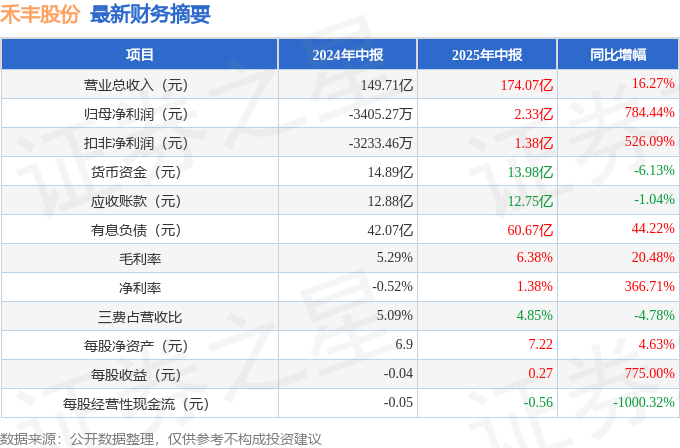
Financial Performance - The company reported a total revenue of 17.407 billion yuan for the first half of 2025, representing a year-on-year increase of 16.27% [1] - The net profit attributable to shareholders reached 233 million yuan, a significant increase of 784.44% compared to the previous year [1] - In Q2 2025, the total revenue was 9.699 billion yuan, up 25.17% year-on-year, while the net profit for the quarter was 115 million yuan, an increase of 68.23% [1] - The gross margin improved to 6.38%, reflecting a year-on-year increase of 20.48%, and the net margin reached 1.38%, up 366.71% [1] Cost and Expenses - Total selling, administrative, and financial expenses amounted to 844 million yuan, accounting for 4.85% of revenue, which is a decrease of 4.78% year-on-year [1] - The company experienced a 14.94% increase in operating costs, attributed to higher sales volumes of feed, poultry, and pigs [3] - Financial expenses rose by 20.89% due to increased interest expenses from the acquisition of a poultry business [4] Balance Sheet Changes - Significant changes in financial items were noted, including a 441.96% increase in derivative financial assets due to increased hedging profits [3] - Accounts receivable increased by 42.75% due to the acquisition of a poultry business, while inventory rose by 57.14% for the same reason [3] - The company’s interest-bearing debt increased by 44.22% to 6.067 billion yuan, indicating a rise in leverage [1] Cash Flow Analysis - The operating cash flow per share was reported at -0.56 yuan, a drastic decrease of 1000.32% year-on-year, indicating cash flow challenges [1] - The net cash flow from investing activities decreased by 153.17%, attributed to increased cash payments for investments [4] - The net cash flow from financing activities surged by 665.7%, primarily due to increased bank loans [4] Business Model and Market Position - The company’s return on invested capital (ROIC) was reported at 4%, with a historical median ROIC of 11.36%, indicating average investment returns [4] - The company relies heavily on marketing-driven performance, necessitating a deeper analysis of the underlying drivers [4] - The company has experienced cyclical performance, with a notable loss in 2023, raising questions about the sustainability of its business model [4]
粤海饲料: 关于 2023 年员工持股计划第二个锁定期解锁条件成就的公告
Zheng Quan Zhi Xing· 2025-08-19 16:34
一、本次员工持股计划的基本情况及审议程序 (一)2023年5月19日,公司召开第三届董事会第八次会议,审议通过了《关 于公司<2023年员工持股计划(草案)>及其摘要的议案》《关于公司<2023年员工 持股计划管理办法>的议案》《关于提请股东大会授权董事会办理公司2023年员工 持股计划相关事宜的议案》,公司独立董事就公司2023年员工持股计划相关议案发 表了同意的独立意见,律师出具了相应的法律意见书。 同日,公司召开第三届监事会第六次会议,审议通过了《关于公司<2023年员 工持股计划(草案)>及其摘要的议案》《关于公司<2023年员工持股计划管理办 法>的议案》,公司监事会对公司2023年员工持股计划的相关事项进行核实并出具 核查意见。 (二)2023年6月7日,公司召开2023年第二次临时股东大会,审议通过了上述 相关议案,并授权公司董事会办理本次持股计划的具体事宜,包括但不限于本次持 股计划的设立、变更和终止等相关事项。 (三)2023年7月11日,公司召开第三届董事会第九次会议,审议通过了《关 于调整公司2023年员工持股计划相关事项的议案》,公司将员工持股计划中的购买 价格由9.03元/股调整为8 ...

饲料板块8月19日涨1.25%,路德环境领涨,主力资金净流入8269.94万元
Zheng Xing Xing Ye Ri Bao· 2025-08-19 08:32
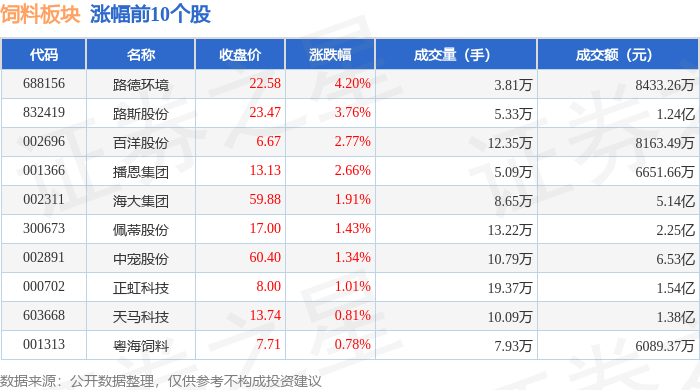
Market Overview - The feed sector increased by 1.25% on August 19, with Lude Environment leading the gains [1] - The Shanghai Composite Index closed at 3727.29, down 0.02%, while the Shenzhen Component Index closed at 11821.63, down 0.12% [1] Individual Stock Performance - Lude Environment (688156) closed at 22.58, up 4.20% with a trading volume of 38,100 and a turnover of 84.33 million [1] - Lusi Co. (832419) closed at 23.47, up 3.76% with a trading volume of 53,300 and a turnover of 124 million [1] - Baiyang Co. (002696) closed at 6.67, up 2.77% with a trading volume of 123,500 and a turnover of 81.63 million [1] - Boen Group (001366) closed at 13.13, up 2.66% with a trading volume of 50,900 and a turnover of 66.52 million [1] - Haida Group (002311) closed at 59.88, up 1.91% with a trading volume of 86,500 and a turnover of 514 million [1] - Petty Co. (300673) closed at 17.00, up 1.43% with a trading volume of 132,200 and a turnover of 225 million [1] - Zhongchong Co. (002891) closed at 60.40, up 1.34% with a trading volume of 107,900 and a turnover of 653 million [1] - Zhenghong Technology (000702) closed at 8.00, up 1.01% with a trading volume of 193,700 and a turnover of 154 million [1] - Tianma Technology (603668) closed at 13.74, up 0.81% with a trading volume of 100,900 and a turnover of 138 million [1] - Family and Country (001313) closed at 7.71, up 0.78% with a trading volume of 79,300 and a turnover of 60.89 million [1] Capital Flow Analysis - The feed sector saw a net inflow of 82.70 million from institutional investors, while retail investors experienced a net outflow of 5.34 million [2][3] - Major stocks like Haida Group and Zhongchong Co. had significant net inflows from institutional investors, with Haida Group receiving 11.50 million [3] - Conversely, stocks like Tianma Technology and Aonong Bio experienced net outflows from institutional investors, indicating a shift in investor sentiment [3]
大北农:公司涉及禽料、蛋品等业务,曾于2016年投资晓鸣股份
Mei Ri Jing Ji Xin Wen· 2025-08-19 01:17
Group 1 - The company has involvement in poultry-related businesses, including feed and egg products [1] - The company invested in Xiaoming Co., Ltd. in 2016, as detailed in its related announcements [1]

禾丰股份上半年净利润实现扭亏为盈,饲料、肉禽、生猪销量均实现同比增长
Zheng Quan Shi Bao Wang· 2025-08-19 01:01
Core Viewpoint - He Feng Co., Ltd. reported significant growth in revenue and profitability for the first half of 2025, driven by increased sales in feed and livestock, alongside lower raw material costs [1][2]. Group 1: Financial Performance - The company achieved a revenue of 17.407 billion yuan, representing a year-on-year increase of 16.27% [1]. - Net profit attributable to shareholders was 233 million yuan, marking a return to profitability compared to the previous year [1]. - The basic earnings per share were 0.27 yuan [1]. Group 2: Sales and Production - Total feed sales reached 2.1 million tons, up 16% year-on-year, with pig feed increasing by 23%, poultry feed by 13%, and ruminant feed by 17% [2]. - The company raised its market share in high-value channels, with sales of processed chicken products increasing by 40% [2]. Group 3: Livestock Operations - The company has a stable breeding stock, with a total of 58,000 sows as of June 2025, including 47,000 breeding sows [3]. - In the first half of 2025, the company sold a total of 840,000 pigs, including 740,000 fattening pigs and 100,000 piglets and breeding pigs [3]. Group 4: Capital Investment - The company plans to invest 70 million yuan in its subsidiary, Jinzhou Xinfeng, to enhance its operational capabilities and support business development [4].