
可再生能源发电

Search documents
国家能源局:全国可再生能源新增装机3.10亿千瓦
Zhong Guo Dian Li Bao· 2025-10-31 10:01
Core Insights - The National Energy Administration held a press conference to discuss the renewable energy grid operation situation for the first three quarters of the year, emphasizing the commitment to carbon peak and carbon neutrality goals [1] Renewable Energy Capacity Expansion - The installed capacity of renewable energy reached nearly 2.2 billion kilowatts, with wind and solar power exceeding 1.7 billion kilowatts [2] - In the first three quarters, the newly added renewable energy capacity was 31 million kilowatts, a year-on-year increase of 47.7%, accounting for approximately 84.4% of the total new capacity [2] - By the end of September, the total installed capacity of renewable energy was 2.198 billion kilowatts, a year-on-year increase of 27%, representing 59.1% of the total power generation capacity in China [2] Renewable Energy Generation Growth - Renewable energy generation increased steadily, accounting for about 60% of industrial electricity consumption [3] - The total renewable energy generation reached 2.89 trillion kilowatt-hours, a year-on-year increase of 15.5%, making up around 40% of total generation [3] - Wind and solar power generation combined reached 1.73 trillion kilowatt-hours, a year-on-year increase of 28.3%, representing 22% of total electricity consumption [3] Hydropower Development - In the first three quarters, the newly added hydropower capacity was 7.16 million kilowatts, with a total installed capacity of 443 million kilowatts by the end of September [3] - The cumulative hydropower generation was 997.1 billion kilowatt-hours, with an average utilization hour of 2,551 hours [3] Wind Power Development - The newly added wind power capacity was 61.09 million kilowatts, with a total installed capacity of 582 million kilowatts by the end of September [4] - The cumulative wind power generation was 813.7 billion kilowatt-hours, a year-on-year increase of 14.3%, with an average utilization rate of 94.0% [4] Solar Power Development - The newly added solar power capacity was 240 million kilowatts, with a total installed capacity of 1.125 billion kilowatts by the end of September [4] - The cumulative solar power generation was 916.3 billion kilowatt-hours, a year-on-year increase of 44.1%, with a utilization rate of 94.7% [4] Biomass Power Development - The newly added biomass power capacity was 1.05 million kilowatts, with a total installed capacity of 46.94 million kilowatts by the end of September [4] - The biomass power generation reached 166 billion kilowatt-hours, a year-on-year increase of 8.3% [4]


摩洛哥自发电并网进展缓慢
Shang Wu Bu Wang Zhan· 2025-10-31 08:25
Core Insights - Morocco has established a legal framework (Loi 82-21) in 2023 to encourage self-generation of electricity by businesses and individuals, allowing for self-use or sale of excess electricity to the grid, aimed at promoting renewable energy development [1] Regulatory Framework - Self-generation projects with a capacity of less than 11 kW can connect at low voltage with simple declarations; projects between 11 kW and 5 MW require an "access permit"; and projects exceeding 5 MW must go through an "authorization" process to connect to medium or high voltage grids [1] Challenges - The promotion of self-generation could alleviate pressure on centralized power plants, enhance the resilience of the energy system, and foster renewable energy development; however, there are multiple challenges including a limit of 20% on the sale of excess electricity, complex connection procedures, lack of storage facilities, and unclear compensation and pricing mechanisms [1] Economic Viability - For small and medium enterprises and household users, while the procedures for small projects are simplified, the economic returns from selling excess electricity remain limited [1] Overall Assessment - The self-generation sector in Morocco faces a reality of "established legal framework but slow practical implementation" [1]
9月中国核发绿色电力证书2.29亿个
Zhong Guo Xin Wen Wang· 2025-10-30 12:51
Core Insights - In September 2025, China issued 229 million green power certificates (GPCs), covering 306,500 renewable energy generation projects, with 158 million being tradable, accounting for 68.86% of the total [1][2] - The trading of GPCs in September 2025 reached 65.12 million, with 21.02 million being green power trading certificates. From January to September 2025, a total of 529 million GPCs were traded, including 179 million green power trading certificates [1] - Major buyers of GPCs include multinational corporations like Apple, as well as leading companies in polysilicon, electrolytic aluminum, steel, and data centers, with significant growth in trading volumes from these sectors [1] - Key regions for GPC purchases include Guangdong, Zhejiang, Shanghai, and Jiangsu, driven by dual control of energy consumption and responsibility for consumption [1] Industry Developments - The current GPC policy framework in China is becoming increasingly comprehensive, effectively promoting green consumption [2] - Future improvements in standards, systems, and labels for green power consumption certification based on GPCs are anticipated, alongside the deepening of policies related to consumption responsibility and carbon dual control [2] - The Chinese GPC market has entered a new stage of high-quality development [2]
国家能源局:9月核发绿证2.29亿个
中国能源报· 2025-10-30 09:34
Summary of Key Points Core Viewpoint - The National Energy Administration has released data on the issuance and trading of renewable energy green power certificates for September 2025, highlighting significant activity in both issuance and trading of these certificates. Issuance of Green Certificates - In September 2025, the National Energy Administration issued 229 million green certificates, covering 306,500 renewable energy generation projects, with 158 million being tradable, accounting for 68.86% of the total issued. In comparison, 200 million green certificates were issued in August 2025, representing 86.98% of the renewable energy generation for that month. From January to September 2025, a total of 2.108 billion green certificates were issued, with 1.435 billion being tradable [1][3]. Breakdown of Issued Green Certificates by Renewable Energy Type - The issuance of green certificates in September 2025 by renewable energy type is as follows: - Wind Power: 72,160 - Solar Power: 73,240 - Conventional Hydropower: 68,760 - Biomass Power: 13,690 - Other Renewable Energy: 1,241 - Total: 229,390 [3]. Trading of Green Certificates - In September 2025, a total of 65.12 million green certificates were traded, with 21.02 million being green power trading certificates. From January to September 2025, 529 million green certificates were traded, including 179 million green power trading certificates [4]. Breakdown of Traded Green Certificates by Renewable Energy Type - The trading of green certificates in September 2025 by renewable energy type is as follows: - Wind Power: 28,600 - Solar Power: 32,880 - Biomass Power: 1,620 - Other Renewable Energy: 2,010 - Total: 65,120 [6]. Trading Price of Green Certificates - In September 2025, the average trading price of green certificates was 4.99 yuan per certificate, reflecting a month-on-month decrease of 11.78%. A total of 44.10 million certificates were traded independently during this period [6].

2025年9月国家能源局核发绿证2.29亿个
Zhong Guo Xin Wen Wang· 2025-10-30 06:13
Core Insights - The National Energy Administration of China has released data on the issuance and trading of renewable energy green power certificates for September 2025, indicating a significant volume of certificates issued and traded [1]. Issuance of Green Certificates - In September 2025, a total of 229 million green certificates were issued, covering 306,500 renewable energy generation projects, with 158 million being tradable, accounting for 68.86% of the total [2]. - For the period from January to September 2025, the total number of green certificates issued reached 2.108 billion, with 1.435 billion being tradable [2]. Breakdown by Renewable Energy Type - Wind Power: 7.216 million (September), 79.112 million (January-September) - Solar Power: 7.324 million (September), 50.117 million (January-September) - Conventional Hydropower: 6.876 million (September), 67.499 million (January-September) - Biomass Power: 1.369 million (September), 12.788 million (January-September) - Other Renewable Energy: 0.124 million (September), 1.241 million (January-September) [4]. Trading of Green Certificates - In September 2025, a total of 65.12 million green certificates were traded, including 21.02 million for green electricity [2]. - From January to September 2025, the total number of traded green certificates was 529 million, with 179 million for green electricity [2]. Breakdown by Renewable Energy Type - Wind Power: 2.860 million (September), 26.204 million (January-September) - Solar Power: 3.288 million (September), 22.861 million (January-September) - Biomass Power: 0.162 million (September), 2.648 million (January-September) - Other Renewable Energy: 0.201 million (September), 1.225 million (January-September) [6]. Average Trading Price - In September 2025, the average trading price for the 44.10 million certificates traded was 4.99 yuan per certificate, reflecting a month-on-month decrease of 11.78% [7]. - The average prices for certificates from different production years were as follows: - 2023 and earlier: 0.23 yuan - 2024: 2.58 yuan - 2025: 6.46 yuan [9].
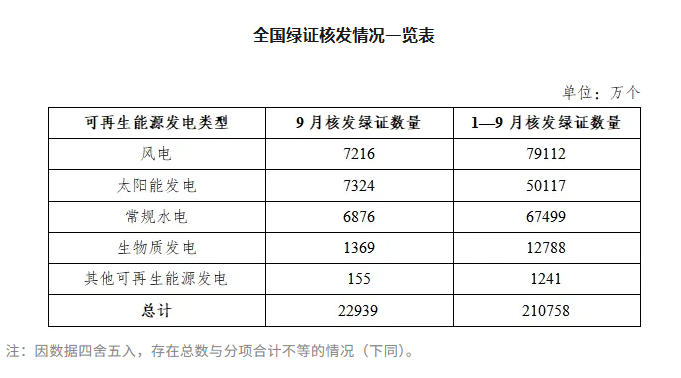
国家能源局:9月核发绿证2.29亿个 其中可交易绿证占比68.86%
Xin Hua Cai Jing· 2025-10-30 02:37
Core Insights - The National Energy Administration issued 229 million green certificates in September 2025, involving 306,500 renewable energy generation projects, with 158 million being tradable, accounting for 68.86% of the total [1][3] - From January to September 2025, a total of 2.108 billion green certificates were issued, with 1.435 billion being tradable [1][3] Renewable Energy Generation Types - Wind Power: 7,216 certificates issued in September, 79,112 in January-September [3] - Solar Power: 7,324 certificates issued in September, 50,117 in January-September [3] - Conventional Hydropower: 6,876 certificates issued in September, 67,499 in January-September [3] - Biomass Power: 1,369 certificates issued in September, 12,788 in January-September [3] - Other Renewable Energy: 1 certificate issued in September, 1,241 in January-September [3] - Total: 22,939 certificates issued in September, 210,758 in January-September [3] Green Certificate Trading - In September 2025, 65.12 million green certificates were traded nationwide, with 21.02 million being green electricity trading certificates [1][5] - From January to September 2025, 529 million green certificates were traded, with 179 million being green electricity trading certificates [1][5] - The average trading price for green certificates in September was 4.99 yuan per certificate, a decrease of 11.78% month-on-month [5]
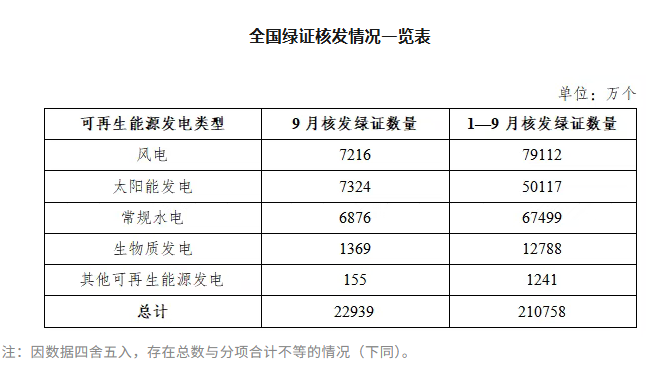
国家能源局发布2025年9月全国可再生能源绿色电力证书核发及交易数据
国家能源局· 2025-10-30 02:14
Green Certificate Issuance - In September 2025, the National Energy Administration issued 229 million green certificates, covering 306,500 renewable energy generation projects, with 158 million being tradable green certificates, accounting for 68.86% [2] - For the period from January to September 2025, a total of 2.108 billion green certificates were issued, of which 1.435 billion were tradable [2] Green Certificate Issuance by Renewable Energy Type - In September 2025, the issuance of green certificates by renewable energy type was as follows: Wind power: 72,160; Solar power: 73,240; Conventional hydropower: 68,760; Biomass power: 13,000; Other renewable energy: 1,241, totaling 229,390 [4] - From January to September 2025, the total issuance was 2,107,580 green certificates [4] Green Certificate Trading - In September 2025, a total of 65.12 million green certificates were traded nationwide, with 21.02 million being green electricity trading certificates [5] - From January to September 2025, a total of 529 million green certificates were traded, with 179 million being green electricity trading certificates [5] Green Certificate Trading by Renewable Energy Type - In September 2025, the trading of green certificates by renewable energy type was as follows: Wind power: 28,600; Solar power: 32,880; Biomass power: 1,620; Other renewable energy: 2,010, totaling 65,120 [7] - The average trading price for green certificates in September 2025 was 4.99 yuan per certificate, reflecting a month-on-month decrease of 11.78% [7][10]
市场消息:日本丸红将为日本永旺集团提供可再生太阳能发电。
Xin Lang Cai Jing· 2025-10-25 00:45
Core Viewpoint - Marubeni Corporation will provide renewable solar power generation for Aeon Group in Japan [1] Group 1 - The collaboration between Marubeni and Aeon Group signifies a strategic move towards sustainable energy solutions in Japan [1] - This partnership is expected to enhance Aeon Group's commitment to renewable energy and reduce its carbon footprint [1] - The initiative aligns with Japan's broader goals of increasing renewable energy usage and decreasing reliance on fossil fuels [1]

北京能源国际(00686) - 二零二五年第三季度发电站发电量之总结
2025-10-24 09:00
香港交易及結算所有限公司及香港聯合交易所有限公司對本公告的內容概不負 責,對其準確性或完整性亦不發表任何聲明,並明確表示,概不就因本公告全部 或任何部份內容而產生或因倚賴該等內容而引致的任何損失承擔任何責任。 | | | | 於二零二五年九月三十日 | | | | 發電量概約 | | | --- | --- | --- | --- | --- | --- | --- | --- | --- | | | | | | | | | | 截至 | | | | | | | | | | 二零二五年 | | | 太陽能 | 風力 | 水力 | 儲能 | 概約併網 | 二零二四年 | 二零二五年 | 九月三十日 | | 位置 | 發電站數目 | 發電站數目 | 發電站數目 | 電站數目 | 裝機容量 | 第三季度 | 第三季度 | 止九個月 | | | | | | | (兆瓦) | (兆瓦時) | (兆瓦時) | (兆瓦時) | | I. 本公司附屬公司持有 | | | | | | | | | | 的發電站 | | | | | | | | | | 中國內蒙古 | 24 | 6 | – | – | 3,235 | 672,02 ...
电车出行折射中国“十四五”绿色转型力度
Zhong Guo Xin Wen Wang· 2025-10-21 01:49
Core Insights - The article highlights the significant progress China is making in its green transition during the "14th Five-Year Plan" period, particularly in the electric vehicle (EV) sector and charging infrastructure [1][6]. Charging Infrastructure Development - During the recent holiday period, China's highway EV charging reached 123 million kilowatt-hours, with a daily average increase of over 45% year-on-year, marking a historical high [1]. - By the end of August 2025, China is expected to have 17.348 million electric vehicle charging points, approximately ten times the number from five years ago [2]. - The number of charging facilities on highways has increased to over 40,000, five times the number from five years ago, with significant expansion into rural areas [2]. Charging Speed and Technology - The average power of newly added DC charging stations has increased from 73.90 kilowatts at the end of 2021 to 98.51 kilowatts by June 2025, indicating a rapid adoption of high-power charging facilities [3]. - Shenzhen has established 1,057 supercharging stations and over 487,000 charging piles, surpassing the number of gas stations and making "full charge with a cup of coffee" a reality [3]. Renewable Energy Integration - The "14th Five-Year Plan" has seen a rapid increase in renewable energy, with the share of renewable energy generation capacity rising from 40% to around 60% [4]. - Wind and solar power generation has significantly increased, with their contribution to total electricity consumption rising from 9.7% in 2020 to an expected 18.6% by 2024 [4]. Traditional Energy Transition - 95% of coal-fired power units in China have achieved ultra-low emissions, with ongoing improvements in coal gangue utilization rates [5]. - The recent announcement of new national contribution targets aims for non-fossil energy to account for over 30% of total energy consumption by 2035, with a sixfold increase in wind and solar capacity compared to 2020 [5]. Future Ambitions - The new targets set forth are more ambitious and indicate that the next five years will see an even greater push towards green transformation in China [6].