
水运

Search documents
到二〇三〇年 智能综合立体交通网全面推进 人工智能让交通运输更“聪明”(政策解读)
Ren Min Ri Bao· 2025-11-12 22:05
Core Viewpoint - The integration of artificial intelligence (AI) with transportation is transforming production and lifestyle, enhancing precision, reliability, and efficiency in traffic management and infrastructure development [1][2]. Group 1: Implementation and Goals - The Ministry of Transport and six other departments issued implementation opinions on "AI + Transportation," outlining 16 specific tasks across four areas, aiming for a fully advanced intelligent transportation network by 2030, with key technologies being self-controlled and at the forefront globally [1][2]. - The focus is on application technology breakthroughs, innovation in smart products, and the construction of a comprehensive transportation model to support the intelligent transformation of the industry [2][3]. Group 2: Efficiency Improvements - The integration of AI is expected to enhance the efficiency of demonstration corridors by approximately 20% and improve emergency response efficiency by around 30% through advanced traffic management models [3][4]. - In 20 demonstration areas for digital transformation, the total mileage of demonstration corridors exceeds 60,000 kilometers, covering major components of the national comprehensive transportation network [3][4]. Group 3: Application Scenarios - The implementation opinions cover seven key areas for intelligent applications, including combined auxiliary driving, smart railways, and intelligent shipping, providing ample testing grounds for new technologies and products [4][5]. - The development of automated ports and intelligent navigation systems is accelerating, with 52 automated terminals established and applications in over ten domestic and international ports [4][5]. Group 4: Infrastructure Support - The successful integration of AI in transportation relies on robust infrastructure, with specific deployments in computing power, data, and network capabilities to support the industry [7][8]. - The establishment of a comprehensive transportation big data center is underway to enhance data sharing and the creation of high-quality datasets, which are essential for AI model training and application [7][8].
10年整改44755个突出问题 四川交出生态环境整改答卷
Si Chuan Ri Bao· 2025-11-07 07:02
Core Viewpoint - Sichuan has rectified 44,755 prominent ecological and environmental issues, reflecting a systematic approach to ecological protection over the past decade [1] Group 1: Environmental Rectification Efforts - Sichuan has undergone three rounds of central ecological environmental protection inspections since 2017, achieving full coverage of 21 cities [2] - The province has implemented a dynamic verification system to address public concerns, leading to significant improvements in issues such as solid waste encroachment and illegal dumping [2] - Specific examples include the cleanup of 194,800 cubic meters of waste in Ya'an and the establishment of a comprehensive river and lake supervision system [2][3] Group 2: Industrial Upgrading and Green Development - Sichuan is integrating environmental rectification with industrial green upgrades, optimizing industrial structures and transportation systems [4] - The province has eliminated over 670 outdated brick and tile production lines and reduced the number of restricted enterprises by over 30% compared to 2023 [4] - The industrial added value in the first half of the year grew by 7.3%, with green and low-carbon industries contributing over 30% [4] Group 3: Transportation Sector Developments - The transportation sector has seen growth in freight volumes, with rail and water transport increasing by 3.2% and 21.7% respectively [5] - Sichuan plans to pilot zero-carbon industrial parks and optimize the layout of hydrogen refueling and battery swapping stations to promote green logistics [5] - The province aims to create a new governance model that aligns ecological protection with high-quality economic development [5]
江西鹰潭港首条集装箱航线正式开通
Yang Shi Wang· 2025-11-05 09:18
Core Points - The opening of the first container shipping route at Yingtan Port marks the end of the region's history without waterway container services [1] - The route operates on a "once a week" schedule with a one-way journey of approximately 3 days, primarily serving the container transportation needs of Northeast Jiangxi and surrounding areas [1] - The first voyage involved transporting empty containers from Jiujiang Port to Yingtan, where goods like premium quartz sand will be loaded for "door-to-door" logistics services [1] Industry Impact - The new shipping route provides an economically efficient channel for goods transportation from Yingtan and integrates the region into Jiangxi's waterway network, enhancing regional economic development [1] - Yingtan Port's Zhongtong Wharf has developed complete container handling capabilities, transforming Yingtan from a traditional cargo source into an inland port with distribution functions [1] - The establishment of this route strengthens the connection between waterway and highway transport systems, laying a solid foundation for a new "road-water combined transport" channel and enhancing Yingtan's hub status in the regional transportation network [1]
前三季度跨区域人员流动量超五百亿人次
Ren Min Ri Bao· 2025-11-04 22:12
Core Insights - A series of major transportation projects are progressing rapidly, with significant investments in infrastructure and improvements in logistics efficiency [1][2][3] Group 1: Transportation Infrastructure Development - The Yanqi Yangtze River Bridge, the world's largest cable-stayed bridge, is nearing completion, expected to be finished by November [1] - The Xinjiang Wuwei Expressway, spanning 319.7 kilometers, is in the final stages, aiming for full operation by the end of this year [1] - The total investment in transportation fixed assets reached 2.6 trillion yuan in the first three quarters, with significant contributions from highways, railways, and waterways [1] Group 2: Personnel and Freight Movement - Cross-regional personnel flow reached 50.6 billion trips in the first three quarters, a year-on-year increase of 3.1% [2] - The total freight volume was 4.325 billion tons, reflecting a year-on-year growth of 3.89%, with notable increases in railway and highway freight [2] - Port cargo throughput grew by 4.6% year-on-year, with foreign trade container throughput showing resilience [2] Group 3: Innovations in Logistics - The "One Bill" system has streamlined logistics processes, significantly reducing costs and improving transport efficiency for exports [3] - The Ningbo Zhoushan Port has launched 111 container sea-rail intermodal routes, achieving over 1.5 million standard container units in business volume [3] - The Ministry of Transport plans to enhance the integration of container sea-rail intermodal transport, targeting an annual growth rate of around 15% by 2027 [3]
同江水运口岸2025年明水期客货运输收官
Zhong Guo Xin Wen Wang· 2025-11-01 12:16
Core Insights - The successful completion of the passenger and cargo transport operations at the Tongjiang Waterway Port for the 2025 clear water period is marked by the arrival of the "Longdu 004" ferry [1] - The port has seen a continuous increase in passenger and cargo volume, facilitated by the implementation of China's visa-free policy for Russian nationals, enhancing business and tourism exchanges [1] - The launch of the "Land-Sea Intermodal Transport Corridor" has improved the efficiency of transporting fresh seafood from Russia to the Chinese market [2] Group 1 - The Tongjiang Waterway Port has effectively managed border inspections and ensured smooth passage for travelers and goods, demonstrating a commitment to national security and operational efficiency [1] - The port's customs and border inspection teams have optimized their operations, including the establishment of a green channel for fresh goods, which has significantly improved inspection efficiency [1] - The port is planning winter operation strategies to ensure year-round accessibility, including the introduction of air-cushion boats and floating ice channels [2] Group 2 - The diversification of the import product list has been achieved, with successful imports of soybean meal, corn, ice cream, and traditional Chinese medicine, marking a breakthrough in multiple categories [2] - The increase in youth exchange and cultural experience programs, such as "study tours," has contributed to the economic vitality of the Tongjiang Waterway Port [1]
“珠海-马瑙斯”远洋集装箱直航航线正式开通
Zhong Guo Chan Ye Jing Ji Xin Xi Wang· 2025-10-22 22:30
Core Points - A Chinese cargo ship has launched a direct shipping route from Zhuhai to Manaus, Brazil, marking the second direct maritime channel to Brazil since the opening of the route to Santana in April 2023 [1] - The new route provides an efficient logistics channel for businesses in both regions, significantly reducing transportation time by 10 to 15 days compared to traditional transshipment methods [1] - The direct shipping route enhances logistics efficiency, reduces risks and costs associated with goods in transit, and supports the introduction of quality industrial products to Manaus [1] Industry Summary - The opening of the direct shipping line is expected to strengthen the regional distribution of materials and improve the overall logistics operation efficiency at the port [1] - The customs authority has implemented proactive measures to ensure smooth operations, including a 24/7 appointment customs clearance model and real-time guidance for companies on electronic data submission [1] - The experience gained from the inaugural voyage has led to improved processes for ship declaration and customs clearance, contributing to a more streamlined operation [1]
镇江以交通“软环境”筑发展“硬支撑”
Xin Hua Ri Bao· 2025-10-17 20:30
Core Insights - The completion of the X252 Shitian Line project enhances the transportation infrastructure between Nanjing and Jurong, addressing previous road conditions and improving regional connectivity [1] - Jiangsu province is focusing on major transportation projects to boost economic development and regional integration, with significant investments in infrastructure [2][3] - The development of water transport capabilities, particularly through the expansion of the Xianbi ship lock, is set to enhance the efficiency of cargo transport and logistics in the region [4][5][6] Group 1: Transportation Infrastructure Development - The X252 Shitian Line project has been completed, contributing to the modernization of the road network in the region, with a total of 6 "broken road" renovations planned for this year, covering 28.3 kilometers [1] - The G312 national highway's rapid transformation in the Zhenjiang section supports regional integration and enhances connectivity between key areas, facilitating the attraction of innovative industries [2] - Zhenjiang has invested 5.5 billion yuan in transportation infrastructure in the first three quarters of the year, marking a 22% increase in fixed asset investment [3] Group 2: Water Transport Enhancements - The Xianbi ship lock has shown impressive performance during the National Day holiday, with a 3% increase in vessel throughput and a 28.8% increase in cargo volume compared to the previous year [4] - The upgraded Xianbi ship lock is expected to become the world's largest single-lift inland ship lock, with an annual throughput capacity projected at 239 million tons [4] - The opening of Danyang Port marks a significant milestone in Zhenjiang's inland container transport capabilities, reflecting the city's commitment to high-quality port development [5][6] Group 3: Service Optimization and Business Environment - Zhenjiang's transportation system has implemented initiatives to improve the business environment, including the establishment of low-altitude flight points and the introduction of convenient transportation services [7] - The city has focused on enhancing service efficiency for driver training and safety measures, contributing to a more favorable operational environment for businesses [7]
河南省高质量完成“十四五”规划系列主题新闻发布会之十 打造121便捷出行圈
He Nan Ri Bao· 2025-10-14 23:01
Core Insights - The Henan provincial government is focused on achieving high-quality transportation development during the "14th Five-Year Plan" period, emphasizing the importance of transportation in China's modernization [2] - The overall transportation network in Henan is set to reach 292,000 kilometers by the end of the "14th Five-Year Plan," an increase of 14,000 kilometers compared to the end of the "13th Five-Year Plan" [3] - The province aims to enhance connectivity, with key travel times established, such as 1-hour access between Zhengzhou and provincial cities, and 2-hour access to surrounding provincial capitals [2] Transportation Infrastructure Development - The total length of highways in Henan is expected to exceed 10,000 kilometers by year-end, with over 90% of counties entering the dual-highway era [3] - The province plans to reconstruct 4,500 kilometers of ordinary trunk roads and 40,000 kilometers of rural roads, addressing historical challenges in rural transportation [3] - The inland waterway network will reach 1,825 kilometers, with significant projects like the Zhoukou Port nearing completion [3] Passenger Travel Improvements - High-speed rail connections now allow for travel from Zhengzhou to major cities like Beijing in as little as 2 hours and 11 minutes [4] - The extension of the Zhengzhou metro network has made it a preferred mode of transport for urban commuting, significantly reducing costs for cross-city travel [4] - Rural passenger transport has expanded with 7,715 new routes, achieving full coverage of scenic spots and villages [4] Freight Transportation Enhancements - By 2024, Henan's total freight volume is projected to reach 2.93 billion tons, with a 34% increase compared to the end of the "13th Five-Year Plan" [5] - The Zhengzhou International Land Port has been officially launched, enhancing the logistics capabilities of the region [5] - Container shipping routes have expanded significantly, with a projected 161,000 standard containers transported via combined rail and water transport by 2024, doubling the volume from the previous plan [5] Strategic Alignment with National Goals - Henan's transportation initiatives align with national strategies, supporting the rise of the central region and enhancing international logistics through key routes like Zhengzhou-Luxembourg and Zhengzhou-Kuala Lumpur [6] - The province is also focusing on ecological protection and high-quality development along the Yellow River, with 34 cross-river transport channels established [6] - Major projects in the Dabie Mountain revolutionary area are being accelerated to inject new momentum into local development [6]

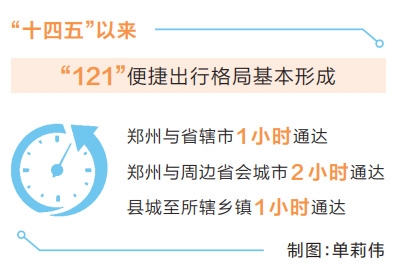
河南“121”便捷出行格局基本形成
Zheng Zhou Ri Bao· 2025-10-14 00:50
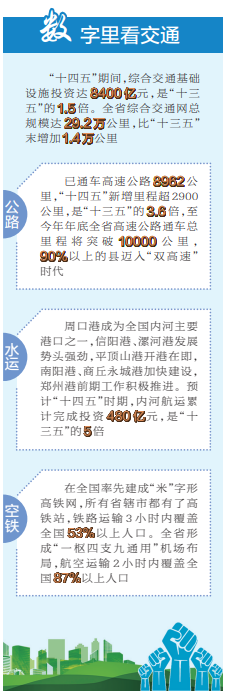
Core Insights - The article discusses the progress and achievements of Henan Province in building a strong transportation network during the "14th Five-Year Plan" period, highlighting significant investments and infrastructure developments [2][3][4]. Transportation Infrastructure Development - The total scale of the comprehensive transportation network in Henan has reached 292,000 kilometers, with an investment of 840 billion yuan, which is 1.5 times that of the previous five-year plan [3]. - The province has added 14,000 kilometers to its transportation network since the end of the "13th Five-Year Plan" [3]. - The total length of highways has reached 8,962 kilometers, with over 2,900 kilometers added during the "14th Five-Year Plan," marking a 3.6 times increase compared to the previous period [3]. Water and Rail Transport Expansion - The inland waterway network has expanded to 1,825 kilometers, with significant investments in ports and shipping infrastructure, including a projected investment of 48 billion yuan during the current plan [4]. - The railway network has reached 6,810 kilometers, including 2,263 kilometers of high-speed rail, covering over 53% of the national population within a three-hour travel radius [4]. Air Transport and Logistics - The air transport network has been enhanced, with 87% of the population within a two-hour flight radius, and the establishment of a comprehensive airport layout [4]. - The cargo volume at Zhengzhou Airport has surpassed 800,000 tons, with significant improvements in logistics efficiency, including a 50% reduction in shipping time for certain goods [5]. Urban and Rural Transportation Improvements - Urban rail transit has increased by 220 kilometers, with a 107% growth compared to the end of the previous plan, making public transport more accessible [6]. - Rural transportation has been bolstered with 7,715 new rural bus routes, achieving full coverage of scenic spots and villages [6]. Freight and Logistics Efficiency - The total freight volume is projected to reach 2.93 billion tons in 2024, with a 34% increase compared to the end of the previous plan [7][8]. - The logistics sector has seen the establishment of 16 five-star logistics companies, enhancing the overall efficiency of the freight system [8]. Technological and Environmental Advancements - The province is focusing on smart transportation solutions, with over 1,000 kilometers of smart highways and the implementation of electronic ticketing systems [9]. - Efforts are being made to promote green transportation, including the transition to electric and hydrogen fuel vehicles, with a significant increase in charging infrastructure [9].
今年江苏计划完成航道建设投资140亿元
Si Chuan Ri Bao· 2025-10-13 10:48
Core Insights - The construction of water transport infrastructure in Jiangsu is accelerating, with significant projects achieving progress, including the completion of the Xianbi ship lock expansion and the commencement of the Nanjing Port Longtan Port Area Phase VII project [1][5] Investment in Waterway Construction - Jiangsu plans to complete an investment of 14 billion yuan in waterway construction this year, ensuring a total investment of 42.6 billion yuan during the 14th Five-Year Plan, which is an increase of over 25 billion yuan compared to the 13th Five-Year Plan, reflecting a year-on-year growth of over 140% [1][3] Key Projects and Developments - The Jinbao shipping route's Huai'an section is progressing efficiently, with 84.01% of the annual plan completed as of September 25, 2023, which is crucial for connecting the Huai River and the Grand Canal [2] - The construction of the Huai River's second phase navigation project and the Lianshen Line's channel improvement project has also made significant progress, with over 30 construction machines working on-site [2][3] Port Development and Economic Impact - The Longtan Port Area Phase VII project will create a new 70,000-ton general berth with an annual throughput capacity of 4 million tons, enhancing the port's role in regional economic development [5] - The "Lianyungang Port—Bengbu Port" container shipping route has been launched, expected to reduce domestic transportation costs by over 30% [4] Multi-Modal Transport and Logistics Efficiency - The "Nanjing—Shanghai" sea-rail intermodal service has been recognized as a national brand route, significantly lowering comprehensive transportation costs for goods [7][8] - Jiangsu aims to cultivate around 15 leading multi-modal transport enterprises by 2030, with a focus on enhancing logistics efficiency and reducing costs [8][9] Overall Growth in Water Transport Capacity - Jiangsu is set to ensure an increase in port throughput capacity exceeding 100 million tons this year, aiming for a total port throughput capacity of 3 billion tons and container throughput capacity exceeding 22 million TEUs by year-end [6][9]