
生态保护

Search documents
高密度城市生物多样性保护的深圳答卷
Zhong Guo Huan Jing Bao· 2025-12-12 01:53
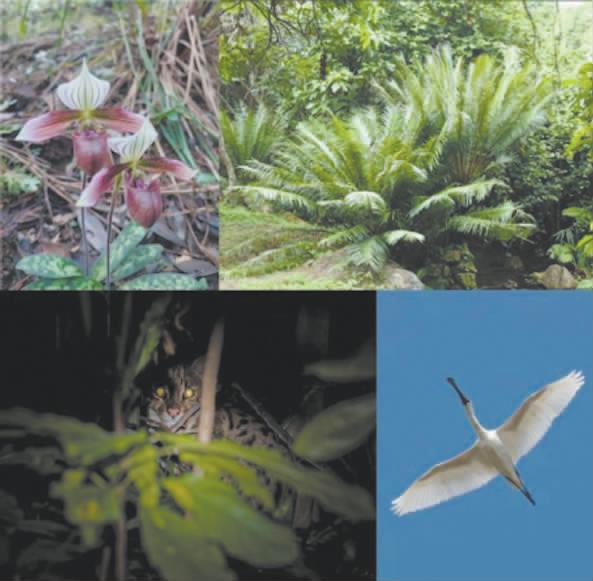
深圳物种资源丰富。 五年,在生态环境保护历程中,可以发生什么?在土地面积仅约2000平方公里的深圳,黑脸琵鹭从稀 有"访客"变稳定栖居的"市民",豹猫在都市中心悄然漫步,唐鱼在清澈溪流中重现身影……深圳以一套 独特的"绣花功夫",在高密度的城市肌理中保育出丰富而典型的生物多样性。 当前,深圳山水林田湖草海要素齐全,拥有陆域野生维管束植物超2200种、本土野生脊椎动物670余 种,其中,区域特有种30余种,其经验正为全球城市化进程中的生态治理提供着宝贵借鉴。 完善体制机制:生物多样性主流化纵深推进 深圳在生物多样性保护领域持续探索制度创新,通过建立一套高效协同的治理体系,为超大城市守护自 然提供了先行示范。 2021年,《深圳经济特区生态环境保护条例》正式施行,其中专设生物多样性保护章节,加速推动生物 多样性主流化进程;同年,深圳发布全国首份城市生物多样性白皮书,系统展示了其生态家底。2022 年,深圳率先在广东省印发了首个城市生物多样性保护行动计划(以下简称行动计划)。 提升公众生态意识,是保护工作的长远基石。深圳率先在全国构建了系统化的自然教育服务体系,目前 全市已有22家自然学校、53家自然教育中心、55 ...

法护长渠清如许
He Nan Ri Bao· 2025-12-11 23:33
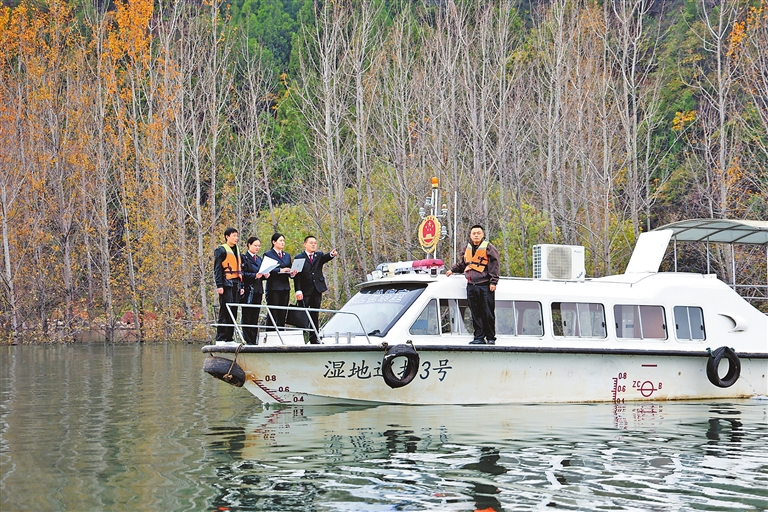
Core Viewpoint - The South-to-North Water Diversion Project is crucial for ensuring water security and quality, with a focus on collaborative legal and ecological protection efforts across regions [1][3][19]. Group 1: Project Overview - The South-to-North Water Diversion Project's central channel officially began operations on December 12, 2014, delivering water from the Danjiang River to Beijing and Tianjin [1]. - The project spans 731 kilometers through eight provincial cities in Henan, emphasizing the importance of maintaining water safety and quality [1]. Group 2: Legal and Ecological Protection - The Henan legal authorities are actively exploring cross-regional collaboration to combat water resource destruction and environmental pollution, establishing a legal framework for ecological protection [1][3]. - The "Yihong Bihui" ecological big data platform in Xichuan County integrates data from multiple departments for real-time water quality monitoring and risk alerts [3][6]. Group 3: Collaborative Efforts - Xichuan County collaborates with surrounding areas to address issues like illegal fishing and pollution, successfully dismantling illegal fish farming operations and promoting ecological restoration [5][6]. - The establishment of a "Judicial + Ecological Restoration" model enhances cooperation between judicial and environmental authorities, leading to effective ecological damage compensation agreements [6][17]. Group 4: Law Enforcement and Community Engagement - Local police units are engaged in continuous patrols along the South-to-North Water Diversion Project, ensuring the security of the water source through both ground and aerial surveillance [8][9]. - Community outreach initiatives educate residents on water protection, fostering a collective responsibility for safeguarding the water source [11][19]. Group 5: Judicial Efficiency - The focus on centralized jurisdiction for environmental cases in regions along the diversion project has improved the efficiency and effectiveness of legal proceedings [12][15]. - The establishment of a specialized environmental court in Jiaozuo enhances the handling of complex environmental cases through a comprehensive approach [16][17].
长株潭发布73项重点合作事项
Chang Sha Wan Bao· 2025-12-11 03:19
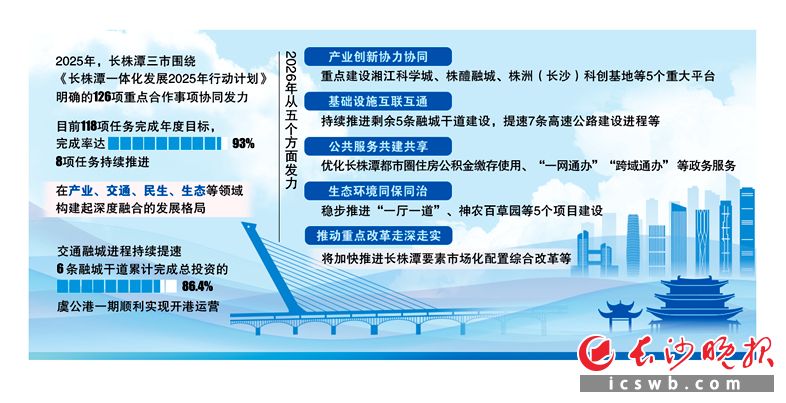
Core Viewpoint - The Longzhutan integrated development initiative is making significant progress, with a focus on collaboration among the three cities of Changsha, Zhuzhou, and Xiangtan, aiming for a more interconnected and sustainable urban ecosystem by 2026 [2][3][4][5] Group 1: Key Cooperation Matters - In 2025, the three cities will focus on 126 key cooperation matters, with 118 tasks already meeting their annual goals, achieving a completion rate of 93% [2] - The transportation integration process is accelerating, with 6 urban integration roads having completed 86.4% of total investment, and the first phase of the Yugu Port successfully commencing operations [2] Group 2: Infrastructure Development - The three cities will work on 16 key infrastructure items to establish a multi-level comprehensive transportation network, focusing on rail transit and road networks [3] - Ongoing projects include the construction of 5 remaining urban integration roads, 7 expressways, and several rail projects, including the Changsha-Liuyang Express Line and the Changsha-Ganzhou High-speed Railway [3] Group 3: Public Services and Community Benefits - The initiative will focus on 18 key public service items to enhance the integration benefits for citizens, including extending quality education and healthcare resources from Changsha to surrounding areas [4] - Efforts will be made to optimize housing fund services and explore joint law enforcement in transportation and quality sectors to improve governance efficiency [4] Group 4: Environmental Protection - The three cities will implement 17 key environmental protection measures, emphasizing the joint management of ecological green spaces and strict adherence to planning and regulatory requirements [4] - Collaborative mechanisms for pollution control and ecological protection will be established to promote harmony between humans and nature [4] Group 5: Reform and Innovation - The initiative will advance 6 reform measures to stimulate internal development dynamics, including market-oriented reforms in resource allocation and cross-regional cooperation [5] - Notably, the collaboration between Xiangjiang New Area and surrounding regions is seen as an innovative practice to enhance the competitive capacity of the Longzhutan urban agglomeration [5]
美丽广西的自然物语
Guang Xi Ri Bao· 2025-12-11 02:42
十二月,桂北的猫儿山巅凝着银霜,寂静中忽有清唳破空——成群的白颈长尾雉,正掠过苍茫山 脊。此时,一种名为刘三姐纤树蛙的新物种,正蛰伏于竹林深处的泥洞中,待到来年春天,它们这才醒 来鸣唱悠扬的"山歌"。 在这静默的寒冬,桂西北龙江的水流缓了,清冷透澈如琉璃。借着一隙天光,可见岩壁上那些微小 的硬壳——"复活"后引起国际学术界轰动的刘氏江旋螺,它们以近乎化石的固守,续写着一首关于演化 与生存的史诗。江河入海处,北部湾也迎来了珍稀的访客——布氏鲸群正游弋在涠洲岛与斜阳岛间的碧 波中,它们深灰色的背脊划开冬日海面,悠长的呼吸声与潮汐共鸣,仿佛在进行一场古老而静谧的对 话。 山清水秀生态美的广西,既是中国南方重要生态屏障,也是全球生物多样性热点地区。"十四五"以 来,广西认真践行习近平生态文明思想,加快建设人与自然和谐共生的美丽广西,生物多样性丰富度位 居全国第三,累计发现动植物新物种249种。八桂大地的山川、河流、海域之间,万物竞生,美美与 共、各美其美,娓娓讲述着一段段美丽动人的蓝色星球自然物语。 守护山川,山中"精灵"频现身 在猫儿山海拔1600米的竹林里,春天不仅带来新叶,还有一阵阵清澈悠扬的"歌声"。这并非山 ...
加强哈拉湖周边管理 确保垃圾日产日清(反馈)
Ren Min Ri Bao· 2025-12-07 22:02
《 人民日报 》( 2025年12月08日 07 版) (责编:赵欣悦、袁勃) 同时,德令哈市政府安排蓄集乡政府联合市文旅局、市林草局发布联合通告,在湖岸沿线1公里范围内 划定生态保护缓冲区,明确冬季期间对哈拉湖地区实施临时性封禁管理,严禁任何游客和社会车辆未经 批准擅自进入。 此外,德令哈市将尽快开通市区通往哈拉湖的铺装道路,组建专业巡护与生态监测队伍,布设视频监控 设备,增设垃圾回收箱,建立"日常巡查+集中清理"的垃圾清理机制,对湖岸沿线、露营区等重点区域 实施常态化清洁,确保垃圾日产日清。 11月24日,本报"读者来信"版刊发《哈拉湖边的垃圾,谁来清理?》一文,曝光青海哈拉湖周边垃圾污 染环境、车辆碾压破坏植被等问题。报道刊发当天,德令哈市立即就相关问题组成核查组,赴哈拉湖现 场排查。 经过排查,就问题所在位置,德令哈市增设5个中型垃圾桶,新增3名专职工作人员,加大日常巡查频 次;制定《德令哈市湖泊环境卫生管控措施》《哈拉湖周边环境卫生综合整治方案》,及时清理湖边垃 圾,严防垃圾污染湖泊的问题发生。 ...
在推动发展方式绿色低碳转型上取得更大突破、争做西部示范
Shan Xi Ri Bao· 2025-12-07 00:10
Core Viewpoint - The modernization in China emphasizes harmonious coexistence between humans and nature, with green development being a prominent feature of this modernization [1] Group 1: Green Development Goals - The 14th Provincial Committee's Ninth Plenary Session proposed achieving greater breakthroughs in green and low-carbon transformation, aiming to set an example in the western region [1][3] - The implementation of these goals is expected to inject more green momentum into the high-quality development of Shaanxi [1] Group 2: Ecological Environment Protection - Shaanxi's ecological environment protection is crucial for its own development quality and sustainability, as well as for the national ecological environment [2] - Since the 14th Five-Year Plan, Shaanxi has fully implemented Xi Jinping's ecological civilization thoughts, achieving significant results in ecological civilization construction [2] - Water quality in the Yellow River has maintained a Class II standard for three consecutive years, and the ecological quality index in the Qinling area is at a first-class national level [2] - The province has achieved a water and soil conservation rate of 70.81%, with a continuous decrease in both the area and intensity of soil erosion [2] Group 3: Pollution Control and Green Economy - From January to October, the PM2.5 concentration in ten national monitoring cities improved by 13.7% year-on-year, indicating ongoing improvements in air quality [2] - Shaanxi has completed afforestation tasks covering 1.976 million acres and has effectively managed desertification in the "Three North" project area [2] - The province has participated in the national carbon market with a cumulative transaction amount of 2.703 billion yuan, and the trading volume of four major pollutants reached 573 million yuan [2] Group 4: Future Development Strategies - The upcoming 15th Five-Year Plan emphasizes ecological environment protection and green low-carbon transformation as key areas for development [3][4] - There is a focus on strengthening ecological safety barriers, reducing total emissions of major pollutants, and achieving carbon peak targets [3] - The relationship between ecological protection and economic development is highlighted, with an emphasis on converting ecological advantages into developmental advantages [3] Group 5: Systematic Governance and Energy Transition - Ecological environment governance is a systematic project that requires a comprehensive approach, balancing local and overall interests [4] - The need for coordinated governance of multiple pollutants and regional collaboration is emphasized to enhance integrated protection of natural resources [4] - The construction of a new energy system is prioritized, focusing on maintaining energy security while achieving carbon peak goals [5] - The integration of traditional and renewable energy sources is essential for promoting a green and low-carbon economy [5]
创新潮涌三江源
Huan Qiu Wang· 2025-12-02 10:22
Group 1: Lithium Industry Development - Qinghai Province is establishing a world-class salt lake industry base, focusing on the development of lithium resources, which are considered a strategic resource for the nation [2][3] - The potential economic value of lithium salt resources in Qinghai's salt lakes is estimated to reach trillions of yuan, with lithium being referred to as "white oil" due to its importance in battery and new energy sectors [2] - The "4+2" ten-thousand-ton lithium salt project has been launched, significantly increasing lithium production capacity and showcasing advancements in technology and production processes [3] Group 2: Agricultural Technology Advancements - The Qingyu No. 9 potato variety has been the most widely promoted potato variety in China, with a promotion area of 7.47 million acres, and is expected to maintain its leading position [4][5] - Qinghai Province has invested 40 million yuan in agricultural technology, supporting the development of a modern potato breeding system that integrates molecular breeding and resource innovation [5][6] - The province has achieved significant advancements in agricultural technology, including leading hybrid breeding levels for rapeseed and improvements in sheep production efficiency [6] Group 3: Ecological Protection and Monitoring - The Datu North River Source National Nature Reserve has identified a population of 57 snow leopards, indicating a healthy ecosystem and biodiversity in the region [7][8] - An integrated monitoring system using infrared cameras and drones has been established to ensure effective management and protection of wildlife in the reserve [8] - Qinghai Province is leveraging technology to enhance ecological protection, addressing challenges in restoring fragile ecosystems and improving resource utilization [9]
汕尾成立品清湖保护联盟与品清湖保护基金
Nan Fang Ri Bao Wang Luo Ban· 2025-12-01 07:55
Core Viewpoint - The establishment of the Pinqing Lake Protection Alliance and the Pinqing Lake Protection Fund marks a significant step towards systematic ecological protection and restoration of Pinqing Lake, aiming to transform it into a permanent habitat for the Chinese white dolphin and promote harmonious coexistence between humans and nature [1][2] Group 1: Environmental Protection Initiatives - The Pinqing Lake, as the largest coastal lagoon in mainland China, covers an area of approximately 23.07 square kilometers and serves as an important ecological barrier and cultural symbol for Shanwei [1] - Recent initiatives include the implementation of the "Shanwei City Pinqing Lake Environmental Protection Regulations," enhancing sewage treatment capacity to 150,000 tons per day, and releasing over 95 million aquatic organisms in the past three years [1] - The area has seen a reduction in beach litter coverage to 0.496‰ and the restoration of over 220,000 square meters of mangroves, contributing to improved ecological conditions [1] Group 2: Community and Funding Engagement - The newly formed Pinqing Lake Protection Alliance integrates resources from government departments, enterprises, research institutions, and the public to foster a community-driven approach to lake protection [2] - The Pinqing Lake Protection Fund, as the first public welfare environmental fund in Shanwei, aims to provide ongoing financial support for the management, governance, protection, and beautification of Pinqing Lake, having raised over 28 million yuan in its initial fundraising [2] - Future projects will include dredging of Pinqing Lake, enhancement of fishery resources, biodiversity surveys of bird species, and the establishment of a sea turtle acclimatization and release base, exploring sustainable development paths [2]
以生态补偿制度创新推进区域协调发展
Zhong Guo Huan Jing Bao· 2025-11-28 01:51
Core Viewpoint - The 20th Central Committee of the Communist Party of China emphasizes accelerating the comprehensive green transformation of economic and social development to build a beautiful China, highlighting the importance of an ecological compensation system for achieving ecological protection and regional coordinated development [1] Group 1: Constructing a Win-Win Ecological Compensation Model - The traditional "unidirectional compensation" model, which primarily focuses on financial payments, leads to "compensation dependency" and weakens intrinsic motivation for ecological protection [2] - A shift from "who pollutes, who governs" to a "who protects, who benefits; who benefits, who compensates" dual logic is proposed to enhance cooperation between protected areas and beneficiary areas [2] - Industry cooperation can create a shared benefits mechanism, as seen in the collaboration between Lishui, Zhejiang, and surrounding economically developed areas to build green industrial parks, allowing both parties to share tax revenues and economic benefits [2] Group 2: Empowering with Technical Support - Technical and talent shortages are core issues limiting ecological protection capabilities in protected areas [3] - A "funding package + technical package + talent package" mechanism is suggested to enhance long-term governance capabilities through technology transfer and capacity building [3] - This approach not only provides short-term support but also fosters deep integration of cross-regional collaboration and ecological governance [3] Group 3: Scientific Quantification of Ecological Compensation Standards - Fairness and efficiency are central to ecological compensation, yet traditional standards often overlook the overall value of ecosystem services and opportunity costs [4] - A systematic accounting approach is needed to ensure the compensation standards are fair and sustainable, covering the basic operational costs of protected areas [4] - The evaluation of ecosystem service values, such as carbon sequestration and biodiversity, is essential for aligning compensation amounts with ecological contributions [5] Group 4: Expanding Channels for Realizing Ecological Value - Current ecological value realization efforts are limited to pilot areas and lack a systematic mechanism for broader promotion [7] - A comprehensive policy framework is necessary to enhance the fairness and operability of ecological compensation, providing stable funding support for ecological protection [7] - Innovative market mechanisms, including carbon trading and ecological product pricing, are crucial for unlocking ecological potential and achieving a win-win situation for ecological protection and economic benefits [7][8]
“巩固好已经取得的成果”——长江禁渔五年观察
Ren Min Ri Bao· 2025-11-28 00:09
Core Viewpoint - The implementation of the ten-year fishing ban on the Yangtze River has shown significant positive effects on the ecosystem, leading to the recovery of aquatic biodiversity and resources, while also providing new livelihoods for former fishermen [1][2][8]. Group 1: Ecological Recovery - The Yangtze River's aquatic biodiversity is gradually recovering, with the population of Yangtze finless porpoises increasing to 1,249 in 2022, up by 237 from 2017 [3][4]. - Key species have returned, indicating a healthier ecological chain; for instance, the population of Chinese paddlefish has increased to four times its pre-ban level in certain areas [4]. - The overall resource density in the Yangtze River has risen by 9.5% year-on-year, and the number of indigenous fish species has increased by 36 since the ban [4][14]. Group 2: Habitat Restoration - Significant efforts have been made to restore aquatic habitats, including the removal of 342 small hydropower stations in the Chishui River, enhancing water connectivity [5]. - The ecological compensation funding for fishing-related projects has increased from 13% in 2021 to 76% [6]. Group 3: Support for Former Fishermen - The fishing ban has affected 231,000 former fishermen, with many transitioning to new livelihoods such as eco-tourism and aquaculture [8][10]. - Training programs and job fairs have been organized, providing nearly 20,000 job opportunities in various sectors for former fishermen [11][12]. - By September 30, 2023, all 142,000 employable former fishermen had transitioned to new jobs, and 220,000 had secured basic pension insurance [12]. Group 4: Regulatory and Enforcement Measures - The government has strengthened law enforcement against illegal fishing, with a focus on improving the capabilities of fishing law enforcement agencies [13][14]. - The Ministry of Agriculture and Rural Affairs has emphasized the need for a coordinated approach to manage the Yangtze River ecosystem effectively [19]. Group 5: Future Directions - The government plans to optimize and enhance policies for the remaining five years of the fishing ban, focusing on ecological restoration and biodiversity monitoring [19][20].