教育医疗

Search documents
海外观察:美国2026年2月非农数据:罢工影响或干扰美国就业数据真实性
Donghai Securities· 2026-03-08 11:16
Employment Data Summary - In February 2026, the U.S. non-farm employment decreased by 92,000, significantly below the expected increase of 59,000[2] - The unemployment rate rose slightly to 4.4%, compared to the expected 4.3% and the previous value of 4.3%[2] - Private sector employment fell by 86,000, with the goods-producing sector losing 25,000 jobs and the service sector losing 61,000 jobs[2] Sector Analysis - The education and healthcare sector, traditionally a stronghold for U.S. employment, saw a reduction of 34,000 jobs, largely due to strikes affecting 31,000 workers in California[2] - The construction and manufacturing sectors were major contributors to the decline, losing 11,000 and 12,000 jobs respectively[2] - The hospitality sector experienced a net loss of 35,000 jobs, marking the fourth consecutive month of decline[2] Wage and Inflation Concerns - Private sector hourly wage growth remained robust at 0.4%, with production and service sector wages increasing by 0.5% and 0.4% respectively[2] - Concerns about inflation persist, as high wage growth combined with geopolitical tensions may lead to renewed inflationary pressures[2] Market Reactions and Predictions - Despite the poor employment data, market expectations for interest rate cuts remain unchanged, with a 96.3% probability of no rate cut in March[2] - The report suggests that the significant drop in employment may not prompt the Federal Reserve to lower interest rates, due to the potential distortions caused by strikes and ongoing inflation risks[3]
2025年Q4美国GDP数据点评:“K 型分化”的边际收敛
GUOTAI HAITONG SECURITIES· 2026-02-23 10:50
Economic Overview - The US GDP for Q4 2025 showed a quarter-on-quarter annualized growth of 1.4%, down from 4.4% in the previous quarter, primarily impacted by the government shutdown and weakened consumer spending[8] - The government shutdown from October 1 to November 12 is estimated to have reduced GDP by approximately 1% due to decreased government consumption and forced furloughs of federal employees[8][21] Core GDP Insights - The "core GDP," which excludes trade, inventory changes, and government spending, slightly declined to a quarter-on-quarter annualized rate of 2.4% from 2.9%[10] - Service consumption remained resilient with a growth rate of 3.4%, while investment growth surged to 3.8%, significantly driven by AI-related investments contributing about 0.16% to GDP growth[12][9] K-Shaped Divergence - The report indicates signs of convergence in the "K-shaped divergence" within the economy, with residential investment stabilizing and AI-driven non-residential investment growth showing signs of convergence[26] - Consumer confidence has stabilized and begun to recover, despite a high-level decline in consumption growth due to stock market fluctuations[26][27] Inflation and Re-inflation Risks - The convergence of the K-shaped divergence increases the probability of re-inflation, driven by lower real interest rates potentially boosting real estate demand and prices[33] - Companies may start passing tariff costs to consumers as consumer confidence improves, impacting PPI and CPI inflation rates[33] Investment and Employment Trends - Investment in information processing equipment grew by 36.1%, while R&D investment increased by 9.4%, indicating strong growth in technology sectors[12] - Employment in interest-sensitive sectors such as mining, construction, and retail has stabilized, narrowing the gap in overall non-farm employment growth[27] Risks and Uncertainties - The uncertainty surrounding the White House's alternative tariff policies and potential escalation of geopolitical conflicts pose risks to economic stability[36]
再造新汕尾 县域主官谈|访华侨管理区党委书记、管委会主任林永长
Xin Lang Cai Jing· 2026-02-14 05:05
Core Viewpoint - The article emphasizes the strategic goal of "Rebuilding a New Shanwei" as part of the city's development plan, highlighting the importance of collaboration and practical measures to achieve modernization and growth in the region [1]. Group 1: Industrial Development - The focus is on enhancing the agricultural sector by promoting local specialties, establishing leading enterprises, and developing a standardized production system for agricultural products [4]. - Projects such as food industrial parks and agricultural product logistics markets are being prioritized to create a high-quality agricultural supply chain [4]. - The development of new industries like renewable energy and new materials is also a key focus, aiming to build a modern industrial system unique to the area [4]. Group 2: Innovation and Technology - There is a strong push for the transformation and upgrading of traditional industries through green manufacturing and technological improvements [6]. - The establishment of a comprehensive quality tracking system for local agricultural products is being implemented to enhance productivity and efficiency [6]. - Talent recruitment initiatives are being expanded to support innovation and technological advancement in the region [6]. Group 3: Governance and Reforms - The article discusses the implementation of streamlined administrative processes to improve service efficiency for businesses and residents [7]. - Efforts are being made to integrate with the Guangdong-Hong Kong-Macao Greater Bay Area, facilitating industrial collaboration and resource sharing [7]. - The establishment of incubation bases for overseas Chinese enterprises is aimed at fostering deeper integration with local industries [7]. Group 4: Social Welfare and Community Development - There is a commitment to improving living conditions through infrastructure development, including waste management and water treatment facilities [8]. - Investments in education and healthcare are being prioritized to enhance service quality and community well-being [8]. - Cultural initiatives are being promoted to strengthen community ties and celebrate local heritage [8]. Group 5: Party Leadership and Governance - The article highlights the importance of strengthening grassroots party organizations to ensure effective governance and community engagement [8]. - Measures are being taken to enhance legal governance and public safety, contributing to a stable and secure environment for residents [8]. - The focus on a clean political atmosphere is emphasized to foster trust and cooperation within the community [8].

美国2026年1月非农数据:教育医疗支撑美国就业市场保持强劲
Donghai Securities· 2026-02-12 05:34
Employment Data - In January 2026, the U.S. added 130,000 non-farm jobs, significantly exceeding the forecast of 70,000 jobs, with the previous month's figure revised down to 48,000 from 50,000[2] - The unemployment rate fell to 4.3%, better than the expected 4.4% and down from the previous 4.4%[2] - Private sector employment increased by 172,000 jobs, with the production sector adding 36,000 jobs and the service sector contributing 136,000 jobs[2] Wage Growth and Inflation Concerns - Average hourly earnings in the private sector rose by 0.4% month-over-month, up from 0.1% in the previous month, raising concerns about inflation driven by wage growth[2] - The significant increase in wages, particularly in cyclical industries like transportation and finance, is attributed to labor shortages caused by adverse weather conditions[2] Sector-Specific Insights - The construction sector saw a rebound with 33,000 new jobs, primarily due to preemptive hiring, although wage growth in this sector slowed from 0.4% to 0.2%[2] - The healthcare and education sectors added 137,000 jobs, largely influenced by the extension of the Affordable Care Act, while financial activities and leisure sectors faced declines[2] Government Employment Trends - Government employment decreased by 42,000 jobs, with federal jobs down by 34,000 and state jobs down by 18,000, likely due to a temporary government shutdown affecting payroll reporting[2] Market Reactions and Economic Outlook - Following the employment data release, markets expect the Federal Reserve to delay interest rate cuts until July, indicating a tightening labor market[2] - The U.S. economy is projected to continue its recovery, but inflation risks remain, particularly due to wage pressures in the labor market[3]
中共中央、国务院批复同意《现代化首都都市圈空间协同规划(2023-2035年)》 优化京津冀城市体系 促进重点领域功能协同
Zhong Guo Zheng Quan Bao· 2026-02-02 22:14
Core Viewpoint - The approval of the "Modern Capital Urban Circle Spatial Coordination Plan (2023-2035)" is a significant measure to advance the coordinated development strategy of Beijing-Tianjin-Hebei, aiming to enhance the capital's functions and support high-quality regional development and modernization in China [1] Group 1: Capital Function Optimization - The plan emphasizes the need to improve the layout of the capital's functional areas, focusing on the relocation of non-capital functions from Beijing to enhance overall regional competitiveness and capacity [1] - It aims to establish a world-class urban circle centered around the capital, serving as a model for China's modernization [1] Group 2: Urban System Optimization - The plan proposes a spatial structure of "one core, two wings, dual cities, multiple points, dual corridors, and multiple circles" for the capital urban circle [2] - It highlights the importance of Beijing's role as the core, enhancing the functions of the "four centers" and creating a first-class central governance environment [2] Group 3: Functional Coordination in Key Areas - The plan calls for the establishment of an industrial collaborative innovation pattern with "two corridors and four belts," promoting the integration of innovation and industrial chains [3] - It aims to develop advanced manufacturing clusters and improve transportation networks to create a comprehensive international transportation hub in the Beijing-Tianjin-Hebei region [3] Group 4: Circle Structure Optimization - The plan outlines the construction of the Beijing-Tianjin and Beijing-Xiong'an corridors, with a focus on commuting and functional circles [4] - It emphasizes the need for a coordinated development mechanism between Beijing's central urban area and its sub-center, as well as collaboration between Tianjin and Hebei [4]
三江源头春潮涌 秘境囊谦气象新
Xin Lang Cai Jing· 2026-01-25 20:19
Core Viewpoint - Nangqian County is experiencing high-quality development, showcasing significant progress in various sectors, including economy, ecology, and social welfare, as evidenced by the positive changes in the community and environment [1][2]. Economic Development - The region's GDP is expected to grow steadily, with retail sales of consumer goods on the rise, reflecting market vitality and consumer confidence [2] - A total of 413 new individual businesses and 130 new registered enterprises have emerged, contributing to job stability with an urban unemployment rate maintained below 3.5% [2] - Agricultural production has reached 132,600 acres, with a stable increase in the planting area of black barley [4] Ecological Protection - The county has implemented 128 million yuan in grassland subsidy funds, resulting in the addition of 2,409 ecological caretakers and the restoration of 32,000 acres of degraded grassland [3] - The ecological protection efforts have led to a significant increase in vegetation coverage and wildlife presence, reflecting a community commitment to environmental stewardship [3] Industry and Tourism - The agricultural sector is being revitalized through innovative practices such as live-streaming sales, generating 21.35 million yuan in direct sales from promotional events [4] - Tourism has flourished, with over 200,000 visitors contributing 131 million yuan in revenue, showcasing the region's unique cultural and natural attractions [4] Social Welfare - The county has prioritized education with a dedicated fund of 105 million yuan, ensuring equitable access to education for all children [6] - Health initiatives have improved, with over 74,000 emergency visits recorded at the county hospital, and significant investments in social security benefiting over 23,000 individuals [6] Infrastructure Development - Key infrastructure projects, including water pollution control and waste management facilities, have been completed, enhancing the quality of life for residents [7] - The county has planned 350 major projects for the upcoming five years, focusing on transportation and public services [7] Community Harmony - A grassroots mediation model has been successfully implemented to resolve community disputes, contributing to social stability and harmony [8] Future Outlook - The county aims to enhance ecological governance, boost the agricultural sector, and improve social welfare, with a focus on sustainable development and community well-being [9]
迈进2026聚焦“开门红”,北京市发改委透露新年投资“计划书”
Bei Ke Cai Jing· 2026-01-15 15:05
Core Viewpoint - Beijing is focusing on major infrastructure and investment projects in 2023, with a total investment of over 1.4 trillion yuan planned for key projects, which will support more than 30% of the city's overall investment [1]. Group 1: Major Projects and Investments - The "3个100" key projects include 100 major technology innovation and modernization industry projects, 100 major infrastructure projects, and 100 major livelihood improvement projects [1]. - In the first quarter, Beijing plans to start 160 major urban projects with a total investment of approximately 518.8 billion yuan, which is crucial for setting a positive economic tone for the year [2][3]. - The city aims to ensure that 32 new key projects commence as soon as possible and that ongoing projects do not halt during the Spring Festival [3]. Group 2: Economic Strategy and Actions - The city will implement six major special actions focusing on boosting consumption, expanding investment, and ensuring livelihood, which includes optimizing supply and enhancing holiday and cultural tourism consumption [2]. - The overall investment strategy emphasizes the integration of investment in physical assets and human resources, aiming to accelerate the construction and reserve of major projects [5]. - There is a strong focus on modernizing the industrial system, improving infrastructure quality, and ensuring balanced livelihood support across urban and rural areas [5][6].
就业供需矛盾加剧——12月美国非农数据解读
陈兴宏观研究· 2026-01-10 09:05
Group 1 - The core viewpoint of the article highlights a continued slowdown in non-farm employment growth, with December's addition dropping to 50,000, below the expected 65,000, and a downward revision of 76,000 for October and November combined [2] - The private sector added 37,000 jobs in December, with an average of 43,000 jobs added in November and December, indicating a persistent trend of slowing job growth [2] - The leisure and hospitality sectors contributed significantly to job growth, adding 47,000 and 41,000 jobs respectively, while manufacturing continued to show negative job growth, indicating weak demand in the sector [5] Group 2 - The unemployment rate unexpectedly fell by 0.1 percentage points to 4.4%, with the labor force participation rate decreasing to 62.4%, suggesting a complex labor market dynamic [6] - The number of job vacancies in November dropped to 7.146 million, the lowest since 2021, indicating a growing mismatch between labor supply and demand [8] - Average hourly earnings in December increased by 0.3% month-on-month, with a year-on-year growth of 3.8%, reflecting resilience in wage growth despite broader economic challenges [9][12] Group 3 - The market's expectation for a Federal Reserve interest rate cut in January decreased significantly from 14% to 5%, indicating a shift in market sentiment following the release of the non-farm data [17] - The overall labor market conditions suggest an increasing supply-demand imbalance, which may continue to exert pressure on the employment market moving forward [17]

长株潭发布73项重点合作事项
Chang Sha Wan Bao· 2025-12-11 03:19
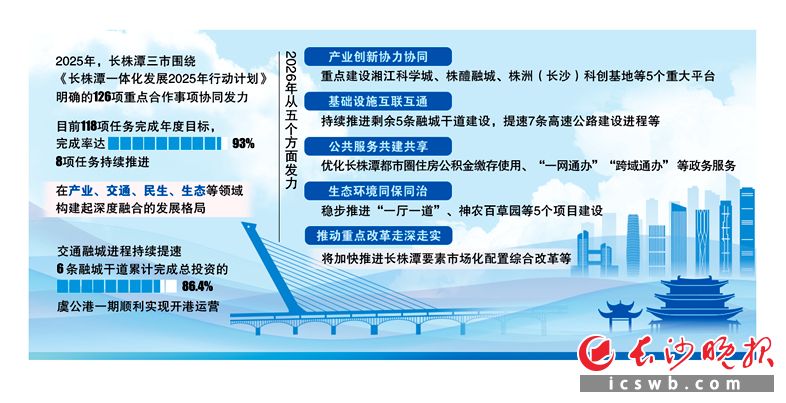
Core Viewpoint - The Longzhutan integrated development initiative is making significant progress, with a focus on collaboration among the three cities of Changsha, Zhuzhou, and Xiangtan, aiming for a more interconnected and sustainable urban ecosystem by 2026 [2][3][4][5] Group 1: Key Cooperation Matters - In 2025, the three cities will focus on 126 key cooperation matters, with 118 tasks already meeting their annual goals, achieving a completion rate of 93% [2] - The transportation integration process is accelerating, with 6 urban integration roads having completed 86.4% of total investment, and the first phase of the Yugu Port successfully commencing operations [2] Group 2: Infrastructure Development - The three cities will work on 16 key infrastructure items to establish a multi-level comprehensive transportation network, focusing on rail transit and road networks [3] - Ongoing projects include the construction of 5 remaining urban integration roads, 7 expressways, and several rail projects, including the Changsha-Liuyang Express Line and the Changsha-Ganzhou High-speed Railway [3] Group 3: Public Services and Community Benefits - The initiative will focus on 18 key public service items to enhance the integration benefits for citizens, including extending quality education and healthcare resources from Changsha to surrounding areas [4] - Efforts will be made to optimize housing fund services and explore joint law enforcement in transportation and quality sectors to improve governance efficiency [4] Group 4: Environmental Protection - The three cities will implement 17 key environmental protection measures, emphasizing the joint management of ecological green spaces and strict adherence to planning and regulatory requirements [4] - Collaborative mechanisms for pollution control and ecological protection will be established to promote harmony between humans and nature [4] Group 5: Reform and Innovation - The initiative will advance 6 reform measures to stimulate internal development dynamics, including market-oriented reforms in resource allocation and cross-regional cooperation [5] - Notably, the collaboration between Xiangjiang New Area and surrounding regions is seen as an innovative practice to enhance the competitive capacity of the Longzhutan urban agglomeration [5]
“小非农”爆冷!11月就业人数意外下降,小微企业成“重灾区”
Jin Shi Shu Ju· 2025-12-03 13:31
Group 1 - The private sector in the U.S. unexpectedly lost 32,000 jobs in November, indicating a further slowdown in the labor market [1] - Small businesses were particularly hard hit, with companies having fewer than 50 employees losing 120,000 jobs, marking the largest decline since March 2023 [4] - In contrast, large companies (those with 50 or more employees) added 90,000 jobs, with the education and healthcare sectors leading the way with an increase of 33,000 jobs [4] Group 2 - Wage growth has slowed, with salaries for retained employees rising 4.4% year-over-year, down 0.1 percentage points from October [5] - The ADP report is significant as it is the last employment data available before the Federal Reserve's meeting on December 9-10, where there is a 90% chance of a 25 basis point rate cut [5] - Recent weeks have seen mixed opinions among Federal Reserve officials regarding the necessity of further rate cuts to prevent further deterioration in the labor market [5]