
电动汽车

Search documents
中国将为世界带来更大发展机遇
人民网-国际频道 原创稿· 2025-12-16 08:32
Group 1 - The core viewpoint of the news is that China's 15th Five-Year Plan emphasizes high-quality development, positioning China as a leader in high-tech development and application globally, which presents new cooperation opportunities for other countries, including developing nations like Pakistan [1][2] - The 15th Five-Year Plan suggests a significant shift towards improving development quality through technological advancement, moving from "Made in China" to "Intelligent Manufacturing in China," which will enhance the technological content of the manufacturing sector and supply chains [1][2] - The plan is expected to drive breakthroughs in key industries such as robotics and healthcare, with China's robotics technology already leading globally and being applied in various fields, indicating a transformative impact on the global economy and society [2][3] Group 2 - The health industry in China is projected to continue its growth and expand into overseas markets, addressing global public health challenges and improving health standards [2] - Chinese technological products, including electric vehicles, solar batteries, and aerospace satellites, are already making significant contributions to global markets, enhancing local industries and driving economic development in other countries [2][3] - The 15th Five-Year Plan is anticipated to create greater development opportunities for the world, with China's growth being a major driver of global development, emphasizing the importance of leveraging the benefits of China's development for future prospects [3]
理想汽车旗下公司重大调整:李想职务变更 注册资本骤减近九成
Feng Huang Wang· 2025-12-16 06:56
Core Viewpoint - Beijing Rockville Technology Co., Ltd. has undergone significant changes, including a major reduction in registered capital and a change in executive leadership [1] Company Changes - The founder, Li Xiang, has stepped down as the executive director and has been reappointed as a board member [1] - The company's registered capital has been drastically reduced from 1 billion RMB to 105 million RMB, representing a decrease of 89.5% [1] Company Background - Beijing Rockville Technology Co., Ltd. was established in December 2017 and is legally represented by Feng Weili [1] - The company's business scope includes technology development and services, enterprise management consulting, and operation of electric vehicle charging infrastructure [1] - The company is wholly owned by Leading Ideal HK Limited, a subsidiary of Li Auto [1]

泰国批准调整 EV3/EV3.5 政策,加强电动车产业管理
Shang Wu Bu Wang Zhan· 2025-12-16 06:09
三、加强政府补贴监管机制 政府将严格跟踪企业执行生产抵扣计划的情况,如未达成既定条件,将暂缓发放补贴,确保预算支出规 范审慎,降低财政风险。 四、允许政策阶段间生产衔接 据泰国头条新闻12月11日报道, 12月9日,泰国政府发布消息称,泰国内阁会议已批准国家电动汽车政 策委员会提出的电动车推广政策(EV3与EV3.5)调整方案。此次调整旨在提升政策执行灵活性,使其 更符合当前经济环境及国际市场竞争,同时防止国内电动车因产能扩张过快而出现供给过剩及价格战风 险,加快推动泰国迈向全球电动汽车生产基地目标。 调整要点主要包括以下五方面: 一、延长国产电动车上市与注册期限 EV3政策支持车型须在2025年12月31日前完成销售,并可延长至2026年1月31日前完成上牌登记;EV3.5 政策支持车型须在2027年12月31日前销售,并可延长至2028年1月31日前登记,以便企业灵活安排生产 与交付。 二、优化出口抵扣生产比例 为鼓励企业拓展海外市场,出口电动车产量可按实际数量的1.5倍计入国内生产抵扣量,且允许将出口 履约期限顺延至次年6月30日,有助于稳定企业生产计划。 获得EV3政策支持的企业可在符合条件的情况下延 ...
践行新发展理念 中国经济行稳致远|全面绿色转型提速 铺就高质量发展底色
Yang Shi Xin Wen Ke Hu Duan· 2025-12-16 05:09
央视新闻客户端消息(新闻联播):绿色发展是中国式现代化的鲜明底色。习近平总书记指出,越是发展 任务重,越要重视生态环境保护,推动经济社会发展全面绿色转型。2025年是绿水青山就是金山银山理念提出 20周年,也是"双碳"目标提出5周年。一年来,逐"绿"前行的中国,绿色低碳转型步伐稳健、成效显著,为高质 量发展注入源源不断的动能。 今天的中国,绿色是最动人的亮色。 0:00 / 6:28 东海之滨,百米超长风电叶片集体从福州港驶往欧洲。今年前10个月,我国风电机组累计出口已过百亿, 同比增长44.9%。 万里长江,绿色船舶呈现快速增长态势。截至今年9月,长江干线建成投运新能源船舶156艘,同比增长翻 番。在全球的绿色船舶订单中,近七成来自中国。 2025年,绿色的生活蔚然成风。中国建成了全球最大的电动汽车充电网络,每5辆车就有2个充电桩。27个 省份出台了碳普惠相关政策,涵盖节约用电、旧物回收等绿色生活场景。 2025年,绿色的方案惠及全球。今年是《巴黎协定》达成十周年,如今的中国,积极引领全球气候治理、 分享绿色发展成果,与43个发展中国家签署55份气候变化南南合作谅解备忘录,实施了300多期能力建设项目。 " ...
一夜暴增1680亿!马斯克身家冲到6770亿美金,钱的新形态出现了?
Sou Hu Cai Jing· 2025-12-16 03:44
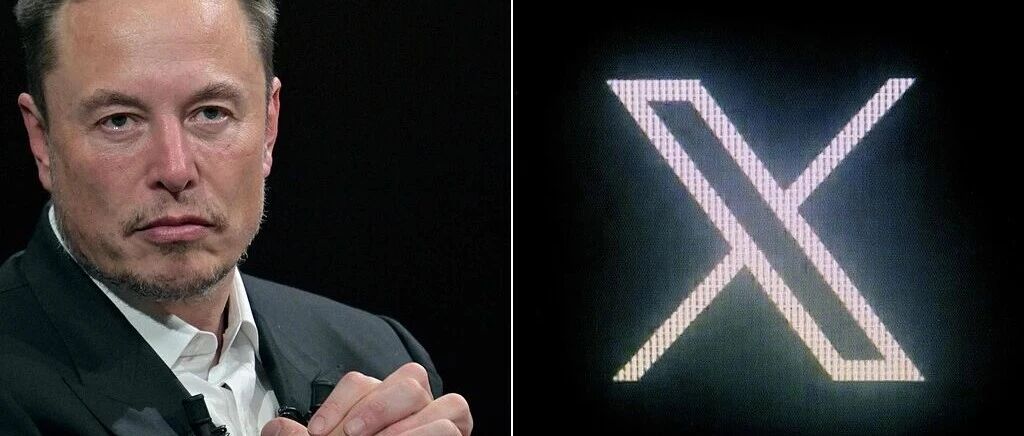
Group 1 - The core point of the article highlights that Elon Musk's net worth has reached $677 billion, with a significant increase of $168 billion occurring in a short period, primarily driven by the doubling of SpaceX's valuation to $800 billion [1][3][4] - This situation challenges traditional wealth accumulation models, suggesting that future top wealth may not solely rely on stock market value but also on controlling advanced entities with "infrastructure" attributes that define the future [1] - Musk's ventures, from electric vehicles to Starlink networks and Mars colonization, create a closed-loop "future ecosystem," with capital markets pricing the ultimate potential of this ecosystem [1] Group 2 - The increase of $168 billion in Musk's wealth is comparable to the total market value of a large multinational company [4] - SpaceX's valuation has reached $800 billion, achieving a remarkable doubling in a short timeframe [3] - Musk's current net worth of $677 billion solidifies his position as the world's richest person [3]

大摩闭门会:邢自强、Laura Wang:2025终盘宏观策略谈 _AI纪要
2025-12-16 03:26
大摩闭门会:邢自强、Laura Wang:2025 终盘宏观策略谈 20251215 摘要 中国 2026 年名义 GDP 增长预期约为 4%,低于市场一致预期,财政政 策预计一季度和上半年将侧重基建投资,货币政策降息降准空间有限, 倾向于结构性工具。 房地产市场方面,按揭利率补贴政策预计在 2026 年二季度推出,若范 围广、力度大且持续时间长,有望稳定市场预期,大城市按揭利率或接 近租金回报率。 消费领域,延续国补以旧换新计划,并可能推出服务业消费补贴,预计 在 2026 年下半年出台,旨在应对消费者不愿加杠杆问题,并防范骗补 行为。 中国在新兴前沿赛道如电池、电动汽车、机器人、光伏等领域具有先发 优势,理工科毕业生占比高,研发投入增加,确保关键赛道领先地位, 出口份额有望提升至 16%-17%。 美国内需改善及库存周期见底对东亚经济体包括中国产生积极影响,科 技板块短期受益于美国 AI 资本开支,长期来看,美国非科技出口也将带 来正面外部效应。 中国需继续推进向消费转型,加强社会保障福利,特别是农民工社保补 贴,以增强消费能力,纠偏重生产轻消费、重供给轻福利的问题,实现 更均衡的发展目标。 预计 202 ...
韦德布什分析师:特斯拉市值明年底或冲3万亿美元
Jin Rong Jie· 2025-12-16 03:01
艾夫斯表示,随着自动驾驶和机器人业务逐步迈向商业化,特斯拉正在进入一个关键发展期。他预计, 到2026年,特斯拉的市值将达到2万亿美元,比目前的水平高出约33%,而乐观情境下,其市值甚至可 能在2026年底达到3万亿美元。 本文源自:格隆汇 12月16日,美国知名投行韦德布什的董事总经理、知名科技分析师丹·艾夫斯坚定看好特斯拉的长期上 涨前景。该分析师周一在X上发文称,由于特斯拉努力开发和推动其人工智能(AI)项目,在乐观情境 下,市值有望在2026年底冲上3万亿美元。 ...

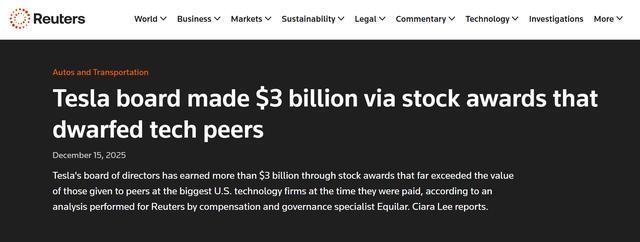
特斯拉董事股票奖励收益超30亿美元,远超同行科技巨头
Huan Qiu Wang Zi Xun· 2025-12-16 02:48
Core Insights - Tesla board members have earned over $3 billion through stock awards, significantly surpassing the total stock awards granted to board members of other major U.S. tech companies during the same period [1][3]. Group 1: Board Member Earnings - The earnings of Tesla's board primarily stem from realized or appreciated stock options, with Kimbal Musk, the CEO's brother, earning nearly $1 billion since 2004, and board member Ira Ehrenpreis earning $869 million since 2007 [3]. - Despite not receiving new stock awards since 2020 and a suspension of board compensation since 2021 due to shareholder lawsuits, the accumulated stock assets continue to yield substantial returns for board members [3]. Group 2: Historical Compensation Levels - From 2018 to 2020, the average cash and stock compensation for Tesla's board was approximately $12 million, which is eight times higher than Alphabet's average for the same period [3]. - Even accounting for the four-year suspension of compensation from 2021 to 2024, Tesla's board average compensation remains 2.5 times higher than that of Meta's board during the same timeframe [3]. Group 3: Stock Options vs. Direct Stock - One key reason for the substantial earnings of Tesla's board is the significant appreciation of the stock received initially, which has outperformed similar awards from other tech giants [4]. - Tesla's choice to compensate board members with stock options rather than direct stock has drawn criticism from corporate governance experts, as stock options allow holders to avoid risks associated with stock price declines while amplifying potential gains [4]. Group 4: Company Response - In response to the controversy, Tesla stated that board compensation is not excessive but directly linked to stock performance and value creation for shareholders, highlighting the board's commitment and high meeting attendance [4].
史上首位,身家超6000亿美元
财联社· 2025-12-16 00:55
Core Viewpoint - Elon Musk is on the verge of becoming the world's first trillionaire, with a net worth reaching $677 billion, primarily due to the soaring valuation of SpaceX, which has doubled to $800 billion from $400 billion in August [4][5]. Group 1: Musk's Wealth and SpaceX Valuation - Musk's wealth increased by $168 billion due to his 42% stake in SpaceX, which is now valued at $800 billion [5]. - The significant difference in wealth estimates between Forbes ($677 billion) and Bloomberg ($470 billion) is attributed to differing valuations of SpaceX, with Bloomberg estimating it at $350 billion [5]. - SpaceX plans to go public in 2026, with a potential valuation of $1.5 trillion, which could elevate Musk's net worth to over $1 trillion [5]. Group 2: Musk's Business Ventures - Musk's portfolio includes several high-profile companies: SpaceX, Tesla, xAI, Neuralink, and The Boring Company [6]. - SpaceX is Musk's most valuable asset, with an estimated value of $336 billion, while his Tesla shares are valued at approximately $197 billion [7]. - xAI is reportedly negotiating a new funding round, with a potential valuation of $230 billion, and Musk holds about 53% of xAI, valued at around $60 billion [8]. Group 3: Historical Wealth Milestones - Musk's wealth has seen significant growth over the past five years, starting from $24.6 billion in March 2020 to crossing the $1 trillion mark potentially in the near future [8]. - He became the first person to surpass $1,000 billion in wealth in August 2020 and has since achieved several milestones, including crossing $2,000 billion in September 2021 and $3,000 billion in November 2021 [9][10].
今日国际国内财经新闻精华摘要|2025年12月16日
Xin Lang Cai Jing· 2025-12-16 00:07
一、国际新闻 隔夜国际金融市场呈现多空交织态势,美股三大指数集体收跌,道指跌0.09%,纳指跌0.59%,标普500 指数跌0.16%,其中特斯拉股价逆势上涨3.5%,推动马斯克身价首次达到6000亿美元,成为有史以来首 位突破该关口的富豪。 大宗商品方面,贵金属延续涨势,现货黄金突破4310美元/盎司,纽约期金突破4340美元/盎司,日内分 别上涨0.10%和0.09%;原油价格则承压下跌,WTI原油期货收跌1.08%报56.82美元/桶,布伦特原油期 货收跌0.92%报60.56美元/桶,盘中WTI原油曾短暂突破57美元/桶。 此外,高盛上调2026年铜价预测至11,400美元/吨,美国银行预计明年铝价将突破3000美元/吨,因供应 短缺预期升温。 二、国内新闻 国际市场中国概念股表现疲软,纳斯达克中国金龙指数收跌2.17%,多只个股跌幅显著:复朗集团跌 9.57%,能链智电跌9.52%,小牛电动跌6.92%,嘉楠科技跌6.15%,趣店跌6.25%;盘中指数一度跌超 2%,反映市场对中概股短期情绪谨慎。 声明:市场有风险,投资需谨慎。本文为AI大模型基于第三方数据库自动发布,任何在本文出现的信 息(包括但 ...