天然气

Search documents
美委冲突升级,对天然气市场有何影响?
Sou Hu Cai Jing· 2026-01-05 10:59
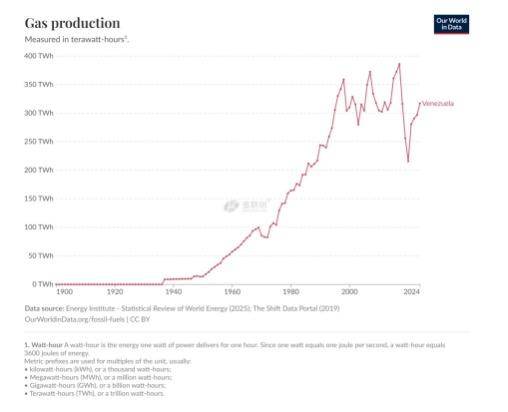
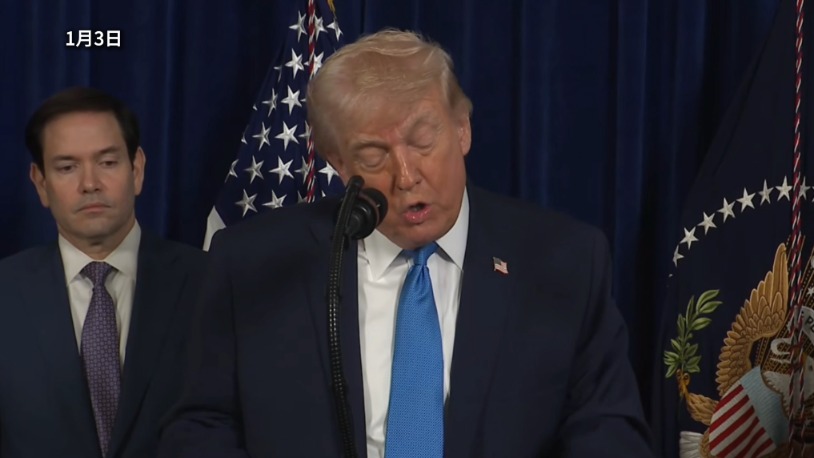
来源:中国能源网 北京时间2026年1月3日晚,美国总统特朗普称抓获委内瑞拉总统马杜罗及其夫人并带离委内瑞拉。稍后 新闻发布会上,特朗普表示,美国将控制委内瑞拉庞大的石油储备,并招募美国公司投资数十亿美元, 以重振该国衰败的石油工业。金联创分析认为,美委冲突升级可能对石油市场带来深刻影响,不过对天 然气市场的直接影响预计有限,多数还是影响到与石油价格挂钩的长协资源上。 委内瑞拉能源背景 因此,美委冲突升级短期来看,供应下滑叠加市场恐慌心态增加,价格有上行风险。但长期来看,可能 会下行。 对我国天然气市场的影响 金联创认为,美委地缘政治冲突升级对我国进口LNG影响相对较小。首先委内瑞拉不出口LNG,其次 委内瑞拉的地理位置也不影响航运。从体量和船运来看,冲突事件对我国LNG进口几乎没有影响。其 次,与委内瑞拉相邻的特立尼达和多巴哥,我国虽然自其进口LNG,但占比也比较小,2025年1-11月, 占比仅有0.4%。 金联创通过公开资料整理,委内瑞拉拥有世界上最大的约3000多亿桶的已探明石油储量。但美国多年来 的制裁导致委内瑞拉石油产量大幅下降,目前委内瑞拉每天仅生产约100万桶石油,约占全球原油产量 的0.8% ...

长庆气田连续四年产气突破500亿立方米
Zhong Guo Xin Wen Wang· 2026-01-05 09:00
Core Viewpoint - China National Petroleum Corporation (CNPC) announced that the Changqing Oilfield, the largest oil and gas field in China, is expected to produce over 51 billion cubic meters of natural gas by 2025, maintaining a production level above 50 billion cubic meters for four consecutive years, contributing significantly to national energy security [1][3]. Group 1: Production Capacity and Achievements - The Changqing Oilfield has developed 15 gas fields, including Jingbian, Yulin, and Sulige, and has produced over 700 billion cubic meters of natural gas since it began supplying gas to Beijing in 1997, equivalent to replacing over 90 million tons of standard coal and reducing carbon dioxide emissions by over 1 billion tons [3]. - The oilfield's development is a representation of China's efforts in unconventional natural gas production, with over 85% of its current gas production coming from challenging "low permeability, low pressure, and low abundance" tight gas [3][6]. - In 2022, the Changqing Oilfield established China's first strategic gas production area with an annual output of 500 billion cubic meters, with energy output equivalent to a large oil field producing 40 million tons annually [3][6]. Group 2: Technological Innovations and Strategies - To address challenges such as declining production from old wells and decreasing formation pressure, the Changqing Oilfield has implemented three key technologies: "expanded plunger, compressed bubble drainage, and optimized speed column," resulting in an increase of 2.6 billion cubic meters of gas from 14,000 well interventions [6]. - The oilfield has also focused on new well capacity construction, adopting an integrated geological engineering and "factory-style" operation model, with over 1,900 new wells put into production, contributing to a cumulative gas output of over 2.8 billion cubic meters [6]. - The Changqing Oilfield currently supplies over 160 million cubic meters of gas daily, ensuring stable supply for residential heating and supporting the country's green and low-carbon development [9].

数据赋能能源脉:李红梅与丰聚能源的数字化革新
Zhong Guo Neng Yuan Wang· 2026-01-05 07:55
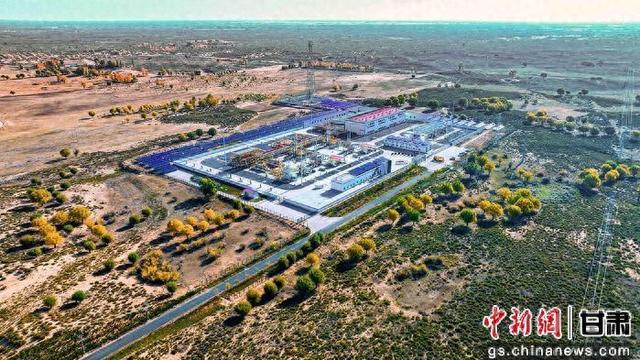
Core Insights - The article emphasizes the importance of natural gas as a clean and efficient energy source in China's energy system, driven by the dual goals of carbon neutrality and energy structure transformation [1] - The company Gansu Fengju Energy Technology Development Co., Ltd. is leading the development of a distributed energy management platform based on IoT technology to address challenges in the distributed natural gas management sector [1][2] Group 1: Industry Challenges - The distributed natural gas management sector faces significant challenges, including delayed data collection, disconnected equipment monitoring, and insufficient energy consumption optimization [1] - Traditional management methods relying on manual inspections and experience are inadequate for ensuring supply stability and improving energy utilization efficiency [1][2] Group 2: Development of the Management Platform - The company conducted a comprehensive survey of 32 industrial parks and 156 distributed gas enterprises in Gansu Province, identifying four core pain points: low data collection efficiency, difficult equipment monitoring, lack of energy consumption analysis, and untimely emergency response [2] - The company aims to create a data-centric platform that enables real-time perception, intelligent analysis, and precise control of distributed energy management [2][3] Group 3: Technological Innovations - The platform's development focuses on solving three key issues: data sourcing, stable transmission, and effective utilization [3] - Customized terminal devices were developed to adapt to various scenarios, ensuring accurate data collection with a target accuracy rate of over 99% [3][4] Group 4: Platform Implementation and Impact - The platform's implementation has significantly transformed operational efficiency, reducing the workforce required for meter reading and inspection from 20 to just 3, resulting in an 85% reduction in labor costs [4] - The average response time for equipment failures has decreased from 3 hours to under 15 minutes, marking a substantial improvement in operational efficiency [4] - The platform has also enhanced gas utilization rates by an average of 12% among partner industrial enterprises, leading to a reduction of over 8,000 tons of carbon emissions annually [4] Group 5: Future Developments - The company is planning to develop a version 2.0 of the platform, which will incorporate AI predictive models for more accurate forecasting of gas demand [5] - The ongoing efforts reflect the company's commitment to leveraging data as a core element in the digital transformation of the energy sector [5]
申万公用环保周报:2026年度长协电价承压,11月天然气消费同比高增-20260105
Shenwan Hongyuan Securities· 2026-01-05 07:24
Investment Rating - The report maintains a positive outlook on the power and gas sectors, indicating potential investment opportunities in these areas [1]. Core Insights - The 2026 long-term electricity prices are under pressure, with significant declines observed in transaction prices across various provinces, reflecting a shift in the power generation model from reliance on thermal power to a more diversified income structure [6][7]. - Natural gas consumption saw a year-on-year increase of 5.1% in November 2025, indicating a recovery in demand, particularly due to heating needs during the winter season [34]. - The report highlights the importance of optimizing the electricity market mechanism and restructuring the power generation mix as key future trends [7]. Summary by Sections 1. Electricity: 2026 Long-term Electricity Prices - The annual transaction results for 2026 show a total transaction volume of 2,724.81 billion kWh in Jiangsu, with a weighted average price of 344.19 yuan/MWh, down 16.55% from the previous year [6][8]. - Similar trends are observed in Guangdong and Anhui, with prices decreasing by 5.03% and 10.09% respectively [6][8]. - The report suggests that coastal provinces will face significant pricing pressure in 2026, as the role of thermal power shifts from being the main energy source to a regulatory support role [7]. 2. Gas: November Natural Gas Consumption - In November 2025, the apparent consumption of natural gas reached 362.8 billion m³, marking a 5.1% increase year-on-year, while the total consumption from January to November was 3,880 billion m³, a slight decline of 0.1% [34]. - The report notes that the increase in consumption is attributed to a low base from the previous year and a recovery in industrial gas demand [34]. - The report also highlights a favorable trend in natural gas pricing, with a decrease in costs due to lower international oil prices and improved supply conditions [36]. 3. Investment Analysis Recommendations - For thermal power, the report recommends companies with integrated coal and power operations, such as Guodian Power and Inner Mongolia Huadian, as well as those with significant large unit ratios like Datang Power and Huaneng International [10]. - In the hydropower sector, companies like Yangtze Power and Guotou Power are recommended due to their sufficient capacity and expected improvements in profit margins [10]. - The report suggests focusing on nuclear power companies like China Nuclear Power and China General Nuclear Power, which have stable cost structures and high utilization hours [10]. - For green energy, companies such as Xintian Green Energy and Longyuan Power are highlighted for their stable returns and increasing operational benefits from environmental value releases [10].



首华燃气股价涨5.01%,永赢基金旗下1只基金重仓,持有10.67万股浮盈赚取7.58万元
Xin Lang Cai Jing· 2026-01-05 06:05
Group 1 - The core point of the news is that Shouhua Gas has seen a stock price increase of 5.01%, reaching 14.89 CNY per share, with a trading volume of 1.47 billion CNY and a market capitalization of 4.291 billion CNY [1] - Shouhua Gas Technology (Shanghai) Co., Ltd. was established on January 8, 2003, and listed on June 30, 2015. The company primarily engages in the research, production, and sales of gardening products, as well as natural gas exploration, development, production, and sales [1] - The company's main business revenue is entirely derived from natural gas operations, accounting for 100% of its revenue, with no contribution from other sources [1] Group 2 - From the perspective of fund holdings, Yongying Fund has one fund heavily invested in Shouhua Gas. The Yongying Hejia One-Year Holding Mixed A Fund (017220) held 106,700 shares, representing 0.3% of the fund's net value, making it the third-largest holding [2] - The Yongying Hejia One-Year Holding Mixed A Fund was established on December 29, 2022, with a current scale of 258 million CNY. The fund has achieved a year-to-date return of 3.56%, ranking 7178 out of 8155 in its category [2] - The fund manager of Yongying Hejia One-Year Holding Mixed A is Yuan Xu, who has been in the position for 1 year and 251 days, managing a total asset size of 5.266 billion CNY, with the best fund return during his tenure being 8.34% [3]

俄气运力危机暗涌 沪金震荡待变
Jin Tou Wang· 2026-01-05 06:05
持续的出口活动为俄罗斯天然气销售带来一定支撑。在失去欧洲这一最大买家、且西方限制不断升级的 困境下,该国正艰难开拓替代市场。去年冬季,由于运力短缺和储气设施接近饱和,北极LNG 2项目曾 被迫大幅减产。当前,这艘唯一的破冰船仅能支撑该项目维持约25%的产能运转,凸显出俄罗斯对更多 能够在冰冻水域航行的运输船只的迫切需求。 【最新黄金期货行情解析】 从1小时图结构来看,沪金价格在前期急跌后已完成快速修复,目前运行于984—988区间,短线进入震 荡整理阶段。布林带整体仍呈收敛态势,沪金价格贴近中轨运行,显示多空分歧加大;MACD红柱缩 短,动能减弱,表明当前更多属于反弹后的修复过程,而非趋势反转。 今日周一(1月5日)亚盘时段,黄金期货目前交投于997.10附近,截至发稿,黄金期货暂992.54元/克, 涨幅1.15%,最高触及992.54元/克,最低下探988.52元/克。目前来看,黄金期货短线偏向震荡走势。 打开APP,查看更多高清行情>> 【要闻速递】 在西方制裁持续收紧的背景下,俄罗斯北极液化天然气(LNG)出口正面临严峻的运力挑战。船舶追 踪数据显示,目前俄罗斯仅依赖一艘名为"克里斯托弗·德·马尔热里 ...
E-Gas系统:2025年12月29日-2026年1月4日当周中国LNG进口量约98万吨
Xin Hua Cai Jing· 2026-01-05 05:21
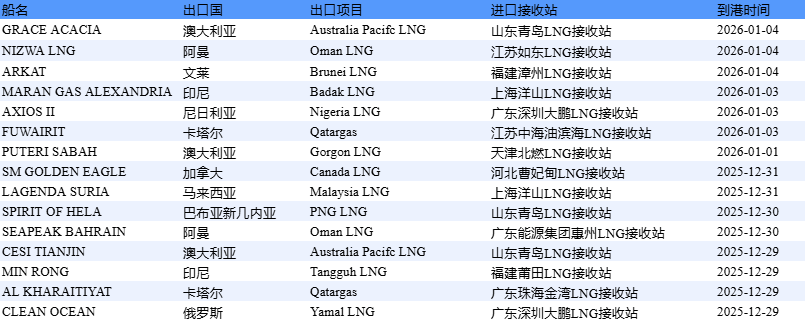
Core Insights - The article reports that China imported a total of approximately 98,000 tons of LNG through coastal receiving stations during the week of December 29, 2025, to January 4, 2026, a significant decrease from the previous week's import of 175,000 tons [1][4]. LNG Import Analysis - During the specified week, China received LNG from 10 different countries, with Australia contributing 3 ships and approximately 18,000 tons, accounting for about 18% of the total imports [4]. - The distribution of LNG imports by region shows that South China received 6 ships, the Yangtze River Delta received 4 ships, and the Bohai Rim received 5 ships. The Qingdao LNG receiving station in Shandong had the highest volume, with 3 ships totaling around 22,000 tons [4]. Future Projections - According to E-Gas system forecasts, China is expected to import 23 ships of LNG, amounting to approximately 158,000 tons, during the week of January 5 to January 11, 2026 [4][5]. E-Gas System Overview - The E-Gas system, developed by the China Economic Information Service in collaboration with the Shanghai Petroleum and Natural Gas Exchange Center, focuses on providing comprehensive information services for the energy sector, including real-time statistics on LNG international trade and an energy industry database [7].
俄“天然气工业”公司获得建设“西伯利亚力量”天然气管线支线许可
Shang Wu Bu Wang Zhan· 2026-01-04 15:58
(原标题:俄"天然气工业"公司获得建设"西伯利亚力量"天然气管线支线许可) 俄罗斯国际文传电讯社网站1月1日报道,俄"天然气工业"公司获得向贝阿 铁路线中心城市阿穆尔州腾达市建设"西伯利亚力量"天然气管线支线和天然气 分送站的许可,俄建设部表示,2025年12月2日做出该决定。 "西伯利亚力量"天然气管线经过腾达地区,支线项目包括6公里直径为200 毫米的管线以及设计能力为50000立方米/小时的天然气分送站,自分送站天然 气借助村镇间管线输送至用户。 ...
记者观察丨美国为何试图推翻马杜罗政府
Xin Hua She· 2026-01-04 08:31
Core Viewpoint - The article discusses the strategic importance of Venezuela in the context of U.S. national security under President Trump's administration, emphasizing the potential for military and resource control in the region. Group 1: Military Strategy - Venezuela's geographical position near the Caribbean and South America makes it a critical area for U.S. military operations, allowing for rapid air and naval support from bases in Puerto Rico [3] - The U.S. possesses strong reconnaissance and long-range strike capabilities in the waters surrounding Venezuela, which could facilitate maritime strikes and special operations [3] - A regime change in Venezuela could establish it as a "military influence point" for the U.S., enabling operations in the Caribbean and South America [3] Group 2: Natural Resources - Venezuela is rich in oil, natural gas, and mineral resources, making it a significant target for U.S. interests [5] - Trump's previous attempts to overthrow the Maduro government indicate a continued interest in reshaping Venezuela's energy and mineral resource landscape [5] Group 3: Political Dynamics - Venezuela has faced long-term isolation and sanctions from the U.S., leading to economic crises and social challenges, which could be exploited by the U.S. to facilitate regime change [7] - The U.S. may leverage internal military factions and opposition groups in Venezuela to achieve political objectives with minimal costs [7] - The Trump administration views controlling Venezuela as essential for countering potential anti-American forces in Latin America, aiming to create a ripple effect that enhances U.S. influence in the region [7]
这才是铁哥们!还清中国81亿欠债,赠百亿大礼,西方各国都眼红
Sou Hu Cai Jing· 2026-01-04 07:43
世界上最难的事情之一,就是借了钱后还能按时还清,更别提数额高达81亿美元了。然而,土库曼斯坦不仅成功完成了这项艰巨任务,还回赠给中国一个价 值上百亿的超级大礼包。或许不少人对土库曼斯坦的了解仍停留在它是中亚五国中最神秘、最低调的国家。 西方媒体曾质疑中亚国家是否会赖账,但土库曼斯坦用实际行动打破了这些怀疑。2025年,土库曼斯坦的天然气年产量突破860亿立方米,出口量稳居全球 第一,顺利成为中国最大的海外能源供应国。对于中国而言,这为西气东输管道提供了稳定的气源,也确保了广东、上海等地的冬季供气不再担心限流。这 才是真正的铁哥们情谊。 那么,土库曼斯坦是如何成为中国能源铁哥们的呢?两国的合作究竟有多深厚?中国借给土库曼斯坦的81亿美元真的一分不少地收回了吗?而那个百亿大礼 又是什么?让我们从土库曼斯坦的资源金饭碗说起。二十年前,土库曼斯坦的天然气储量惊人,达到19.5万亿立方米,但当时它的日子却过得异常艰难。很 多老百姓幽默地说,家里煤气灶烧的不是天然气,而是心酸。 为什么会这样呢?原因很简单,虽然土库曼斯坦拥有丰富的资源,但开采和运输的技术完全依赖于外部,尤其是俄罗斯。每年出口天然气都需要看俄罗斯的 脸色, ...