
存储芯片

Search documents
A股晚间热点 | 茅台再度出手!拟最高30亿元回购股份
智通财经网· 2025-11-28 15:27
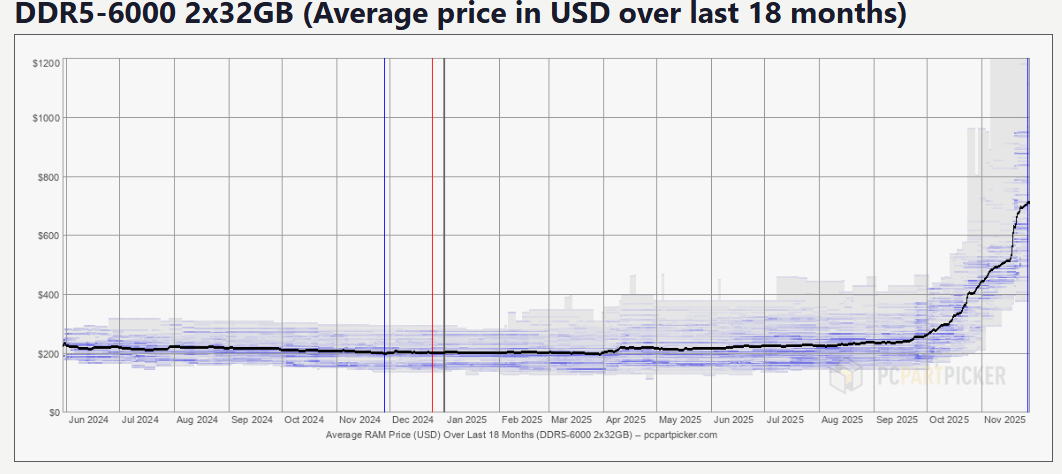
Group 1: Guizhou Moutai Share Buyback - Guizhou Moutai plans to repurchase shares with an amount between RMB 1.5 billion and RMB 3 billion, using its own funds through centralized bidding [1] - The maximum repurchase price is set at RMB 1,887.63 per share, with an estimated repurchase quantity of approximately 794,647 to 1,589,294 shares, representing about 0.0635% to 0.1269% of the total issued share capital [1] Group 2: Battery Industry Regulation - The Ministry of Industry and Information Technology (MIIT) is accelerating the regulation of the power and energy storage battery industry to improve competition order and promote high-quality development [2] - The MIIT emphasizes the need for effective monitoring and regulation of production capacity to prevent irrational competition in the battery sector [2] - Analysts are optimistic about the future demand for batteries, driven by increased electrification and higher battery capacity per vehicle [2] Group 3: Tianfeng Securities Investigation - Tianfeng Securities is under investigation by the China Securities Regulatory Commission (CSRC) for information disclosure violations related to the previous major shareholder's fund occupation [3] - The occupied funds and interest were fully repaid by the end of 2022, which may mitigate long-term uncertainties for the company [3] Group 4: Commercial Real Estate Investment Trusts - The CSRC is drafting a proposal for a pilot program for commercial real estate investment trusts (REITs) to enhance the quality of the REITs market and support new real estate development models [4] Group 5: State-Owned Enterprises Profit Decline - From January to October, the total profit of state-owned enterprises reached RMB 34,214.4 million, reflecting a year-on-year decline of 3% [5] Group 6: Lifan Technology Penalties - The CSRC has imposed penalties on Lifan Technology for falsely reporting financial data, resulting in a cumulative inflation of revenue by RMB 638 million and costs by RMB 628 million from 2021 to 2023 [6] - The company is facing a potential delisting process due to serious violations of securities laws [6] Group 7: Global Memory Chip Shortage - A global shortage of memory chips is intensifying, with predictions of a 50% price increase by the second quarter of 2026 due to rising demand from AI infrastructure [7] - Major consumer electronics companies are warning of potential price hikes for their products due to chip shortages [7] Group 8: Positive and Negative Announcements - Positive announcements include China Jushi's shareholder plan to increase holdings between RMB 550 million and RMB 1.1 billion [9] - Negative announcements involve investigations into Yongtai Energy and other companies facing regulatory scrutiny [10]



美股科技股普涨,存储芯片板块领涨
Di Yi Cai Jing Zi Xun· 2025-11-28 14:52
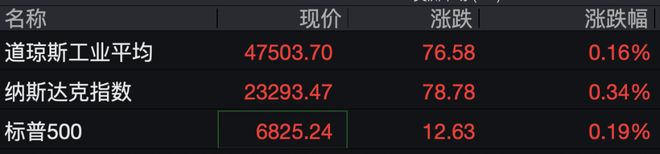
Market Performance - On November 28, US stock indices opened higher, with the Dow Jones up 0.16%, Nasdaq up 0.34%, and S&P 500 up 0.19% [1] - The current price of the Dow Jones Industrial Average is 47,503.70, with an increase of 76.58 points [2] - The Nasdaq index stands at 23,293.47, rising by 78.78 points [2] - The S&P 500 index is at 6,825.24, gaining 12.63 points [2] Sector Performance - Technology stocks mostly rose, with Google and Amazon both increasing by approximately 1% [2] - The storage chip sector led the gains, with SanDisk rising over 4%, Micron Technology up 2.8%, and Western Digital up 2% [2] Chinese Stocks - Chinese concept stocks generally performed well, with BaWang Tea up over 4% and Pony.ai up more than 3% [2] - Canadian Solar saw a decline of nearly 2% [2]



美股异动 存储概念股盘前集体上涨 SanDisk(SNDK.US)涨超3%
Jin Rong Jie· 2025-11-28 14:48
Core Viewpoint - The storage sector is experiencing a collective rise in stock prices due to increasing demand for storage chips driven by artificial intelligence infrastructure development, leading to a worsening global chip shortage [1] Group 1: Stock Performance - Storage concept stocks saw a pre-market collective increase, with SanDisk (SNDK.US) rising over 3%, Micron Technology (MU.US) over 2%, and Western Digital (WDC.US) and Seagate Technology (STX.US) both rising over 1% [1] Group 2: Industry Challenges - Several U.S. consumer electronics manufacturers have warned of potential price increases for certain products due to the rapid rise in costs and chip shortages [1] - Dell's COO stated that the company has never seen costs rise so quickly, indicating a shortage of certain storage chips and the possibility of raising equipment prices [1] - HP's CEO mentioned that due to potential depletion of chip inventory, profit margins may be pressured by the second half of 2026, with price increases being considered if necessary [1] Group 3: Price Forecast - Research institutions predict that storage chip prices are expected to rise by approximately 50% from current levels before the second quarter of 2026 due to the ongoing chip shortage [1]

美股科技股普涨,存储芯片板块领涨
第一财经· 2025-11-28 14:47
中概股普遍走高,霸王茶姬涨超4%,小马智行涨逾3%,阿特斯太阳能跌近2%。 编辑 | 钉钉 科技股多数上涨,谷歌、亚马逊涨约1%;存储芯片板块领涨,SanDisk涨超4%,美光科技涨2.8%,西部数据涨2%。 11月28日,美股三大股指 开盘集体上涨,道指涨0.16%,纳指涨0.34%,标普500指数涨0.19%。 | 名称 | 现价 | 涨跌 | 涨跌幅 | | --- | --- | --- | --- | | 道琼斯工业平均 | 47503.70 | 76.58 | 0.16% | | 纳斯达克指数 | 23293.47 | 78.78 | 0.34% | | 标普500 | 6825.24 | 12.63 | 0.19% | ...

美股集体高开,谷歌链和存储芯片板块领涨
Feng Huang Wang Cai Jing· 2025-11-28 14:43
Group 1: Market Overview - On November 28, US stock indices opened higher, with the Dow Jones up 0.16%, Nasdaq up 0.33%, and S&P 500 up 0.17% [1] - Google shares rose nearly 1% as CEO Sundar Pichai expressed hopes to send TPU to space by 2027 [1] - Oracle shares fell over 3% as multiple banks are negotiating to provide $38 billion in loans to Oracle and data center builder VANTAGE [1][2] - Storage stocks collectively increased, with SanDisk up over 4%, Micron Technology up 2.8%, and Western Digital up 2%, driven by a worsening global shortage of storage chips, with prices expected to rise by 50% [1] Group 2: Company News - Oracle and Vantage are in talks for a $38 billion loan to expand data centers for OpenAI [2] - Apple notified the EU Commission that its advertising and mapping services meet the thresholds of the Digital Markets Act, which could lead to it being designated as a gatekeeper [3] - MAN Truck & Bus, a subsidiary of Volkswagen, announced plans to cut 2,300 jobs in Germany, representing about 20% of its workforce, due to high energy and labor costs and competition from Asian rivals [4] - S&P Global completed the acquisition of With Intelligence for a total of $1.8 billion, led by a consortium of major investors [5] - Global DRAM sales surged by 30% quarter-on-quarter in Q3, with SK Hynix maintaining its position as the top seller for three consecutive quarters [6]


纳指高开0.34%,存储概念股齐涨
Ge Long Hui· 2025-11-28 14:35
Group 1 - The probability of a 25 basis point rate cut by the Federal Reserve in December has risen to 86.9% [1] - Major U.S. stock indices opened higher, with the Nasdaq up 0.34%, S&P 500 up 0.19%, and Dow Jones up 0.17% [1] - Google shares increased by over 1%, with Morgan Stanley projecting that selling approximately 500,000 TPU units will boost earnings per share by about 3% by 2027 [1] Group 2 - Storage-related stocks saw significant gains, with SanDisk rising over 5% and Micron Technology increasing by over 2% [1] - Research institutions predict that storage chip prices are expected to rise by an additional 50% [1] Group 3 - Bawang Tea's shares rose by over 4.7%, reporting a global store count of 7,338 and a GMV of 7.93 billion yuan in Q3, with an adjusted net profit of 503 million yuan [1]
AI算力飙升引爆存储牛市,美银预测周期延续至2027上半年
智通财经网· 2025-11-28 10:26
Core Viewpoint - The report from Bank of America emphasizes a "super cycle" in the global storage market driven by unprecedented demand for AI infrastructure, particularly in high-performance storage solutions like HBM and enterprise SSDs, which are essential for AI applications and data centers [1][5][7]. Group 1: Market Dynamics - The global storage market is experiencing a significant surge, with major players like SK Hynix, Samsung, and Micron seeing stock price increases exceeding 100% this year, and companies like Seagate and Western Digital witnessing over 200% growth [1][2]. - The demand for high-performance storage products, particularly HBM and enterprise SSDs, is expected to continue growing, with Bank of America predicting that the current storage super cycle will last until at least early 2027 [5][10]. Group 2: Company Performance - SK Hynix is establishing a leading position in HBM4/4e and HBM3e, becoming the preferred supplier for major AI clients like NVIDIA and Google, with expectations of significant price increases for HBM products [2][8]. - Bank of America projects a potential stock price increase of 50% for SK Hynix and 40% for Samsung, based on their strong market positions and the ongoing demand for high-performance storage solutions [5][10][13]. Group 3: Future Outlook - The report indicates that the demand for DRAM and NAND products will continue to exceed supply, with expectations of further price increases in the coming months, particularly for DRAM contracts [2][14]. - The anticipated launch of new AI applications, such as Google's Gemini3, is expected to drive further demand for AI computing power and associated storage solutions, reinforcing the bullish outlook for storage companies [5][6][7].
存储芯片板块走高,雷科防务涨停
Mei Ri Jing Ji Xin Wen· 2025-11-28 02:35
Group 1 - The storage chip sector experienced a rise, with LeiKe Defense hitting the daily limit up, indicating strong market performance [1] - Other companies such as Jiangbo Long, Weidao Nano, Maiwei Co., and TuoJing Technology also saw increases in their stock prices, reflecting a positive trend in the industry [1]



存储芯片股拉升,江波龙、佰维存储涨超3%
Ge Long Hui· 2025-11-28 02:28
Core Viewpoint - The A-share market saw a significant rise in storage chip stocks on November 28, with multiple companies experiencing notable gains in their stock prices [1]. Group 1: Stock Performance - LeiKe Defense (雷科防务) reached a limit-up with a gain of 10.06%, bringing its total market value to 10.1 billion [2]. - HuiCheng Co., Ltd. (汇成股份) increased by 9.16%, with a total market capitalization of 13 billion [2]. - Jingyi Equipment (京仪装备) rose by 8.93%, achieving a market value of 16.1 billion [2]. - Shanghai Xinyang (上海新阳) saw a gain of 5.31%, with a market cap of 17.8 billion [2]. - Benhai Materials (本海道材) increased by 4.29%, with a total market value of 48 billion [2]. - JingSheng Co., Ltd. (晶升股份) rose by 4.21%, with a market capitalization of 4.893 billion [2]. - Aerospace Intelligent Equipment (航天智装) increased by 3.35%, with a market value of 18.4 billion [2]. - Kexiang Co., Ltd. (科翔股份) saw a gain of 3.26%, with a market cap of 6.963 billion [2]. - Zhenhua Wind Power (振华风光) increased by 3.28%, with a market value of 11.6 billion [2]. - Jiangbolong (江波龙) rose by 3.17%, achieving a market capitalization of 103.4 billion [2]. - Chengbang Co., Ltd. (诚邦股份) increased by 2.98%, with a market value of 4.014 billion [2]. - Baiwei Storage (佰维存储) rose by 3.05%, with a total market capitalization of 49.4 billion [2]. Group 2: Year-to-Date Performance - LeiKe Defense (雷科防务) has a year-to-date increase of 75.69% [2]. - HuiCheng Co., Ltd. (汇成股份) has risen by 70.56% year-to-date [2]. - Jingyi Equipment (京仪装备) has a year-to-date increase of 95.82% [2]. - Shanghai Xinyang (上海新阳) has risen by 53.52% year-to-date [2]. - Benhai Materials (本海道材) has a year-to-date increase of 24.27% [2]. - JingSheng Co., Ltd. (晶升股份) has risen by 26.44% year-to-date [2]. - Aerospace Intelligent Equipment (航天智装) has a year-to-date increase of 97.45% [2]. - Kexiang Co., Ltd. (科翔股份) has a year-to-date increase of 110.14% [2]. - Zhenhua Wind Power (振华风光) has risen by 13.42% year-to-date [2]. - Jiangbolong (江波龙) has a remarkable year-to-date increase of 186.81% [2]. - Chengbang Co., Ltd. (诚邦股份) has a year-to-date increase of 223.19% [2]. - Baiwei Storage (佰维存储) has risen by 70.91% year-to-date [2].


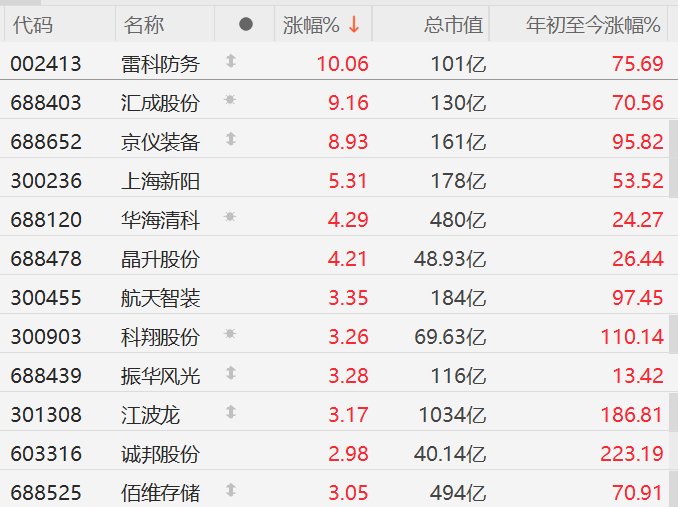
A股存储芯片股拉升,江波龙、佰维存储涨超3%
Ge Long Hui· 2025-11-28 02:23
Core Viewpoint - The A-share market has seen a significant rise in storage chip stocks, indicating positive market sentiment in this sector [1] Group 1: Stock Performance - LeiKe Defense has reached the daily limit increase [1] - HuiCheng Co. has risen over 9% [1] - JingYi Equipment has increased by more than 8% [1] - Shanghai XinYang has gained over 5% [1] - HuaHai QingKe and JingSheng Co. have both risen over 4% [1] - Aerospace Intelligence and KeXiang Co. have increased by over 3% [1] - ZhenHua Wind Power, JiangBoLong, ChengBang Co., and BaiWei Storage have also seen gains of over 3% [1]
