
信托

Search documents
四川信托股权变更获批 蜀道集团成为控股股东
Mei Ri Jing Ji Xin Wen· 2025-09-25 15:15
上月,蜀道集团党委副书记、副董事长、总经理张胜专题调研四川信托、天府证券改革发展情况。张胜 表示,两家公司要积极融入集团转型创新发展大局,增强整体实力,提升服务实体经济质效水平,着力 打造金融行业"天府系"金字招牌。 四川信托恢复展业提速 值得注意的是,四川信托新股东阵容还包括四川天府春晓企业管理有限公司(持股约15%)、成都交子 金融控股集团有限公司(持股约10%)、成都兴蜀青企业管理有限公司(持股约10%)等。 事实上,蜀道集团入主四川信托早有消息传出。 今年2月,蜀道集团董事长张正红率队调研宏信证券和四川信托改革发展工作时表示,要打造蜀道"天府 金融"品牌核心价值。随后,5月,宏信证券更名为"天府证券"。 近日,国家金融监督管理总局公布相关批复,同意四川信托有限公司(以下简称四川信托)变更 96.8020%股权,其中,实控人为四川省国资委的蜀道投资集团有限责任公司(以下简称蜀道集团)持 有58.6278%股权,成为四川信托控股股东。 据悉,蜀道集团于2021年5月揭牌成立,目前总资产超过1.5万亿元,为四川省属国有企业首家"世界500 强"并连续4年入围。 多名新股东"浮出水面" 近年来,蜀道集团的"天 ...
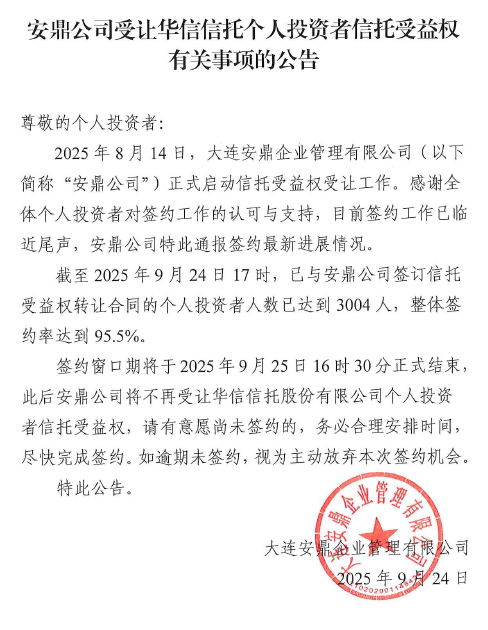
华信信托风险处置接近尾声,超95%比例投资者签约
2 1 Shi Ji Jing Ji Bao Dao· 2025-09-25 11:32
Core Viewpoint - The risk disposal process of Huaxin Trust is nearing completion after five years, with a high signing rate among investors for the trust beneficiary rights transfer contract [1][2]. Group 1: Signing Progress - As of September 24, 2025, 3,004 individual investors have signed the trust beneficiary rights transfer contract, achieving an overall signing rate of 95.5% [1]. - The signing window will officially close on September 25, 2025, at 16:30, after which any unregistered investors will forfeit their opportunity to sign [1][3]. - A small number of investors remain who have yet to sign the contract as of September 25, 2025 [1][3]. Group 2: Involvement of Local State Capital - On August 14, 2025, Huaxin Trust announced that Dalian Anding Enterprise Management Co., Ltd. would acquire the trust beneficiary rights of qualified individual investors by September 25, 2025 [2]. - Dalian Anding, established on July 31, 2025, has a registered capital of 10 billion yuan and is fully controlled by the Dalian Municipal Finance Bureau [2]. Group 3: Historical Context and Financial Impact - Huaxin Trust's risk disposal has been ongoing since April 2020, when its "fund pool" business was halted by regulators, leading to multiple product delays [5]. - Investors have received sporadic small percentage repayments, with the first transfer of trust beneficiary rights in June 2021 amounting to 5.2% of the principal [5]. - The total unpaid trust plan principal raised from social investors is approximately 7.08 billion yuan [6].

*ST惠程(002168) - 002168*ST惠程投资者关系管理信息20250925
2025-09-25 10:26
Financial Performance - The company repaid all acquisition loans to AVIC Trust amounting to 830 million yuan using self-owned and self-raised funds [1] - For the first half of 2025, the company achieved a total revenue of 179.79 million yuan [2] - The company aims to ensure the completion of its annual operational goals and mitigate delisting risks [3] Employee Information - As of December 31, 2024, the total number of employees is 383, excluding the subsidiary Ruien Pharmaceutical [2] Restructuring Plans - The company is currently in the pre-restructuring phase, with the Chongqing Fifth Intermediate People's Court completing the filing for pre-restructuring [3] - There is significant uncertainty regarding whether the company will formally enter the restructuring process [3] - The company signed restructuring investment agreements with strategic investors in September 2025, which may lead to changes in control [3][4] Debt and Compensation - The company is actively pursuing the collection of performance compensation from individuals, with a total of 135 million yuan already paid by Kou Han and 21.41 million yuan by Lin Jiaxi, leaving outstanding balances of 311.99 million yuan and 22.70 million yuan respectively [5][6] - The company is conducting a debt review as part of the pre-restructuring process, with specific figures to be disclosed in future announcements [5] Future Outlook - The company is focused on improving its core business operations and exploring partnerships to enhance market demand [8] - The introduction of strategic investors is expected to provide financial and operational support to improve the company's performance [9][10] - The company plans to implement a capital increase through the conversion of capital reserves, with a proposed ratio of 10 shares for every 4.8 shares issued [13][14]

华信信托个人投资者信托受益权受让:窗口期25日结束
Jing Ji Guan Cha Bao· 2025-09-25 06:55
Group 1 - The core announcement is regarding the transfer of trust beneficiary rights from Huaxin Trust to Anding Company, which officially commenced on August 14, 2025 [1] - As of September 24, 2025, a total of 3,004 individual investors have signed contracts for the transfer of trust beneficiary rights, resulting in an overall signing rate of 95.5% [2] - The signing window will close on September 25, 2025, at 16:30, after which Anding Company will no longer accept the transfer of trust beneficiary rights from individual investors [2] Group 2 - Anding Company was established on July 31, 2025, and is located in Dalian, Liaoning Province, primarily engaged in the financial industry with a registered capital of 1 million yuan [2] - The sole shareholder of Anding Company is Dalian State-owned Financial Capital Management and Operation Co., Ltd., which is fully owned by the Dalian Municipal Finance Bureau and has a registered capital of 10 billion yuan [2]
不动产信托登记迎来“天津样本” 首创“持有+购买”双模式
2 1 Shi Ji Jing Ji Bao Dao· 2025-09-25 05:31
Core Viewpoint - Tianjin has officially joined the pilot program for real estate trust property registration, becoming the fifth city in China to do so, following Beijing, Shanghai, Guangzhou, and Xiamen, with the aim of integrating financial innovation with real estate trust services to better serve the economy and meet public needs [1][2]. Summary by Sections Pilot Program Announcement - The pilot program for real estate trust property registration in Tianjin was announced by multiple local and national regulatory bodies, marking a significant step in financial innovation [1]. Objectives of the Pilot Program - The pilot program aims to achieve three core objectives: 1. Establish Tianjin as a demonstration benchmark for financial innovation and service industry openness [2]. 2. Encourage the trust industry to return to its core purpose of serving the real economy, focusing on areas such as elderly care, special needs, intergenerational wealth transfer, social welfare, asset revitalization, and risk management [3]. 3. Leverage the advantages of the Tianjin Free Trade Zone to enhance the real estate trust property registration system [3]. Innovations in the Registration System - The pilot program introduces three major innovations to optimize service experience and improve efficiency: 1. "Revitalizing existing assets" is defined as the core application scenario for real estate trusts, addressing issues like asset liquidity and high conversion costs [5]. 2. The program allows for both "holding and purchasing" real estate, providing flexibility in trust establishment and catering to various business needs [6][7]. 3. A "dual process" for asset transfer is established, enhancing transparency and efficiency in the registration process, with a focus on seamless transitions from establishment to exit [8]. Collaborative Mechanism - A collaborative mechanism involving six departments has been established to ensure smooth implementation of the pilot program, enhancing information sharing and coordination throughout the registration process [8].
如何做好消保工作 听他们说……
Jin Rong Shi Bao· 2025-09-25 03:13
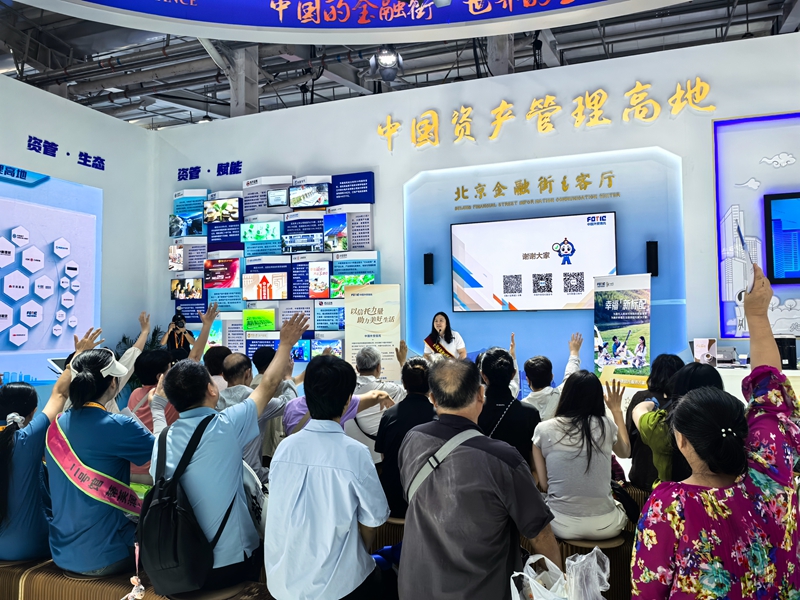
Core Viewpoint - Trust companies are enhancing consumer financial education and protection efforts, transitioning from periodic promotions to ongoing services, fostering consumer trust and understanding of trust products [1][5][15] Group 1: Consumer Expectations - Consumers expect sincerity, professionalism, and partnership from financial institutions, emphasizing the need for realistic and responsible product introductions [4][20] - Trust companies should actively engage in investor education and communication regarding macroeconomic trends and market dynamics [6][11] Group 2: Industry Initiatives - During the 2025 China International Service Trade Fair, China Foreign Trade Trust effectively engaged the audience through interactive activities to promote trust knowledge [3][9] - Trust companies are increasingly utilizing innovative methods, such as technology-driven educational tools, to enhance public understanding of trust services [9][14] Group 3: Consumer Insights - Long-term trust investors express a preference for stable, low-risk products, with a focus on wealth preservation and retirement planning [10][12][20] - Some consumers appreciate trust companies that prioritize education from a buyer's perspective, respecting their risk preferences while offering diverse product options [12][21] Group 4: Industry Responsibility - Trust companies must build public trust to ensure long-term development, recognizing that every interaction with consumers carries significant responsibility [15][18] - The industry faces the challenge of improving public understanding of trust mechanisms and their applications in wealth management and philanthropy [17][21]
以“信”守护消费者权益
Jin Rong Shi Bao· 2025-09-25 03:00
Group 1 - Financial consumers are crucial participants in the financial market and play a significant role in promoting high-quality financial development, emphasizing the importance of respecting, serving, and protecting consumers [1] - The financial consumer protection framework in China is rapidly evolving, with a focus on enhancing the protection of consumers' legal rights [1] - The trust industry is actively participating in the "big consumer protection" initiative by improving risk control and service mechanisms to safeguard consumers' financial interests [1] Group 2 - Financial education is fundamental for consumer protection, enhancing self-protection capabilities, and promoting healthy industry development [2] - Trust companies are adopting diverse communication methods, such as internet and video platforms, to raise awareness about illegal financial practices and expand the reach of financial education [2] - Initiatives like community financial service consultation stations and themed promotional activities aim to make financial knowledge more accessible and relatable to the public [2] Group 3 - Trust companies are focusing on integrating consumer rights protection with their operational management and business processes, actively listening to customer needs and resolving financial disputes [3] - Effective communication and dispute resolution mechanisms are being established, with companies like Xiamen International Trust recognized for their proactive approach in managing consumer complaints [4] - The emphasis is on prevention, mediation, and grassroots engagement to resolve conflicts promptly, supported by regulatory bodies and industry organizations [4] Group 4 - The China Trust Industry Association is enhancing consumer protection practices through improved mechanisms, increased public awareness, cultural development, and diversified dispute resolution [5] - The association's efforts aim to create a comprehensive consumer protection system that is efficient, considerate, and closely aligned with consumer needs [5]
守初心 强服务 筑防线
Jin Rong Shi Bao· 2025-09-25 02:49
Core Viewpoint - Trust companies are increasingly focusing on consumer rights protection through various educational activities and initiatives, recognizing it as a fundamental mission rather than an additional responsibility [1][2]. Group 1: Consumer Rights Protection Initiatives - Trust companies have been actively engaging in consumer rights protection activities, such as the "Financial Consumer Rights Protection Education Month" and "Financial Education Promotion Week" [1]. - The unique institutional advantages and service models of trust companies have positioned them as significant players in wealth management for residents [1]. - To maintain competitiveness, trust companies must integrate consumer rights protection throughout their business processes, transforming institutional advantages into effective services [1]. Group 2: Innovative Approaches to Consumer Education - There is a need to move beyond traditional methods and develop engaging consumer protection plans that resonate with the public [2]. - Utilizing platforms like video accounts and Douyin, trust companies can create relatable content, such as skits and animations, to address common consumer issues like false advertising [2]. - Establishing a standardized information disclosure system is essential, presenting key product information clearly to consumers [2]. Group 3: Complaint Handling and Risk Management - An efficient complaint handling and feedback mechanism is crucial for addressing consumer concerns and preventing potential risks [2]. - Trust companies should continuously improve their risk prevention and dispute resolution mechanisms, ensuring that consumer disputes are resolved quickly and effectively [2][3]. - Integrating consumer rights protection into every aspect of product design and risk management is vital for building trust and becoming a reliable "wealth guardian" for consumers [3].
朱勇:坚持长期主义穿越周期 实现信托业高质量发展
Zhong Guo Zheng Quan Bao· 2025-09-25 00:36
Core Viewpoint - The trust industry has experienced significant fluctuations over the past 23 years, characterized by three distinct development phases: exploration, rapid growth, and adjustment. The future outlook remains optimistic as the industry adapts to regulatory changes and seeks new growth avenues. Summary by Sections Development Phases - The trust industry can be divided into three phases: exploration (2002-2006), rapid growth (2007-2017), and adjustment (2018-present). The exploration phase laid the groundwork for future development, while the rapid growth phase saw trust assets increase from 4.8 trillion yuan to 26.25 trillion yuan, marking a significant transformation in the industry [2][3]. Asset Scale and Growth - By the end of 2007, trust assets reached 9.8 trillion yuan, doubling from the previous year. The industry experienced exponential growth, with annual increases exceeding 50% from 2007 to 2013. However, growth began to slow after 2013, with assets at 10.91 trillion yuan, indicating a shift in the growth trajectory [3][4]. Current Trends and Future Outlook - The trust asset scale declined to a low of 20.49 trillion yuan by the end of 2020 but has since shown signs of recovery, projected to reach 29.56 trillion yuan by the end of 2024. The industry is adapting to new regulations and focusing on service-oriented trusts, which are expected to drive future growth [4][10]. Profitability and Economic Contribution - Trust industry profits have closely followed asset growth, peaking at 82.4 billion yuan in 2017 before declining. The industry plays a vital role in the national economy, contributing significantly to tax revenues through asset management product VAT [4][5]. Key Industry Insights - The trust industry does not face systemic risks, with most companies having addressed issues related to non-standard funding pools. The industry has moved away from rigid repayment structures, allowing for healthier growth dynamics [6][7]. Regulatory Environment and Market Perception - The trust industry has been subject to strict regulation, distinguishing it from shadow banking. Recent regulatory frameworks have enhanced transparency and compliance, positioning the industry for sustainable growth [7][8]. Long-term Strategies - The future of the trust industry hinges on restructuring business models according to the three classifications of trust services: asset service trusts, asset management trusts, and charitable trusts. This reclassification is expected to alleviate competitive pressures and foster new growth opportunities [9][10]. Risk Management and Cultural Development - Trust companies are encouraged to enhance risk management capabilities and cultivate a culture of trust to ensure long-term sustainability. Emphasizing service value and community engagement will be crucial for the industry's future success [11].
智造新“徽”煌
Shang Hai Zheng Quan Bao· 2025-09-24 19:47
Core Insights - The 2025 World Manufacturing Conference held in Anhui from September 20 to 23 showcased the province's manufacturing achievements and attracted over 80 listed companies and financial institutions to explore investment opportunities [1][20] - Anhui's industrial revenue has increased from 3.8 trillion yuan in 2020 to 5.49 trillion yuan in 2024, moving from 12th to 6th place nationally, marking its entry into the ranks of major industrial provinces [2] - The province is accelerating its industrial transformation, with significant production in sectors such as automotive, photovoltaic, electronics, home appliances, and equipment manufacturing, contributing to nearly 10% of global display panels and 11% of new energy vehicles [3][9] Investment Opportunities - The Anhui government is fostering a favorable business environment to attract domestic and international investors, emphasizing the integration of technology, industry, and capital [6][12] - Listed companies are increasingly focusing on Anhui's emerging industries, with significant investments in photovoltaic projects and integrated circuits, highlighting the province's competitive advantages [9][10] - The establishment of a new industrial ecosystem in Anhui is evident, with over 175 funds set up to support emerging industries, totaling investments exceeding 430 billion yuan [13][12] Industrial Transformation - Anhui is transitioning from a resource-based economy to a new industrial highland, with a focus on new energy vehicles and advanced manufacturing [30][35] - The province's manufacturing sector is experiencing a qualitative change, with high-tech industries now accounting for over 30% of industrial output [31][35] - The local government is actively promoting the development of new industries, with a reported 19.8% increase in high-tech industry value added in the first half of 2025 [31][35] Technological Innovation - The conference highlighted Anhui's advancements in quantum technology, artificial intelligence, and smart manufacturing, positioning the province as a leader in these fields [20][22] - Companies are encouraged to collaborate with local enterprises and research institutions to drive technological breakthroughs and enhance production efficiency [26][35] - The integration of digital and green technologies is a core strategy for Anhui's industrial upgrade, with numerous factories recognized for their digital transformation efforts [33][35] Future Outlook - Anhui aims to build a modern industrial system supported by diverse emerging industries, focusing on new materials, high-end equipment manufacturing, and artificial intelligence [35][36] - The province's strategic location within the Yangtze River Delta and its commitment to innovation are expected to attract more investment and foster economic growth [36][37] - The ongoing transformation of Anhui's industrial landscape reflects a broader trend of regional modernization and sustainable development in China [36][37]