贸易

Search documents
中信金属收盘下跌4.77%,滚动市盈率14.38倍,总市值381.71亿元
Jin Rong Jie· 2025-07-31 11:38
7月31日,中信金属今日收盘7.79元,下跌4.77%,滚动市盈率PE(当前股价与前四季度每股收益总和的 比值)达到14.38倍,总市值381.71亿元。 从行业市盈率排名来看,公司所处的贸易行业行业市盈率平均46.29倍,行业中值37.73倍,中信金属排 名第16位。 股东方面,截至2025年6月9日,中信金属股东户数80949户,较上次增加1028户,户均持股市值35.28万 元,户均持股数量2.76万股。 中信金属股份有限公司的主营业务是金属及矿产品的贸易业务。公司的主要产品是铌、铜、铝、镍等有 色金属产品以及铁矿石、钢材、铬矿、锰矿。公司作为全球最大的铌产品供应商CBMM在中国的独家 分销商,在国内铌产品市场约占80%的市场份额。目前公司处于中国铜精矿贸易企业的前列,未来公司 凭借LasBambas和艾芬豪的股权投资,以及相应的铜精offtake为基础,不断提高铜精矿的市场份额以及 国际影响力。 最新一期业绩显示,2025年一季报,公司实现营业收入282.49亿元,同比5.28%;净利润5.71亿元,同 比268.89%,销售毛利率2.01%。 序号股票简称PE(TTM)PE(静)市净率总市值(元)5 ...

贸易板块7月31日跌2.08%,中信金属领跌,主力资金净流出1.12亿元
Zheng Xing Xing Ye Ri Bao· 2025-07-31 08:37
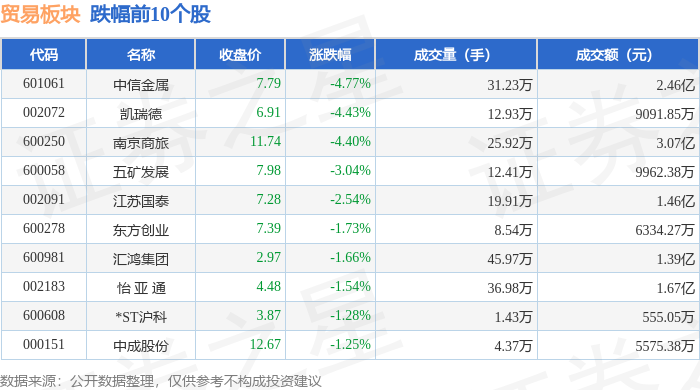
从资金流向上来看,当日贸易板块主力资金净流出1.12亿元,游资资金净流入1780.25万元,散户资金净 流入9393.22万元。贸易板块个股资金流向见下表: 证券之星消息,7月31日贸易板块较上一交易日下跌2.08%,中信金属领跌。当日上证指数报收于 3573.21,下跌1.18%。深证成指报收于11009.77,下跌1.73%。贸易板块个股涨跌见下表: | 代码 | 名称 | 主力净流入(元) | 主力净占比 游资净流入 (元) | | 游资净占比 散户净流入(元) | | 散户净占比 | | --- | --- | --- | --- | --- | --- | --- | --- | | 002091 | 江苏国泰 | = 434.93万 | 2.98% | 273.35万 | 1.87% | -708.28万 | -4.85% | | 002072 | 凯瑞德 | 432.51万 | 4.76% | 499.39万 | 5.49% | -931.90万 | -10.25% | | 600287 | 江苏舜天 | -99.49万 | -2.37% | 34.09万 | 4 0.81% | 65.39万 ...

后贸易谈判时期的美元和黄金
Sou Hu Cai Jing· 2025-07-31 06:58
Economic Growth and Consumer Spending - The U.S. GDP for Q2 grew at an annualized rate of 3%, reversing the -0.5% contraction in Q1 and exceeding market expectations of 2.6% [2][3] - Key factors for the strong growth included a significant decline in imports and a faster increase in consumer spending, with net exports contributing 5 percentage points to GDP [3] - Consumer spending grew by 1.4%, slightly below the expected 1.5%, marking the slowest growth in two consecutive quarters [3] Inflation and Price Indices - The core Personal Consumption Expenditures (PCE) price index for Q2 showed an annualized quarter-on-quarter initial value of 2.5%, down from 3.5% but above the expected 2.3%, indicating a rebound in inflation [2][3] - The overall PCE price increased by 2.5% over the past 12 months, with core PCE rising by 2.7%, reflecting changes in price composition [5] Employment Data - The ADP employment report for July indicated an increase of 104,000 jobs, surpassing the expectation of 76,000, although still below last year's average levels [3][5] - The labor market remains cautious due to uncertainties surrounding tariff policies, leading to a generally weak demand for labor [3] Federal Reserve's Monetary Policy - The Federal Reserve decided to pause interest rate cuts during the July meeting, with Chairman Powell indicating that it is too early to predict a rate cut in September [4][5] - Powell noted that the current interest rate level is appropriate given the uncertainties surrounding tariffs and inflation [5] Currency and Market Dynamics - The U.S. dollar index surged over 1% on July 31, approaching the 100 mark, while U.S. Treasury yields rose across the board [2][6] - The dollar's decline earlier in the year was attributed to weak economic data and concerns over a potential recession, but recent strong economic indicators have alleviated these fears [6][7] - The resolution of trade tensions and established tariff rates among developed economies have contributed to a more stable outlook for the dollar [6][7]

海容冷链成立青岛金汇容国际贸易有限公司
Zheng Quan Zhi Xing· 2025-07-31 01:37
Group 1 - Qingdao Jinhui Rong International Trade Co., Ltd. has been established with a registered capital of 10 million yuan [1] - The legal representative of the company is Wang Cunjing [1] - The business scope includes general projects such as import and export of goods, technology import and export, sales of refrigeration and air conditioning equipment, sales of gas compression machinery, sales of mechanical equipment, sales of household appliances, sales of household appliance parts, sales of mechanical parts and components, retail of hardware products, and sales of electronic products [1] Group 2 - The company is wholly owned by Hairong Cold Chain [1]

长三角地区上半年进出口总值增长5.4%
Ren Min Ri Bao· 2025-07-30 22:09
Core Insights - The total import and export value of the Yangtze River Delta region reached 8.16 trillion yuan in the first half of the year, a year-on-year increase of 5.4%, accounting for 37.4% of China's total import and export value during the same period [1] - Exports amounted to 5.22 trillion yuan, reflecting a growth of 9.9% [1] Group 1: Regional Performance - Jiangsu, Zhejiang, and Shanghai had import and export values of 2.81 trillion yuan, 2.73 trillion yuan, and 2.15 trillion yuan respectively [1] - Anhui achieved a double-digit growth with an import and export value of 458.54 billion yuan, growing by 15.2% [1] Group 2: Private Sector Contribution - Private enterprises accounted for over half of the import and export activities in the Yangtze River Delta, with a total of 4.55 trillion yuan, growing by 9.4% [1] Group 3: Trade with Key Regions - Trade with ASEAN and the EU saw rapid growth, with import and export values of 1.3 trillion yuan and 1.25 trillion yuan respectively, increasing by 17.8% and 4.4% [1] - The total import and export value with countries involved in the Belt and Road Initiative reached 4.09 trillion yuan, growing by 10.2% [1] Group 4: Product Export Performance - Mechanical and electrical products accounted for nearly 60% of exports, with a total export value of 3.1 trillion yuan, growing by 9.7% [1] - Integrated circuit exports reached 258.99 billion yuan, increasing by 17.8%; computer and its components at 222.01 billion yuan, growing by 1.6%; and automobiles at 179.29 billion yuan, growing by 18.8% [1]
逆势攀升!从7.1%看无锡外贸韧性与活力
Xin Hua Ri Bao· 2025-07-30 21:16
Group 1: Foreign Trade Performance - Wuxi's foreign trade achieved a robust growth of 7.1% from January to June, surpassing the provincial average by 1.9 percentage points, with a total import and export value reaching 388.6 billion yuan, marking a historical high for the same period [1] - The city has recorded the highest historical import and export scale for four consecutive months, showcasing its resilience in the face of a complex international trade environment [1] Group 2: Industry Innovation and Upgrades - Wuxi's ShenNan Circuit Co., Ltd. has maintained a leading position in the electronic industry through significant R&D investment, with a projected revenue growth rate exceeding 30% in 2024 [2] - From January to June, Wuxi's electromechanical product exports reached 195.32 billion yuan, a year-on-year increase of 18.6%, accounting for 72.7% of the city's total exports [2] - High-tech products such as integrated circuits, lithium batteries, and printed circuit boards saw export growth rates of 38.7%, 41.4%, and 28.5% respectively, driving foreign trade growth [2] Group 3: Market Expansion and New Products - Wuxi's manufacturing enterprises are increasingly innovating to meet market demands, with high-tech product exports growing by 22.2% in the first half of the year, representing 40.8% of total foreign trade exports [3] - Companies like Zhongke Weizhi Technology Co., Ltd. have successfully broken into international markets, with a 15% year-on-year increase in export value from January to May [4] Group 4: Global Partnerships and Trade Growth - Wuxi's foreign trade enterprises are actively expanding into emerging markets, with exports to South Korea and ASEAN growing by 22.5% and 13.2% respectively [4] - The total import and export value with countries involved in the Belt and Road Initiative reached 203.77 billion yuan, a growth of 9.9%, accounting for 52.4% of the city's total [4] Group 5: Support for Exporting Enterprises - Wuxi is implementing a comprehensive support system for foreign trade enterprises, including subsidies for exhibition fees and organizing overseas trade fairs for over 1,000 companies [8] - The city has introduced a special action plan for cross-border trade facilitation, with 20 key measures aimed at reducing transaction costs and enhancing trade efficiency [8]
润欣科技股价下跌2.43% 公司回应股东减持事项
Jin Rong Jie· 2025-07-30 20:28
Group 1 - The core viewpoint of the article highlights that Runxin Technology's stock price experienced a decline of 2.43% on July 30, closing at 20.48 yuan, with a trading volume of 225,168 hands and a transaction amount of 463 million yuan [1] - Runxin Technology operates in the trade industry, focusing on areas such as the Internet of Things and mobile payments, and has a total market capitalization of 10.498 billion yuan since its listing in 2015 [1] - The company responded to investor inquiries on the same day, clarifying that the recent shareholder reduction in holdings was due to personal financial needs and does not reflect a negative outlook on the company's future development [1] Group 2 - The company emphasized its stable operations since its listing, with a strong focus on its core business and confidence in its long-term value, aiming to enhance performance [1] - On July 30, the net outflow of main funds was 5.5306 million yuan, accounting for 0.05% of the circulating market value [1]

躲过衰退!欧元区二季度GDP超预期增长0.1%,降息预期回落
Hua Er Jie Jian Wen· 2025-07-30 10:56
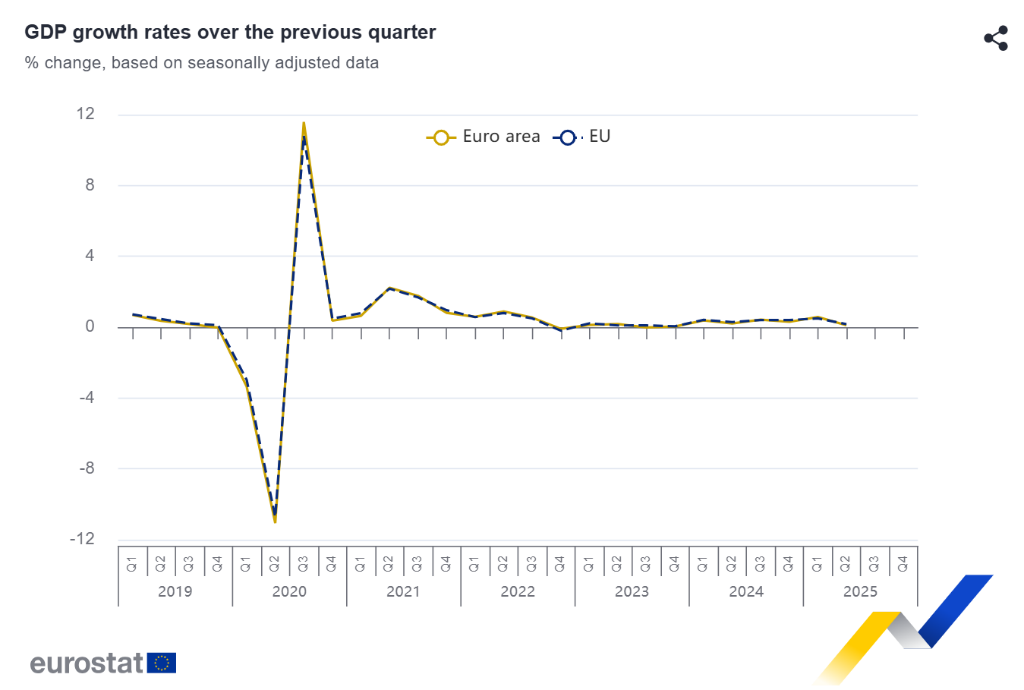
Economic Performance - Eurozone's GDP growth in Q2 2025 shows a significant slowdown, with a quarter-on-quarter growth rate dropping from 0.6% in Q1 to 0.1%, but still surpassing the market expectation of zero growth [1][2] - Year-on-year GDP growth for the Eurozone reached 1.4%, exceeding the anticipated 1.2% [1][2] Country-Specific Insights - Germany's economy contracted by 0.1% in Q2 2025, following a 0.3% growth in Q1, indicating a notable slowdown [8] - Italy unexpectedly shrank by 0.1% in Q2, contrary to expectations of slight growth, posing challenges for the government [8] - France's economy grew by 0.3% in Q2, driven mainly by inventory increases, despite weak domestic demand [8] - Spain outperformed expectations with a 0.7% growth in Q2 [9] Monetary Policy Outlook - The European Central Bank (ECB) has lowered its key interest rate to 2% over the past 13 months to stimulate the economy, but the latest data suggests a reduced necessity for further easing [1][12] - Market expectations for another rate cut by the ECB before December are currently at 50% [1][12] Trade and Economic Environment - The trade environment remains a primary concern, particularly due to the impact of U.S. tariffs on European economies [5] - A new trade agreement with the U.S. has raised concerns among German and French leaders about potential negative impacts on the EU economy [5][12] - Germany plans to significantly increase budget spending for infrastructure and defense starting next year, which may mitigate the negative effects of tariffs [12]
厦门信达龙虎榜数据(7月30日)
Zheng Quan Shi Bao Wang· 2025-07-30 09:32
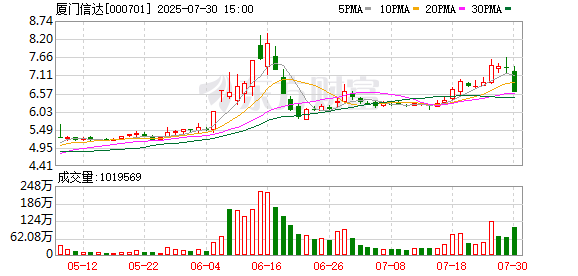
厦门信达今日跌停,全天换手率15.27%,成交额7.02亿元,振幅11.67%。龙虎榜数据显示,机构净买入 2524.29万元,营业部席位合计净卖出9164.92万元。 深交所公开信息显示,当日该股因日跌幅偏离值达-9.26%上榜,机构专用席位净买入2524.29万元。 证券时报·数据宝统计显示,上榜的前五大买卖营业部合计成交1.97亿元,其中,买入成交额为6545.32 万元,卖出成交额为1.32亿元,合计净卖出6640.63万元。 具体来看,今日上榜的营业部中,共有5家机构专用席位现身,即买一、买二、买三、买四、买五、卖 三,合计买入金额6338.39万元,卖出金额3814.10万元,合计净买入2524.29万元。 近半年该股累计上榜龙虎榜7次,上榜次日股价平均跌5.18%,上榜后5日平均跌8.54%。 资金流向方面,今日该股主力资金净流出1.68亿元,其中,特大单净流出1.19亿元,大单资金净流出 4926.70万元。近5日主力资金净流出9003.42万元。(数据宝) 厦门信达7月30日交易公开信息 | 买/卖 | 会员营业部名称 | 买入金额(万元) | 卖出金额(万元) | | --- | --- ...

贸易板块7月30日跌0.33%,江苏舜天领跌,主力资金净流出6470.23万元
Zheng Xing Xing Ye Ri Bao· 2025-07-30 08:27
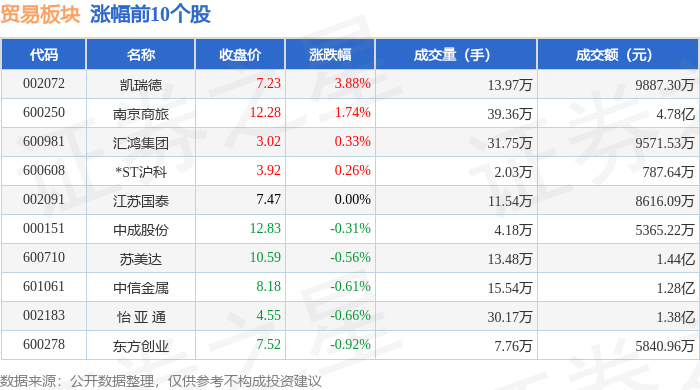
证券之星消息,7月30日贸易板块较上一交易日下跌0.33%,江苏舜天领跌。当日上证指数报收于 3615.72,上涨0.17%。深证成指报收于11203.03,下跌0.77%。贸易板块个股涨跌见下表: | 代码 | 名称 | 收盘价 | 涨跌幅 | 成交量(手) | | 成交额(元) | | --- | --- | --- | --- | --- | --- | --- | | 002072 | 訓瑞德 | 7.23 | 3.88% | | 13.97万 | 9887.30万 | | 600250 | 南京商旅 | 12.28 | 1.74% | | 39.36万 | 4.78亿 | | 600981 | 汇鸿集团 | 3.02 | 0.33% | | 31.75万 | 9571.53万 | | 600608 | *ST沪科 | 3.92 | 0.26% | | 2.03万 | 787.64万 | | 002091 | 江苏国泰 | 7.47 | 0.00% | | 11.54万 | 8616.09万 | | 000151 | 中成股份 | 12.83 | -0.31% | | 4.18万 | 5365.22万 ...