
网约车

Search documents
曹操出行港交所上市,从定制车到Robotaxi构建差异化壁垒
Di Yi Cai Jing· 2025-06-26 08:49
Core Viewpoint - The successful listing of Cao Cao Mobility on the Hong Kong Stock Exchange marks a significant milestone for the company, which has developed a unique business model centered around customized vehicles in the ride-hailing industry [1][3]. Group 1: Company Overview - Cao Cao Mobility, incubated by Geely Group, has spent ten years developing a ride-hailing ecosystem focused on customized vehicles, contrasting with other platforms that pursued rapid expansion [4]. - The company has become the largest ride-hailing platform listed on the Hong Kong Stock Exchange, demonstrating resilience in a complex regulatory environment [3]. Group 2: Financial Performance - The average hourly income for Cao Cao Mobility drivers increased from RMB 30.9 in 2022 to RMB 35.7 in 2024, significantly higher than the industry average of RMB 27 [6][10]. - The customized vehicle strategy has positively impacted the company's financials, with gross profit margin improving from -5.8% in 2023 to 8.1% in 2024 [7]. Group 3: Cost Efficiency and Service Improvement - The total cost of ownership (TCO) for drivers is projected to decrease by 36.4%, reaching approximately RMB 0.5 per kilometer, enhancing operational efficiency [8]. - Cao Cao Mobility's partnership with Geely has led to a 25% reduction in maintenance time and a 54% decrease in costs, further benefiting drivers [11]. Group 4: Future Prospects and Innovations - The company is exploring the Robotaxi market, leveraging its customized vehicle experience to create a closed-loop ecosystem that integrates vehicle manufacturing, autonomous driving technology, and ride-hailing services [12][14]. - Cao Cao Mobility plans to launch a customized Robotaxi model designed for L4 autonomous driving by the end of 2026, aiming to capitalize on the future trillion-dollar market [15].


我国最大海上气田建成;港股最大出行平台来了;600360,国资拟入主→
新华网财经· 2025-06-26 00:28
Core Viewpoint - The article highlights significant developments in various sectors, including energy, transportation, finance, and consumer services, indicating a dynamic market environment with new opportunities and challenges for investors. Group 1: Energy Sector - China's first deep-water high-pressure gas field, "Deep Sea No. 1" Phase II project, has been fully put into production, marking the completion of the largest offshore gas field in the country with a maximum daily production capacity of 15 million cubic meters [1][11]. Group 2: Transportation Sector - Cao Cao Travel officially listed on the Hong Kong Stock Exchange, becoming the largest ride-hailing platform in Hong Kong, with a global offering of approximately 44.18 million shares at a price of HKD 41.94 per share [2][18]. - The market for passenger vehicles in China saw retail sales of 1.269 million units from June 1 to June 22, a year-on-year increase of 24%, with new energy vehicles accounting for 690,000 units sold, reflecting a 38% increase [11]. Group 3: Financial Sector - The Ministry of Finance reported that in May, national lottery sales reached CNY 57.036 billion, a year-on-year increase of 19.8%, driven by a rise in sports events boosting sales of betting-type lotteries [4]. - The People's Bank of China conducted a MLF operation of CNY 300 billion, resulting in a net liquidity injection of CNY 1.18 trillion for June, marking the fourth consecutive month of increased liquidity [7]. Group 4: Consumer Services - Shenzhen's municipal government issued measures to promote high-quality service consumption, including support for new business models such as e-sports and live-streaming e-commerce [8]. - IKEA recalled 2,452 units of a garlic press due to the risk of metal fragments detaching, urging customers to stop using the product and seek refunds [18]. Group 5: Corporate Developments - *ST Huamei announced a share transfer agreement where its controlling shareholder will transfer 214 million shares (22.32% of total shares) to Yadong Investment, changing the controlling shareholder to Yadong Investment and the actual controller to the State-owned Assets Supervision and Administration Commission of Jilin Province [3][13]. - New Times Da announced the completion of a share transfer agreement with Haier Group, resulting in Haier becoming the controlling shareholder with 29.24% of the voting rights [21].





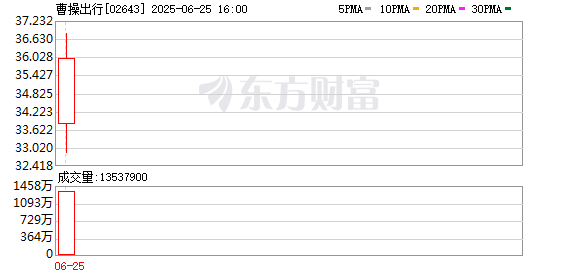
曹操出行港股上市首日破发跌14.16%,出行平台纷纷押注Robotaxi赛道
Guang Zhou Ri Bao· 2025-06-25 23:08
Group 1: Company Overview - Cao Cao Mobility, a ride-hailing platform incubated by Geely Group, was listed on the Hong Kong Stock Exchange on June 25, becoming the largest ride-hailing platform in Hong Kong [1][2] - The company has been experiencing continuous losses for three consecutive years, with losses of approximately 2.007 billion yuan, 1.981 billion yuan, and 1.246 billion yuan from 2022 to 2024 [2] - The primary revenue source for Cao Cao Mobility is its ride-hailing services, which are expected to account for 92.6% of total revenue in 2024 [2] Group 2: Market Position and Competition - As of 2024, Cao Cao Mobility holds a market share of 5.4% in the ride-hailing sector [2] - The company is highly dependent on aggregation platforms, with orders from these platforms constituting 49.9%, 73.2%, and 85.4% of Gross Transaction Value (GTV) from 2022 to 2024 [2] - The ride-hailing industry is facing increasing competition, with leading platforms capturing significant market shares and investing heavily in operational costs and marketing subsidies [1][5] Group 3: Future Prospects and Innovations - The shared mobility sector is expected to see an increase in market share, with projections indicating that by 2030, shared mobility could account for 6.0% of the domestic transportation market [3] - Cao Cao Mobility has launched its autonomous driving platform, with plans to introduce a custom L4-level Robotaxi model by the end of 2026 [3] - Investment in autonomous driving technology is growing, as evidenced by the strategic financing of over 3 billion yuan for the Robotaxi business by Hello Chuxing, with significant backing from Ant Group and CATL [3]
今日新闻丨赛力斯引入50亿元战略投资!曹操出行港股上市!
电动车公社· 2025-06-25 16:59
Group 1 - The core viewpoint of the article highlights significant developments in the automotive industry, particularly focusing on strategic investments and IPOs in electric vehicle and ride-hailing sectors [1][4]. Group 2 - Seres Automotive has successfully attracted strategic investments amounting to up to 5 billion RMB, increasing its registered capital from 9.96 billion RMB to approximately 10.084 billion RMB [2][3]. - In Q1 2025, Seres achieved a revenue of 19.147 billion RMB and a net profit of 748 million RMB, marking a year-on-year growth of 240.6%, positioning it as an attractive investment target in the automotive sector [3]. Group 3 - Cao Cao Mobility has made its debut on the Hong Kong Stock Exchange, planning to issue 44.1786 million shares at a price of 41.94 HKD per share [5]. - As of the end of March 2025, Cao Cao Mobility expanded its coverage to 146 cities, with a year-on-year order volume increase of 51.8% and revenue reaching 4.2 billion RMB, alongside a gross margin rise to 8.5% [6]. - The company plans to launch a custom L4-level Robotaxi model designed for autonomous driving by the end of 2026, indicating a clear timeline for advancements in autonomous ride-hailing technology [6].


曹操出行港股上市,定制车生态锚定Robotaxi未来出行
21世纪经济报道· 2025-06-25 14:01
Core Viewpoint - Cao Cao Mobility has officially listed on the Hong Kong Stock Exchange, becoming the largest shared mobility company in Hong Kong, with significant revenue growth projected from 2022 to 2024 [1][2] Group 1: Company Overview - Cao Cao Mobility's revenue is expected to grow from 7.631 billion yuan in 2022 to 14.657 billion yuan in 2024, with a compound annual growth rate (CAGR) of 38.59% [7] - The company has established a strong market position, ranking second in the domestic ride-hailing market by Gross Transaction Value (GTV) since 2021 [1][2] - The company operates over 34,000 customized vehicles across 31 cities in China, making it the largest fleet of its kind in the country [14] Group 2: Market Potential - The Chinese mobility market is projected to reach 8 trillion yuan by 2024, with shared mobility services accounting for 344.4 billion yuan, indicating a penetration rate of only 4.3% [6] - The shared mobility market is expected to grow to 804.2 billion yuan by 2029, with a penetration rate increasing to 7.6% [6] Group 3: Business Model and Competitive Advantage - Cao Cao Mobility is transitioning from a traditional ride-hailing model to an ecosystem-based intelligent mobility service provider, leveraging its full industry chain advantage [2][4] - The company has developed a competitive edge through its integration of upstream automotive manufacturing, midstream ride-hailing platform, and downstream customized vehicle fleet [12][14] - The average total cost of ownership (TCO) for Cao Cao's customized vehicles is 36.4% lower than typical electric vehicles used in shared mobility [17] Group 4: Financial Performance - The company's operating costs increased from 7.970 billion yuan to 12.472 billion yuan from 2022 to 2024, with a CAGR of 30.01% [7] - Cao Cao Mobility has been narrowing its net loss, with expectations to achieve breakeven in the near term as market concentration increases and subsidy expenditures decrease [10] Group 5: Future Prospects - The company has launched its autonomous driving platform, Cao Cao Zhixing, and is piloting Robotaxi services in Suzhou and Hangzhou, positioning itself for future market opportunities [20][21] - Cao Cao Mobility plans to develop a customized L4 Robotaxi model in collaboration with Geely, expected to launch by the end of 2026 [21][22] - The company has secured cornerstone investments from major industry players, enhancing its capital stability for future growth in the smart electric mobility sector [24]


曹操出行上市首日破发,股价大跌19%
新华网财经· 2025-06-25 12:52
Core Viewpoint - The initial public offering (IPO) of Cao Cao Travel on the Hong Kong Stock Exchange faced a disappointing debut, with a significant drop in share price, raising concerns about the company's future growth and profitability [1][4]. Group 1: IPO Performance - Cao Cao Travel officially listed on the Hong Kong Stock Exchange on June 25, opening below its issue price and experiencing a drop of up to 19% [1]. - The stock's opening price was HKD 33.80, with a market capitalization of HKD 191.82 billion, and it reached a historical low of HKD 32.85 during trading [2]. Group 2: Financial Performance - The company reported revenue growth from 72 billion to 107 billion from 2021 to 2023, with a 39.8% year-on-year increase in 2023 [4]. - Despite revenue growth, Cao Cao Travel has not yet achieved profitability, with adjusted net losses decreasing from 29.59 billion in 2021 to 9.66 billion in 2023 [5]. Group 3: Market Position and Competition - Cao Cao Travel ranks among the top three ride-hailing platforms in China by gross transaction value (GTV) and was the second-largest in the industry last year, holding a market share of only 5.4% compared to Didi's 70.4% [3][5]. - The company relies heavily on aggregator platforms, with the share of orders from these platforms increasing from 49.9% in 2022 to 85.4% in 2024, leading to rising commission costs [5]. Group 4: Future Strategies - The company plans to enhance its profitability by focusing on customized vehicles and Robotaxi services, with plans to purchase approximately 8,000 customized vehicles annually from 2025 to 2027 [6]. - A portion of the net proceeds from the IPO will be allocated to technology improvements and investments in autonomous driving, with 17% aimed at enhancing technology and 12% specifically for autonomous driving initiatives [6].

两只港股新股双双破发!
Zheng Quan Shi Bao· 2025-06-25 11:24
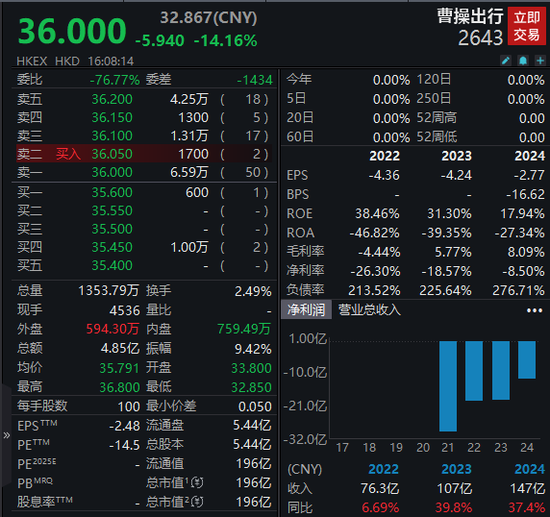
Core Viewpoint - The recent IPOs of Cao Cao Mobility and Xiangjiang Electric have not maintained the strong momentum seen in the Hong Kong IPO market, with both companies experiencing significant declines in their stock prices shortly after listing [1][7]. Group 1: Company Performance - Cao Cao Mobility's shares were priced at HKD 41.94 and fell by 14.16% to close at HKD 36.00, while Xiangjiang Electric's shares were priced at HKD 2.86 and dropped by 11.89% to close at HKD 2.52 [1][3]. - The total market capitalization for Cao Cao Mobility approached HKD 20 billion, while Xiangjiang Electric's market cap was around HKD 700 million [7]. - Prior to their public offerings, both companies showed signs of weak demand, with Cao Cao Mobility's institutional subscription rate at 2.78 times and Xiangjiang Electric's at just 1.08 times [10][11]. Group 2: Company Background - Cao Cao Mobility, founded in 2015, is a strategic investment of Geely Holding Group in the "new energy vehicle sharing ecosystem" and has become a significant player in China's ride-hailing market [4]. - As of 2024, Cao Cao Mobility operates in 136 cities with a total Gross Transaction Value (GTV) of RMB 17 billion, representing a year-on-year growth of 38.8% and a market share of 5.4% [4]. - Xiangjiang Electric is known for kitchen small appliances and has a market share of 0.8% in the Chinese kitchen small appliance industry, with significant exports to North America [6]. Group 3: Future Prospects - Cao Cao Mobility is collaborating with Geely Group to develop a custom vehicle for Robotaxi services, expected to launch by the end of 2026, which will include pre-installed autonomous driving components [5][6]. - The company plans to leverage its relationship with Geely to deploy vehicles at scale without significant upfront investment, enhancing its competitive edge in the ride-hailing industry [6].
曹操出行登陆港股,网约车平台打响Robotaxi抢滩战
Hua Xia Shi Bao· 2025-06-25 11:20
Core Viewpoint - Cao Cao Mobility, the second-largest ride-hailing platform in China, has officially listed on the Hong Kong Stock Exchange, becoming the largest mobility platform in the market [1] Group 1: Listing Details - Cao Cao Mobility's stock began trading on June 25, with a closing price of HKD 35.3 [1] - The company issued 44.1786 million H-shares, with 30% allocated for public offering in Hong Kong and 70% for international investors, raising approximately HKD 1.718 billion [2] - The public offering was oversubscribed by 21.14 times, while the international offering was oversubscribed by 2.78 times [2] - Six cornerstone investors, including Mercedes-Benz and other firms, committed to purchasing shares worth approximately HKD 952 million, accounting for over half of the total fundraising [2] Group 2: Market Context - The ride-hailing market is experiencing intense competition, with Didi holding a 70% market share, while Cao Cao Mobility ranks second with a 5.4% share [5] - In 2023, Cao Cao Mobility reported a revenue of nearly HKD 14.7 billion, a 37% year-on-year increase, with a gross margin of 8.1%, the highest in three years [5] - The company has expanded its operations to 146 cities, planning to enter 85 new cities in 2024, focusing on second-tier and lower-tier cities [6] Group 3: Future Prospects - The development of Robotaxi services is a key competitive focus for ride-hailing platforms, with Cao Cao Mobility planning to launch its autonomous driving platform in February 2025 [7] - The company aims to introduce a custom L4-level Robotaxi model by the end of 2026, indicating a strategic shift towards technology-driven solutions [7] - Industry experts suggest that scaling user base and operational capacity will be crucial for competitive advantage in the ride-hailing market [6]
两只港股新股双双破发!
证券时报· 2025-06-25 11:11
Core Viewpoint - Both Cao Cao Mobility and Xiangjiang Electric experienced a decline in their stock prices after their IPOs, indicating a lack of investor confidence in these companies [1][12][13]. Group 1: Cao Cao Mobility - Cao Cao Mobility, founded in 2015, is a strategic investment by Geely Holding Group in the "new energy vehicle sharing ecosystem" and has become a significant player in China's ride-hailing market [4]. - As of 2024, Cao Cao Mobility operates in 136 cities with a total Gross Transaction Value (GTV) of 17 billion CNY, reflecting a year-on-year growth of 38.8% and a market share of 5.4%, ranking second in the industry [6]. - The company has a fleet of over 34,000 customized vehicles, with orders from customized vehicles accounting for approximately 25.1% of the total GTV [6]. - The IPO attracted six cornerstone investors, including companies affiliated with Mercedes-Benz and other notable investment firms [6]. - The company is collaborating with Geely Group to develop a new customized vehicle for Robotaxi services, expected to launch by the end of 2026 [9]. - Following the IPO, Cao Cao Mobility's market capitalization approached 20 billion HKD, with a significant drop in share price post-listing [12][13]. Group 2: Xiangjiang Electric - Xiangjiang Electric is a well-known kitchen small appliance manufacturer that previously attempted to list on the Shenzhen main board but later opted for a Hong Kong listing [10]. - In 2024, Xiangjiang Electric held the tenth position in China's kitchen small appliance industry, with a market share of 0.8%, and its electric kettles have a significant export share to North America [10]. - The company operates primarily on an ODM/OEM model, serving clients like Walmart and Philips, with most of its revenue coming from kitchen small appliances [10]. - After its IPO, Xiangjiang Electric's market capitalization was approximately 700 million HKD, also experiencing a decline in share price [12].

曹操出行上市破发 吉利李书福持股超四分之三
Zhong Guo Jing Ying Bao· 2025-06-25 10:48
Core Viewpoint - Cao Cao Mobility officially listed on the Hong Kong Stock Exchange but experienced a significant drop in stock price on the first day of trading, closing at HKD 36.00, which is below the IPO price of HKD 41.94 [2][3] Group 1: IPO Details - The company planned to issue 44.18 million shares globally, with 4.42 million shares for Hong Kong and 39.76 million shares for international investors, aiming to raise HKD 18.53 billion [3] - Despite the initial drop, six cornerstone investors, including Mercedes-Benz and others, committed to purchasing 22.64 million shares, accounting for 51.4% of the total fundraising [3] - The estimated valuation of Cao Cao Mobility at the IPO was approximately HKD 228.23 billion, but the market capitalization at closing was HKD 195.90 billion, about 85.8% of the pre-IPO valuation [3][4] Group 2: Financial Performance - The company has reported losses every year since its establishment, with operating losses of HKD 1.9 billion, HKD 1.6 billion, and HKD 800 million for the years 2022 to 2024, respectively [4] - Net losses for the same period were HKD 2 billion, HKD 2 billion, and HKD 1.2 billion, with expectations of continued net losses in 2025 [4] Group 3: Market Context and Future Outlook - The drop in stock price is part of a broader trend in the Hong Kong market, where over 30% of new listings have experienced price declines [4] - The company is focusing on the Robotaxi market, which has significant growth potential, and has launched its autonomous driving platform in early 2025 [6] - Competitors in the Robotaxi space include major players like Didi and Baidu, indicating a highly competitive environment [6][7]