基础设施业

Search documents
印度首富弟弟被指同爱泼斯坦私密交往多年,对方献上“瑞典金发女郎”
Xin Lang Cai Jing· 2026-02-07 15:37
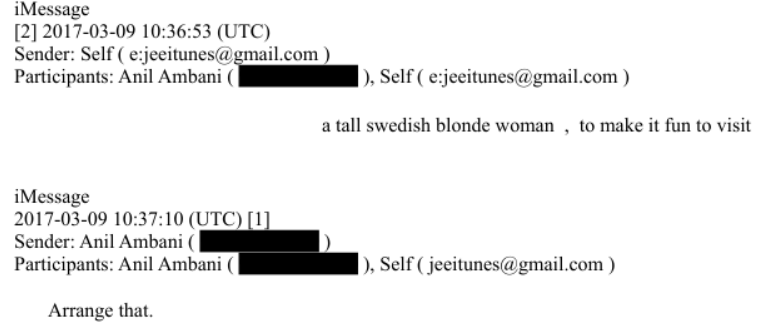
Core Viewpoint - The recent release of documents related to Jeffrey Epstein has revealed his extensive connections with high-profile individuals, including Anil Ambani, a prominent Indian billionaire, and has raised significant concerns regarding the implications for Indian politics and society [1][2][9]. Group 1: Epstein's Connections - Epstein maintained a vast business and social network even after his 2008 conviction for soliciting minors for prostitution, extending his influence beyond the United States [2]. - He invested considerable effort in building relationships with the Ambani family, specifically purchasing books to understand their history and internal conflicts [2][4]. - Anil Ambani, who faced significant financial difficulties after the split of the Reliance Group, received support from Epstein during his career downturn [2][4]. Group 2: Communication with Anil Ambani - Epstein's correspondence with Anil Ambani began in early 2017 and continued until shortly before Epstein's arrest in 2019, discussing various topics including international affairs and potential business collaborations [5][7]. - The two planned to meet in Paris in 2017, but the meeting did not occur; however, they did meet in New York shortly before Epstein's arrest [7][19]. Group 3: Political Implications - Anil Ambani appeared to act as an intermediary for the Indian government in facilitating meetings with U.S. officials, including Jared Kushner and Steve Bannon, ahead of Prime Minister Modi's visit to the U.S. [10][11]. - Epstein's emails suggested that Modi followed advice to enhance his image in the U.S. by engaging in public displays during his visit to Israel, which has sparked outrage in India [13][14]. - The revelations have led to political turmoil in India, with opposition parties demanding explanations from the government regarding Modi's connections to Epstein [19].

第十届“一带一路”高峰论坛在港闭幕 促成45份合作备忘录创新高
Zhong Guo Xin Wen Wang· 2025-09-12 01:47
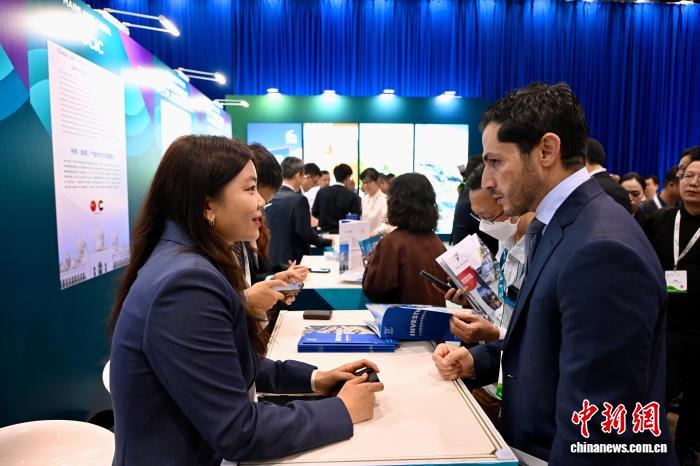
Group 1 - The 10th "Belt and Road" Summit held in Hong Kong concluded with a record of 45 cooperation memorandums signed, involving over 6,200 participants from more than 70 countries and regions [1][3] - The cooperation memorandums cover various sectors including aviation, energy, finance, infrastructure, and technology, involving regions such as mainland China, Hong Kong, ASEAN countries, the Middle East, Australia, Pakistan, and the United States [1][3] - The summit showcased over 300 investment projects and facilitated more than 800 one-on-one project matching sessions, promoting several "small but beautiful" livelihood projects, such as a joint venture between an Indonesian company and a Hong Kong firm in agricultural technology [3] Group 2 - The Hong Kong government emphasized a "change-seeking" spirit to enhance its role as a bridge and "super value-added" player in the Belt and Road Initiative [3] - Recent agreements and transactions related to the Belt and Road Initiative reached nearly $1 billion in total value, highlighting Hong Kong's position as an ideal hub for the initiative [4]
金融总量合理增长 支持实体经济力度稳固
Zhong Guo Zheng Quan Bao· 2025-07-14 20:55
Core Points - The central viewpoint of the articles emphasizes the stable growth of financial metrics in China, with a focus on the implementation of a moderately loose monetary policy to support the real economy and enhance domestic demand [1][2][3]. Financial Metrics - In the first half of the year, new RMB loans increased by 12.92 trillion yuan, with the total social financing stock reaching 430.22 trillion yuan, reflecting an 8.9% year-on-year growth [1]. - The broad money supply (M2) stood at 330.29 trillion yuan, showing an 8.3% year-on-year increase [1]. - The structure of loans has improved, with corporate loans accounting for 89.5% of new loans, an increase of 6.6 percentage points compared to the same period last year [1]. Loan Distribution - New loans have been primarily directed towards key sectors such as manufacturing and infrastructure, indicating a continued optimization of loan distribution [1][2]. - The financial system has effectively met the funding needs of the real economy, with a notable increase in government bond financing [2]. Monetary Policy Tools - The People's Bank of China (PBOC) has implemented structural monetary policy tools to support major strategies and sectors, including real estate and capital markets [3][4]. - New initiatives include a 500 billion yuan loan for service consumption and elderly care, as well as risk-sharing tools for technology innovation bonds [3]. Future Outlook - Experts predict that financial metrics will continue to grow at a reasonable pace, supported by strong internal economic dynamics and ongoing policy effects [2][4]. - The PBOC aims to maintain a balance between total and structural monetary policy tools, focusing on technology innovation and consumption [4]. Exchange Rate Stability - The PBOC emphasizes the importance of market forces in determining the exchange rate while maintaining stability and preventing excessive fluctuations [5]. - The central bank's stance is to avoid using currency depreciation as a means to gain international competitive advantage [5].
上半年金融数据出炉!社融规模增量近23万亿元,M2增速8.3%
Sou Hu Cai Jing· 2025-07-14 14:09
Core Viewpoint - The People's Bank of China (PBOC) reported that in June 2025, new loans and social financing both exceeded market expectations, indicating a positive trend in credit growth and monetary policy effectiveness [1][2]. Group 1: Credit Growth - In June 2025, new RMB loans amounted to 2.24 trillion yuan, an increase of 1.1 billion yuan year-on-year [1]. - The total social financing scale in June reached 4.1993 trillion yuan, up by 900.8 billion yuan year-on-year [1]. - The balance of RMB loans at the end of June was 268.56 trillion yuan, reflecting a year-on-year growth of 7.1% [2]. Group 2: Monetary Policy and Economic Support - The PBOC has implemented a moderately loose monetary policy, utilizing various tools to support high-quality development of the real economy [2]. - The increase in credit is attributed to the PBOC's actions, including interest rate cuts and liquidity injections, which have improved financing conditions for businesses and households [3][4]. - The government bond issuance peak has also contributed to the rise in social financing data [1]. Group 3: Loan Structure and Sector Focus - The first half of 2025 saw a total loan increase of 12.92 trillion yuan, with significant allocations to manufacturing and infrastructure sectors [4]. - Corporate medium- and long-term loans increased by 400 billion yuan in June, ending a four-month decline [5]. - The demand for medium- and long-term loans is supported by various factors, including financial support measures and ongoing infrastructure investments [5]. Group 4: Social Financing and Government Bonds - The total social financing increment for the first half of 2025 was 22.83 trillion yuan, an increase of 4.74 trillion yuan year-on-year [6][7]. - Government bond financing was a major contributor to the increase, with a year-on-year rise of 4.32 trillion yuan [7]. - In June, new social financing reached 4.20 trillion yuan, reflecting a seasonal increase and a year-on-year growth of 9008 billion yuan [7]. Group 5: Future Outlook - Experts anticipate that the PBOC may continue to implement interest rate cuts and reserve requirement ratio reductions in the second half of 2025 [9][10]. - The growth of M2 money supply is expected to support the financing needs of enterprises and households, with a year-on-year increase of 8.3% [9]. - The ongoing adjustments in monetary policy are aimed at enhancing domestic demand and mitigating external economic pressures [10].
央行重磅发声!事关货币政策、汇率
财联社· 2025-07-14 08:42
Core Viewpoint - The People's Bank of China (PBOC) is implementing structural monetary policy tools to support technological innovation and boost consumption, aiming to enhance economic transformation and upgrade [3][8]. Group 1: Monetary Policy Measures - In May, the PBOC launched a comprehensive set of financial policy measures, all of which were implemented by the end of May, with a focus on supporting technological innovation and consumption [3][7]. - As of the end of June, the total social financing stock increased by 8.9% year-on-year, with M2 growing by 8.3% and RMB loans up by 7.1% [6]. - Since 2020, the PBOC has cut the one-year and five-year Loan Prime Rate (LPR) by 115 and 130 basis points respectively, reflecting a supportive monetary policy stance [5][9]. Group 2: Economic Indicators - By the end of May, the contract amount for loans related to technological innovation and technological transformation reached 17.4 trillion yuan, available for enterprises to draw upon [3]. - The balance of loans for the "Five Major Financial Articles" reached 103.32 trillion yuan by the end of May, a year-on-year increase of 14%, with technology loans accounting for 43.3 trillion yuan, up 12% [16]. - In the first half of the year, new loans primarily targeted the manufacturing and infrastructure sectors, with manufacturing medium- and long-term loans growing by 8.7% and infrastructure loans by 7.4% [15]. Group 3: Consumption and Service Sector - The PBOC has established a 500 billion yuan service consumption and elderly care refinancing facility to enhance financial support for the service sector, which is crucial for boosting consumption and expanding domestic demand [13]. - The service consumption market shows strong demand, but the main limitation to expanding service consumption is supply [12][13]. Group 4: Bond Market and Financing - In the first half of 2025, China's bond market issued various bonds totaling 4.43 trillion yuan, a 16% year-on-year increase, significantly supporting fiscal policy implementation and financing for real enterprises [19]. - The net financing from bonds accounted for 38.6% of the increase in social financing, indicating a robust bond market performance [19].