
聚苯硫醚

Search documents
调查揭晓,24小时内中方对四国加税,特朗普图谋破产
Sou Hu Cai Jing· 2025-12-06 05:16
Core Viewpoint - The Chinese Ministry of Commerce has decided to continue imposing anti-dumping duties on polyphenylene sulfide products originating from the United States, Japan, South Korea, and Malaysia, significantly raising the barriers for U.S. products entering the Chinese market [1][3]. Group 1: Impact on Domestic Industry - The anti-dumping measures are a response to the abnormal influx of these products at unusually low prices, which disrupts normal market competition and leads to harmful price suppression [3]. - Domestic companies are currently under significant pressure due to technological challenges and financial constraints, making it difficult for them to endure prolonged price wars [3]. - The demand for polyphenylene sulfide is increasing in various sectors, including new energy vehicles and electronics, necessitating stable pricing and supply chains to support industry growth [3][9]. Group 2: International Trade Dynamics - The U.S. has imposed a 40% tariff on goods routed through third countries to evade tariffs, which is seen as creating trade barriers rather than promoting fair competition [5]. - China’s investigation into Malaysia indicates a willingness to take necessary measures against actions that harm its interests, emphasizing the need for mutual respect and adherence to rules in trade [5][7]. - The ongoing trade tensions highlight a divergence in approaches, with China focusing on maintaining market order within existing frameworks, while the U.S. relies on tariffs and conditions to exert pressure [7]. Group 3: Market Confidence and Recovery - The certainty brought by the anti-dumping policy has led to a return of orders and increased confidence among domestic enterprises, prompting many projects to move from research to implementation stages [9]. - The local production capabilities for materials are expected to stabilize prices and ensure orderly supply, which will positively impact downstream industries [9]. - The adjustment of tax measures is viewed as a reinforcement of manufacturing infrastructure, providing a model for other countries to protect their interests while maintaining international order [9].


宣布征收反倾销税,日本69%美国220%,关乎国内两大产业发展
Sou Hu Cai Jing· 2025-12-05 16:12
Group 1 - The core viewpoint of the news is that the anti-dumping duties on polyphenylene sulfide (PPS) are being maintained and adjusted to protect domestic industries from foreign competition, particularly from Japan and the United States [2][7] - The anti-dumping tax rates for different companies range from 23.3% to 220.9%, with Japanese companies facing specific rates, the highest being 34.5% for Sumitomo Bakelite, while U.S. companies have the highest rates reaching up to 220.9% [2][4] - The demand for PPS is increasing significantly in China due to the growth of the automotive industry and emerging sectors like robotics, making it a crucial product for domestic supply chains [5][7] Group 2 - Japan has a strong presence in the PPS market, with several companies having high production capacities, while Chinese companies like Zhejiang Xinheng are emerging as leaders in the domestic market [4] - PPS is characterized by its high-temperature resistance, corrosion resistance, and excellent mechanical properties, making it suitable for applications in automotive electronics and robotics [5] - The Chinese government is implementing comprehensive countermeasures against Japan, indicating that the anti-dumping duties on PPS are likely to continue as part of a broader strategy to protect domestic industries [9]

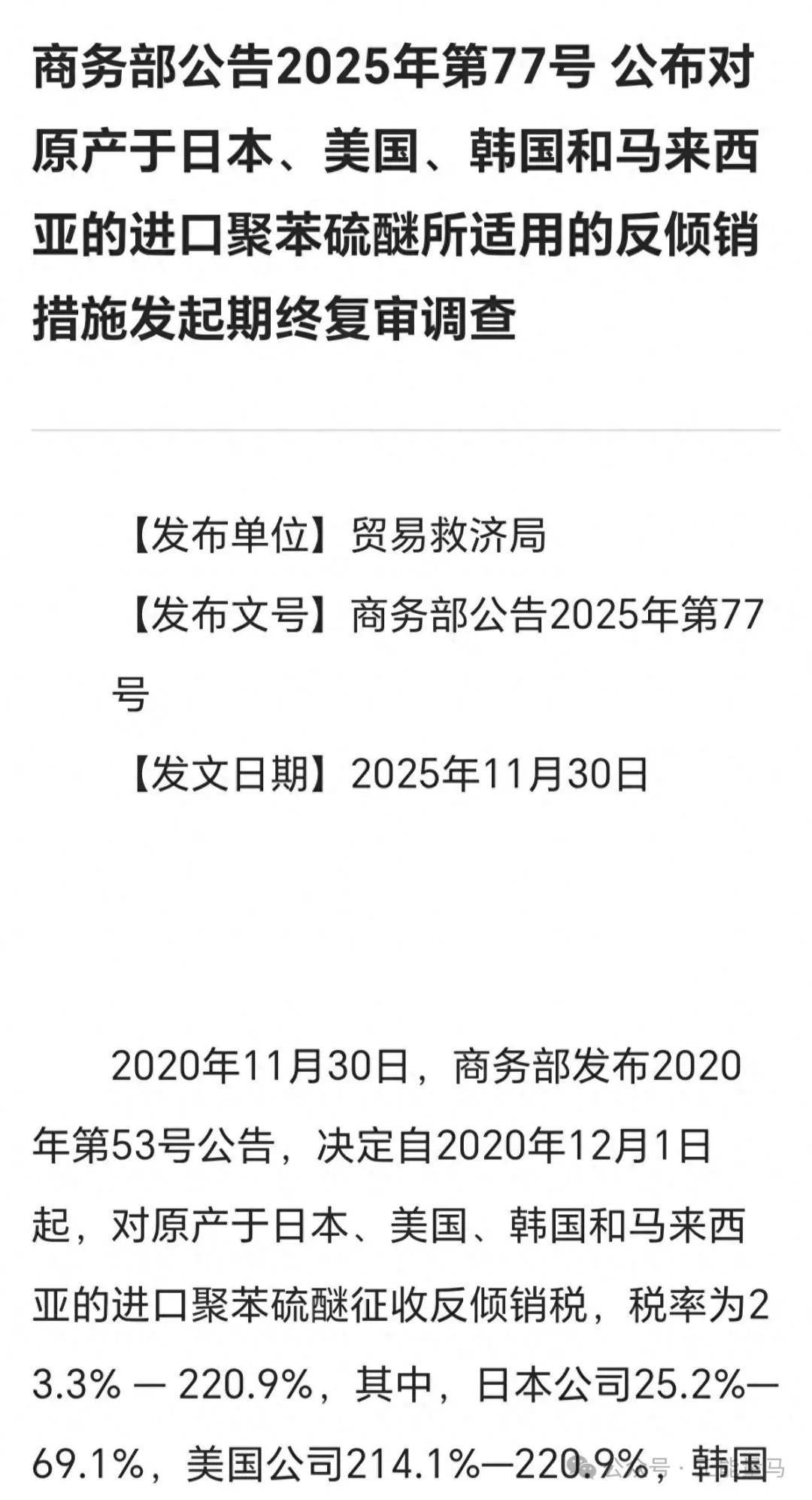
调查结果出炉,24小时内,中方一口气对4国加税,特朗普图谋破产
Sou Hu Cai Jing· 2025-12-02 09:41
Group 1 - China will continue to impose anti-dumping duties on imported polyphenylene sulfide from Japan, the United States, South Korea, and Malaysia starting December 1, with rates reaching up to 220.9% for U.S. companies, 25.2% to 69.1% for Japanese companies, 26.4% to 46.8% for South Korean companies, and 23.3% to 40.5% for Malaysian companies [1][3] - The decision follows a final review investigation by the Ministry of Commerce, which indicated that terminating the anti-dumping measures could lead to serious harm to China's domestic industry due to continued dumping from these countries [3] - The tax increase is seen as a response to the U.S. trade policies, particularly the expanded tariffs that target Chinese goods routed through other countries, which has prompted China to take protective measures [3][5] Group 2 - Other Southeast Asian economies are also affected, as labor-intensive industries have shifted from China to countries like Vietnam and Cambodia to avoid U.S. tariffs, but the U.S. has pressured these countries to comply with its sanctions [5][7] - China has engaged in multiple rounds of discussions with Malaysia and Cambodia regarding the U.S. proposed national security agreements, emphasizing that any agreements should not hinder global trade development or harm China's interests [7] - The tax measures serve as a signal against unilateralism and trade barriers, advocating for cooperation as the foundation for mutual development in the context of global economic changes [7]

我国对进口聚苯硫醚发起反倾销复审
Zhong Guo Hua Gong Bao· 2025-12-02 02:34
Group 1 - The Ministry of Commerce announced an anti-dumping investigation review for imported polyphenylene sulfide from Japan, the United States, South Korea, and Malaysia, with the review period from July 1, 2024, to June 30, 2025 [1] - During the review period, the original anti-dumping tax rates will remain in effect, which range from 23.3% to 220.9% depending on the country of origin [1] - The investigation will assess whether terminating the anti-dumping measures could lead to continued or renewed dumping and damage [1] Group 2 - Zhejiang Xinhecheng Special Materials Co., Ltd. submitted a request for the anti-dumping review, seeking to maintain the existing measures, supported by Enhua Lixin Engineering Materials (Zhejiang) Co., Ltd. [2] - The Ministry of Commerce decided to initiate the review investigation starting December 1, 2025 [2]
商务部:对美日韩等国进口聚苯硫醚发起反倾销措施期终复审调查
DT新材料· 2025-12-01 16:04
Core Viewpoint - The Ministry of Commerce of China has initiated a final review investigation of anti-dumping measures on imported polyphenylene sulfide (PPS) from Japan, the United States, South Korea, and Malaysia, following a request from Zhejiang Xinheng Special Materials Co., Ltd. [2] Group 1: Anti-Dumping Measures - The Ministry of Commerce announced the initiation of a final review investigation on November 30, 2025, regarding anti-dumping measures applicable to imported PPS from Japan, the United States, South Korea, and Malaysia [2]. - During the investigation period, the anti-dumping duties will continue to be levied according to the rates specified in previous announcements from 2020, 2021, and 2022 [2]. - The anti-dumping tax rates for various companies are as follows: - Japan: 26.9% to 69.1% - United States: 214.1% to 220.9% - South Korea: 26.4% to 32.7% - Malaysia: 40.5% [4] Group 2: Product Description and Applications - Polyphenylene sulfide (PPS) is a high-performance thermoplastic resin characterized by a molecular chain containing phenyl sulfide, known for its excellent properties such as high-temperature resistance, corrosion resistance, radiation resistance, flame retardancy, and electrical insulation [2]. - PPS is widely used in various industries, including textiles, automotive, electronics, machinery, petroleum, chemical, and aerospace [3].

东兴证券晨报-20251201
Dongxing Securities· 2025-12-01 10:32
Economic News - The Ministry of Transport emphasizes the strong cooperation between China and Norway in the shipping industry, highlighting the potential for collaboration in green and smart shipping [2] - The Ministry of Foreign Affairs announces French President Macron's upcoming state visit to China, marking a significant moment in Sino-French relations [2] - The Ministry of Commerce initiates a final review investigation on anti-dumping measures for imported polyphenylene sulfide from Japan, the US, South Korea, and Malaysia [5] - The People's Bank of China reports that in October, the bond market issued a total of 63,574.6 billion yuan in various bonds, with government bonds accounting for 11,695.5 billion yuan [5] - The National Bureau of Statistics indicates that the manufacturing PMI rose to 49.2% in November, showing signs of improvement in both production and demand [5] Company News - Xunbang Intelligent plans to issue shares and pay cash to acquire 100% of Wuxi Yindi Chip Microelectronics, with the transaction pending approval from the Shenzhen Stock Exchange and the China Securities Regulatory Commission [6] - Changhua Group receives a development notification from a domestic automaker for key metal structural components, with an estimated total sales amount of approximately 732 million yuan over a five-year project lifecycle [6] - Lizhong Group signs a technical agreement with Beijing Weijing Intelligent Technology for the processing of humanoid robot components, utilizing its advanced production facilities [6] - Chongqing Port's board approves a new investment plan for the modernization of the Jiangjin Port's multi-modal transport capacity, with an estimated total investment of 299 million yuan [6] - Hanma Technology reports a significant increase in truck production and sales in November, with production reaching 1,947 units, a year-on-year increase of 137.44% [8] Industry Analysis - The pig farming industry is experiencing low prices, with October prices showing a slight rebound but lacking sustained support, leading to increased pressure on supply [9] - The supply side indicates a decrease in the breeding sow inventory, with a reported 40.35 million heads, a 0.70% decrease from the previous month [10] - Policy adjustments and low prices are expected to accelerate capacity reduction in the pig farming sector, with a potential price increase anticipated in the second half of 2026 [11] - Major pig farming companies, including Muyuan Foods, report significant declines in average selling prices for October, with prices dropping by over 10% [12]

涉美日韩等,商务部最新公告
券商中国· 2025-11-30 14:52
Core Viewpoint - The Ministry of Commerce has initiated a final review investigation of anti-dumping measures applicable to imported polyphenylene sulfide (PPS) from Japan, the United States, South Korea, and Malaysia, following a request from the Chinese PPS industry [1][2][3]. Group 1: Anti-Dumping Measures - The anti-dumping duties imposed on imported PPS from Japan, the United States, South Korea, and Malaysia range from 23.3% to 220.9%, with specific rates for companies in each country [1][4]. - The review period for the investigation will cover the period from July 1, 2024, to June 30, 2025, while the injury investigation period will span from January 1, 2021, to June 30, 2025 [5]. Group 2: Product Scope and Description - The product under review is polyphenylene sulfide (PPS), a high-performance thermoplastic resin known for its excellent properties such as high-temperature resistance, corrosion resistance, and flame retardancy [6]. - PPS is widely used in various industries, including textiles, automotive, electronics, machinery, petroleum, chemical, and aerospace [6]. Group 3: Investigation Process - Interested parties can register to participate in the investigation within 20 days from the announcement date, providing necessary information regarding their involvement with the investigated products [9][10]. - The Ministry of Commerce will utilize various methods, including questionnaires and hearings, to gather information during the investigation [14].

商务部:对美日韩等国进口聚苯硫醚所适用反倾销措施发起期终复审调查
Yang Shi Xin Wen· 2025-11-30 12:54
Core Points - The Ministry of Commerce announced the initiation of a final review investigation on anti-dumping measures applicable to imported polyphenylene sulfide from Japan, the United States, South Korea, and Malaysia, effective December 1, 2025 [1] - During the review period, the anti-dumping duties will continue to be levied according to previously published announcements [1] Summary by Company - **Japanese Companies**: - Toray Industries, Inc. 26.9% - DIC Corporation 27.3% - POLYPLASTICS CO., LTD. 25.2% - Tosoh Corporation 25.6% - IDEMITSU FINE COMPOSITES CO., LTD. 33.6% - Sumitomo Bakelite Co., Ltd. 34.5% - Other Japanese companies 69.1% [2] - **American Companies**: - Solvay Specialty Polymers USA, LLC 214.1% - Fortron Industries LLC 220.9% - Other American companies 220.9% [2] - **South Korean Companies**: - Toray Advanced Materials Korea Inc. 26.4% - HDC POLYALL Co., Ltd. 32.7% - Other South Korean companies 46.8% [2] - **Malaysian Companies**: - Polyplastics Asia Pacific Sdn. Bhd. 23.3% - DIC Compounds (Malaysia) Sdn. Bhd. 40.5% - Other Malaysian companies 40.5% [2] Investigation Periods - The dumping investigation period is from July 1, 2024, to June 30, 2025, while the industry damage investigation period is from January 1, 2021, to June 30, 2025 [3]
重磅!100大新材料国产替代研究报告(附100+行研报告)
材料汇· 2025-11-28 16:01
Core Insights - The article emphasizes the strategic importance of new materials in the context of global technological competition and industrial chain restructuring, highlighting the need for domestic innovation to reduce reliance on foreign technologies [2][4]. Semiconductor Wafer Manufacturing Materials - The global photoresist market is projected to reach approximately $15 billion by 2030, with a current domestic market size of about 12 billion RMB, indicating significant growth potential [7]. - The domestic photoresist localization rate is around 10%, with high-end products heavily reliant on imports [7]. - Major foreign players in the photoresist market include Tokyo Ohka Kogyo, Dow Chemical, and Sumitomo Chemical, which dominate the market shares [8]. - Domestic companies such as Beijing Kehua and Suzhou Ruihong are making strides in production, but high-end products still face challenges [9]. Advanced Packaging Materials - The global market for high-performance epoxy encapsulants is expected to grow to $3.5 billion by 2030, with a current domestic market size of 4 billion RMB [39]. - The localization rate for epoxy encapsulants is around 30%, with high-end products still dependent on imports [39]. - Key foreign companies include Sumitomo Bakelite and Henkel, while domestic players include Hengshuo Huawai and Jiangsu Zhongpeng New Materials [40]. Semiconductor Components - The global market for electrostatic chucks is projected to reach $2.5 billion by 2030, with a current domestic market size of 2 billion RMB [56]. - The localization rate for electrostatic chucks is approximately 10%, with high-end products largely dominated by foreign manufacturers [56]. - Major foreign companies include Applied Materials and Lam Research, while domestic companies are beginning to emerge [57]. Display Materials - The global OLED materials market is expected to exceed $10 billion by 2030, with a current domestic market size of about 8 billion RMB [64]. - The localization rate for OLED materials is around 20%, with high-end materials still reliant on foreign sources [65].





明水经开区:产业集群蓄势聚能,推动章丘工业高质量发展
Qi Lu Wan Bao Wang· 2025-07-29 05:39
Core Viewpoint - The Ming Shui Economic and Technological Development Zone is actively promoting industrial investment and project development, with significant contributions to the local economy and industrial transformation. Group 1: Investment and Project Development - The Ming Shui Economic and Technological Development Zone plans to complete a total industrial investment of 162.97 billion yuan and technological transformation investment of 107 billion yuan in 2023 and 2024, accounting for approximately 75% of the total investment in the district, with technological transformation investment exceeding 10% of the city's total [1] - The development zone has established a full lifecycle work mechanism for attracting investment projects, utilizing various methods such as industrial chain, scenario, ecological, and fund-based investment, resulting in a reserve of 110 projects and 67 signed projects, with nearly 90% being industrial projects [2] - The development zone maintains an annual initiation of over 15 industrial projects with investments exceeding 100 million yuan, implementing more than 260 industrial investment projects annually, which accounts for over 10% of the city's total [2] Group 2: Industrial Transformation and Upgrading - The development zone focuses on high-end manufacturing, with significant projects like the Jianghe Curtain Wall Green Manufacturing Center being completed and operational [2] - The zone promotes digital intelligence, with five enterprises recognized as national intelligent manufacturing excellent scenarios, and emphasizes green initiatives through energy-saving renovations and photovoltaic projects, earning the title of a national-level green industrial park [2] - The introduction of the Snow Beer project in 2022 has not only attracted supporting enterprises but also established the first seamless connection intelligent production line for canned beer in the country, projecting a revenue of over 2 billion yuan by 2024 [2] Group 3: Industry Chain Development - The development zone leverages leading enterprises like China National Heavy Duty Truck Group to create an ecosystem of "leading enterprises + supporting clusters," attracting 33 automotive industry projects in the past three years, generating nearly 5 billion yuan in new output value [3] - Traditional industries are being revitalized through targeted investments, such as the 2.5 billion yuan investment by Mingquan Group in a polyphenylene sulfide project, transitioning from basic chemical materials to new high-end materials [3] - New industries are being developed, focusing on low-altitude economy and aerospace information industries, with projects like the artificial crystal innovation platform aimed at addressing critical technology issues and establishing a domestic highland for artificial crystal materials and devices [3]