
第六代移动通信等

Search documents
积极布局未来产业,各地有何“密码”?
Xin Lang Cai Jing· 2026-02-06 06:35
Group 1 - The concept of "future industries" has gained significant attention in 2026, with a focus on development during the "14th Five-Year Plan" period, emphasizing the importance of strategic planning and innovation in emerging sectors [1][2] - Future industries are defined as emerging sectors driven by cutting-edge technologies, currently in the early stages of development, characterized by strategic significance and potential for disruptive innovation [1][2] - China is transitioning from a phase of technological catch-up to proactive layout in future industries, with a mix of leading, parallel, and following positions in various sectors such as quantum technology and 6G [1][2] Group 2 - Shanghai is leveraging its comprehensive advantages to develop future industries, with specific plans to cultivate sectors like brain-computer interfaces and fourth-generation semiconductors by 2026 [1][2] - Anhui province has established itself as a leader in quantum technology, with a significant concentration of quantum enterprises and a complete industrial chain in both quantum and nuclear fusion energy sectors [2] - Other provinces like Beijing, Guangdong, and Jiangsu are also making strides in future industries, focusing on their unique strengths and aligning with national strategic goals [2] Group 3 - The Chinese government is implementing various measures to support future industry development, including the establishment of investment funds and the promotion of innovative ecosystems [2] - The emphasis is on creating a supportive environment for potential disruptive technologies, ensuring that local policies align with national strategies while fostering regional characteristics [2]
热词看未来|培育壮大新兴产业和未来产业
Xin Hua Wang· 2025-11-17 02:05
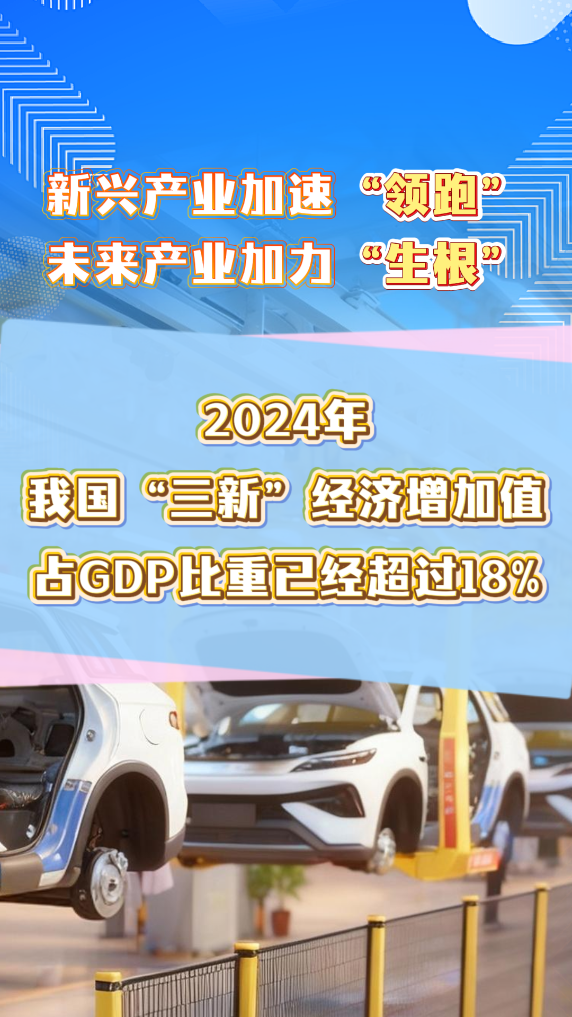
Core Insights - The central viewpoint emphasizes the cultivation and expansion of emerging and future industries in China, with a target for the "three new" economy's contribution to GDP exceeding 18% by 2024 [1] Group 1: Emerging Industries - The proposal highlights the acceleration of strategic emerging industries such as new energy, new materials, aerospace, and low-altitude economy, aiming for large-scale development through innovation and technology [4] - China has maintained its position as the global leader in new energy vehicle production and sales for ten consecutive years, with solar and wind power equipment production ranking among the highest in the world [4] - Over 60 national advanced manufacturing clusters in emerging industries have been cultivated, along with the establishment of 23 national independent innovation demonstration zones [4] Group 2: Future Industries - The proposal advocates for the advancement of future industries including quantum technology, biomanufacturing, hydrogen energy, nuclear fusion energy, brain-computer interfaces, embodied intelligence, and sixth-generation mobile communications as new economic growth points [7] - The biomanufacturing industry in China has reached a scale of nearly 1 trillion yuan, with the embodied intelligence market expected to reach 5.295 billion yuan by 2025, accounting for approximately 27% of the global market [7] Group 3: Economic Impact - The cultivation and expansion of emerging and future industries are projected to generate a new scale equivalent to recreating China's high-tech industry over the next decade, providing continuous new momentum for high-quality economic development [9]

中国经济信心说丨加快场景培育和开放 尽快把“试验田”变成“高产田”
Yang Shi Xin Wen Ke Hu Duan· 2025-11-10 03:06
Core Viewpoint - The Chinese government emphasizes the importance of creating application scenarios to accelerate the commercialization of "black technology" and enhance new productive forces, ultimately supporting high-quality economic and social development [1][2]. Group 1: Importance of Scenarios - Scenarios are likened to "experimental fields" for testing new technologies, which are essential for transforming "black technology" into new productive forces [1]. - The government aims to build various types of scenarios, including comprehensive major scenarios and high-value niche scenarios, to facilitate the rapid application of new technologies and products [1][2]. Group 2: Challenges and Solutions - Despite the potential of "black technology," large-scale commercial applications face challenges, such as the need for policy adjustments and technological upgrades [2]. - The approach of "testing in small areas" is suggested to address development issues, allowing for gradual exploration and problem-solving [2][3]. Group 3: Role of Government and Market - The government is tasked with expanding the supply of production, work, and living scenarios to encourage social capital investment and facilitate the transformation of technological achievements into productive forces [3]. - Opening up scenario resources is expected to stimulate market competition, enabling companies to benefit from technological advancements and efficiency improvements [3]. Group 4: Future Growth Areas - The "14th Five-Year Plan" suggests promoting emerging industries such as quantum technology, biomanufacturing, hydrogen energy, and brain-computer interfaces as new economic growth points [3]. - Establishing typical application scenarios for these future industries, along with innovative regulatory approaches, is crucial for fostering the development of small and medium-sized enterprises and nurturing unicorn companies [3].
中经评论:为何要再造一个高技术产业
Jing Ji Ri Bao· 2025-10-31 00:09
Core Insights - The Chinese government aims to recreate a high-tech industry over the next decade, which is expected to inject new momentum into the economy and support high-quality development [1][4] - The initiative addresses the current economic challenges of weakening traditional growth drivers and the slow emergence of new ones, aiming for a dual growth model that combines traditional industry upgrades with high-tech industry expansion [1][2] Industry Transformation - The move to recreate a high-tech industry is crucial for enhancing industrial competitiveness, as China has been a manufacturing giant but lacks strength in core components and high-end materials [2] - High-tech manufacturing currently accounts for less than 20% of the industrial value added, indicating a significant gap compared to developed countries [2] - The strategy aims to solidify China's leading position in advantageous sectors while seizing opportunities in future industries, ultimately transitioning from a manufacturing powerhouse to a manufacturing stronghold [2] Technological Advancement - The initiative is a strategic choice to capitalize on the ongoing technological revolution, particularly in areas like artificial intelligence, which is reshaping production processes and industry models [2][3] - The rapid emergence of new technologies presents both opportunities and uncertainties, making it essential to build a robust high-tech industry to mitigate risks and ensure sustainable economic growth [2][3] Economic Foundation - China's industrial foundation is strong, with the "three new" economies projected to contribute 24.29 trillion yuan to GDP in 2024, representing over 18% of the total [3] - The country has the largest and most comprehensive industrial system globally, with leading positions in sectors like new energy vehicles, photovoltaics, and 5G [3] - Continuous increases in R&D investment, with China ranking second globally in total R&D expenditure, support the potential for breakthroughs in cutting-edge fields [3] Future Industry Development - The focus will be on nurturing emerging and future industries, with strategic clusters in new energy, new materials, aerospace, and low-altitude economy expected to create significant market opportunities [3] - Future industries such as quantum technology, biomanufacturing, and sixth-generation mobile communications are targeted for development, transitioning from technological reserves to market applications [3] - The synergistic development of both emerging and future industries is anticipated to strengthen current economic foundations while expanding future growth avenues [3][4]
为何要再造一个高技术产业
Jing Ji Ri Bao· 2025-10-30 22:14
Core Insights - The Chinese government aims to cultivate and expand emerging and future industries, with the goal of creating a new high-tech industry equivalent to the size of China's existing high-tech sector over the next decade, injecting continuous new momentum into the economy and high-quality development [1][3] Economic Context - China's economic growth faces challenges due to the weakening of traditional growth drivers and the slow replacement by new drivers, necessitating the reconstruction of a high-tech industry to stabilize growth [1][2] - The current contribution of high-tech manufacturing to industrial value added is less than 20%, indicating a significant gap compared to developed countries, which positions the reconstruction of a high-tech industry as a strategic move to enhance competitiveness [2] Strategic Importance - The reconstruction of a high-tech industry is seen as a critical step in reshaping industrial advantages, allowing China to consolidate its leading position in advantageous sectors and seize opportunities in future markets [2][4] - The ongoing technological revolution, particularly in areas like artificial intelligence, presents both opportunities and uncertainties, making the establishment of a high-tech industry essential for capturing new technological advancements and mitigating risks [2][3] Industrial Foundation - China's "three new" economy is projected to contribute 24.29 trillion yuan to GDP in 2024, exceeding 18%, supported by a robust industrial system and leadership in sectors like new energy vehicles and 5G [3] - The country ranks second globally in R&D expenditure, with significant breakthroughs in quantum computing and artificial intelligence, indicating a strong foundation for the development of a new high-tech industry [3] Future Industry Development - The focus will be on nurturing emerging pillar industries such as new energy, new materials, and aerospace, which are expected to create substantial market opportunities and drive the expansion of the high-tech sector [3][4] - Future industries will be strategically developed in areas like quantum technology and brain-computer interfaces, transitioning from technological reserves to market applications, thus becoming new growth points for the economy [3] Transformation of Manufacturing - The initiative to rebuild a high-tech industry represents a qualitative transformation of Chinese manufacturing, moving away from being "big but not strong" to a more resilient and innovative position in global competition [4]
策略解读:对比历史看四中全会公报:五年一次产业变迁
Guoxin Securities· 2025-10-24 06:20
Core Insights - The report emphasizes the importance of high-quality development, technological self-reliance, and deepening reforms as key goals for the 14th Five-Year Plan period [3][4][5][6] - It highlights the transition from traditional industries to strategic emerging industries, focusing on innovation-driven growth and intelligent manufacturing [5][6][7] - The future outlook suggests that technological self-reliance will be the main theme for the next five years, with significant growth expected in new strategic industries [7][8] Summary by Sections 12th Five-Year Plan - The core focus was on optimizing industrial structure and enhancing foundational capabilities, with key areas including modern agriculture, manufacturing upgrades, and strategic emerging industries [4] - The report notes that the growth sector's market share was only 14.5% at the beginning of the 12th Five-Year Plan, while traditional industries saw significant value increases due to urbanization and industrialization [4] 13th Five-Year Plan - The emphasis shifted to innovation-driven development and intelligent manufacturing, with a clear directive to implement the "Made in China 2025" initiative [5] - The report indicates that the market share of consumption rose to 25.47%, with a notable 78% increase in the consumption index net value during this period [5] 14th Five-Year Plan - The focus is on modernizing the industrial chain and ensuring technological self-sufficiency, with a push for new generation information technology and green industries [6] - The report highlights that the consumer sector's market share decreased to 23.94%, while the growth sector's share increased to 21.50%, indicating a shift in market dynamics [6] Future Outlook - The report anticipates that by 2024, the contribution of the "three new" economies to GDP will exceed 18%, with emerging industries like new energy and materials expected to drive significant market growth [7][8] - It identifies sectors with strong global competitiveness, such as general computing equipment and electronic chemicals, as key areas for investment during the 15th Five-Year Plan [12]