
绿色建材等

Search documents
广西“十五五”规划建议:全力打造制造业十大现代化支柱产业
Zheng Quan Shi Bao Wang· 2025-12-07 01:53
Core Viewpoint - The Guangxi Zhuang Autonomous Region aims to establish ten modern pillar industries in manufacturing as part of its 15th Five-Year Plan, focusing on enhancing industrial strength and creating trillion-yuan industrial clusters [1] Group 1: Key Industries - The plan emphasizes upgrading industries such as non-ferrous metals and key metal materials, advanced steel materials, modern green chemicals, artificial intelligence and next-generation information technology, high-end equipment manufacturing, new energy vehicles and batteries, food processing, forestry products and paper, biomedicine and health, and green building materials [1] - The goal is to create new trillion-yuan industrial clusters and add several hundred-billion-yuan industries [1] Group 2: Strategic Actions - The region will implement actions to strengthen and extend the supply chain of key advantageous industries, cultivate advanced manufacturing clusters, and promote large-scale equipment upgrades [1] - Development initiatives will focus on intelligent manufacturing, green manufacturing, and service-oriented manufacturing, aiming to establish a high-end brand "Guangxi Intelligent Manufacturing" [1] Group 3: Ecosystem and Innovation - The plan includes the establishment of a comprehensive experimental zone for high-quality development of key metals in Nandan and the creation of a national advanced manufacturing cluster for key metals [1] - There will be efforts to improve the industrial ecosystem, promote venture capital, and implement a strategic emerging industry doubling plan, along with the establishment of future industry incubators and pilot zones [1] - The initiative aims to foster the development of specialized, innovative small and medium-sized enterprises and cultivate unicorn companies [1]
2027年形成3个万亿级消费领域和10个千亿级消费热点
Xin Hua Wang· 2025-11-30 22:29
Core Viewpoint - The Ministry of Industry and Information Technology, along with five other departments, has issued an implementation plan aimed at enhancing the adaptability of supply and demand in consumer goods, targeting significant optimization of the supply structure by 2027 and establishing three trillion-level consumption sectors and ten hundred-billion-level consumption hotspots [1][2]. Group 1: Key Objectives - By 2027, the supply structure of consumer goods is expected to be significantly optimized, with the formation of three trillion-level consumption sectors and ten hundred-billion-level consumption hotspots [1]. - The plan emphasizes leading industrial upgrades through consumption upgrades and aims for a dynamic balance between supply and demand, with a goal of establishing a high-quality development pattern by 2030 [1][2]. Group 2: Key Tasks - The plan outlines 19 key tasks across five areas: accelerating the application of new technologies and models, expanding the supply of distinctive and new products, precisely matching the needs of different demographics, cultivating new consumption scenarios and business formats, and creating a favorable development environment [2]. - Specific focus areas include intelligent connected new energy vehicles, smart home products, consumer electronics, modern textiles, food, and green building materials, with the goal of creating hundreds of iconic products and innovative enterprises [2]. Group 3: Market Segmentation - The plan aims to enhance the supply of green products, improve rural consumer goods, and significantly develop leisure and sports products, adapting to trends in green and low-carbon consumption [2]. - It also targets niche markets by enriching the supply of baby and children's products, enhancing quality student supplies, expanding fashionable "trendy" products, and optimizing products for the elderly [2].
六部门发文,到2027年我国将形成3个万亿级消费领域!
Ren Min Ri Bao· 2025-11-27 10:12
Core Viewpoint - The State Council's executive meeting emphasizes enhancing supply-demand adaptability as an effective measure to unleash consumption potential and facilitate economic circulation. The Ministry of Industry and Information Technology, along with five other departments, has issued an implementation plan aiming to establish three trillion-level consumption sectors and ten billion-level consumption hotspots by 2027 [1]. Group 1: Development of New Technologies and Models - Focus on key industries such as smart connected new energy vehicles, smart home, consumer electronics, modern textiles, food, and green building materials, launching a dual-hundred innovation application initiative to create a hundred iconic products and a hundred innovative enterprises [1]. - Promote flexible and customized manufacturing models, implementing a "thousand factories, thousand faces" transformation plan, and establishing a digital system that connects user demand, intelligent design, and flexible production [3]. - Encourage the application of artificial intelligence across the entire consumer goods industry, promoting generative AI and 3D digital design tools [4]. Group 2: Expansion of New Product Supply - Adapt to the trend of green and low-carbon consumption by improving energy efficiency and water efficiency standards for consumer goods, and revising national standards for volatile organic compounds (VOCs) and heavy metals [8]. - Encourage the development of energy-efficient appliances and green building materials, as well as the promotion of green low-carbon consumption in sectors like new energy vehicles [8]. - Support the development of rural-friendly high-efficiency products and enhance rural commerce infrastructure [9]. Group 3: Targeted Consumer Matching - Promote the development of high-quality, intelligent products for infants and children, focusing on feeding, travel, outdoor activities, and educational toys [20]. - Encourage the design of protective writing tools and personalized learning kits for students, integrating traditional stationery with smart hardware [23]. - Enhance the development of age-friendly products for the elderly, including care robots and multifunctional nursing beds [26]. Group 4: Cultivation of New Consumption Scenarios and Business Models - Support the establishment of flagship stores and new concept stores, and organize product launch events to enhance consumer engagement [28]. - Develop new business models such as live e-commerce and instant retail, leveraging AI to match user needs with products and services [29]. - Promote the development of shared consumption models, including shared bicycles and wheelchairs in public spaces [32].


事关促消费!六部门印发重磅文件→
Sou Hu Cai Jing· 2025-11-27 03:26
Core Insights - The Ministry of Industry and Information Technology, along with several other government departments, has issued a plan to enhance the adaptability of supply and demand in consumer goods, aiming for consumption upgrades to lead industrial upgrades and achieve a dynamic balance between supply and demand by 2027 [1][4]. Summary by Sections Overall Requirements - The plan aims to optimize the supply structure of consumer goods by 2027, creating three trillion-level consumption sectors and ten hundred-billion-level consumption hotspots, while fostering high-quality consumer goods with cultural significance [4]. Accelerating Innovation in New Technologies and Models - Focus on key industries such as smart connected new energy vehicles, smart home products, and modern textiles to develop innovative applications and create a hundred landmark products and enterprises [5]. - Promote flexible and customized manufacturing models, establishing a digital system that connects user demand with intelligent design and flexible production [6]. - Encourage the integration of artificial intelligence across the consumer goods industry, promoting smart products that provide various life services [6]. Expanding Supply of Unique and New Products - Adapt to the trend of green and low-carbon consumption by improving energy efficiency standards and promoting green building materials [7]. - Support the development of high-quality leisure and sports products to meet new demands from the sports economy [8]. - Encourage innovation in health products, focusing on special dietary foods and high-end medical devices [9]. Precise Matching of Different Consumer Needs - Enhance the supply of quality children's products, promoting safety and quality standards [10]. - Expand the supply of fashionable "trendy" products, focusing on sustainable materials and high-end brands [12]. - Develop age-appropriate products for the elderly, emphasizing comfort and functionality [13]. Cultivating New Consumption Scenarios and Business Models - Support the establishment of flagship stores and new concept stores to enhance consumer experience [13]. - Encourage the development of new business models such as live e-commerce and instant retail, leveraging advanced technologies for immersive shopping experiences [14]. Creating a Favorable Development Environment - Strengthen financial support for the consumer goods industry, promoting policies for equipment upgrades and trade-in programs [15]. - Organize promotional activities to highlight quality consumer products and brands, aiming to cultivate a strong consumer market [16]. - Maintain market order by addressing issues like local protectionism and ensuring product safety standards are updated [16].
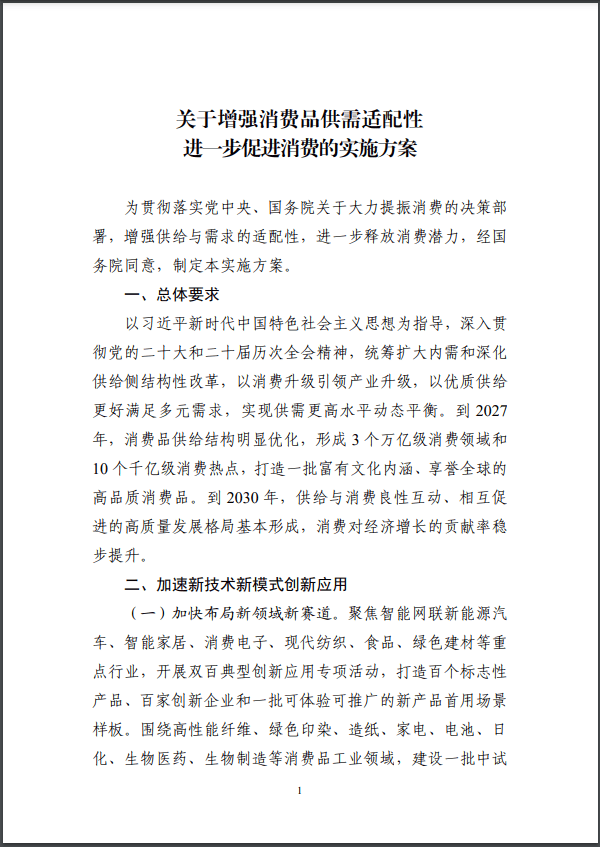
事关促消费!工信部等六部门部署增强消费品供需适配性
中汽协会数据· 2025-11-27 02:13
Core Viewpoint - The article discusses the implementation plan for enhancing the adaptability of supply and demand in consumer goods, aiming to promote consumption and achieve a dynamic balance between supply and demand by 2027 and 2030 [1][5][22]. Group 1: Overall Requirements - By 2027, the plan aims to optimize the supply structure of consumer goods, forming three trillion-level consumption fields and ten hundred-billion-level consumption hotspots, while creating high-quality consumer goods with cultural connotations [5][20]. - By 2030, a high-quality development pattern characterized by positive interaction between supply and consumption is expected to be established, with a steady increase in the contribution of consumption to economic growth [5][22]. Group 2: Key Tasks - The plan outlines five main areas with 19 key tasks, including expanding new technologies and innovative applications, enhancing the supply of unique and new products, accurately matching different demographic needs, cultivating new consumption scenarios and business formats, and creating a favorable development environment [2][6][9]. Group 3: Expanding Unique and New Product Supply - The plan emphasizes promoting green product expansion and iteration, enhancing rural consumer goods quality, and developing leisure and sports products to meet new demands [9][10][25]. - It also focuses on innovating health products, increasing the influence of historical classic products, and expanding diverse interest consumption supplies [10][11][26]. Group 4: Precise Matching of Different Demographic Needs - The plan aims to enrich the supply of baby and children's products, enhance the quality of student supplies, and expand the supply of fashionable "trendy" products [12][13][27]. - It also includes optimizing the supply of age-appropriate products for the elderly [13]. Group 5: Cultivating New Consumption Scenarios and Business Formats - The plan supports the establishment of flagship stores and new concept stores, promoting the launch of new products and enhancing the core business district's capabilities [14][28]. - It encourages the orderly development of platform consumption, including live e-commerce and circular e-commerce, while standardizing shared consumption [15][28]. Group 6: Creating a Favorable Development Environment - The plan highlights the importance of financial support for consumption, promoting the use of old-for-new policies, and enhancing consumer finance products and services [16][29]. - It also emphasizes maintaining market order, strengthening network market supervision, and updating safety and environmental standards for consumer goods [17][30].

工业和信息化部等六部门联合发文 到2027年形成3个万亿级消费领域和10个千亿级消费热点
Zheng Quan Ri Bao· 2025-11-26 16:08
Core Insights - The implementation plan aims to enhance the adaptability of supply and demand in consumer goods, targeting significant optimization of supply structure by 2027 and establishing a high-quality development pattern by 2030 [1][2][3] Group 1: Goals and Objectives - By 2027, the plan targets the formation of three trillion-level consumption sectors and ten hundred-billion-level consumption hotspots, with a focus on high-quality consumer goods that have cultural significance [1] - By 2030, the plan aims for a well-functioning interaction between supply and consumption, with a steady increase in the contribution of consumption to economic growth [1] Group 2: Innovation and Technology - The plan emphasizes the acceleration of new technology and model applications, promoting efficient manufacturing responses and the integration of artificial intelligence [1] - Key industries targeted include smart connected vehicles, smart home products, consumer electronics, modern textiles, food, and green building materials [1] Group 3: Product Supply Expansion - The plan outlines measures to enhance the supply of green products, improve rural consumer goods, and promote the development of leisure, sports, and health products [2] - Specific actions include adapting to green consumption trends and revising national standards for volatile organic compounds (VOCs) and heavy metals in products [2] Group 4: Consumer Demand Matching - The plan aims to diversify product offerings to meet the needs of different demographics, including children, students, and the elderly [2] - It promotes the development of high-quality, intelligent, and refined products for children, as well as optimizing products for the elderly [2] Group 5: New Consumption Scenarios and Business Models - The plan encourages the establishment of new consumption scenarios, including the launch of flagship stores and the development of new business models such as live e-commerce and instant retail [2] - It also supports the promotion of shared consumption models in public spaces [2] Group 6: Supportive Environment - The plan emphasizes the importance of financial and fiscal support, maintaining market order, and organizing special events to foster a conducive environment for consumer goods [3] - Specific measures include leveraging policies for equipment upgrades and trade-in programs to support the consumer goods industry [3]
A股尾盘突发!消费板块,大爆发
Sou Hu Cai Jing· 2025-11-26 15:06
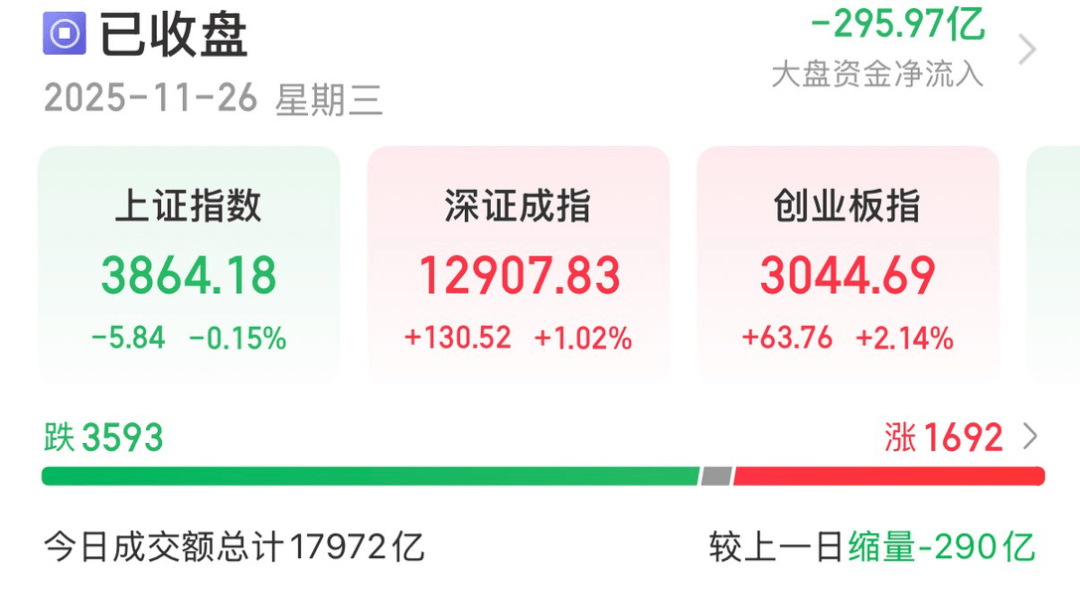
Market Performance - The Shenzhen Component Index and ChiNext Index opened lower but rose throughout the day, with the ChiNext Index increasing by over 3% at one point [1] - By the end of trading, the Shanghai Composite Index fell by 0.15%, while the Shenzhen Component Index rose by 1.02% and the ChiNext Index increased by 2.14% [1] - The total trading volume in the Shanghai and Shenzhen markets was 1.78 trillion yuan, a decrease of 28.8 billion yuan compared to the previous trading day, with 1,689 stocks rising and over 3,500 stocks falling [1] Sector Activity - Active sectors included CPO, influenza, and consumer sectors, while military and commercial aerospace sectors experienced adjustments [3] - The Ministry of Industry and Information Technology, along with other government bodies, issued a plan to enhance the adaptability of consumer goods supply and demand, aiming for significant optimization of the consumer goods supply structure by 2027 [3] Policy Initiatives - The plan aims to create three trillion-level consumption fields and ten hundred-billion-level consumption hotspots, focusing on high-quality consumer goods with cultural significance [3] - It emphasizes upgrading consumption to lead industrial upgrades and achieving a dynamic balance between supply and demand, with a goal of improving the contribution of consumption to economic growth by 2030 [3] Key Tasks - The plan outlines 19 key tasks across five areas, including accelerating the application of new technologies, expanding the supply of unique and new products, and fostering new consumption scenarios and business formats [3][4] - Specific focus areas include smart connected vehicles, smart home products, consumer electronics, modern textiles, food, and green building materials, with the goal of creating hundreds of iconic products and innovative companies [4] Market Segmentation - The plan also targets the expansion of green products, enhancement of rural consumer goods, and development of leisure and sports products [4] - It aims to adapt to trends in green and low-carbon consumption, improve product efficiency standards, and strengthen the supply of quality sports and outdoor equipment [4] - Additionally, it seeks to enrich the supply of children's products, enhance quality student supplies, expand fashionable "trendy" products, and optimize products for the elderly [4]
利好来了,六部门联合发文
2 1 Shi Ji Jing Ji Bao Dao· 2025-11-26 14:25
Core Viewpoint - The article highlights a significant opportunity emerging from the government's new consumption policy aimed at enhancing the adaptability of supply and demand in consumer goods, with a focus on innovation and quality improvement in the market [1][3]. Group 1: Policy Implementation - The State Council has introduced an implementation plan to enhance the adaptability of supply and demand in consumer goods, which includes multiple key tasks such as accelerating the layout of new fields, promoting efficient manufacturing models, and integrating artificial intelligence [1][3]. - The plan sets clear targets, aiming to form three trillion-level consumption sectors and ten billion-level consumption hotspots by 2027, with a focus on high-quality development and increased contribution of consumption to economic growth [1][3]. Group 2: Industry Focus - The plan emphasizes key industries such as smart connected vehicles, smart home products, consumer electronics, modern textiles, food, and green building materials, aiming to create a hundred iconic products and a hundred innovative enterprises [5][6]. - The automotive sector, particularly in new energy vehicles, has shown strong growth, with October sales reaching 1.715 million units, a 20% year-on-year increase, marking a significant milestone in the market [5]. Group 3: Consumer Demand and Manufacturing - The article discusses the importance of flexible manufacturing to meet personalized consumer demands, highlighting the need for high-quality, small-batch, and specialized products [6][14]. - The plan proposes the promotion of efficient response manufacturing models, including flexible and customized production, to better align with consumer preferences [6][14]. Group 4: Artificial Intelligence Integration - The plan advocates for the application of artificial intelligence across the entire consumer goods industry, aiming to enhance product development efficiency and innovation through tools like generative AI and 3D digital design [8][10]. - AI is expected to play a crucial role in understanding consumer needs, providing customized products and services, and improving the overall shopping experience [11][12]. Group 5: Lifecycle Consumption - The plan addresses the needs of different consumer demographics, including children and the elderly, promoting the development of high-quality, intelligent products tailored to these groups [15]. - The focus on "lifecycle consumption" reflects a shift from merely meeting basic needs to creating quality living experiences, indicating a broader trend in consumer behavior [15].

促进消费新方案来了!
清华金融评论· 2025-11-26 07:01
Core Viewpoint - The article outlines a comprehensive plan to enhance the adaptability of supply and demand in consumer goods, aiming to significantly optimize the supply structure by 2027 and establish a high-quality development pattern by 2030, with a focus on cultural and high-quality consumer products [6][7]. Group 1: Key Tasks - The plan includes 19 key tasks across five main areas: expanding new increments, deepening existing stock, segmenting markets, empowering scenarios, and optimizing the environment [4]. - It emphasizes the acceleration of new technology and model innovation, including the promotion of flexible manufacturing and the integration of artificial intelligence in the consumer goods sector [8][9]. Group 2: Product Supply Enhancement - The plan aims to expand the supply of distinctive and new products, focusing on green products, rural consumption upgrades, and the development of leisure and sports products [10][11]. - It encourages innovation in health products and aims to enhance the influence of historical classic products, promoting traditional crafts and cultural heritage [11][12]. Group 3: Market Segmentation - The strategy includes precise matching of different demographic needs, such as enriching the supply of children's products, enhancing quality student supplies, and expanding fashionable "trendy" products [13][14]. - It also focuses on optimizing products for the elderly, ensuring comfort and functionality in elder care products [14][15]. Group 4: New Consumption Scenarios - The plan promotes the establishment of new consumption scenarios and business models, including the support for flagship stores and innovative retail formats [16]. - It encourages the development of platform consumption and shared consumption models, leveraging technology to enhance consumer experiences [16][17]. Group 5: Supportive Environment - The plan outlines measures to strengthen financial support for the consumer goods industry, including the promotion of consumption finance products and government procurement [17]. - It emphasizes the importance of maintaining market order and enhancing regulatory measures to ensure product quality and safety [18].

六部门:增强消费品供需适配性 进一步促进消费
智通财经网· 2025-11-26 06:50
Core Viewpoint - The implementation plan aims to enhance the adaptability of supply and demand for consumer goods, promoting consumption through various new business models and technologies [1][4]. Group 1: Overall Requirements - The plan is guided by Xi Jinping's thoughts and aims to achieve a dynamic balance between supply and demand, with a target of optimizing the supply structure of consumer goods by 2027 and establishing a high-quality development pattern by 2030 [5]. Group 2: Accelerating Innovation in New Technologies and Models - Focus on key industries such as smart connected vehicles, smart home, and green building materials, with initiatives to create flagship products and innovative enterprises [7]. - Promote flexible and customized manufacturing models, establishing a digital system that connects user demand with intelligent design and flexible production [7]. - Encourage the integration of artificial intelligence across the consumer goods sector, supporting the development of smart home products and digital art [8]. Group 3: Expanding Supply of Unique and New Products - Promote green products and set standards for energy efficiency and emissions, encouraging low-carbon consumption in various sectors [9]. - Support the upgrade of consumer goods in rural areas, enhancing infrastructure and promoting high-quality products [9]. - Develop leisure and sports products to meet new demands from events and outdoor activities [10]. Group 4: Precise Matching of Different Consumer Needs - Enhance the supply of baby and children's products, focusing on safety and quality [12]. - Improve the availability of quality student supplies, integrating traditional and smart products [12]. - Expand the supply of fashionable products, fostering independent designers and high-end brands [12]. Group 5: Cultivating New Consumption Scenarios and Business Models - Support the establishment of flagship stores and new concept stores, enhancing core business districts [14]. - Encourage the development of platform consumption models such as live e-commerce and instant retail, utilizing AI and other technologies [14]. - Promote shared consumption models in public spaces, ensuring quality and safety [14]. Group 6: Creating a Favorable Development Environment - Strengthen financial support for the consumer goods industry, enhancing the adaptability of financial services [15]. - Organize promotional activities to highlight quality consumer goods and brands [15]. - Maintain market order by addressing issues like local protectionism and ensuring product safety standards [16].