
供需适配性

Search documents
进一步激活消费增长新动能
Zheng Quan Ri Bao· 2025-12-17 16:13
Core Viewpoint - The central economic work conference prioritizes "expanding domestic demand and building a strong domestic market" for the upcoming year, emphasizing the continuity and stability of consumption expansion policies in the context of a complex global economic environment and the gap in consumer rates between China and developed countries [1] Group 1: Consumption Expansion Policies - The expansion of domestic demand is a long-term strategic move, with consumption being the core pillar of domestic demand [1] - China's total consumption scale has steadily increased, with new consumption hotspots and trends emerging, but there are still challenges in internal driving forces [1] - In 2024, China's consumer rate is projected to be 39.9%, which is still 10 to 30 percentage points lower than that of developed countries, particularly in terms of service consumption [1] Group 2: Supply-Demand Matching - High-quality supply must be aligned with consumption upgrades to eliminate supply-demand mismatches, enhancing supply-demand adaptability [2] - The Ministry of Industry and Information Technology and other departments have issued a plan focusing on "leading industrial upgrades through consumption upgrades," emphasizing structural optimization alongside incremental growth [2] - This policy direction aligns with trends towards low-carbon and digital development, addressing supply shortfalls in areas like home services and health tourism [2] Group 3: Strengthening Consumer Capacity - Consumer capacity and willingness are foundational for expanding consumption, supported by stable income expectations and a robust social security system [3] - Policies should focus on increasing residents' income share in national income distribution and enhancing social security measures to alleviate financial pressures on education, healthcare, and pensions [3] - Only with income support and reduced living concerns can consumer willingness translate into actual purchasing power [3] Group 4: Reform and Market Activation - Comprehensive reforms are necessary to eliminate barriers to consumption and release market growth potential [4] - In major consumption areas, unreasonable restrictions should be gradually removed, while service consumption should focus on easing market access and integrating business models [4] - Strengthening the management of new consumption formats and enhancing consumer rights protection will encourage residents to consume confidently [4] Group 5: Policy Tools and Economic Growth - There are ample policy tools available to boost consumption, with supply optimization addressing "availability" issues, welfare policies alleviating "willingness" concerns, and reforms removing "accessibility" barriers [4] - The coordinated and precise implementation of these policies is expected to unleash consumer potential and promote an economic development model driven by domestic demand and consumption [4]
增强供需适配性 释放汽车消费乘数效应
Zhong Guo Qi Che Bao Wang· 2025-12-09 01:33
Core Viewpoint - The article emphasizes the shift in China's automotive industry towards enhancing supply-demand adaptability, aiming to resolve structural contradictions and promote a virtuous cycle of consumption and production [2][10][12]. Group 1: Policy Changes and Objectives - The "Implementation Plan" aims to create three trillion-yuan consumption sectors and ten hundred-billion-yuan consumption hotspots by 2027, with a focus on smart connected new energy vehicles [3]. - The policy marks a transition from "single stimulus" to "system adaptation," focusing on activating existing resources and improving the quality of new demand [4][5]. - The new approach emphasizes user-oriented value reconstruction, addressing the diverse and personalized needs of consumers, particularly targeting the younger generation [5][11]. Group 2: Market Dynamics and Trends - The automotive market is experiencing a slowdown in new car consumption, while smart connected new energy vehicles are maintaining high growth rates, with sales reaching 12.4% year-on-year growth [6][7]. - The article highlights the need for a dual-driven model of activating existing resources and enhancing new demand, which aligns with the current market state [4][10]. - The automotive consumption structure is evolving from merely fulfilling transportation needs to pursuing quality and personalization, necessitating innovation from manufacturers [8][14]. Group 3: Supply-Demand Adaptability - "Enhancing supply-demand adaptability" is identified as a key term in the "Implementation Plan," aiming to address long-standing market mismatches [9][11]. - The article discusses the necessity of transitioning from standardized production to flexible production to meet the growing demand for personalized and diversified vehicles [14][15]. - The plan encourages automotive companies to invest in smart connected new energy vehicle technologies, fostering a competitive edge in the global market [11][12]. Group 4: Consumer Experience and Market Expansion - The article stresses the importance of creating a comprehensive service ecosystem that extends beyond traditional car buying and usage to include various lifestyle experiences [7][16]. - It suggests that the automotive rental market, currently underdeveloped, presents significant potential for growth and consumer satisfaction [7][16]. - The need for a dynamic adaptation system that aligns supply with evolving consumer demands is highlighted, aiming to break traditional production-driven models [18][19].


在供需“双向奔赴”中推动消费扩容提质
Sou Hu Cai Jing· 2025-12-06 00:29
Core Viewpoint - The implementation plan issued by six departments, including the Ministry of Industry and Information Technology, aims to enhance the adaptability of supply and demand in consumer goods, addressing issues of mismatch and resource waste in the current market [1] Group 1: Causes of Supply-Demand Mismatch - The mismatch in supply and demand is attributed to multiple factors, including information asymmetry, where producers struggle to accurately gauge rapidly changing consumer demands, and consumers find it difficult to effectively communicate their needs to producers [2] - Another contributing factor is the time lag in innovation, where the transition from identifying demand to realizing innovative supply takes time, leading to a situation where production structures and product development may lag behind upgraded consumer demands [2] - Institutional barriers, such as market entry barriers in certain industries, can also restrict supply activities and affect the responsiveness of supply to demand [2] Group 2: Characteristics of Consumer Demand - As residents' income levels continue to rise, the demand side of China's consumer market is increasingly characterized by diversification, personalization, and quality [2] - The younger generation is becoming the main consumer force, placing greater emphasis on the emotional value and cultural connotation of products, necessitating a continuous increase in quality supply from the supply side to adapt to new consumption trends [2] Group 3: Enhancing Supply-Demand Adaptability - To enhance supply-demand adaptability, it is essential to establish a sound consumer goods standard system, improve quality certification, and leverage market competition and pricing mechanisms to promote the emergence of more high-quality products [3] - Strengthening technological innovation is crucial, with a focus on nurturing new growth points such as "artificial intelligence + consumption," utilizing technology to empower supply-demand matching through consumer data analysis [3] - Optimizing the consumption environment is also vital, which includes improving infrastructure, innovating consumption scenarios, and ensuring consumer rights protection to facilitate the effective transmission of consumer needs to the supply side [3] Group 4: Economic Implications - The relationship between supply-demand adaptability and personal quality of life, corporate innovation, and high-quality economic development is significant, as mutual promotion between supply and consumption allows companies to quickly capture changes in consumer trends and provide suitable products [3] - Enhanced supply-demand interaction is expected to contribute to a prosperous consumer market and improve the resilience and vitality of economic development, injecting lasting and healthy endogenous power into the Chinese economy [3]
建信期货纸浆日报-20251204
Jian Xin Qi Huo· 2025-12-04 01:58
Report Information - Report Name: Pulp Daily Report [1] - Date: December 4, 2025 [2] Industry Investment Rating - Not provided Core View - The short - term suspension of overseas pulp mills boosts the futures price. The main contract is mainly a game between new and old warehouse receipts. The fundamentals have not formed a trend - setting force, and the pulp market is still expected to fluctuate within a wide range at a low level [8] Summary by Directory 1. Market Review and Operation Suggestions - The previous settlement price of the pulp futures 01 contract was 5,272 yuan/ton, and the closing price was 5,458 yuan/ton, a rise of 3.53%. The intended transaction price range of softwood pulp in the Shandong wood pulp market was 4,750 - 6,300 yuan/ton, up 20 yuan/ton from the previous trading day. The quotation of Shandong Yinxing was 5,500 - 5,550 yuan/ton [7] - In November, Arauco's FOB prices for wood pulp were: softwood pulp Silver Star at $680/ton (unchanged from last month), natural pulp Venus at $620/ton (up $30/ton from last month), and hardwood pulp Star at $550/ton (up $10/ton from last month). In October, the chemical pulp shipments of 20 major pulp - producing countries decreased by 3.5% year - on - year, with softwood pulp down 7.1% and hardwood pulp down 1.9%. Shipments to the Chinese market decreased significantly. In October 2025, the total wood pulp inventory in European ports decreased by 10.2% month - on - month and 6.5% year - on - year. As of November 27, 2025, the weekly pulp inventory in major regions and ports increased by 1.51% month - on - month. The downstream paper prices adjusted slightly, and the processing cost pressure remained high. Some cultural paper mills issued price increase letters for December, boosting market confidence [8] 2. Industry News - On December 3, several ministries and commissions jointly issued the Implementation Plan on Enhancing the Adaptability of Consumer Goods Supply and Demand and Further Promoting Consumption. The plan aims to optimize the supply structure of consumer goods, form 3 trillion - level consumption areas and 100 - billion - level consumption hotspots by 2027, and establish a high - quality development pattern of positive interaction between supply and consumption by 2030 [9] 3. Data Overview - The report provides multiple figures related to pulp market data, including import softwood pulp spot prices in Shandong, pulp futures prices, pulp futures - spot price differences, needle - broadleaf price differences, inter - period price differences, warehouse receipt totals, domestic main port pulp inventories, European main port pulp inventories, paper prices and price differences, and the US dollar - RMB exchange rate [15][17][19]
每日资讯-20251204
Lian He Zi Xin· 2025-12-04 01:45
Core Insights - The report highlights a collaborative initiative by six departments to enhance the adaptability of supply and demand in consumer goods, aiming to create a long-term mechanism that drives industrial upgrades through consumption upgrades [2][3] - The focus is on breaking down barriers in the entire chain from demand identification to supply response, financial support, and market environment, marking a shift from short-term measures to a systematic approach [2] Group 1: Policy Intent and Focus Areas - The core policy intent is to establish a dynamic matching mechanism by simultaneously addressing both supply and demand sides, utilizing big data analysis and consumption trend forecasting to identify and create new demands, particularly in green, smart, and health-oriented consumption [2] - On the supply side, the initiative encourages enterprises to shift from "producing what is sold" to "producing based on demand" and even "creating demand through intelligent production," promoting personalized customization and scenario-based solutions [2] Group 2: Impact on Industries and Credit Fundamentals - The implementation of this initiative is expected to accelerate credit differentiation among consumer goods-related industries, benefiting companies that can quickly respond to policy directions and possess strong product innovation capabilities, particularly in smart home, national trend culture, and green consumption sectors [3] - Conversely, companies that are slow to transform and have serious product homogeneity will face greater market pressure, while the emphasis on quality standards and consumer rights protection will raise compliance thresholds, favoring leading companies that meet regulatory and technical standards [3] Group 3: Bond Market Insights - In the bond market, a total of 632 credit bonds were issued this week, with an average interest rate of 2.09%, reflecting a year-on-year increase of 4 basis points [5] - The average interest rate for one-year AA+ rated bonds saw a significant year-on-year increase of 48 basis points, while AAA rated bonds experienced a decrease of 9.36 basis points [5][6]
2027年形成3个万亿级消费领域和10个千亿级消费热点
Xin Hua Wang· 2025-11-30 22:29
Core Viewpoint - The Ministry of Industry and Information Technology, along with five other departments, has issued an implementation plan aimed at enhancing the adaptability of supply and demand in consumer goods, targeting significant optimization of the supply structure by 2027 and establishing three trillion-level consumption sectors and ten hundred-billion-level consumption hotspots [1][2]. Group 1: Key Objectives - By 2027, the supply structure of consumer goods is expected to be significantly optimized, with the formation of three trillion-level consumption sectors and ten hundred-billion-level consumption hotspots [1]. - The plan emphasizes leading industrial upgrades through consumption upgrades and aims for a dynamic balance between supply and demand, with a goal of establishing a high-quality development pattern by 2030 [1][2]. Group 2: Key Tasks - The plan outlines 19 key tasks across five areas: accelerating the application of new technologies and models, expanding the supply of distinctive and new products, precisely matching the needs of different demographics, cultivating new consumption scenarios and business formats, and creating a favorable development environment [2]. - Specific focus areas include intelligent connected new energy vehicles, smart home products, consumer electronics, modern textiles, food, and green building materials, with the goal of creating hundreds of iconic products and innovative enterprises [2]. Group 3: Market Segmentation - The plan aims to enhance the supply of green products, improve rural consumer goods, and significantly develop leisure and sports products, adapting to trends in green and low-carbon consumption [2]. - It also targets niche markets by enriching the supply of baby and children's products, enhancing quality student supplies, expanding fashionable "trendy" products, and optimizing products for the elderly [2].
剑指要素错配和资源浪费,促消费再出新招
Hua Xia Shi Bao· 2025-11-28 13:42
Core Insights - The recent implementation of the consumption promotion plan aims to enhance the adaptability of supply and demand in the consumer goods market, targeting the formation of three trillion-level consumption sectors and ten hundred-billion-level consumption hotspots by 2027 [2][6] - The plan emphasizes the transformation from quantity to quality in production and consumption, focusing on customized solutions to improve the adaptability and flexibility of the supply system [4][6] - Artificial intelligence is identified as a catalyst for consumption growth, with the user base for generative AI products reaching 515 million by mid-2023, indicating a significant expansion of application scenarios [2][7] Consumption Market Overview - China is the world's second-largest consumer market, with a total of 230 million types of consumer goods, leading in over 100 categories such as home appliances and furniture [3] - From 2013 to 2023, the average annual per capita consumer spending in China increased from 8,000 yuan to 15,000 yuan, maintaining a share of over 50% in total consumer spending [3] - In the first ten months of 2023, China's retail sales reached 36.6 trillion yuan, with a year-on-year growth of 4.4%, accelerating by 1.2 percentage points compared to the same period last year [3] Structural Challenges - The current consumption market faces structural contradictions, including an oversupply of certain products and a lack of high-quality offerings, alongside demographic changes and generational shifts in consumption [4] - The promotion plan aims to address these issues by enhancing the quality and cultural value of traditional consumer goods while creating new products and services to meet emerging demands [4][6] Policy Initiatives - The government has implemented policies such as trade-in programs for consumer goods, which generated over 2.4 trillion yuan in sales and benefited more than 360 million people in the first ten months of 2023 [5] - Future initiatives will focus on promoting new product launches, enhancing health-related consumption, and fostering digital and green consumption [5] Future Consumption Trends - The plan anticipates the emergence of new consumption markets worth trillions, driven by supply-side structural reforms and the application of new technologies [6] - Key consumption sectors expected to grow include smart connected vehicles, elderly care products, and consumer electronics, with significant potential in areas like children's products, wearable technology, and health and fitness equipment [8]

稳定增长、促进消费、优化机制 借助关键词感知经济发展新“动”力
Yang Shi Wang· 2025-11-28 06:36
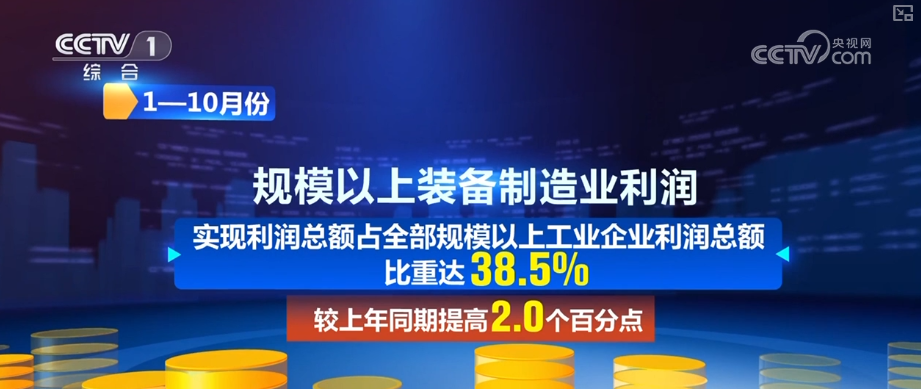
Group 1: Industrial Profit Growth - In the first ten months of the year, profits of large-scale industrial enterprises increased by 1.9% year-on-year, marking three consecutive months of growth since August 2025 [1] - Profits in the equipment manufacturing sector grew significantly, with a year-on-year increase of 7.8%, accounting for 38.5% of total profits in large-scale industrial enterprises, an increase of 2.0 percentage points from the previous year [3] - Seven out of eight major categories in the equipment manufacturing sector reported profit growth, particularly in railways, shipping, aerospace, and electronics, which saw double-digit profit increases [3] Group 2: High-tech Manufacturing Performance - Profits in the high-tech manufacturing sector rose by 8.0% year-on-year during the same period, with strong growth observed in smart electronics, unmanned aerial vehicles, smart vehicle equipment, semiconductor manufacturing, and precision instruments [5] Group 3: Consumption Promotion Policies - The Ministry of Industry and Information Technology, along with five other departments, introduced a plan to enhance the adaptability of supply and demand in consumer goods, aiming to boost consumption [6][10] - The plan outlines 19 key tasks across five areas, focusing on accelerating the application of new technologies and models, expanding the supply of unique and new products, and precisely matching the needs of different consumer segments [10] - By 2027, the goal is to establish three trillion-yuan consumption sectors and ten hundred-billion-yuan consumption hotspots, with a vision for a high-quality development pattern by 2030 [13][15] Group 4: Credit Repair Mechanism - The State Administration for Market Regulation announced a new Credit Repair Management Measures to assist more enterprises in correcting mistakes and restoring their credit [16][19] - The measures include a systematic approach to credit repair, detailing conditions, procedures, and special circumstances, allowing businesses to rebuild their credit in a structured manner [21] - The new regulations categorize violations into "minor, general, and serious," with varying public disclosure periods, and reduce the processing time for credit repair from 15 working days to 7 [23]
产品上新场景焕新活动出新 丰富特色文旅产品供给
Yang Shi Wang· 2025-11-27 04:28
Core Insights - The government is enhancing the adaptability of supply and demand in consumer goods to promote consumption through new products, refreshed scenarios, and innovative activities [2] Group 1: Supply and Demand Adaptability - There is a strong demand for domestic products, cultural creations, and intangible cultural heritage products, leading to the emergence of popular products that meet consumer needs while enhancing cultural identity and spiritual satisfaction [2] - Structural mismatches in supply and demand still exist, with some products experiencing oversupply while high-quality supply remains insufficient [2] - The transition from old to new driving forces is ongoing, with a lack of innovative applications and supply for new products that cater to residents' quality and personalized needs [2] Group 2: Support for Quality Cultural and Tourism Products - The government is supporting the launch of quality cultural tourism products, including awards for animation to encourage innovation in the industry and the development of quality intellectual properties [3] - Initiatives include expanding the pilot scope for cultural and creative product development and promoting high-quality products through exhibitions and trade activities [3] Group 3: Revitalizing Cultural and Tourism Consumption Scenarios - Guidelines for the construction of intangible cultural heritage workshops are being developed to enhance quality and efficiency, promoting a range of related products and services [4] - Seasonal activities such as "Non-Heritage Goodies, National Trend Renewal" are being organized to promote non-heritage products in various sales channels, including supermarkets and duty-free shops [4] Group 4: Innovative Cultural and Tourism Consumption Activities - Nationwide cultural and tourism consumption promotion activities are being held, focusing on seasonal products and services that enhance the consumer experience [6] - Initiatives like "Travel with Performances" and "Travel with Events" are designed to meet diverse consumer needs while promoting rural products [6] - The government is also implementing measures to attract more international tourists through tax refund policies and promoting immediate refunds for purchases [6]
用供需适配性激活消费潜力(市场漫步)
Ren Min Ri Bao· 2025-11-25 22:20
Core Insights - The article emphasizes the importance of adapting supply and demand to enhance consumer satisfaction and activate the potential of the large-scale market [1][2][3] Group 1: Market Trends - The current consumer market is characterized by new trends such as deep application of new technologies, online and offline integration, and multi-channel development [1] - There is a growing demand for personalized, diversified, and high-quality consumption, particularly among younger generations like Generation Z, who prioritize trendiness, social attributes, and experiential consumption [1][2] Group 2: Supply and Demand Adaptation - There exists a structural contradiction of insufficient quality supply, which restricts the release of consumption potential and affects economic circulation efficiency [2] - Enhancing supply-demand adaptability is identified as a key strategy to unlock consumption potential [2] Group 3: Data-Driven Insights - Companies are encouraged to utilize data to accurately identify consumer trends, as demonstrated by successful collaborations like Fuguang and JD.com during this year's "Double 11" sales event [2] - Establishing regular research mechanisms and leveraging big data and artificial intelligence are essential for aligning supply with market demands [2] Group 4: Supply Innovation - Supply-side innovation is crucial for addressing adaptation challenges, with examples including the integration of cultural institutions into commercial spaces and the rise of domestic brands [2] - Future efforts should focus on accelerating the application of new technologies, enhancing high-quality supply, and developing flexible manufacturing to meet personalized demands [2] Group 5: Efficient Distribution Channels - Efficient circulation is vital for ensuring that quality supply meets demand, with significant progress made in modern trade circulation systems since the 14th Five-Year Plan [3] - By 2024, the wholesale and retail industry's added value is projected to reach 13.8 trillion yuan, a 40% increase from the end of the 13th Five-Year Plan [3] - Continued development of modern circulation systems is necessary to lower logistics costs and support supply-demand matching [3] Group 6: Economic Growth - The article highlights the immense potential of China's large-scale market and the need for a virtuous cycle of "consumption upgrade—industry upgrade—supply-demand balance" to better unleash consumption potential [3]