连锁

Search documents
食品饮料行业2025年三季报前瞻:白酒加速出清,大众逐渐改善
Huachuang Securities· 2025-10-22 00:46
Investment Rating - The report maintains a recommendation for the liquor sector, indicating a bottoming out phase with potential for recovery in the future [2]. Core Insights - The liquor industry is experiencing a significant decline in sales, with an expected drop of over 20% in overall sales volume. However, there are signs of month-on-month improvement, and the decline is narrowing [5][9]. - Major liquor companies like Moutai and Wuliangye are showing strong recovery in payment collection, with over 80% collection rates, while regional brands are performing adequately [5][9]. - The report emphasizes the importance of focusing on high-quality liquor brands that are likely to recover faster, such as Moutai and Fenjiu, while also highlighting the need to monitor companies undergoing significant changes [6][9]. Summary by Sections 1. Liquor Sector: Q3 Accelerated Decline and Bottoming Out - The liquor sector is facing a 20%+ decline in sales due to external demand shocks, with a gradual improvement expected in the coming months [5][9]. - High-end liquor brands are expected to show resilience, with Moutai projected to achieve a 3% revenue growth in Q3, while Wuliangye is expected to see a 20% revenue decline [10][11]. - The report indicates that companies are adjusting their strategies to reduce channel pressure and improve operational efficiency [9][10]. 2. Consumer Goods Sector: Overall Demand Weakness, Structural Resilience - The consumer goods sector is experiencing overall weak demand, but segments like snacks and beverages are showing higher resilience [17][24]. - The report notes that while the demand for dairy and beer remains stable, the restaurant supply chain is still under pressure [17][24]. - Raw material prices are generally declining, which may provide some cost relief to companies in the sector [24][25]. 3. Investment Recommendations: Focus on Liquor Bottoming Catalysts and Selective Consumer Goods Trends - The report suggests focusing on liquor companies that are at the bottom of their cycles, with Moutai and Fenjiu being primary recommendations [6][9]. - For consumer goods, the report highlights the potential of snack and beverage companies, recommending brands that are well-positioned to benefit from current trends [6][17].






今年的国庆消费,很不一样
虎嗅APP· 2025-10-12 03:02
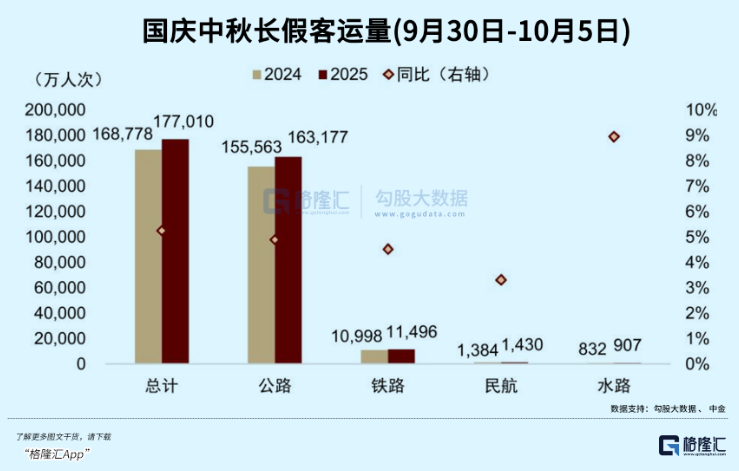
Core Viewpoint - The article discusses the contrasting experiences of tourism during the recent holiday period, highlighting a significant increase in travel numbers but a decline in per capita spending, indicating a shift in consumer behavior towards local tourism and budget-consciousness [12][14][46]. Group 1: Travel Data and Trends - During the holiday from October 1 to October 8, the total cross-regional movement of people reached approximately 2.432 billion, averaging 304 million per day, a year-on-year increase of 6.2% [12]. - The actual number of domestic travelers during the 8-day holiday was 888 million, an increase of 123 million compared to the previous year's 7-day holiday [14]. - The majority of travel was local, with 2.24 billion people traveling by road, indicating that many travelers were either visiting local attractions or returning home rather than traveling long distances [20][22]. Group 2: Consumer Spending Patterns - Total spending on domestic travel during the holiday was approximately 809 billion, an increase of 108.2 billion from the previous year [27]. - Per capita daily spending was 113.9 yuan, a decline of 13% year-on-year, and only 95.9% of the level seen in 2019 [28]. - The average daily expenditure suggests that many travelers spent significantly less, with some spending as little as 28 yuan on additional expenses after basic costs [30][32]. Group 3: Shift in Tourist Demographics - The increase in local tourism is attributed to a rise in local visitors, while the number of out-of-town tourists has decreased, leading to a bustling atmosphere in popular attractions primarily due to local visitors [23][68]. - The trend of camping and outdoor activities has surged, with tent rental orders increasing by 410% year-on-year, reflecting a shift towards more budget-friendly travel options [39]. Group 4: Impact on the Tourism Industry - The tourism industry is experiencing a decline in profitability despite an increase in visitor numbers, as evidenced by the poor performance of several hospitality and restaurant stocks during the holiday period [48]. - The article highlights that the overall consumer sentiment among the middle class has decreased, leading to a more frugal approach to spending on travel and leisure activities [60][71].


今年的国庆消费,很不一样
Hu Xiu· 2025-10-10 13:07
Core Insights - The overall travel data during the holiday period shows a significant increase in the number of travelers, with a total of 2.432 billion cross-regional movements, averaging 304 million per day, a year-on-year increase of 6.2% [10] - Despite the increase in travel numbers, many smaller tourist cities experienced a lack of visitors, indicating a shift towards local tourism rather than long-distance travel [27][22] - The average daily spending per person during the holiday was 113.9 yuan, a decline of 13% year-on-year, suggesting a decrease in overall consumer spending in the tourism sector [31][52] Travel Trends - The number of travelers during the holiday increased by 1.23 billion compared to last year, with a total of 888 million trips taken [12][17] - The majority of travel was local, with 2.24 billion trips made by road, indicating that many people opted for nearby destinations rather than traveling far [21][22] - The rise in local tourism has led to a significant increase in camping and outdoor activities, with tent rental orders surging by 410% compared to last year [42] Consumer Behavior - There is a noticeable trend of younger travelers being more budget-conscious, opting for camping over traditional hotel stays, which has resulted in over 60% of hotel rooms remaining unoccupied during the holiday [48][65] - The shift in consumer behavior reflects a broader trend of reduced spending among the middle class, with a 35% decrease in consumption expectations [74][77] - The overall spending in the tourism sector has not kept pace with the increase in visitor numbers, indicating that while more people are traveling, they are spending less [53][91] Industry Performance - The tourism industry is facing challenges, with many companies reporting declines in stock prices, reflecting the overall downturn in profitability despite increased visitor numbers [55] - The restaurant and hospitality sectors are particularly affected, with significant drops in revenue reported in major cities like Chengdu, where restaurant income fell by 34% [79][82] - The current economic climate has led to a paradox where tourism appears busy, but the profitability of businesses in the sector is declining, highlighting a potential "Disney effect" where certain industries thrive during economic downturns but struggle with profitability [86][91]
聚焦新动向 探索新路径 2025连锁企业用工状况专题座谈会举行
Sou Hu Cai Jing· 2025-08-13 06:11
Core Viewpoint - The meeting focused on employment issues in the retail chain industry, aiming to address labor challenges and explore new pathways for stable employment in the context of changing market dynamics and workforce needs [1][3]. Group 1: Employment Status and Challenges - The retail chain industry employs over 50 million people, accounting for approximately 7% of the total employment population, making it a crucial player in stabilizing and promoting employment [3]. - The current market competition has heightened demands for employee skills and cost control, while demographic changes and shifts in employment perceptions are increasing management difficulties and costs for companies [3]. - The meeting highlighted new trends and challenges in the labor market, particularly with the rise of Generation Z, who prioritize flexible employment, career development, and work-life balance, impacting traditional employment models [5]. Group 2: Innovative Practices for Employment Stability - Retail chains are implementing various strategies to stabilize employment, including optimizing scheduling systems, advancing digital management, providing skills training, and establishing new labor relations [5][6]. - The meeting discussed specific issues such as the application of smart robots, management of hourly workers, cross-regional labor collaboration, and the development of skilled talent pipelines [5]. Group 3: Legal Implications and Compliance - The upcoming implementation of the new judicial interpretation regarding labor disputes, effective September 1, has raised significant attention in the industry, particularly concerning labor relationship recognition and compensation payments [6]. - The meeting explored the specific impacts of these new regulations on labor management and strategies for compliance and risk prevention [6]. Group 4: Future Initiatives and Collaboration - The outcomes of the meeting will be compiled into a report addressing common industry issues and suggestions, which will be submitted to relevant government departments for policy-making reference [7]. - The China Chain Store and Franchise Association plans to continue its role as a bridge, establishing regular communication mechanisms and various initiatives to support the retail chain industry in achieving stable employment and development [7].