Small Household Appliances

Search documents
研判2026!中国烘鞋器行业发展背景、产业链、市场规模、竞争格局、发展趋势:场景拓展与全球化推动,行业市场规模持续上涨[图]
Chan Ye Xin Xi Wang· 2026-02-23 01:32
Core Insights - The shoe dryer industry has experienced steady growth driven by three core factors: population expansion, increased awareness, and demand upgrades [1][7] - The market for shoe dryers in China is projected to reach 1 billion yuan by 2025, with a year-on-year increase of 25.0% [1][8] Market Overview - Shoe dryers, also known as drying machines, are small appliances designed for drying shoes, featuring functions such as drying, sterilization, and deodorization [3] - The primary consumer base for shoe dryers is concentrated in humid southern regions of China, with expanding demand from outdoor workers and sports enthusiasts [1][7] - The shift from low-cost homogenization to high-end differentiation in product structure is a key driver of industry growth [1] Economic Factors - The growth in disposable income and consumer spending in China is a significant factor driving the expansion of the shoe dryer market [4] - From 2020 to 2025, China's per capita disposable income is expected to rise from 32,189 yuan to 43,377 yuan, while per capita consumption expenditure is projected to increase from 21,210 yuan to 29,476 yuan [4][5] Industry Chain - The shoe dryer industry supply chain includes upstream raw materials like engineering plastics and metals, midstream manufacturing, and downstream sales channels such as e-commerce platforms and physical stores [6] - By 2025, major online sales channels for shoe dryers will be Taobao/Tmall and JD.com, accounting for 60% of the market share [6] Competitive Landscape - The shoe dryer industry is transitioning from homogeneous competition to segmented competition, with traditional appliance brands entering the market [9] - Key players in the industry include Chengdu Rainbow Electric Group, Zhejiang Superman Technology, and Guangdong Zhigao Air Conditioning [9][10] Development Trends - The integration of IoT and AI technologies is driving the smart development of shoe dryers, enhancing user experience through features like automatic moisture detection and remote control via mobile apps [11] - The application of shoe dryers is expanding beyond households to include schools, gyms, and hotels, addressing collective living and public health needs [12] - Environmental sustainability is becoming a core competitive advantage, with companies adopting energy-efficient technologies and eco-friendly materials [13]




年货节吹起“悦己”风,小家电如何重塑年轻人的年味与日常
Sou Hu Cai Jing· 2026-01-23 13:55
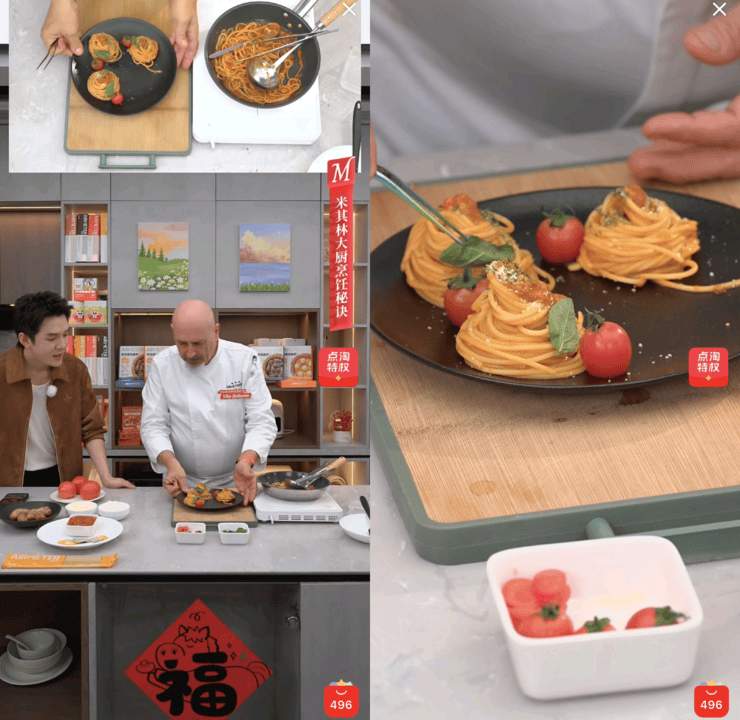
Core Insights - The Tmall New Year shopping festival is witnessing a surge in sales of kitchen small appliances, with products like vacuum machines, air fryers, health pots, soy milk machines, and wall-breaking machines ranking among the top five in live streaming sales, showing significant growth compared to the same period last year [1] Group 1: Consumer Behavior - Consumers are not becoming "lazy"; instead, they are finding a balance between wanting to cook and lacking culinary skills, leading to a demand for convenient cooking tools [3] - Young consumers are no longer satisfied with just "making do" with meals; they seek to create dishes that have a sense of ritual using convenient appliances [3] Group 2: Live Streaming Influence - Live streaming sessions, particularly those hosted by influencers like Li Jiaqi, showcase the transformation of products into appealing food outcomes, enhancing consumer understanding of the appliances' usage and benefits [5] - The immersive demonstration style in live streams highlights the high cost-performance ratio of previously lesser-known products, aligning with young consumers' pursuit of a refined lifestyle [5] Group 3: Social Media and Cooking Trends - The lowering of cooking barriers through small appliances has encouraged many novice cooks to attempt homemade meals, leading to the sharing of their culinary achievements on social media platforms [5] - The popularity of kitchen small appliances during the New Year festival reflects consumers' pursuit of quality of life, embodying the essence of "self-satisfying consumption" by enhancing satisfaction and happiness in daily meals [5] Group 4: Role of Live Streaming - Live streaming serves multiple roles: it is a showcase for product functionality, an interactive platform for user communication, and a trust bridge connecting brands with consumers [5] - The "visible, learnable, and usable" presentation style in live streams transforms small appliances from mere kitchen tools into significant contributors to home dining upgrades and enhanced life rituals [5]
“100多块的电饭锅,怎么可能让你用很多年?”
Xin Lang Cai Jing· 2025-12-10 16:11
Core Viewpoint - The article highlights the growing dissatisfaction among consumers regarding the durability and repairability of small household appliances, which are increasingly perceived as disposable items rather than durable goods [2][6]. Group 1: Consumer Experiences - Consumers report that small appliances, such as rice cookers, often break shortly after the warranty period, leading to frustration when seeking repairs [2][4]. - Many consumers struggle to find local repair services, with some companies requiring them to send appliances back to the manufacturer at their own expense [3][4]. - The trend of small appliances failing quickly is noted, with consumers recalling that older models lasted significantly longer than recent purchases [4][5]. Group 2: Industry Practices - Experts indicate that the reduction of physical repair locations by small appliance companies has made repairs increasingly difficult, contributing to the perception of these products as "one-time" use [2][6]. - The cost of repairs often exceeds the cost of replacement, leading companies to favor mail-in repairs or replacement over maintaining local service centers [5][6]. - There is a noted disparity in quality between online and offline products, with online versions often being of lower quality, which contributes to higher failure rates [5]. Group 3: Environmental and Social Implications - The article discusses the environmental impact of small appliances becoming disposable, leading to significant resource waste, particularly concerning rare materials used in their production [6]. - Experts call for increased regulatory oversight to ensure product quality and to prevent the establishment of "hidden rules" within the industry that compromise consumer rights [6]. - Recommendations include providing better support for older consumers who may not be comfortable with online services, such as covering shipping costs for repairs or offering home service options [6].

2026-2032年全球及中国自动多功能料理机市场监测调查及投资战略评估预测报告
Sou Hu Cai Jing· 2025-11-13 01:43
Group 1 - The global multifunctional cooking machine market is projected to reach USD 3.88 billion by 2031, with a compound annual growth rate (CAGR) of 7.5% from 2024 to 2031, indicating a steady growth trend [7][9] - Key drivers for market growth include the adaptation of consumer demand to fast-paced lifestyles, an increase in home cooking frequency by 32% since 2019, and the integration of IoT and AI technologies into cooking machines [9][10] - The market has expanded from high-end products to a diverse range of price points, with domestic brands reducing entry-level product prices to below 1,000 yuan, making them more affordable for a wider audience [9][10] Group 2 - Major obstacles to market development include the perceived gap in cooking quality compared to manual methods, high prices of mid-to-high-end products, product homogeneity leading to competitive pricing wars, and a steep learning curve for users [10][11] - The global market is moderately concentrated, with the top ten manufacturers holding approximately 35% of the market share in 2024, featuring both international brands like Thermomix and domestic brands like Joyoung [11]
2025年上海市手持式风扇产品质量监督抽查结果公布
Zhong Guo Zhi Liang Xin Wen Wang· 2025-11-06 03:09
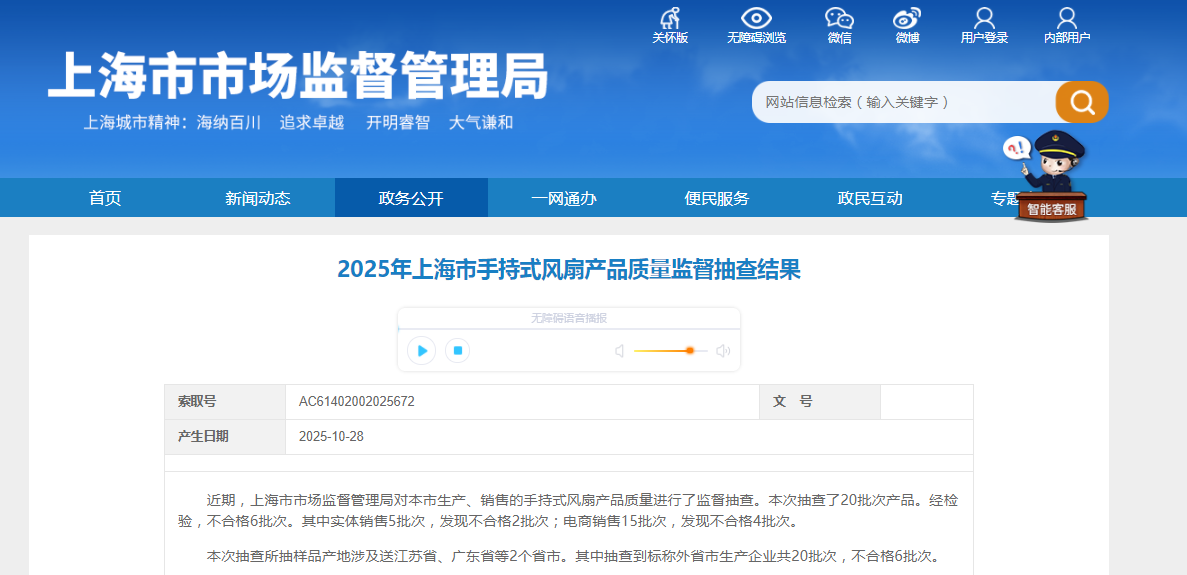
Core Insights - The Shanghai Municipal Market Supervision Administration recently conducted a quality inspection of handheld fans, revealing that out of 20 batches tested, 6 were found to be non-compliant with quality standards [2][4]. Group 1: Inspection Results - A total of 20 batches of handheld fans were sampled, with 6 batches failing the quality inspection [2]. - Among the 20 batches, 5 batches from physical sales and 4 batches from e-commerce sales were identified as non-compliant [2]. - The inspection was conducted based on the SHSSXZ0231-2025 guidelines for product quality supervision [2]. Group 2: Non-compliance Analysis - The non-compliance issues primarily involved labeling and instructions, which are critical for user safety [5]. - Specific failures included the absence of necessary information such as rated voltage, power input, and manufacturer identification, which could lead to user misuse [5]. Group 3: Consumer Usage Tips - Handheld fans come in various styles, including straight-handle and foldable types, suitable for different usage scenarios [6]. - Brand reputation is crucial for ensuring product quality, and consumers are advised to research brands before purchasing [6]. - Safety features such as overcharge protection and electrical insulation should be checked to prevent accidents [6]. Group 4: Additional Features and After-Sales Service - Some handheld fans offer additional features like misting, lighting, and aromatherapy, which may enhance user experience [7]. - Understanding the after-sales service policies, including warranty and repair options, is important for consumers [7].
小熊电器被投诉“养生壶爆炸致一岁宝宝烫伤”!称原因未查明
Nan Fang Du Shi Bao· 2025-09-28 09:25
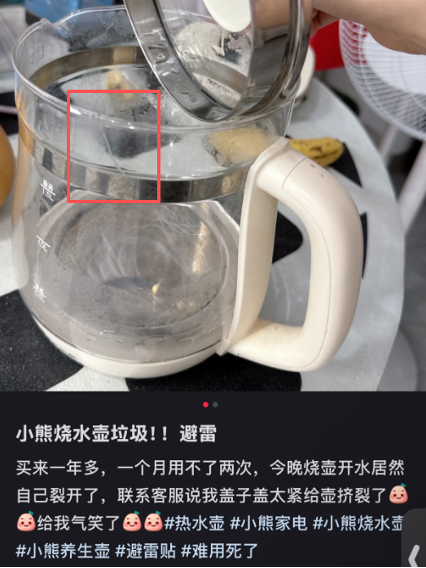
Core Viewpoint - A recent incident involving a Xiaoxiong health pot explosion has resulted in severe injuries to a one-year-old child, raising significant public concern and scrutiny towards the company [1] Company Response - Xiaoxiong Electric has promptly sent representatives to the hospital to comfort the injured child and family, and has maintained communication with them to provide necessary assistance [1][1] - The company stated that the specific cause of the incident and liability have not yet been determined, as the family has not provided the product or the scene for evaluation [1][1] Incident Details - The incident occurred on September 20, when the health pot exploded while the child was playing nearby, resulting in 40% severe burns on the child's body, including second and third-degree burns on the face, neck, shoulders, and chest [1][1] - The explosion also caused glass shards to injure the child, leading to significant blood loss and requiring immediate medical attention [1][1]

养生壶爆炸致1岁宝宝烫伤,网红品牌小熊电器陷质量危机
Feng Huang Wang· 2025-09-28 09:21
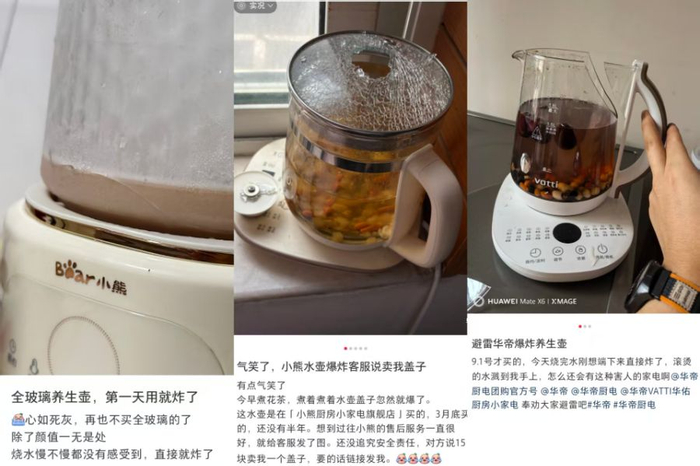
Core Viewpoint - The incident involving a small bear electric kettle explosion has raised significant public concern and scrutiny regarding the safety and quality of the company's products, particularly its high borosilicate glass offerings [1][2][11]. Company Overview - Small Bear Electric, founded in 2006, has positioned itself in the market as a provider of creative small appliances, leveraging youthful design and online marketing strategies to gain market share [9]. - As of 2023, the company has achieved a market share ranking of fourth, following major competitors such as Supor, Midea, and Joyoung [9]. Incident Details - On September 20, a small bear electric kettle exploded during normal use, resulting in severe burns to a one-year-old child [2]. - The company has not yet disclosed core information regarding the incident, stating that it is conducting a thorough investigation [1][11]. Consumer Complaints - There has been a notable increase in complaints regarding the spontaneous cracking or exploding of various glass products from Small Bear Electric, occurring during normal heating processes [5][6]. - Customers have reported issues with multiple product categories, including kettles, washing machines, and other appliances, often citing safety hazards and poor customer service experiences [5][6][8]. Customer Service Response - The company's customer service has been criticized for its handling of complaints, often attributing product failures to user error and denying warranty coverage for glass components [6][8]. - Customers have expressed dissatisfaction with the slow response times and perceived lack of support from the company's service team [8]. Market Context - The small appliance market has seen a shift in consumer behavior, with a growing emphasis on quality and practicality, moving away from the previous trend of viral products [10]. - The recent quality issues faced by Small Bear Electric highlight the challenges of maintaining brand reputation in a competitive market that increasingly prioritizes high-quality standards [10][11].
小熊电器回应养生壶爆炸:正在调查事故原因
2 1 Shi Ji Jing Ji Bao Dao· 2025-09-28 08:29
Core Viewpoint - A recent incident involving a glass health pot from Bear Electric resulted in severe injuries to a child, raising concerns about the safety of such kitchen appliances [1][3] Company Response - Bear Electric responded promptly to the incident, sending representatives to the hospital to assist the affected family and maintain communication for support [1] - The company stated that it could not determine the cause of the explosion without access to the product and promised to update the media and users once the investigation is complete [1] Industry Context - Reports indicate that incidents of explosions involving health pots are not isolated, suggesting a potential safety issue within the industry [1] - An expert in materials highlighted several possible causes for the explosions, including production defects, rapid temperature changes, and inherent risks associated with tempered glass products [3] Financial Performance - Bear Electric's financial results for the first half of 2025 showed total revenue of 2.535 billion yuan, an increase of 18.94% year-on-year, and a net profit of 205 million yuan, up 27.32% [3] - The kitchen small appliance segment generated revenue of 1.673 billion yuan, reflecting a year-on-year growth of 5.02% [3]
数据解码2025年线上消费:重点行业趋势复盘与展望
Sou Hu Cai Jing· 2025-09-13 07:55
Market Overview - The total retail sales of consumer goods in China showed a growth trend from July 2024 to July 2025, with a year-on-year increase of 5.0% in the first half of 2025, driven by policies like trade-in programs and promotions on e-commerce platforms [12][13] - In the first half of 2025, significant growth was observed in various sectors, including home appliances, food, and pet products, with specific categories like ice makers growing by 168% and special medical formula foods increasing by 46% [1][12] Key Industry Trends - The personal care and household cleaning industry is expected to see stable demand and growth, with retail sales projected to increase due to supply chain optimization and market expansion [21][22] - The foundation makeup market in China is anticipated to surpass 100 billion yuan, with brands like Estée Lauder and Lancôme leading in sales on e-commerce platforms [37][38] - The small home appliance market is expanding, with significant sales growth in water purifiers and household appliances, driven by consumer demand for convenience and quality [2][21] - The outdoor and sports industry is experiencing an upward trend in sales, particularly for yoga, fitness, and outdoor travel products, with a notable increase in consumer interest in outdoor apparel and pet-related outdoor products [2][3]

找出那只“毒饭煲”
虎嗅APP· 2025-08-19 10:00
Core Viewpoint - The article highlights the safety hazards associated with low-priced rice cookers, revealing that only a small fraction of popular models pass safety tests, raising concerns about consumer health and product quality [2][5][9]. Group 1: Product Testing and Safety - A recent evaluation of 16 popular rice cookers found that only 5 passed all safety tests, resulting in a pass rate of less than 32% [5][9]. - The main issues identified were the excessive migration of harmful substances from plastic and metal components, particularly in low-priced models [5][10]. - The article emphasizes the importance of ensuring that harmful chemical substances and heavy metals remain within safe limits during cooking [5][6]. Group 2: Market Dynamics and Consumer Behavior - The rice cooker market is highly concentrated, with major brands like Midea, Supor, and Joyoung holding over 60% market share, while low-priced white-label products proliferate due to lower quality standards [9][10]. - Many consumers are misled by e-commerce platforms that prioritize low prices, resulting in a surge in sales of low-quality rice cookers [11][12]. - The article suggests that consumer choices are often influenced by misleading marketing tactics and algorithms that promote low-priced items without regard for quality [12][13]. Group 3: Industry Response and Quality Assurance - In response to the identified issues, JD.com has launched a quality assessment initiative called "Avoid雷情报局" to transparently present product testing results to consumers [5][14]. - JD.com has established a dedicated quality testing laboratory to ensure rigorous evaluation of kitchen appliances, including rice cookers, and to maintain high standards above industry norms [18][20]. - The initiative aims to empower consumers with reliable information, thereby enhancing their purchasing decisions and promoting quality consumption [20][23].