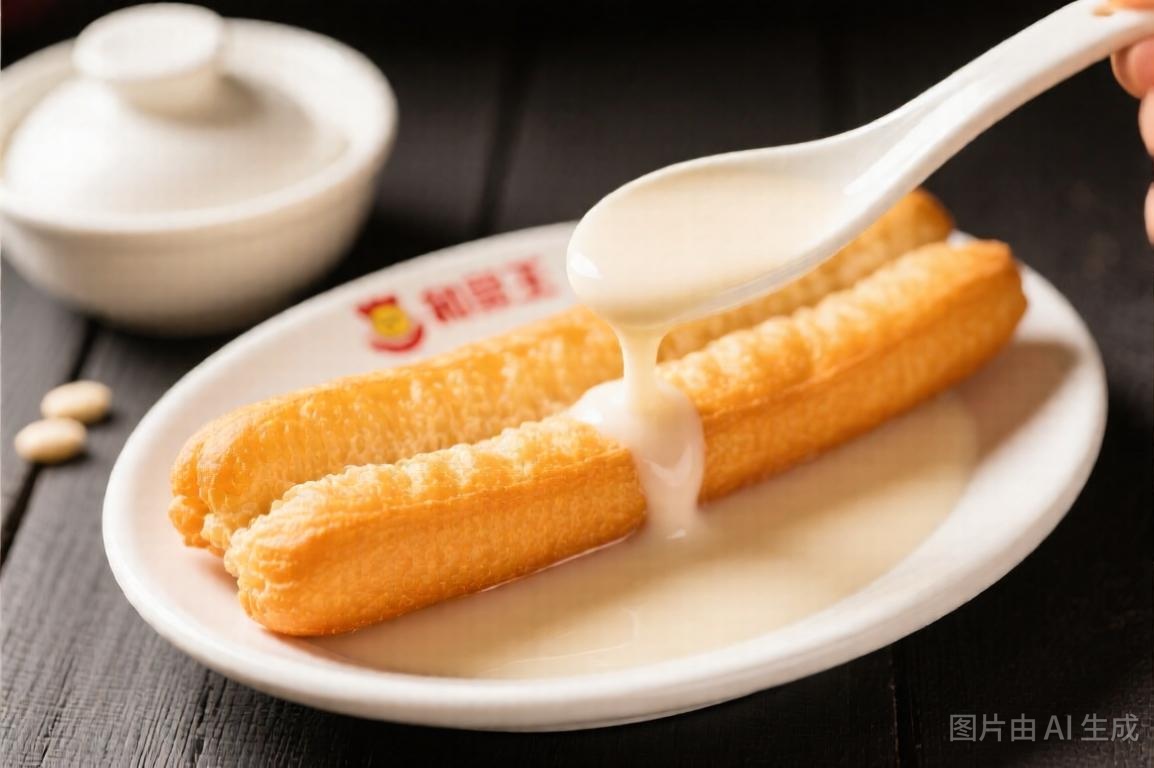
中式快餐

Search documents
老乡鸡IPO:老乡鸡供给侧改革创新赋能上市之路
Sou Hu Cai Jing· 2026-02-24 09:29
Core Viewpoint - The IPO journey of Laoxiangji, a Chinese fast-food brand originating from Anhui, reflects the symbiotic relationship between livelihood catering and capital empowerment, emphasizing the importance of quality and cost-effectiveness in the restaurant industry under the backdrop of expanding domestic demand [1] Group 1: Business Model and Strategy - Laoxiangji's full industry chain layout is the core strength behind its commitment to affordable pricing, with self-built standardized chicken farms ensuring quality and cost control through a two-stage breeding model [3] - The central kitchen is equipped with automated devices, achieving better food processing efficiency and lower waste compared to industry averages, which further reduces costs [3] - The company maintains a stable average customer price range of 20-30 yuan, with individual item prices between 10-30 yuan, absorbing cost pressures through operational efficiency rather than raising prices [3] Group 2: Customer Value and Transparency - Laoxiangji emphasizes customer value through health, variety, cleanliness, and friendliness, being the first in China to pilot a "nutritional labeling demonstration project" to ensure transparency in nutritional information [3] - The company publishes dish traceability reports and provides real-time kitchen monitoring to uphold cleanliness standards, fostering a sense of familiarity and warmth through home-style dishes [3] Group 3: Capital Utilization and Industry Impact - The IPO is not merely a pursuit of blind expansion but aims to inject capital into the upgrade of the entire industry chain, reinforcing supply chain and store standardization to sustain the affordable pricing strategy nationwide [4] - This approach exemplifies a "capital feeding back to livelihood" model, relying on industry chain optimization and quality upgrades rather than premium competition to meet people's aspirations for a better life [4] - Laoxiangji's growth from a regional store to over 1,600 nationwide locations illustrates the response of supply-side initiatives to livelihood demands, balancing social responsibility with commercial sustainability [6]

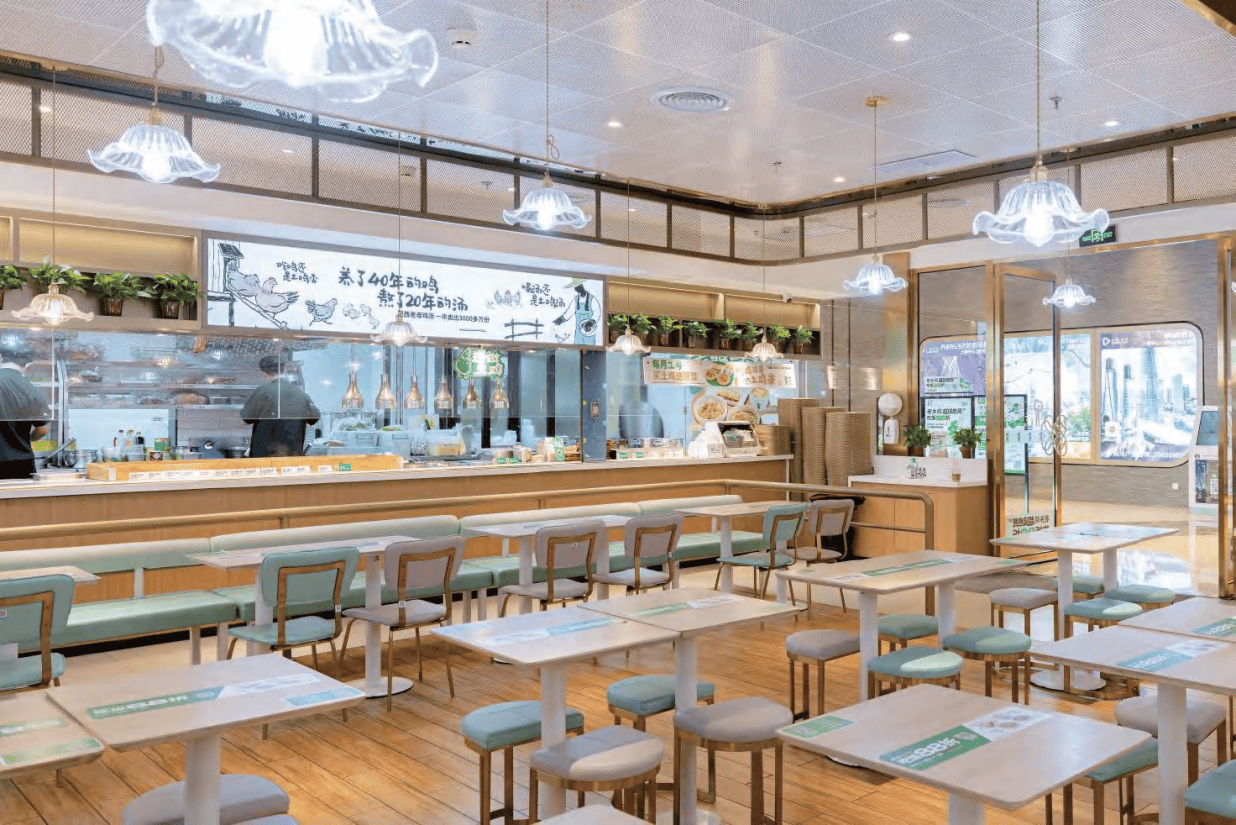
2026年中国餐饮行业报告——连锁化进程加速,加盟模式主导行业发展-勤策消费研究
Sou Hu Cai Jing· 2026-02-15 09:23
Group 1 - The core viewpoint of the article highlights the robust growth of China's consumer market in 2025, with total retail sales of social consumer goods surpassing 50 trillion yuan, and restaurant revenue reaching 57.982 billion yuan, accounting for 11.6% of total retail sales, showing resilience despite a slight year-on-year growth decline of 3.2% compared to overall consumption growth [1][11][12] - The restaurant industry is characterized by high volatility, strong seasonality, and significant resilience, with holiday consumption being a crucial growth driver, particularly during the summer and year-end periods [1][15] - The industry has shifted from incremental competition to stock competition, with a significant increase in the number of restaurant enterprises and employees from 2016 to 2024, driven by the popularity of online food delivery and the influx of private capital [1][16] Group 2 - The restaurant supply chain is undergoing transformation, with upstream fresh agricultural product output steadily increasing, shifting focus from total supply assurance to quality enhancement and precise distribution [2][39] - The cost structure of the restaurant industry is changing, with raw materials, labor, and rent accounting for nearly 75% of revenue, leading to new cost pressures from labor and delivery expenses [2][41] - Fast food is becoming a significant growth driver in the industry, with an expected compound annual growth rate of 7.7% from 2020 to 2030, and Chinese fast food is projected to dominate the market, accounting for 60.9% of the Chinese fast food market by 2024 [2][30] Group 3 - The development of Chinese fast food is driven by multiple factors, including increased dining out rates, significant potential for chain penetration, accelerated standardization, supply chain upgrades, and deepening online channels [3] - The future of the industry is expected to show increased global penetration, improved digitalization, continuous product innovation, and a preference for freshly made consumption, with multi-scenario and all-channel integration becoming key trends [3][34] - The restaurant industry is experiencing a shift towards a low-cost brand dominance, with local brands like Shaxian Snacks and Mixue Ice City forming a duopoly, while high-end dining remains scarce [1][26][27]

沙拉食刻陨落记:1.5亿融资、周杰伦代言 难敌商业模式致命缺陷
Xin Lang Cai Jing· 2026-02-03 09:45
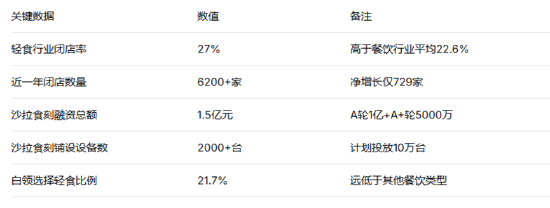
Core Insights - The dramatic downfall of "Salad Time" reflects the challenges faced by the healthy food industry, highlighting the contradictions between health and convenience in its business model [2][18][19] Company Overview - "Salad Time" was founded in 2020 in Dongguan, leveraging an "AI vending machine + light meal salad" model, quickly becoming a capital darling [2][12] - The company aimed to deploy 100,000 AI vending machines within five years, with over 2,000 machines installed by April 2025 in major cities [2][12][19] Financial Performance - The company raised a total of 1.5 billion yuan in funding, including 100 million yuan in Series A and 50 million yuan in Series A+ [8][19] - Despite ambitious revenue projections of at least 1 billion yuan annually, actual operational performance lagged significantly behind expectations [3][13] Operational Challenges - The company's aggressive expansion strategy led to operational inefficiencies, with reports of unpaid wages and delayed payments to franchisees surfacing by March 2025 [3][13][16] - By October 2025, "Salad Time" was officially declared bankrupt, with the founder facing legal issues due to debt disputes [14][16] Business Model Flaws - The company's reliance on a fixed-location vending machine model failed to meet the dynamic lunch needs of office workers, leading to a mismatch between consumer behavior and service delivery [15][16] - The franchise model, which included complex revenue-sharing arrangements, contributed to financial instability and management difficulties [16][19] Industry Context - The healthy food sector is characterized as a "high-risk category," with a closure rate of 27% from 2023 to 2024, surpassing the average closure rate of 22.6% in the broader restaurant industry [18][19] - The market is witnessing an influx of non-healthy food brands entering the light meal segment, increasing competition for independent healthy food brands [20][19] Lessons Learned - The collapse of "Salad Time" serves as a cautionary tale for the healthy food industry, emphasizing the need for a balance between health and convenience in product offerings [18][19] - Successful brands are now focusing on localized innovations that cater to traditional Chinese tastes, moving away from the rigid vending machine model [19][20]
2025餐饮行业观察:规模红利消退,靠什么赢得明天?
3 6 Ke· 2026-01-30 00:25
Group 1: Industry Overview - In 2025, the domestic catering industry in China reported a total revenue of 57,982 billion yuan, marking a year-on-year growth of 3.2% [1] - The revenue from catering enterprises above designated size reached 16,337 billion yuan, with a growth rate of 2.0% [1] - The industry is experiencing a shift from incremental expansion to stock competition, with challenges such as market fragmentation and evolving consumer demands [1] Group 2: Hot Pot Industry Insights - The hot pot industry has entered a phase of "stable total, optimized structure," with a decline in the number of hot pot restaurants by 5.7% year-on-year, totaling approximately 551,000 by the end of 2023 [2] - The top 100 hot pot brands accounted for a market share of 16% in the first half of 2025, generating a combined revenue of 99 billion yuan [2] - Despite the increase in industry concentration, leading companies like Haidilao and Jiumaojiu reported declines in revenue and net profit, indicating overall pricing pressure in the industry [3] Group 3: Consumer Trends and Market Dynamics - The average spending per person on hot pot has decreased from over 80 yuan to around 70 yuan, reflecting a price-sensitive market [3] - The rise of small hot pot brands is notable, with over 24,000 related enterprises existing by November 2025, showing a year-on-year growth of 2.6% [4] - Consumer preferences are diversifying, with younger consumers favoring unique flavors and healthier options, leading to a segmented market [5] Group 4: Challenges in the Hot Pot Sector - The hot pot industry faces challenges such as oversaturation of stores, rising costs, and a lack of innovation, with food ingredient costs increasing from 38% to 45% of total expenses [6] - The industry is experiencing a shift from reliance on store expansion to focusing on supply chain efficiency and differentiated positioning [6] - The competition is intensifying, with brands needing to balance cost and quality to maintain profitability [6] Group 5: Chinese Cuisine and Market Fragmentation - The Chinese dining market is characterized by a "big market, small companies" phenomenon, with leading brands holding less than 1% of the total market share [8] - High cooking standards and regional flavor preferences hinder the scalability of Chinese cuisine, making it difficult for brands to achieve nationwide recognition [8][9] - Many brands are exploring "fusion cuisine" to overcome regional limitations, but face challenges in maintaining flavor integrity and operational efficiency [9] Group 6: Fast Food Sector Challenges - The fast food segment, represented by brands like Laoxiangji and Yuanji Yun Jiao, faces intense competition despite having a large number of stores [11] - Laoxiangji, as the leading brand, has expanded to 1,404 stores but struggles with maintaining quality across its franchise model [12] - Yuanji Yun Jiao's rapid expansion through franchising raises concerns about quality control and food safety, impacting brand reputation [12] Group 7: Future Outlook - The growth logic of the catering industry is shifting from "store scale competition" to "single-store efficiency competition," emphasizing supply chain optimization and quality management [15] - Brands that can balance expansion, quality control, and cost management will likely succeed in the evolving market landscape [15] - The industry is expected to continue facing challenges related to consumer trust and operational efficiency, necessitating ongoing innovation and adaptation [15]
遇见小面(02408)发盈喜,预期2025年度利润约1亿元至1.15亿元 同比增加约64.7%至89.5%
智通财经网· 2026-01-29 11:11
Core Viewpoint - The company, Meet Xiaomian (02408), anticipates a significant increase in profits for the fiscal year ending December 31, 2025, driven by expansion in its restaurant network and improved operational efficiency [1] Financial Performance - The company expects to achieve a profit ranging from approximately RMB 100 million to RMB 115 million for the fiscal year ending December 31, 2025, representing an increase of about 64.7% to 89.5% compared to the profit of RMB 60.7 million for the fiscal year ending December 31, 2024 [1] - The adjusted net profit (non-IFRS measure) is projected to be between approximately RMB 125 million and RMB 140 million, which is an increase of about 95.6% to 119.1% from the adjusted net profit of RMB 63.9 million for the fiscal year ending December 31, 2024 [1] Growth Drivers - The anticipated improvement in profitability is primarily due to the expansion of the company's direct-operated and franchised restaurant network, increasing the total number of restaurants from 360 as of December 31, 2024, to 503 by December 31, 2025 [1] - The company is gradually expanding its restaurant locations from city centers to surrounding areas, where rental costs are lower but profit margins are higher [1] - The contribution of operating profit from restaurants in the Hong Kong Special Administrative Region is expected to increase as the number of outlets grows, along with further dilution of headquarters costs [1]
老乡鸡更新招股书:门店数1777家,8个月营收超45亿元
Sou Hu Cai Jing· 2026-01-14 15:20
Core Viewpoint - LXJ International Holdings Limited, known as "Laoxiangji," is advancing its IPO process on the Hong Kong Stock Exchange, with CICC and Guotai Junan acting as joint sponsors [2] Group 1: Company Overview - Laoxiangji is one of the first standardized Chinese fast-food companies in all core operational aspects, with its first restaurant opening in Hefei, Anhui in 2003 [2] - As of August 31, 2025, Laoxiangji operates 1,658 stores across 61 cities in China, including 925 direct-operated and 733 franchised stores, with plans to increase to 1,777 stores by December 31, 2025 [2] - Laoxiangji ranks first in the Chinese Chinese fast-food industry with a market share of 0.9% and eighth in the overall fast-food industry with a market share of 0.5% based on 2024 transaction volume [2] Group 2: Market Position and Growth - The Chinese fast-food market is growing, with the Chinese fast-food segment being the largest and growing faster than the overall industry [3] - The East China region is the largest and fastest-growing market for Chinese fast food, expected to reach a market size of 462.6 billion yuan by 2029, growing at a compound annual growth rate of 10.3% [3] - Laoxiangji has 1,434 restaurants in East China, accounting for 86.5% of its total restaurants, and holds a market share of 2.2% in the region, which is 2.5 times that of the second-largest competitor [3] Group 3: Operational Efficiency - Laoxiangji is the only major Chinese fast-food company with a full supply chain layout, including chicken farming, central kitchens, and restaurant services, and the first to implement a comprehensive traceability system [4] - As of December 31, 2025, Laoxiangji operates three chicken farms in Anhui and two automated central kitchens, along with eight distribution centers nationwide [4] - The company has adopted digital tools since the 2010s, establishing an IT center and a digital growth department to enhance operational efficiency and standardization [4] Group 4: Customer Engagement and Financial Performance - As of August 31, 2025, Laoxiangji has approximately 31.4 million registered members, including 13 million active members and 600,000 paying members, making it the largest membership base among Chinese fast-food companies [5] - Revenue figures for Laoxiangji from 2022 to 2024 are 4.528 billion yuan, 5.651 billion yuan, and 6.288 billion yuan, with an increase of 10.9% in revenue to 4.578 billion yuan in the first eight months of 2025 compared to the same period in 2024 [5] - Adjusted net profits from 2022 to 2024 are 268 million yuan, 403 million yuan, and 439 million yuan, with a 13.2% increase in adjusted net profit to 394 million yuan in the first eight months of 2025 compared to the same period in 2024 [5] Group 5: IPO and Future Plans - Prior to the IPO, Cahuac Capital holds a 4.98% stake in Laoxiangji as the only institutional investor [6] - The net proceeds from the IPO will be used to strengthen the integrated supply chain, expand the store network, enhance IT capabilities, and support brand promotion and marketing activities [6]
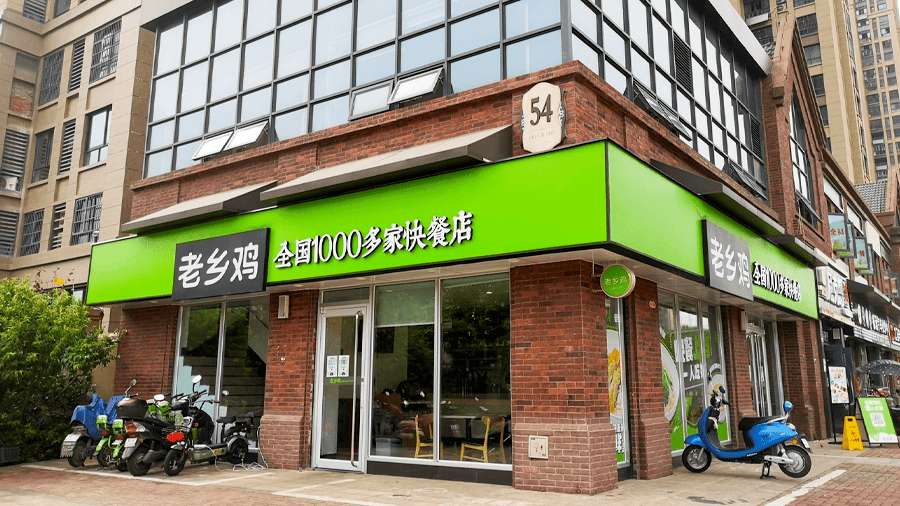
老乡鸡继续推进港交所上市进程:门店数增至1777家,8个月营收超45亿元
IPO早知道· 2026-01-14 14:27
Core Viewpoint - LXJ International Holdings Limited, known as "Laoxiangji," is advancing its IPO process on the Hong Kong Stock Exchange, with a focus on expanding its integrated supply chain and store network while enhancing digital capabilities and brand marketing [2][6]. Group 1: Company Overview - Laoxiangji opened its first restaurant in Hefei, Anhui in 2003 and has since developed a "direct + franchise" store network, with 1,658 stores across 61 cities as of August 31, 2025, projected to increase to 1,777 by December 31, 2025 [2]. - The company is recognized as one of the first standardized Chinese fast-food companies in all core operational aspects [2]. Group 2: Market Position - Laoxiangji ranks first in the Chinese Chinese fast-food industry with a market share of 0.9% based on total transaction volume in 2024, and ranks eighth in the overall fast-food industry with a 0.5% market share [2]. - In the East China region, Laoxiangji holds the largest market share of 2.2% in the Chinese Chinese fast-food sector, significantly higher than the second-largest competitor [3]. Group 3: Financial Performance - Revenue figures for Laoxiangji from 2022 to 2024 were 4.528 billion, 5.651 billion, and 6.288 billion yuan, respectively. For the first eight months of 2025, revenue increased by 10.9% to 4.578 billion yuan compared to the same period in 2024 [5]. - Adjusted net profits for the same period were 268 million, 403 million, and 439 million yuan, with a 13.2% increase in the first eight months of 2025 to 394 million yuan [5]. Group 4: Supply Chain and Technology - Laoxiangji is the only major Chinese fast-food company with a fully integrated supply chain, including chicken farming, central kitchens, and restaurant services, and is the first to implement a comprehensive traceability system [4]. - The company has established three chicken farms and two automated central kitchens in Anhui, along with eight distribution centers nationwide to ensure fresh ingredient delivery [4]. Group 5: Membership and Customer Engagement - As of August 31, 2025, Laoxiangji has approximately 31.4 million registered members, with 13 million active members and 600,000 paying members, leading the Chinese Chinese fast-food sector in membership size [5]. - Active members place an average of 8.1 orders, while paying members have a monthly purchase frequency of 5.8 times [5].
先声药业分拆先声再明赴港IPO,文创IP公司桑尼森迪递表港交所
Sou Hu Cai Jing· 2026-01-13 07:38
Group 1 - The core viewpoint of the article highlights the recent IPO activities in the Shanghai Stock Exchange, Shenzhen Stock Exchange, and Hong Kong Stock Exchange, with a focus on the performance of newly listed companies and their market valuations [2][8][12] - In the Shanghai Stock Exchange, only one company, Shaanxi Tourism, was listed during the period, with its stock price increasing by 72.18% from the issue price, reaching a market capitalization of approximately 10.7 billion yuan [3][2] - The Hong Kong Stock Exchange saw a more active IPO environment with seven companies listed, including notable performers like Zhipu Huazhang and MiniMax, which saw significant stock price increases of 79.35% and 141.21% respectively [9][10][11] Group 2 - Zhipu Huazhang, an AI company, achieved a market capitalization of approximately 91.7 billion HKD after a 79.35% increase in stock price [9] - MiniMax, another AI-focused company, experienced a remarkable 141.21% increase in stock price, leading to a market capitalization of around 123.1 billion HKD [10] - Other companies like Tian Shu Zhi Xin and Jing Feng Medical also reported substantial stock price increases, indicating a strong interest in tech and healthcare sectors [10][11] Group 3 - Several companies submitted IPO applications during the period, including Zhejiang Borui Biopharmaceutical and Hangzhou Deshi Biotechnology, indicating ongoing interest in the biotech sector [16][26] - The financial data of these companies show varying revenue and profit trends, with Borui Biopharmaceutical projecting revenues of 12.57 billion yuan and 16.23 billion yuan for 2023 and 2024 respectively [24][26] - Deshi Biotech reported revenues of 52.84 million yuan and 70.35 million yuan for the same periods, highlighting the growth potential in the medical imaging sector despite initial losses [27] Group 4 - Companies like Xizi Health and Sanisen Di are focusing on expanding their market presence in the health and nutrition sectors, with Xizi Health projecting revenues of 14.47 billion yuan and 16.92 billion yuan for 2023 and 2024 [36][38] - Sanisen Di aims to enhance its product competitiveness and expand its sales network, reflecting a trend towards innovation in the toy industry [39] - The financial performance of these companies indicates a mix of growth and challenges, with Xizi Health showing a profit increase while Sanisen Di is still working towards profitability [40][38] Group 5 - The article also discusses the performance of established companies like Laoxiangji, which is the largest Chinese fast-food brand, reporting revenues of 45.28 billion yuan in 2022 and projected growth in subsequent years [44] - Laoxiangji's market strategy includes optimizing its supply chain and expanding its store network, which is crucial for maintaining its competitive edge in the fast-food industry [43] - The financial outlook for Laoxiangji shows a steady increase in revenue and profit, indicating a strong market position despite potential risks associated with brand recognition and operational challenges [45][44]


老乡鸡三度递表港交所拟上市,中金海通联席保荐,发展态势受关注
Sou Hu Cai Jing· 2026-01-10 05:08
Core Viewpoint - LXJ International Holdings Limited, the parent company of Anhui Laoxiangji Catering Co., Ltd., has submitted a prospectus to the Hong Kong Stock Exchange for an initial public offering (IPO), marking its third attempt to go public after previous applications lapsed due to time constraints [1] Company Overview - Laoxiangji was founded by Shu Congxuan in 2003 and has grown to become one of the largest Chinese fast-food brands, adhering to the philosophy of "healthy, rich, clean, and friendly" to provide a home-like dining experience [3] - As of April 30, 2025, Laoxiangji operates 1,658 stores across 58 cities in 9 provinces in China, including 925 direct-operated stores and 733 franchised stores, serving over 206 million customers in the first eight months of 2025 [3] Market Position - According to Zhaoshang Consulting, Laoxiangji ranks first in the Chinese Chinese fast-food market with a market share of 0.9% based on total transaction volume in 2024, and ranks eighth in the overall Chinese fast-food industry with a market share of 0.5% [3] Financial Performance - Laoxiangji has shown steady growth in recent years, with revenues of 4.528 billion RMB, 5.651 billion RMB, and 6.288 billion RMB for the years 2022, 2023, and 2024 respectively, and net profits of 252 million RMB, 375 million RMB, and 409 million RMB for the same years [5] - In the first eight months of 2025, the company achieved a revenue of 4.578 billion RMB and a net profit of 371 million RMB, continuing its growth trend [5] Ownership Structure - The ownership structure of Laoxiangji is relatively concentrated, with Shu Congxuan's son, Shu Xiaolong, holding 70.78% of the shares through Constantly Soar Ltd, while his sister, Shu Wen, holds 15.02% through Jump Spark Ltd, and Shu Xiaolong's spouse, Dong Xue, holds 6.22% through Favourable Impression Ltd [4]

永和大王等中国业务或被“打包”上市,快乐蜂意图国际资本“乘风破浪”
Xi Niu Cai Jing· 2026-01-10 02:17
Group 1 - The core point of the article is that Jollibee Foods Corporation plans to spin off its international operations, including its Chinese business, into a new entity called "Jollibee International Company," with plans for an independent listing on a U.S. stock exchange by the end of 2027 [2][3] - The spin-off aims to allow the original Jollibee Group to focus on its stable and cash-generating domestic market in the Philippines, while the new entity will pursue global expansion ambitions [2] - The Chinese operations, which include brands like Yonghe King and Hongzhuangyuan with over 550 stores, are facing intense competition from local brands such as Luckin Coffee and Mixue Ice Cream, prompting strategic adjustments [2] Group 2 - Yonghe King has implemented a "value model" by lowering menu prices to attract customers, resulting in a significant increase in order volume [2] - The company has also reduced the costs of opening new stores and plans to focus on second-tier cities with more favorable rental conditions, aiming to shorten the investment payback period [2] - As a result of these strategies, Jollibee's Chinese business saw a same-store sales growth of 8% in the third quarter of 2025 [2] Group 3 - The spin-off is seen as a "shot in the arm" for Jollibee's international business, particularly in China, as it will allow for more focused funding for international expansion and enhance brand visibility in global markets [3] - This move will enable Chinese brands like Yonghe King to potentially receive more resources to accelerate their transformation and expansion in the Chinese market [3] - The success of the planned U.S. listing will depend on market conditions and regulatory approvals, but it sets the stage for a promising future for the Chinese fast-food business [3]