
中证全债指数

Search documents
指数那么多,到底该怎么选?一文带你搞懂最常见的指数
雪球· 2026-03-14 04:46
Core Viewpoint - The article discusses various types of investment indices, their characteristics, and suitability for different types of investors, emphasizing the importance of asset allocation for stable returns [2][3]. Group 1: Types of Indices - High Dividend Index: Composed of companies with high and stable cash dividends, providing relatively high dividend income even during market fluctuations [6][7]. - Low Volatility Index: Offers a smoother net value curve during market downturns, suitable for investors seeking stability [11]. - Industry Index: Represents specific industries by selecting the most representative companies based on market capitalization and liquidity, directly investing in the future of that industry [15][19]. - Thematic Index: Targets specific trends and identifies quality assets across industries, acting as a "weather vane" for investment opportunities [21][30]. Group 2: Specific Indices - Hang Seng Tech Index: Comprises 30 major Hong Kong tech companies, covering sectors like internet, e-commerce, and fintech, with high growth potential but also higher risk compared to broader indices [23][24]. - Nasdaq 100 Index: Includes the largest 100 non-financial companies listed on the Nasdaq, primarily global tech giants, with high growth potential and associated risks [27][29]. Group 3: Bond and Commodity Indices - Bond Index: Composed of various bonds, with the China Bond Index reflecting the overall performance of the domestic bond market, offering stable returns and low volatility [36][40]. - Commodity Index: Tracks the price performance of major commodities like gold and oil, often moving independently from stock and bond markets, useful for inflation hedging [41][43].


中证指数公司:1月科创100指数上涨13.83% 黄金股票指数上涨48.4%
智通财经网· 2026-02-11 12:12
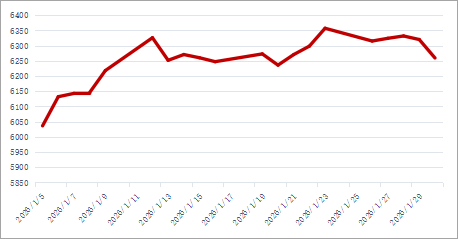
Capital Market Performance - In January, the CSI All Share Index closed at 6,259.18 points, up by 5.75% [2] - Major A-share market indices generally rose, with the Sci-Tech Innovation 100 Index increasing by 13.83% [4] - The CSI All Share primary industry indices showed mixed results, with the Materials Index rising by 18.10% [6] - The Gold Mining, CS Precious Metals, and Gold Stocks Indices increased by 50.17%, 49.22%, and 48.40% respectively [8] Trading Volume and Activity - Total trading volume for Shanghai stocks reached 259,873.65 million yuan, up by 45.70% from the previous month [15] - Shenzhen stocks totaled 343,595.69 million yuan, an increase of 37.16% [15] - The average daily trading volume for Shanghai stocks was 12,993.68 million yuan, up by 67.55% [15] - The average daily trading volume for Shenzhen stocks was 17,179.78 million yuan, up by 57.73% [15] Index and Fund Management - As of the end of January 2026, the China Securities Index Company published a total of 2,836 indices, including 1,800 stock indices [20] - The total scale of funds tracking indices managed by the China Securities Index Company reached 46,640 billion yuan, with 25,516 domestic fund products [26] - In January, 37 new fund products tracking indices managed by the China Securities Index Company were established, raising a total of 20.1 billion yuan [31] Index Revisions - One index was revised in January, changing the name from "CSI Hong Kong 300 Financial Services Index" to "CSI Stock Connect Financial Services Index" [22][25]
找到不确定性中的锚点:一份真诚的A500基金配置指南
Sou Hu Cai Jing· 2025-12-02 10:04
Core Insights - The article discusses the shift in investor consensus from "expected returns and star products" to "multi-asset and multi-strategy" approaches in the current uncertain market environment [4] - The A500 ETF and its connected funds are highlighted as key tools for this asset allocation transformation, providing a stable investment strategy amidst market volatility [5][6] Investment Strategies - The concept of "balance between stocks and bonds" is emphasized, rooted in Benjamin Graham's investment philosophy, advocating for a balanced allocation of equity and fixed-income assets [7][8] - A practical implementation of a 50-50 stock-bond strategy using the CSI A500 index and the CSI All Bond Index has shown significant historical performance, achieving a total return of 527.6% over the past two decades [13][15] - The strategy's annualized return of 9.2% outperformed a fully invested A500 strategy, demonstrating the effectiveness of dynamic rebalancing to mitigate risks and enhance returns [15][16] Performance Analysis - Various stock-bond allocation combinations were analyzed, revealing that a 50% A500 and 50% bond allocation yielded the highest total return and a manageable level of risk [16] - The article presents a detailed performance table showing the total returns, annualized returns, and minimum annual returns for different stock-bond allocation ratios, highlighting the benefits of a balanced approach [16] Core-Satellite Strategy - The core-satellite investment strategy is introduced as a method to simplify asset allocation, where core assets (70-80%) provide stability and satellite assets (20-30%) seek higher returns [17][19] - The CSI A500 index is positioned as a preferred choice for core assets due to its balanced representation of the market and long-term performance [19][21] Practical Application - For investors seeking to balance risk and return, a suggested allocation of 70% core assets in a combination of CSI A500 and CSI All Bond Index, with 30% in satellite assets, is recommended [22] - The article emphasizes the importance of tailoring asset allocation to individual risk tolerance and investment goals, rather than strictly adhering to historical ratios [17][22] Conclusion - The A500 ETF and its associated funds are positioned as effective tools for investors to build resilient portfolios that can adapt to market changes, reducing anxiety over daily market fluctuations [36][38] - The article concludes that constructing a well-balanced investment portfolio is crucial for long-term success, rather than attempting to predict short-term market movements [35]

一年十大资管重磅事件全梳理
2 1 Shi Ji Jing Ji Bao Dao· 2025-08-05 11:46
Core Insights - The asset management industry is undergoing significant changes driven by regulatory policies and market dynamics, with a focus on compliance, consumer protection, and high-quality development [1] Group 1: Policy Changes - On September 24, 2024, a comprehensive set of financial policies was introduced, leading to a turning point in stock and bond market trends, with the Shanghai Composite Index surging by 4.2% on the same day [2][3] - The introduction of several key regulations, including the "Financial Institutions Product Appropriateness Management Measures," aims to enhance compliance and protect consumer rights in the wealth management sector [5][6] Group 2: Market Trends - The stock market experienced a significant shift, with the CSI 300 Index rising by 21% by the end of October 2024, marking a transition from a bear to a bull market [3] - The bond market saw fluctuations, with the 10-year government bond yield dropping below 2.5% following the implementation of easing policies [3][4] Group 3: Investment Strategies - The introduction of policies to promote long-term capital market investments, including increasing the investment ratio of commercial insurance funds in A-shares, is expected to shape asset allocation strategies for large asset management institutions [7][8] - The public fund industry is responding to new regulations by implementing performance-based fee structures and enhancing the assessment mechanisms for fund managers [9][10] Group 4: Industry Developments - The number of private equity firms is decreasing due to stricter regulations, with 568 private fund managers being deregistered in the first half of 2025 [15] - The popularity of passive investment strategies is rising, with passive equity fund sizes surpassing active funds, reflecting a shift in investor preferences [16][17] Group 5: Gold Investment - The gold market has seen a significant increase in investment, with the price rising from approximately $1,178 per ounce in late 2018 to around $3,280 per ounce by mid-2025, marking a cumulative increase of about 178% [18][19] Group 6: Bond ETF Growth - The bond ETF market is rapidly expanding, with the total scale surpassing 500 billion yuan, and new products like the Sci-Tech Bond ETF being introduced to cater to evolving market needs [20]
基金业绩比较基准研究系列:国内主动型债券基金
CMS· 2025-05-26 09:04
1. Report Industry Investment Rating No relevant content provided. 2. Core Viewpoints of the Report The report focuses on the performance comparison benchmarks of domestic active bond funds. It analyzes the benchmark settings of various sub - types of active bond funds and their deviations in actual operations. After the release of the "Action Plan", some bond funds have adjusted their performance comparison benchmarks. The report also studies the correlation between funds and benchmarks, tracking errors, and excess returns [1][9]. 3. Summary According to the Table of Contents 3.1 Introduction On May 7, 2025, the CSRC issued the "Action Plan for Promoting the High - quality Development of Public Funds", emphasizing the importance of performance comparison benchmarks. The report, as the second in the series, will analyze the benchmark settings and actual operation deviations of domestic active bond funds [9]. 3.2 Active Bond Fund Performance Comparison Benchmark Characteristics - **Generalized Active Bond Fund Sample Selection**: As of May 7, 2025, 4191 generalized active bond funds in existence and with performance comparison benchmarks were selected as samples, with a total scale of 9.05 trillion yuan. The samples include 7 types of funds, and the medium - long - term pure - bond funds have the largest number and scale [9][10][12]. - **Performance Benchmark Composition Method**: The performance comparison benchmarks of active bond funds have various forms, mainly including single bond indexes or weighted composites of different indexes. The component indexes can be classified into 6 major categories, and the bond index can be further divided into 5 sub - types, while the stock index can be divided into 9 sub - types [13]. - **Performance Benchmark Commonly Used Indexes**: The top ten "main benchmark indexes" of medium - long - term pure - bond funds are mainly indexes compiled by ChinaBond. For example, the number of funds with ChinaBond - Composite Full Price (Total Value) Index as the main benchmark index is 964, accounting for 52.56%. The main benchmark indexes of convertible bond funds are mainly convertible bond indexes, with CSI Convertible Bond Index being the most used. The main benchmark indexes of fixed - income enhanced funds are mainly A - share market indexes such as CSI 300 Index [36][41][50]. - **Comparison of Commonly Used Index Clusters**: The ChinaBond index system is compiled by the Central Government Bond Depository Trust & Clearing Co., Ltd., and the CSI index system is compiled by CSI Index Co., Ltd. The component bond listing locations, remaining maturities, and credit ratings of ChinaBond and CSI indexes are different [54][57]. - **Weight Distribution of "Main Benchmark Indexes"**: For most active bond funds, the weights of ChinaBond - Composite Full Price (Total Value) Index and ChinaBond - Composite Wealth (Total Value) Index are mainly in the range of 90 - 100% for medium - long - term pure - bond funds, mixed bond - type first - level funds, and mixed bond - type second - level funds. The weights of equity indexes in the performance comparison benchmarks of mixed bond - type second - level funds, convertible bond - type funds, and partial - debt hybrid funds are relatively concentrated [62][66]. 3.3 Fund Performance and Benchmark Correlation and Other Analyses - **Correlation Analysis between Active Bond Funds and Their Benchmarks**: From 2022 to 2025, convertible bond - type funds, short - term pure - bond funds, medium - short - term pure - bond funds, medium - long - term pure - bond funds, and partial - debt hybrid funds have relatively high correlations with their performance comparison benchmarks, while mixed bond - type first - level funds and mixed bond - type second - level funds have relatively low correlations [72][73]. - **Tracking Error and Excess Return of Funds Relative to the Benchmark**: The average tracking error of pure - bond funds is less than that of products with embedded options. Among fixed - income enhanced bond funds, first - level bond funds have lower tracking errors, second - level bond funds and partial - debt hybrid funds are relatively close, and convertible bond funds have the highest and most volatile tracking errors. Most pure - bond funds can outperform the benchmark in most years, and the average outperformance is within 2%. Among fixed - income enhanced funds, partial - debt hybrid funds have relatively high average excess returns [3][78]. - **Distribution of Fund Types with Significant Underperformance against the Benchmark**: Pure - bond funds have relatively small deviations from the benchmark and a low proportion of significant underperformance. The performance of fixed - income enhanced funds is related to the selected time interval and the performance of the equity market. In the long - term, active bond funds have the ability to obtain positive excess returns relative to the benchmark, but there are significant performance differences within each type of fund [3].