科创100指数

Search documents
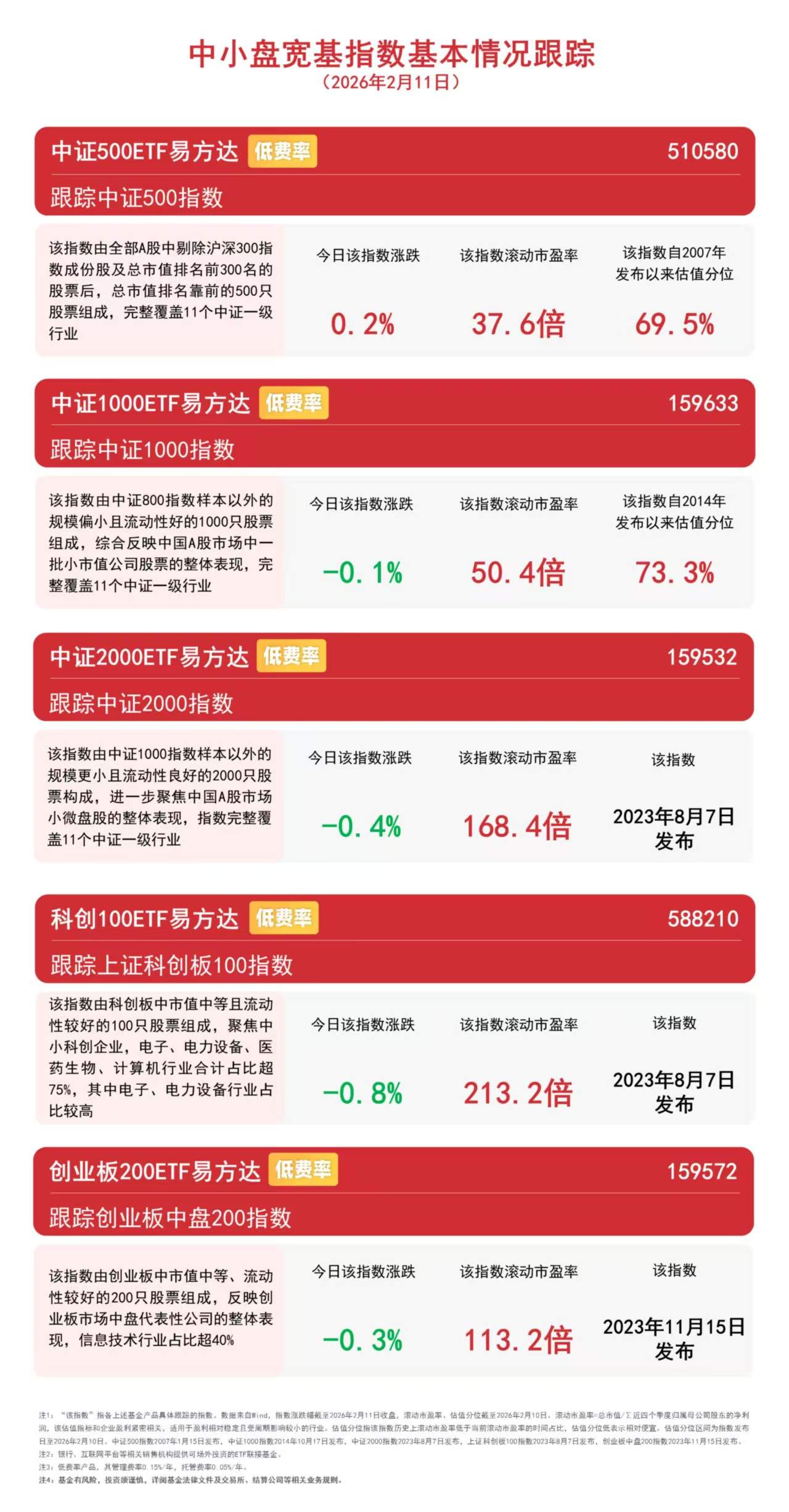
科创板指数将进行一季度样本调整
Zheng Quan Ri Bao· 2026-02-28 01:11
Group 1 - The core announcement is about the quarterly adjustment results of the Sci-Tech 50 and other indices, which will be implemented after the market closes on March 13 [1] - Three companies, including Keda Guandun Quantum Technology Co., Ltd., Shenzhen Zhongke Feimeng Technology Co., Ltd., and Zhongke Xingtai Co., Ltd., will be added to the Sci-Tech 50 Index, while ten other securities will be added to the Sci-Tech 100 Index [1] - After the adjustments, the total market capitalization of the Sci-Tech 50 Index will be 4.5 trillion yuan, covering 39% of the market, while the Sci-Tech 100 Index will have a total market capitalization of 2.7 trillion yuan, covering 24% of the market, resulting in a combined coverage of 63%, an increase of 1.1% [1] Group 2 - The Shanghai Stock Exchange has been enhancing its "one body, two wings" index system to improve the quality and diversity of indices, effectively supporting long-term capital inflow and national strategic initiatives [2] - The periodic adjustments of existing indices aim to optimize industry structures, with the weight of information technology and other "new economy" sectors increasing by 4.9% and 4.7% respectively by the end of 2024 [2] - The newly launched indices cover the entire market capitalization and industry chain of the Sci-Tech Board, guiding over 320 billion yuan into "hard technology" companies [2]



A股重要指数,调样在即
Zhong Guo Zheng Quan Bao· 2026-02-27 14:56
Group 1 - The core viewpoint of the news is the periodic adjustment of the sample stocks in the Sci-Tech Innovation Board indices, which enhances the representativeness of the indices and supports the development of new productivity in China [2][3]. - After the adjustment, the total market capitalization coverage of the Sci-Tech 50 Index and the Sci-Tech 100 Index over the entire Sci-Tech Board increased to 63%, up by 1.1% from before the adjustment [2]. - The adjustment allows for an orderly exchange of sample stocks between the Sci-Tech 50 Index and the Sci-Tech 100 Index, with the former incorporating stocks from the latter, thereby enhancing the representation of large and medium-cap securities on the Sci-Tech Board [3]. Group 2 - The Sci-Tech 50 Index saw an approximate 2% increase in the weight of the new generation information technology sector, while the Sci-Tech 100 Index experienced a 4% increase in sectors such as new materials and biomedicine [3]. - The Shanghai Stock Exchange is continuously improving its index system to enhance quality and diversity, which supports long-term capital inflow and aligns with national strategic goals [3]. - As of February 27, the Sci-Tech 50 Index, Sci-Tech 100 Index, and North Exchange 50 Index have recorded increases of 10.7%, 14.22%, and 6.71% respectively since the beginning of the year [5][6]. Group 3 - The adjustment of indices is part of a routine process, reflecting the ongoing trend of index-based investment in the A-share market, which is gaining momentum [7]. - The overall improvement in the quality of listed companies and the favorable economic conditions are seen as strong support for the development of domestic indices and index investment [7].

中证指数公司:1月科创100指数上涨13.83% 黄金股票指数上涨48.4%
智通财经网· 2026-02-11 12:12
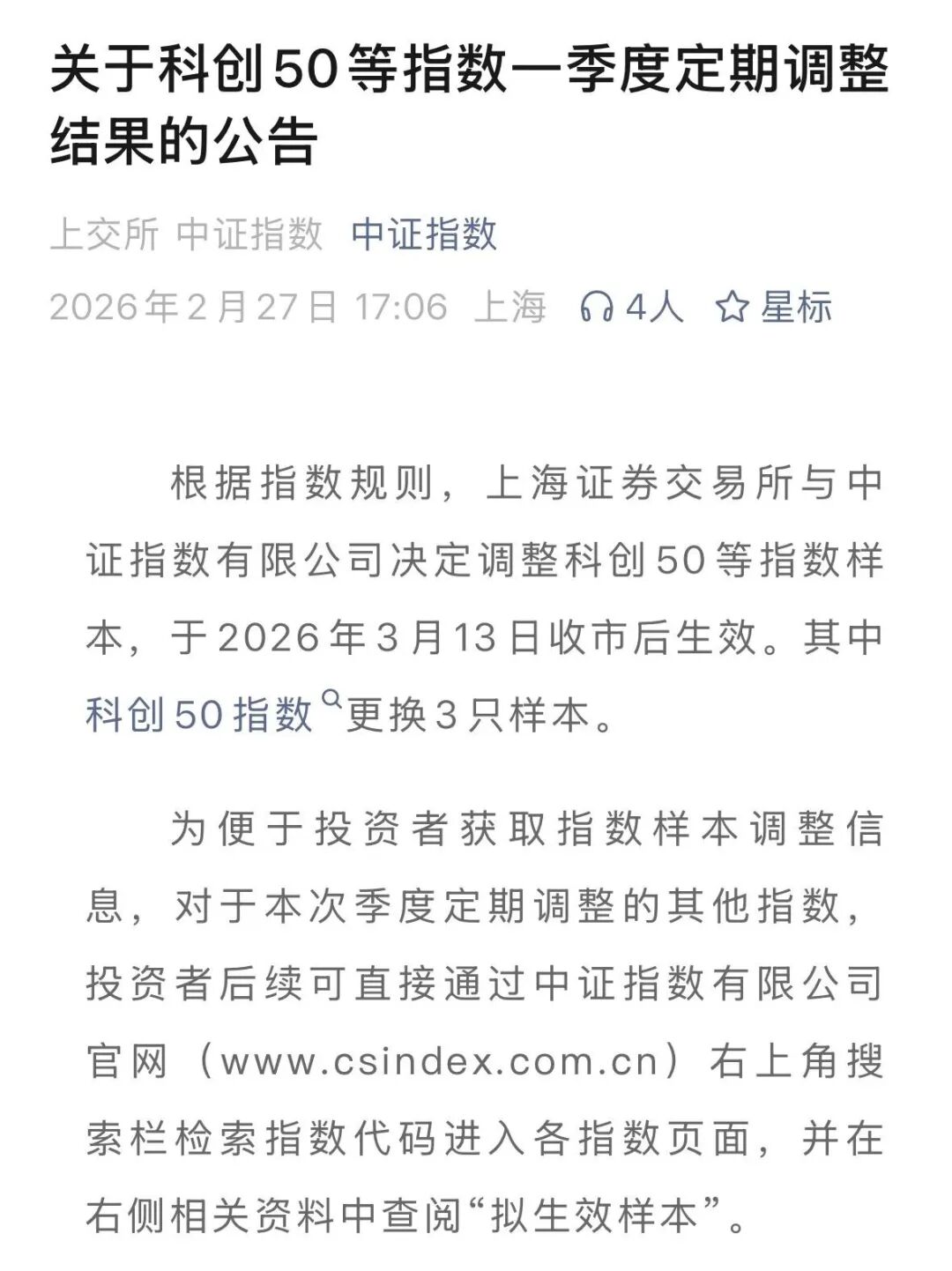
Capital Market Performance - In January, the CSI All Share Index closed at 6,259.18 points, up by 5.75% [2] - Major A-share market indices generally rose, with the Sci-Tech Innovation 100 Index increasing by 13.83% [4] - The CSI All Share primary industry indices showed mixed results, with the Materials Index rising by 18.10% [6] - The Gold Mining, CS Precious Metals, and Gold Stocks Indices increased by 50.17%, 49.22%, and 48.40% respectively [8] Trading Volume and Activity - Total trading volume for Shanghai stocks reached 259,873.65 million yuan, up by 45.70% from the previous month [15] - Shenzhen stocks totaled 343,595.69 million yuan, an increase of 37.16% [15] - The average daily trading volume for Shanghai stocks was 12,993.68 million yuan, up by 67.55% [15] - The average daily trading volume for Shenzhen stocks was 17,179.78 million yuan, up by 57.73% [15] Index and Fund Management - As of the end of January 2026, the China Securities Index Company published a total of 2,836 indices, including 1,800 stock indices [20] - The total scale of funds tracking indices managed by the China Securities Index Company reached 46,640 billion yuan, with 25,516 domestic fund products [26] - In January, 37 new fund products tracking indices managed by the China Securities Index Company were established, raising a total of 20.1 billion yuan [31] Index Revisions - One index was revised in January, changing the name from "CSI Hong Kong 300 Financial Services Index" to "CSI Stock Connect Financial Services Index" [22][25]
机构称春节前后小盘风格有望占优,关注中证2000ETF易方达(159532)、中证500ETF易方达(510580)配置价值
Mei Ri Jing Ji Xin Wen· 2026-02-11 11:08
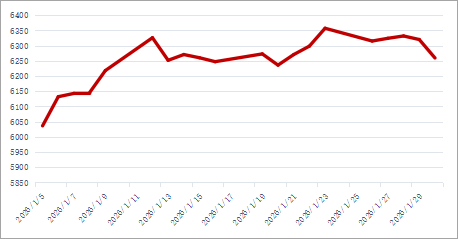
Group 1 - The core viewpoint is that A-shares are likely to experience a favorable upward trend in the next 1-2 months, driven by a combination of favorable timing, conditions, and human factors, particularly during the strong seasonal effect of spring and around the Chinese New Year [1] - The CSI 500 index rose by 0.2%, while the CSI 1000 index fell by 0.1%, the CSI 2000 index decreased by 0.4%, the STAR 100 index dropped by 0.8%, and the ChiNext Mid-cap 200 index declined by 0.3% [1] Group 2 - The CSI 500 ETF, which tracks the CSI 500 index, has a rolling price-to-earnings ratio of 37.6 times since its inception [3] - The CSI 1000 index, composed of 1,000 smaller and more liquid stocks, has a rolling price-to-earnings ratio of 50.4 times [4] - The CSI 2000 index, focusing on even smaller and more liquid stocks, has a rolling price-to-earnings ratio of 168.4 times since its launch [5]
20cm速递|成长风格仍占优,科技主线回调或可布局,科创100ETF国泰(588120)回调0.5%
Mei Ri Jing Ji Xin Wen· 2026-02-11 07:23
Group 1 - The core viewpoint is that the growth style remains dominant, and there may be opportunities to invest during the recent pullback in the technology sector [1] - From a macro perspective, the current growth cycle is shorter than the historical average of 34 months, indicating that it is only in the mid-stage of its cycle [1] - Policy support, liquidity easing, and AI industry drivers continue to support the relative performance of growth stocks, with a forecasted net profit growth rate for high P/E indices expected to maintain the growth trend through 2026 [1] Group 2 - The 科创100ETF国泰 (588120) tracks the 科创100 index (000698), which has a daily price fluctuation limit of 20% and includes 100 securities selected from the Sci-Tech Innovation Board based on market capitalization and liquidity [1] - The 科创100 index reflects the overall performance of listed companies related to technological innovation, covering high-tech fields such as information technology, biomedicine, and high-end manufacturing, showcasing strong innovation and growth characteristics [1] - The disparity in AI investment cycles is noted, with overseas AI capital expenditures exceeding expectations, while domestic AI investments are still in the early stages [1]
硬科技板块集体调整,持续关注科创200ETF易方达(588270)、科创50ETF易方达(588080)投资机会
Sou Hu Cai Jing· 2026-02-11 05:16
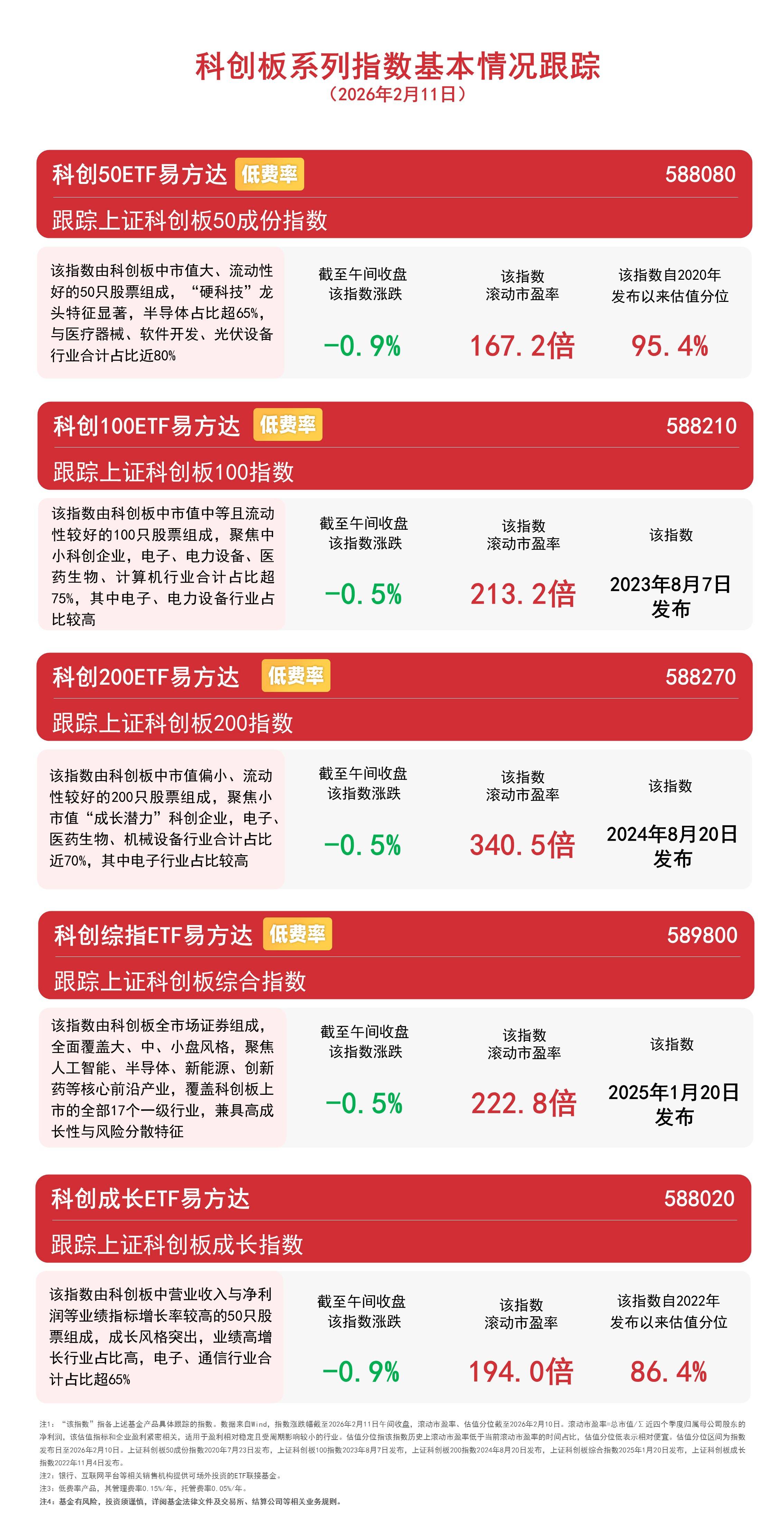
Group 1 - The core viewpoint of the news indicates a collective adjustment in hard technology sectors such as CPO, storage chips, and semiconductor equipment, with a decline in AI application concepts as of the morning session on February 11 [1] - The ChiNext 100 Index, ChiNext 200 Index, and ChiNext Composite Index all experienced a drop of 0.5%, while the ChiNext 50 Index and ChiNext Growth Index fell by 0.9% [1] Group 2 - The ChiNext 200 ETF is designed to track the ChiNext 200 Index, which consists of 200 stocks from the ChiNext board that are smaller in market capitalization and have good liquidity, focusing on small-cap "growth potential" technology enterprises [7] - The electronic and biomedical sectors, along with machinery equipment, account for nearly 70% of the ChiNext 200 Index, with the electronic sector having a significant share [7] - The ChiNext Composite Index ETF aims to track the comprehensive index of the ChiNext board, covering large, medium, and small-cap styles, with a focus on artificial intelligence, semiconductors, and new energy [7]
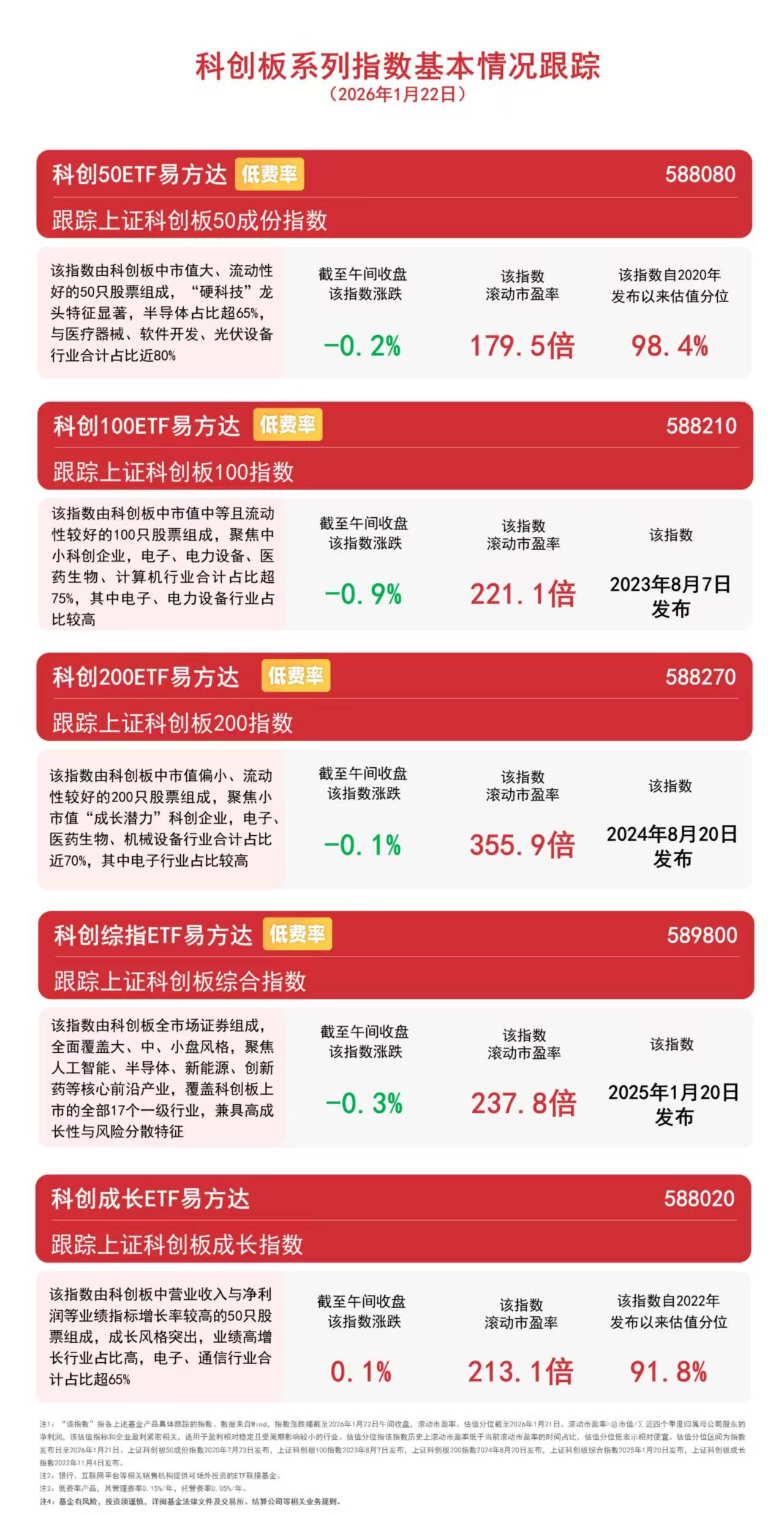
科创板系列指数高开低走,关注科创200ETF易方达(588270)、科创50ETF易方达(588080)等投资价值
Sou Hu Cai Jing· 2026-01-22 05:17
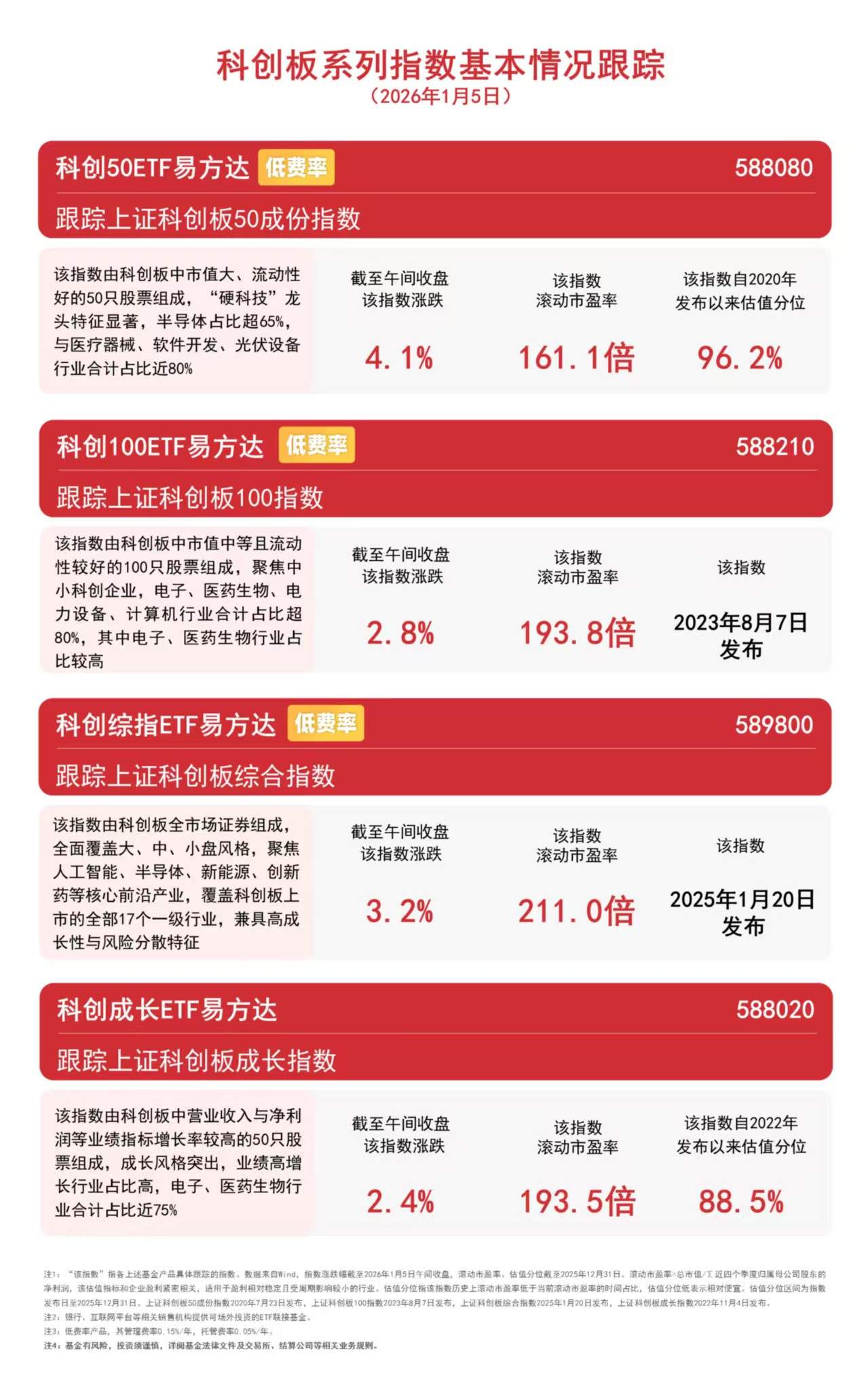
Group 1 - The index consists of 50 stocks from the Sci-Tech Innovation Board, characterized by large market capitalization and liquidity, with over 65% in the semiconductor sector and nearly 80% combined with medical devices, software development, and photovoltaic equipment [2] - As of the midday close, the index experienced a decline of 0.2%, with a rolling price-to-earnings ratio of 179.5 times since its launch [2] Group 2 - Another index is composed of 200 smaller market capitalization stocks from the Sci-Tech Innovation Board, focusing on "growth potential" enterprises in electronics, biomedicine, and machinery, which together account for nearly 70%, with a significant portion in the electronics sector [4] - This index also saw a decline of 0.1% as of the midday close, with a rolling price-to-earnings ratio of 355.9 times [4] Group 3 - A third index includes 50 stocks with high growth rates in revenue and net profit, showcasing a growth style with over 65% in the electronics and communications sectors [6] - This index recorded a slight increase of 0.1% at midday, with a rolling price-to-earnings ratio of 213.1 times since its inception [6]
20cm速递|科创板100ETF(588120)盘中回调,关注回调布局机会,科技行业仍具备持续占优条件
Mei Ri Jing Ji Xin Wen· 2026-01-15 06:47
Core Viewpoint - The technology sector remains poised for long-term superiority, supported by strong earnings growth, overseas market dynamics, and an upward semiconductor cycle [1]. Group 1: Earnings Growth - The TMT (Technology, Media, and Telecommunications) sector is currently experiencing superior earnings growth compared to the overall A-share market, mirroring characteristics seen before previous technology market rallies in 2013, 2015, and 2020-2021 [1]. Group 2: Overseas Market Dynamics - The current technology sector is benefiting significantly from the expansion of capital expenditure cycles among global technology giants, providing solid fundamental support for domestic related industries [1]. Group 3: Semiconductor Cycle - The global semiconductor industry has entered a new upward cycle since the end of 2023, currently in its early stages, which is expected to sustain the overall optimism for the technology sector [1]. Group 4: ETF Overview - The Sci-Tech Innovation Board 100 ETF (588120) tracks the Sci-Tech 100 Index (000698), which includes 100 securities with larger market capitalization and better liquidity from the Sci-Tech Board, covering high-tech fields such as new-generation information technology, biomedicine, and new materials [1].
20cm速递|科创板100ETF(588120)涨超1.6%,昨日净流入超5000万元,科技行业占优条件依然未变
Mei Ri Jing Ji Xin Wen· 2026-01-09 02:50
Group 1 - The core viewpoint of the article highlights that the technology sector continues to maintain favorable conditions in the current market environment, with significant positive factors concentrated in this field [1] - The TMT (Technology, Media, and Telecommunications) sector is showing superior profit growth compared to the overall A-share market, reminiscent of conditions seen in 2013, 2015, and 2020-2021 [1] - The expansion of capital expenditure cycles by global tech giants serves as a crucial driver for the current technology sector, providing fundamental support for the industry chain [1] - The global semiconductor cycle is currently experiencing an upward trend, entering the initial phase of a new upturn that began at the end of 2023 [1] Group 2 - The Science and Technology Innovation Board 100 ETF (588120) rose over 1.6%, with a net inflow of over 50 million yuan, indicating strong investor interest in the technology sector [1] - The index tracked by the Science and Technology Innovation Board 100 ETF consists of 100 securities selected from the Science and Technology Innovation Board, focusing on large market capitalization and good liquidity, covering high-tech fields such as new-generation information technology, biomedicine, and new materials [1]
硬科技爆发,科创50指数半日涨超4%,科创50ETF易方达(588080)成交额超12亿元
Mei Ri Jing Ji Xin Wen· 2026-01-05 06:11
Group 1 - The article discusses the recent trends in the investment banking sector, highlighting the impact of economic conditions on deal-making activities [2] - It notes a significant decline in mergers and acquisitions (M&A) activity, with a year-over-year drop of approximately 30% in deal volume [2] - The report emphasizes the importance of adapting to changing market dynamics to identify new investment opportunities [2] Group 2 - The article mentions that companies are increasingly focusing on strategic partnerships rather than traditional M&A to drive growth [2] - It highlights the role of technology in reshaping the investment landscape, with fintech companies gaining traction [2] - The analysis points out that regulatory changes are influencing investment strategies and market behavior [2]