主动量化产品

Search documents
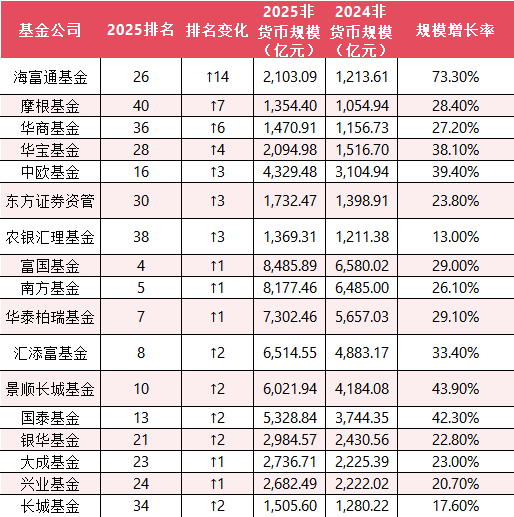
2025非货规模“上升榜”揭晓:海富通成最大黑马,摩根、华商等中小公司异军突起
Xin Lang Cai Jing· 2026-01-23 04:21
Core Insights - The public fund industry is experiencing significant growth in management scale, with notable disparities in growth rates among companies, indicating a shift from "scale expansion" to "quality and differentiation competition" [1][6][10] Group 1: Company Performance - Hai Fu Tong Fund emerged as the biggest "dark horse," rising 14 places to rank 26th, with a non-monetary scale increase of 73.3% to 210.3 billion yuan, driven by dual efforts in "fixed income +" and equity products, particularly in pension management and customized institutional services [1][7] - China Europe Fund moved up 3 places to 16th, with a scale growth of 39.4%, reinforcing its position as an "active equity expert" [1][7] - Invesco Great Wall Fund and Guotai Fund each rose 2 places, with scale increases exceeding 42%, benefiting from their strategies in ETF and active quantitative fields [1][7] - Huatai-PB Fund improved its ranking by 1 place to 7th, with a scale growth of 29.1%, solidifying its leading position in broad-based and dividend ETFs [1][7] - Huitianfu Fund climbed 2 places to 8th, with a scale increase of 33.4%, as consumer and pharmaceutical-themed products continued to attract capital [1][7] Group 2: Emerging Companies - Among smaller firms, Morgan Fund (China) and Huashang Fund rose 7 and 6 places respectively, reflecting the potential of "boutique" and "specialized" strategies in a competitive market [2][7] - Companies that saw ranking improvements generally exhibited three characteristics: focused product lines in advantageous sectors, dual-driven growth from institutional and retail businesses, and proactive layouts in innovative areas like ETFs and quantitative strategies [2][7] Group 3: Industry Trends - The median growth rate of companies that improved their rankings exceeded 25%, significantly surpassing the industry average, indicating their sustained active management capabilities [2][7] - The dramatic changes in the non-monetary scale rankings serve as a clear "scorecard" of the industry's fierce competition and evolving landscape, primarily reflecting capital flows and market enthusiasm [5][10]

量化投资深度对话:拆解超额收益逻辑,展望行业未来趋势
雪球· 2025-12-25 08:04
Core Viewpoint - The article discusses the performance and future trends of quantitative investment strategies in 2025, highlighting the coexistence of differentiation and opportunities within the public quantitative fund industry [2][4][5]. Group 1: Differentiation in Quantitative Investment - The public quantitative industry in 2025 is characterized by product differentiation, with a wider variety of quantitative products available compared to previous years, including strategies covering 500, 1000, and 2000 indices [4]. - Alpha differentiation has expanded, with significant variations in excess returns among different models on the same platform, indicating a rare occurrence of divergence within the industry [4]. - There is a notable performance gap between public and private quantitative funds, with public funds being more conservative due to compliance constraints, while private funds have shown better performance in small-cap stocks [4]. Group 2: Opportunities in Quantitative Investment - 2025 is seen as a significant year for quantitative investment, with active market participation and substantial individual stock differentiation creating a favorable environment for excess returns [5]. - The year marks the implementation of high-quality development policies in public funds, promoting "constrained active management" as a mainstream approach, which opens new opportunities for quantitative methods across various investment processes [5]. - Quantitative investment is increasingly recognized as a valuable methodology for predicting returns, managing risks, optimizing portfolios, and executing trades, leading to broader application across the asset management industry [5]. Group 3: Trends and Future Outlook - The future of public quantitative investment is expected to be expansive, with an increasing number of listed companies and improved liquidity, providing ample opportunities for differentiation in quantitative strategies [10]. - The integration of AI into public quantitative investment is anticipated to enhance investment methodologies, emphasizing the need for precision and detail in research and development [10]. - The focus for 2026 will be on strengthening the alpha generation capabilities while ensuring robust risk management to maintain investor confidence during market volatility [11].

风格轮动对于量化多头的影响大不大?如何衡量?
私募排排网· 2025-09-19 07:21
Core Viewpoint - Market style rotation is a typical characteristic of A-shares, where no single style can consistently outperform the market. This rotation significantly impacts quantitative long strategies, influencing their excess returns directly [2][3]. Group 1: Impact of Style Rotation - Style rotation serves as a double-edged sword for quantitative long strategies, affecting performance and sustainability. When market style aligns with historical preferences of quantitative models (e.g., small-cap style), strategies can capture significant stock selection alpha, leading to outstanding performance [3]. - In the first half of 2023 and the small-cap market in 2024, many quantitative products achieved considerable returns. However, when market styles reverse sharply (e.g., collective pullback of small-cap stocks in early 2024), quantitative strategies face significant challenges, often resulting in noticeable drawdowns [3]. - Quantitative models rely on historical data to identify patterns. If a particular style (like small-cap) remains dominant, models will increase exposure to that style. A sudden style reversal can lead to the short-term failure of factors based on historical data, causing stock selection alpha to vanish or even turn negative [3]. Group 2: Performance Disparity Among Strategies - Style rotation exacerbates performance disparities among different quantitative products. Funds focusing on different tracks (e.g., 300 index enhancement vs. 1000 index enhancement) or employing varying style constraints or risk control capabilities will exhibit significant performance differences during style shifts [3]. - The average excess return of over 200 quantitative long strategy products under billion-yuan private equity was approximately -1.69%, with only 22.67% showing positive excess returns, indicating a high exposure to small-cap and growth styles [7]. Group 3: Market Conditions and Future Outlook - The market exhibited significant style switching from August to September 2025, driven by macroeconomic changes, capital flows, and policy expectations. The relative performance of broad-based indices reflects the rotation between large-cap and small-cap styles [7]. - The small-cap factor's return volatility has increased, and the average excess drawdown during rapid style transitions typically ranges from 1-4%, with the potential for a higher average excess drawdown of 8-9% in February 2024. However, subsequent recovery trends are generally smooth [11].

电子增强组合周度收益跑至主动型科技基金产品前列-20250811
Changjiang Securities· 2025-08-11 13:37
Quantitative Models and Construction Methods - **Model Name**: Dividend Enhanced Portfolio **Model Construction Idea**: Focuses on high-dividend stocks, aiming to capture excess returns from dividend-paying assets through a systematic approach[6][15] **Model Construction Process**: 1. Selects stocks with high dividend yields from the market. 2. Constructs two portfolios: "Central SOE High Dividend 30 Portfolio" and "Balanced Growth Dividend 50 Portfolio". 3. Applies a "steady + growth" style for the Central SOE portfolio and a "balanced offensive and defensive" style for the Dividend 50 portfolio[14][21] **Model Evaluation**: The model underperformed the benchmark this week, indicating weaker relative performance in the current market environment[21] - **Model Name**: Electronics Enhanced Portfolio **Model Construction Idea**: Focuses on the electronics sector, leveraging quantitative methods to identify outperforming sub-sectors and stocks[7][14] **Model Construction Process**: 1. Constructs two portfolios: "Electronics Balanced Allocation Enhanced Portfolio" and "Electronics Sector Preferred Enhanced Portfolio". 2. The Balanced Allocation Portfolio adopts a diversified approach across the electronics sector. 3. The Preferred Portfolio targets leading companies in mature sub-sectors of the electronics industry[14][31] **Model Evaluation**: Both portfolios outperformed the electronics sector index, demonstrating strong relative performance[31] Model Backtesting Results - **Dividend Enhanced Portfolio**: - Central SOE High Dividend 30 Portfolio: Weekly return of approximately 4.49%, underperforming the benchmark[15][21] - Balanced Growth Dividend 50 Portfolio: Weekly return of approximately 2.57%, also underperforming the benchmark[15][21] - **Electronics Enhanced Portfolio**: - Electronics Balanced Allocation Enhanced Portfolio: Weekly excess return of approximately 0.59%, ranking in the 15th percentile among active technology funds[7][31] - Electronics Sector Preferred Enhanced Portfolio: Weekly excess return of approximately 0.47%, ranking in the 17th percentile among active technology funds[7][31]
潮涌东方启新章 券商资管先行者的十五载价值投资征程
券商中国· 2025-07-27 23:22
Core Viewpoint - The article highlights the evolution and achievements of the brokerage asset management industry over the past 15 years, emphasizing the importance of value investment and the establishment of a diversified product matrix to meet investor needs [1][2][19]. Industry Development - The brokerage asset management industry began its independent operations in 2010 with the establishment of the first brokerage asset management company, marking a new chapter in the industry [2]. - The industry has experienced significant growth, with assets under management increasing from 2.8 trillion yuan at the end of 2011 to a peak of 18.8 trillion yuan in April 2017, driven by regulatory changes and market demand [5][6]. - The introduction of the new fund law in 2013 allowed brokerage firms to apply for public fund licenses, further expanding their operational scope [5][6]. Value Investment and Research Platform - The industry has focused on building a robust research and investment platform, emphasizing value investment based on fundamental research to achieve sustainable returns for investors [3][4]. - The establishment of independent asset management subsidiaries has allowed leading brokerages to enhance their operational capabilities and adapt to market changes [4][6]. Product Matrix and Innovation - The brokerage asset management sector has transitioned from a focus on single asset management to a more diversified product offering, including public and private fund management [10][11]. - As of June 30, 2025, the company managed 106 collective asset management plans across various investment fields, showcasing its strong investment management and risk control capabilities [10][11]. - The company has been proactive in launching innovative products, including the first public fund license among brokerages and a comprehensive range of FOF products tailored to different investor profiles [12][13]. Client Service and Trust Building - The company has developed a unique client service model, conducting extensive outreach and educational initiatives to foster a healthy investment mindset among clients [14][15][17]. - The "Oriental Red Ten Thousand Miles" client service initiative has been instrumental in building trust, with over 14,000 events held nationwide, reaching more than 2 million participants [17]. - The company aims to deepen its relationship with investors through a comprehensive service model that combines research, investment, and advisory services [18]. Future Outlook - The company is set to embark on a new strategic plan in 2025, focusing on serving emerging industries and integrating into the broader financial ecosystem [21]. - The commitment to value creation and high-quality service will continue to guide the company's operations as it seeks to enhance its competitive edge in the asset management industry [19][21].