
全国碳排放配额(CEA)

Search documents
2026年3月碳排放月报:全国CEA交易进入淡季-20260302
Bao Cheng Qi Huo· 2026-03-02 04:28
1. Report Industry Investment Rating No information provided in the report. 2. Core Viewpoint of the Report As of February 25, 2026, the closing price of the national carbon market carbon emission allowance (CEA) was 81.00 yuan/ton, remaining flat compared to the previous month and down 9.75% compared to the same period last year. In the past 30 trading days, the average trading volume of national carbon emission allowances was 463,000 tons, a month-on-month decrease of 1.465 million tons from the previous period, indicating a decline in the activity of the carbon emission spot market [3][32][68]. 3. Summary According to Relevant Catalogs 3.1 Industry News - The Ministry of Ecology and Environment issued a notice on the work related to the national carbon emission trading market in 2026, including strengthening the management of the list of key emission units, data quality, quota allocation and settlement, and the management requirements for other key industries [9]. - The EU's Carbon Border Adjustment Mechanism (CBAM) officially came into effect on January 1, 2026. The EU's setting of a significantly high default value for China's product carbon emission intensity and plans to expand the product coverage range are unfair and discriminatory, and China firmly opposes these practices [30][31]. 3.2 National Carbon Market Carbon Emission Allowance (CEA) As of February 25, 2026, the closing price of CEA was 81.00 yuan/ton, remaining flat compared to the previous month and down 9.75% compared to the same period last year. In the past 30 trading days, the average trading volume was 463,000 tons, a month-on-month decrease of 1.465 million tons, indicating a decline in market activity [32]. 3.3 Carbon Price Influence Factor Analysis 3.3.1 Energy Price - As of February 25, 2026, the price of steam coal at Qinhuangdao Port showed an increase compared to the end of the previous month but a decrease compared to the end of 2025. The pithead price of steam coal also showed a similar trend. The coke price remained flat compared to the end of the previous month but decreased compared to the end of 2025. The LNG ex-factory price index decreased compared to the previous period, and the European natural gas spot price decreased compared to the end of the previous month and the end of 2025 [35][36][37]. 3.3.2 Energy Consumption In 2025 from January to December, the cumulative apparent consumption of natural gas in the country was 426.55 billion cubic meters, 500 million cubic meters more than the previous year; the cumulative apparent consumption of coke was 496.7758 million tons, 15.706 million tons more than the previous year; the total apparent consumption of gasoline, kerosene, and diesel was 376.7113 million tons, 6.2874 million tons less than the previous year [40]. 3.3.3 Domestic Carbon Emission Structure China's total carbon emissions have exceeded 10 billion tons, accounting for about one-third of the world's carbon emissions. The largest source of carbon emissions in China is the "Electricity, Steam and Hot Water Production and Supply" industry, followed by the "Ferrous Metal Smelting and Rolling Processing" industry. In terms of energy types, carbon emissions mainly come from the consumption of coal, followed by fuel oil and natural gas [44][51]. 3.3.4 Total Social Electricity Consumption In 2025, the total social electricity consumption was 1,0368.2 billion kWh, a year-on-year increase of 5.0%. The electricity consumption of the tertiary industry and urban and rural residents' living contributed 50% to the growth of electricity consumption. The slowdown in the growth rate of the secondary industry's electricity consumption was in line with China's economic structural transformation [54][55]. 3.3.5 Power Generation Structure In December 2025, the power generation of industrial enterprises above the designated size was 858.6 billion kWh, a year-on-year increase of 0.1%. The total power generation of four types of clean energy accounted for 32.3% of the total power generation, an increase of 2.9 percentage points compared to the same period last year. In 2025, the thermal power generation of industrial enterprises above the designated size showed a year-on-year negative growth for the first time since 2014, indicating a turning point in the development model of the power industry [58][60][61]. 3.4 Conclusion As of February 25, 2026, the closing price of CEA was 81.00 yuan/ton, remaining flat compared to the previous month and down 9.75% compared to the same period last year. The average trading volume decreased month-on-month, indicating a decline in market activity. The price of steam coal showed a short-term strong trend. In 2025, the apparent consumption of natural gas and coke increased, while the total consumption of gasoline, kerosene, and diesel decreased. In December 2025, the total social electricity consumption and the power generation of industrial enterprises above the designated size increased year-on-year, and the proportion of clean energy power generation increased [68][69][71].
碳配额价格同比降幅明显:碳排放月报-20260130
Bao Cheng Qi Huo· 2026-01-30 01:38
1. Report Industry Investment Rating - No information provided in the report. 2. Core Viewpoints of the Report - As of January 26, 2026, the closing price of the national carbon market's carbon emission allowances (CEA) was 81.79 yuan/ton, up 12.69% from the same period last month and down 12.46% from the same period last year. The average trading volume of national carbon emission allowances in the past 30 trading days was 145.2 million tons, a month-on-month decrease of 64.7 million tons, indicating a decline in the activity of the carbon emission spot market [1][55]. - As of January 27, 2026, the quotation of 5500K coal at Qinhuangdao Port was 686 yuan/ton, 10 yuan/ton higher than the end of last month and 77 yuan/ton lower than the end of 2024. During the peak winter period, the supply and demand of thermal coal are strong, but the market expects long - term looseness. Downstream users are still cautious in purchasing. It is expected that the thermal coal price will remain in a narrow range in February, and may weaken after the Spring Festival [1][55]. 3. Summary According to the Directory 3.1 Industry News - In 2025, the national carbon market operated smoothly and orderly, with steadily increasing market vitality. The carbon - reduction awareness of key emission units in the carbon emission trading market continued to strengthen, and the quota settlement completion rate remained at a high level. The support area of the voluntary greenhouse gas emission - reduction trading market was further expanded, and the market expanded rapidly. The total number of key emission units under quota management was 3378, including 2087 in the power generation industry, 232 in the steel industry, 962 in the cement industry, and 97 in the aluminum smelting industry. The market operated for 243 trading days. The cumulative trading volume of carbon emission allowances in 2025 was 235 million tons, a year - on - year increase of about 24%, and the trading volume was 14.63 billion yuan. The trading price remained in a reasonable range [7]. - In 2026, the National Development and Reform Commission will fully implement the dual control of carbon emission总量 and intensity. It will strengthen work measures in energy transformation, industrial upgrading, comprehensive conservation, and scientific assessment. It will develop non - fossil energy, build a new power system, promote industrial upgrading, implement a comprehensive conservation strategy, and establish a scientific assessment system [10][11][12]. - In 2025, the Ministry of Ecology and Environment carried out climate change response actions, promoted the coordinated progress of pollution reduction and carbon reduction, and accelerated the green and low - carbon transformation. In 2026, it will actively respond to climate change, strengthen ecological environment law enforcement supervision, and improve the adaptability to climate change [13][15][16]. 3.2 National Carbon Market Carbon Emission Allowances (CEA) - As of January 26, 2026, the closing price of CEA was 81.79 yuan/ton, up 12.69% from the same period last month and down 12.46% from the same period last year. In the past 30 trading days, the average trading volume was 141.3 million tons, a month - on - month decrease of 67.4 million tons, indicating a decline in market activity [17]. 3.3 Carbon Price Influence Factor Analysis 3.3.1 Energy Price - There is a certain correlation between the carbon emission market and the energy market. When energy demand is strong and energy prices rise, the demand for carbon emission allowances also increases, and a stronger carbon price promotes corporate low - carbon emission reduction. As of January 27, 2026, the port prices of thermal coal at different calorific values and the pit - mouth prices in some regions have changed compared to the end of last month and the end of 2024. The coke price has decreased, and the natural gas price has increased [20][21][22]. 3.3.2 Energy Consumption - From January to November 2025, the cumulative apparent consumption of natural gas nationwide was 388 billion cubic meters, 570 million cubic meters less than the same period last year; the cumulative apparent consumption of coke was 454.5211 million tons, 15.4757 million tons less than the same period last year; from January to December 2025, the total apparent consumption of gasoline, kerosene, and diesel was 376.7113 million tons, 6.2874 million tons less than the same period last year [2][32][56]. 3.3.3 Domestic Carbon Emission Structure - China's total carbon emissions exceed 10 billion tons, accounting for about one - third of global carbon emissions. In 2021, the largest carbon - emitting industry was the "production and supply of electricity, steam, and hot water" with 5.253 billion tons, accounting for 50.72%. By energy type, coal - related energy consumption was the main source of carbon emissions in 2021, accounting for 67.2% of the total [38][40][45]. 3.3.4 Total Social Electricity Consumption - In 2025, the total social electricity consumption was 10.3682 trillion kWh, a year - on - year increase of 5.0%. The electricity consumption of the third industry and urban and rural residents' living contributed 50% to the growth of electricity consumption. The slowdown in the electricity consumption growth rate of the secondary industry was in line with China's economic structural transformation [47]. 3.3.5 Power Generation Structure - In December 2025, the power generation of above - scale industrial enterprises was 858.6 billion kWh, a year - on - year increase of 0.1%. The proportion of clean energy power generation in December was 32.3%, 2.9 percentage points higher than the same period last year. In 2025, the thermal power generation of above - scale industrial enterprises had a year - on - year negative growth for the first time since 2014, indicating a turning point in the power industry's development model and accelerating the low - carbon transformation of the power system [52][53]. 3.4 Conclusion - The situation of the national carbon market CEA price and trading volume is the same as the core viewpoints. The energy price, energy consumption, and power - related data are also consistent with the previous analysis [55][56][57].
复旦大学可持续发展研究中心公布2025年12月复旦碳价指数
Zheng Quan Ri Bao Wang· 2025-12-01 07:09
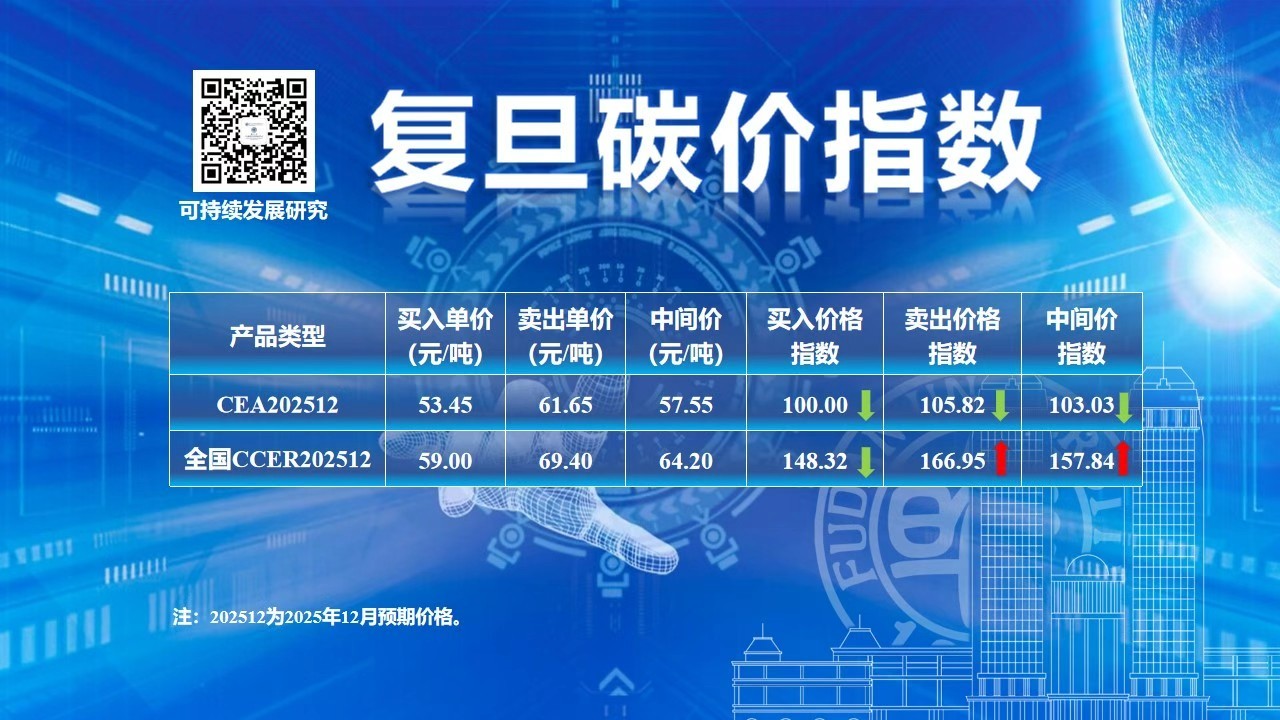
Core Insights - The Fudan University Sustainable Development Research Center released the carbon price index for December 2025, indicating expected buy and sell prices for national carbon emission allowances (CEA) and certified voluntary emission reductions (CCER) [1][2] Group 1: Carbon Price Indices - The expected buy price for CEA is 53.45 CNY/ton, and the sell price is 61.65 CNY/ton, with a midpoint of 57.55 CNY/ton [1] - The expected buy price for CCER is 59.00 CNY/ton, and the sell price is 69.40 CNY/ton, with a midpoint of 64.20 CNY/ton [1] - The buy price index for CCER decreased by 1.12% to 148.32, while the sell price index increased by 1.80% to 166.95 [1] Group 2: Green Certificate Prices - The expected price for green certificates from centralized projects for 2025 is 4.31 CNY/unit, with a price index of 78.36 [2] - The expected price for green certificates from distributed projects is 4.39 CNY/unit, with a price index of 89.07 [2] - The expected price for green certificates from biomass power generation is 3.53 CNY/unit, with a price index of 68.41 [2] Group 3: Carbon Market Performance - In November, the average closing price for CEA was 59.87 CNY/ton, a significant increase of approximately 11% compared to October's average of 53.94 CNY/ton [2] - The average daily trading volume of carbon allowances in November was 236.22 million tons, a decrease of 3.38% from October's 244.49 million tons [2] Group 4: Regulatory Developments - The Ministry of Ecology and Environment announced a quota allocation plan for the steel, cement, and aluminum industries, marking a significant step in carbon market management [3] - By 2027, additional industries such as chemicals, petrochemicals, civil aviation, and papermaking will be included in the carbon market, covering approximately 75% of national CO2 emissions [3] Group 5: Global Carbon Market Trends - The global carbon market showed overall recovery in trading volume, although the Korean carbon market experienced a notable decline [4] - Major global carbon markets generally saw price fluctuations, with mixed results in trading prices month-over-month [4]
复旦碳价指数:2025年12月GEC价格指数涨跌参半
Sou Hu Wang· 2025-11-29 07:59
Core Insights - The Fudan University Sustainable Development Research Center released the carbon price indices for December 2025, including the national carbon emission allowance (CEA) price index, the national voluntary emission reduction (CCER) price index, and the Chinese Green Electricity Certificate (GEC) price index [1] Carbon Emission Allowance and CCER Price Trends - The expected buying price for the CEA in December 2025 is 53.45 CNY/ton, with a selling price of 61.65 CNY/ton, resulting in a midpoint price of 57.55 CNY/ton; the buying price index is 100.00, and the selling price index is 105.82, with a midpoint price index of 103.03 [2] - The expected buying price for CCER is 59.00 CNY/ton, with a selling price of 69.40 CNY/ton, leading to a midpoint price of 64.20 CNY/ton; the buying price index is 148.32 (down 1.12%), the selling price index is 166.95 (up 1.80%), and the midpoint price index is 157.84 (up 0.44%) [2] Green Certificate Price Index Trends - The expected price for the 2024 produced centralized project green certificates is 2.89 CNY/unit, with a price index of 58.38; for distributed projects, the price is 2.6 CNY/unit (index 49.73); and for biomass power generation, the price is 1.48 CNY/unit (index 32.96) [4] - The expected price for the 2025 produced centralized project green certificates is 4.31 CNY/unit (index 78.36); for distributed projects, the price is 4.39 CNY/unit (index 89.07); and for biomass power generation, the price is 3.53 CNY/unit (index 68.41) [4] - Price trends for green certificates show divergence, with distributed and biomass project certificates increasing in price for 2024, while centralized project certificates decreased; for 2025, centralized and distributed project certificates increased, while biomass project certificates decreased [4] Carbon Market Activity in November - The average closing price for CEA in November was 59.87 CNY/ton, a significant increase of approximately 11% compared to October's average of 53.94 CNY/ton; the price showed a notable rise and fall, peaking at 67.87 CNY/ton before dropping back below 60 CNY/ton [6] - The average daily trading volume for carbon allowances in November was 236.22 million tons, a decrease of 3.38% from October's 244.49 million tons; nearly two-thirds of trading days saw volumes exceeding 2 million tons, with a peak of 420.29 million tons on November 11 [6] National Carbon Market Expansion - The Ministry of Ecology and Environment announced a quota allocation plan for the steel, cement, and aluminum smelting industries, marking a significant step in expanding the carbon market; by 2027, additional industries such as chemicals, aviation, and paper will be included, covering approximately 75% of national CO2 emissions [7] - Global carbon markets showed overall recovery in November, with the EU carbon market's average daily trading volume increasing by 52.21%, while the UK market rose by 16.73%; however, the Korean market experienced a decline of 32.53% [7] Global Carbon Market Price Trends - In November, the EU carbon market price decreased from 93.36 USD/ton to 92.93 USD/ton, a drop of 0.46%, while the average daily price increased by 2.46%; the UK market price fell from 76.19 USD/ton to 75.81 USD/ton, a decrease of 0.50%, with a daily average increase of 1.64% [8] - The Korean carbon market price dropped from 7.28 USD/ton to 7.07 USD/ton, a decline of 2.80%, with a daily average price decrease of 0.75%; the New Zealand market price fell from 33.16 USD/ton to 32.43 USD/ton, a decrease of 2.18%, while the daily average price increased by 0.61% [8]

复旦大学可持续发展研究中心:9月全国碳市场放量下跌
Cai Fu Zai Xian· 2025-09-29 07:36
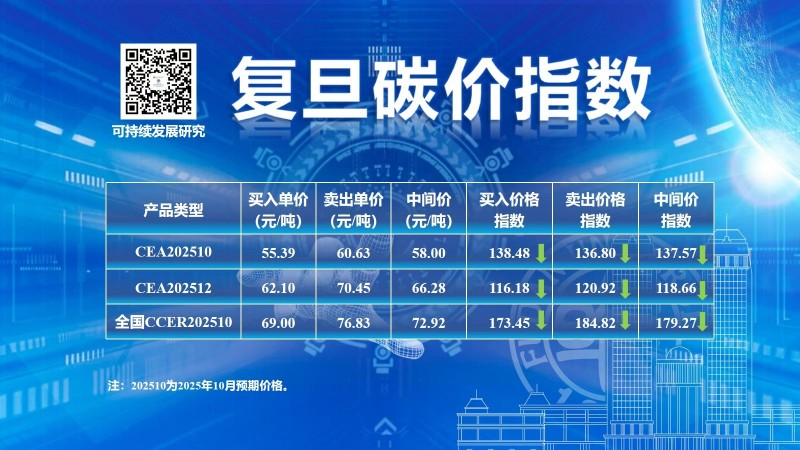
Core Insights - The Fudan University Sustainable Development Research Center released the carbon price index for October 2025, including national carbon emission allowance (CEA) prices, voluntary carbon market (CCER) prices, and green electricity certificate (GEC) prices [1][2]. CEA and CCER Price Indices - The expected buying price for CEA in October 2025 is 55.39 CNY/ton, with a selling price of 60.63 CNY/ton, resulting in a midpoint price of 58.00 CNY/ton. The buying price index decreased by 19.09%, and the selling price index decreased by 16.23% [2][3]. - For December 2025, the expected buying price for CEA is 62.10 CNY/ton, with a selling price of 70.45 CNY/ton, leading to a midpoint price of 66.28 CNY/ton [2][3]. - The expected buying price for CCER in October 2025 is 69.00 CNY/ton, with a selling price of 76.83 CNY/ton, resulting in a midpoint price of 72.92 CNY/ton. The buying price index decreased by 7.75%, and the selling price index decreased by 9.29% [2][3]. GEC Price Indices - The expected price for green certificates (GEC) for centralized projects produced in 2024 is 3.11 CNY/unit, with a price index of 62.79. For distributed projects, the price is 2.82 CNY/unit (index 53.87), and for biomass power generation, it is 1.84 CNY/unit (index 40.88) [4][5]. - For 2025 production, the expected price for centralized projects is 5.45 CNY/unit (index 99.09), for distributed projects is 5.20 CNY/unit (index 105.51), and for biomass projects is 5.55 CNY/unit (index 107.56) [4][5]. Market Activity in September - In September, the average closing price for CEA was 62.94 CNY/ton, down 11.5% from August's average of 71.12 CNY/ton. The price fluctuated from 69.41 CNY/ton at the beginning of the month to 59.16 CNY/ton by the end [6]. - The average daily trading volume for carbon allowances increased to 136.78 million tons, a 90% increase compared to August's 71.95 million tons, indicating heightened market activity [6]. - The announcement of China's 2035 national contributions reflects a comprehensive approach to low-carbon development, emphasizing China's role in global climate governance [6]. Global Carbon Market Trends - In September, global carbon market trading volumes generally increased, with the EU market seeing a 30.02% rise in average daily trading volume, while the Korean market experienced a 49.10% decline [7]. - The EU carbon market's average price rose from 86.18 USD/ton to 88.90 USD/ton, while the UK market's price increased from 73.04 USD/ton to 75.99 USD/ton [7].
价跌量缩后 全国碳市场后市如何走?
Zheng Quan Shi Bao Wang· 2025-08-02 09:47
Group 1 - The national carbon market closed at 72.43 yuan/ton on August 1, down 0.07% from the previous day, with a 3.39% decline from the end of June [1] - In July, the national carbon market saw a total trading volume of 11.6642 million tons, a decrease of 26.57% month-on-month, ending a four-month growth trend [1] - The average daily trading volume in July was 510,300 tons, down 35.75% from June's 794,200 tons [1] Group 2 - The Fudan Carbon Price Index forecasts a buying price of 71.25 yuan/ton and a selling price of 76.04 yuan/ton for carbon emission allowances (CEA) by August 2025 [2] - As of July, the national carbon market has cumulatively traded 6.811 billion tons, with a total transaction value of 46.823 billion yuan [2] - The carbon trading management regulations will take effect on May 1, 2024, marking a significant step in the development of the carbon market [2] Group 3 - The chairman of Shanghai Environment Energy Exchange stated that efforts will continue to enhance the mechanisms of the national carbon trading market [3]