
全域AI 2.0技术体系

Search documents
【新能源】2026年1月新能源汽车行业月报
乘联分会· 2026-03-09 08:41
Sales Performance - In January, the overall passenger car market sales were 1.554 million units, a year-on-year decrease of 15.1% and a month-on-month decrease of 32.9% [6] - The new energy vehicle (NEV) market sales were approximately 565,000 units, a year-on-year decrease of 19.7% and a month-on-month decrease of 57.6% [6] - The NEV market accounted for 36.3% of total passenger car sales, down 2.1% compared to the same period last year [6] New Energy Market Performance - In January, pure electric vehicle sales were about 345,000 units, down 11.5% year-on-year and down 55.7% month-on-month [7] - Plug-in hybrid sales were approximately 220,000 units, down 29.9% year-on-year and down 60.2% month-on-month [7] Top 10 Cities for NEV Sales - The top 10 cities accounted for 30.5% of NEV sales, an increase of 0.9% from the previous month [12] - The top three cities for sales were Shanghai, Guangzhou, and Shenzhen, with significant variations in year-on-year growth rates among them [10][12] - The highest penetration rates for NEVs were in Shenzhen (54.4%), Hangzhou (52.0%), and Shanghai (48.2%) [12] Pure Electric Market Analysis - The top three segments in the pure electric market were C-SUV (25.7%), B-SUV (20.8%), and A0 class (12.2%) [13] - The market share of C-SUV increased significantly from 8.1% to 25.7% year-on-year, while the C-class market share decreased from 13.2% to 5.3% [13] Market Dynamics - Key industry dynamics included significant partnerships and investments, such as CATL's strategic investment in Fulin Precision and Geely's AI platform launch [20][22] - The collaboration between GAC Group and Huawei aims to enhance their strategic partnership in the NEV sector [20] Industry Policies - The release of the mandatory national standard GB 18384-2025 for electric vehicle safety requirements aims to enhance safety protocols and testing methods [27] - Various provinces, including Guangdong and Sichuan, have introduced policies to promote green manufacturing and the integration of AI in transportation [29][36]



2026智驾迎来“价值深化”新一年
Zhong Guo Qi Che Bao Wang· 2026-01-23 09:15
Core Insights - The automotive industry is increasingly focusing on intelligent assisted driving, with companies like BYD investing over 100 billion yuan and forming specialized teams to enhance their capabilities [2] - The shift in the industry is moving from scale and accessibility to user experience, emphasizing the importance of value creation in the competitive landscape [3][12] Investment and Development - BYD has established a team of over 5,000 for assisted driving and aims to deploy its "Tian Shen Zhi Yan" system in over 2.5 million vehicles by December 2025, generating over 150 million kilometers of effective driving data daily [3] - The establishment of new companies, such as the joint venture between BAIC and Horizon Robotics, indicates a growing trend towards collaboration in the intelligent driving sector [2][4] Technological Pathways - Companies are adopting full-stack self-research as a key strategy to deepen their understanding of technology and user needs, with BYD exemplifying this approach through significant investment and team size [3][5] - Open collaboration with third-party solution providers is also becoming a vital strategy, allowing companies to enhance their systems' performance and functionality through shared resources [4][5] User Experience and Market Trends - The concept of "intelligent driving equity" is emerging, indicating a shift towards making advanced driving features accessible in the mid-range vehicle market, particularly in the 100,000 to 150,000 yuan price range [12][14] - User feedback highlights the importance of stability in high-frequency scenarios, ease of use in interaction design, and the need for cost-effective solutions [13][14] Industry Dynamics - Suppliers are transitioning from providing single hardware products to offering integrated software and hardware solutions, becoming deep partners in the development of intelligent driving systems [6][8] - The competitive focus is shifting from merely having intelligent driving capabilities to ensuring their reliability, safety, and user-friendliness in complex driving environments [7][11] Future Outlook - The industry is expected to evolve towards a model where technology is not only usable but also provides a good user experience, ultimately leading to a sustainable business model [14] - As regulations and infrastructure improve, the Chinese intelligent driving industry is poised for high-quality development on a global scale, driven by technology and user experience [14]
汽车行业周报:全年销量符合预期,智驾引领再提速-20260112
Guoyuan Securities· 2026-01-12 09:47
Investment Rating - The report maintains a "Recommended" investment rating for the automotive and automotive parts industry [6] Core Insights - The overall sales of passenger vehicles met expectations with a year-on-year growth of 9%, while new energy passenger vehicles saw a growth of 25% [1][2] - In December 2025, the retail sales of passenger vehicles were 2.296 million units, a year-on-year decrease of 13%, but a month-on-month increase of 3%. Cumulatively, retail sales for the year reached 23.779 million units, a year-on-year increase of 4% [1][20] - The report highlights the rapid advancements in intelligent driving technologies, with multiple automakers updating their systems and competing in the autonomous driving sector [3][4] Summary by Sections Sales Performance - In December 2025, wholesale sales of passenger vehicles were 2.759 million units, a year-on-year decrease of 10%, with cumulative wholesale sales for the year reaching 29.524 million units, a year-on-year increase of 9% [1][20] - For new energy vehicles, December retail sales were 1.387 million units, a year-on-year increase of 7%, with cumulative retail sales for the year at 12.859 million units, a year-on-year increase of 18% [1][20] Industry Developments - Several automakers, including Zeekr and Geely, are enhancing their intelligent driving systems, indicating a shift towards integrated decision-making models in vehicle technology [3][4][32] - The report emphasizes the importance of continued policy support for the automotive industry and the potential investment opportunities arising from advancements in autonomous driving technology [4] Market Trends - The automotive sector saw a 2.53% increase in the week of January 3-9, 2026, with most related sub-sectors also experiencing growth [12] - The report notes that the intelligent driving technology is becoming a key competitive area among automakers, with significant investments and innovations being made [3][4][39]
对话千里科技印奇:抓住 “想做、能做、可做” 的闪现时刻,决胜智驾淘汰赛
晚点Auto· 2026-01-10 07:30
Core Viewpoint - The article discusses the competitive landscape of intelligent driving in China, highlighting the potential for latecomers to succeed by leveraging advanced technology and strategic partnerships, as exemplified by Geely and Qianli's collaboration on the G-ASD system [3][6][11]. Group 1: G-ASD System Overview - The G-ASD system, developed by Geely and Qianli, utilizes a state-of-the-art end-to-end model architecture, enabling full-range intelligent driving capabilities without relying on high-precision maps [4][10]. - The system is powered by 23.5 EFLOPS of computing power and vast amounts of real driving data, allowing for rapid iteration and self-evolution through a "world behavior model" [4][10]. Group 2: Strategic Insights - Geely's CEO emphasizes the integration of new energy and intelligence as a unified goal, aiming to establish Geely's intelligent driving as a benchmark in China and compete globally [6][11]. - Qianli's competitive edge lies in its lack of historical technical burdens and a composite team with expertise from various sectors, enhancing its ability to innovate and execute [7][8]. Group 3: Market Positioning and Future Outlook - The article predicts that only three to four leading intelligent driving suppliers will emerge globally, with Qianli and Geely's collaboration positioned to capitalize on economies of scale and technological advancements [11][24]. - Qianli aims to focus on a "big customer strategy," seeking deep partnerships with a select few major automotive clients to build a robust competitive barrier [24][25].


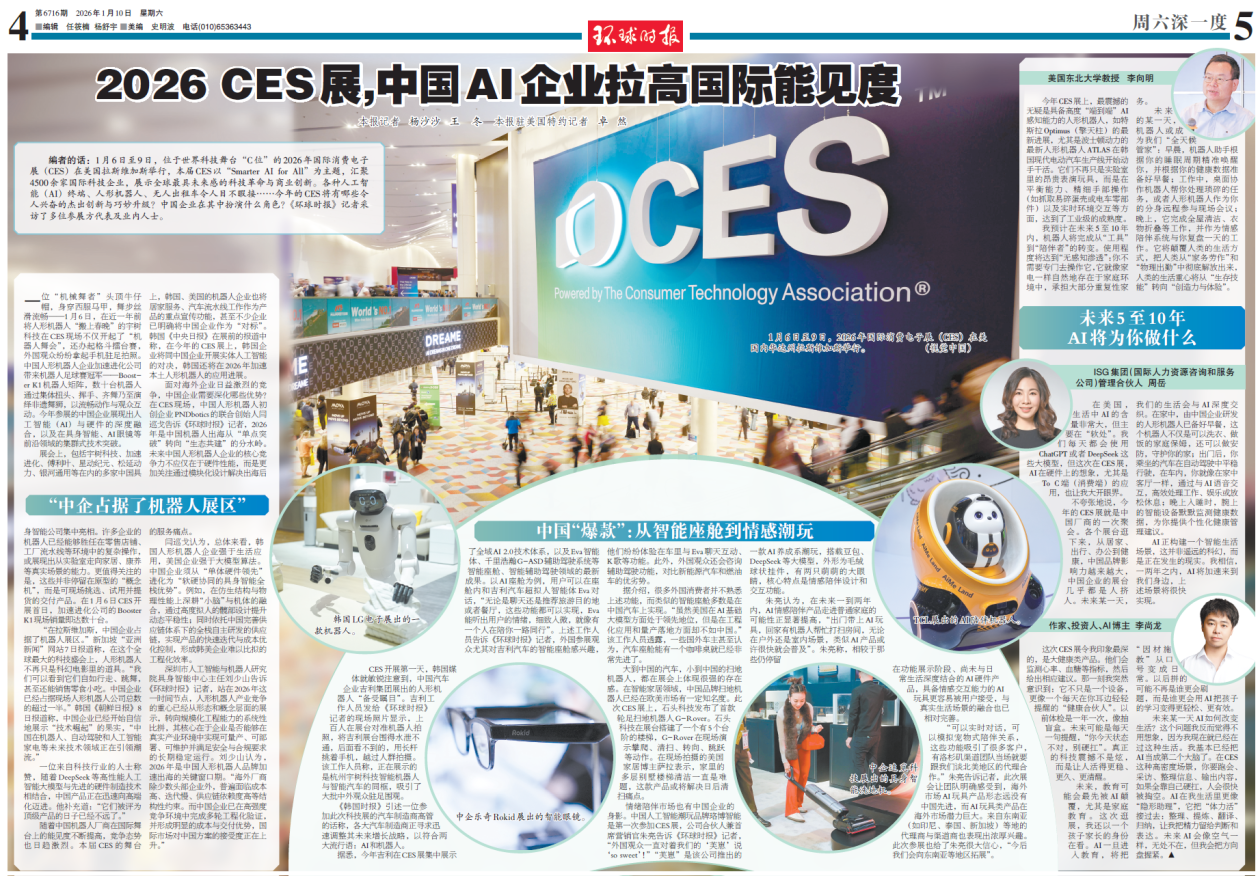
【环时深度】2026 CES展,中国AI企业拉高国际能见度
Huan Qiu Shi Bao· 2026-01-09 22:37
Group 1 - The 2026 International Consumer Electronics Show (CES) in Las Vegas showcased over 4,500 international tech companies, focusing on the theme "Smarter AI for All" [2] - Chinese companies demonstrated significant advancements in humanoid robots and AI integration, with many products ready for immediate purchase and use [5][10] - The presence of Chinese firms in the humanoid robot sector exceeded half of the total exhibitors, indicating a strong competitive stance against Korean and American companies [5][11] Group 2 - Chinese humanoid robot companies are evolving from hardware-centric approaches to a focus on modular design and service solutions for international markets [7] - The competition in the humanoid robot industry is shifting towards the ability to produce scalable, deployable, and maintainable systems that meet safety and compliance standards [9] - Chinese brands are increasingly recognized for their engineering efficiency and cost advantages, enhancing their acceptance in international markets [9] Group 3 - The automotive sector, represented by companies like Geely, highlighted the integration of AI in smart cabins and autonomous driving systems, attracting significant attention from international audiences [11][12] - The CES showcased a variety of AI products, from smart home devices to emotional companion toys, indicating a growing market for AI in everyday life [12][15] - The potential for AI to transform daily living is emphasized, with expectations for AI to become an integral part of household management and personal assistance in the near future [18][21]

吉利发布全域AI 2.0,消费电子ETF(561600)盘中蓄势
Xin Lang Cai Jing· 2026-01-08 02:04
Core Viewpoint - The consumer electronics sector is experiencing mixed performance, with notable developments in AI technology and structural growth opportunities for key manufacturers and suppliers [1] Group 1: Market Performance - As of January 8, 2026, the CSI Consumer Electronics Theme Index (931494) decreased by 0.22%, with component stocks showing varied performance [1] - Chip Yuan Co. (688521) led the gains with an increase of 3.34%, while Luxshare Precision (002475) saw the largest decline at 3.81% [1] - The Consumer Electronics ETF (561600) fell by 0.16%, with the latest price at 1.26 yuan [1] Group 2: Industry Developments - On January 7, Geely Automobile Group unveiled its AI 2.0 technology system at the 2026 Consumer Electronics Show (CES) in Las Vegas, introducing the G-ASD (Geely Afari Smart Driving) system [1] - Geely plans to launch high-speed L3 and low-speed L4 autonomous driving features to the market by 2026 [1] - According to Jinyuan Securities, the consumer electronics sector saw a weekly increase of 0.93%, with the components and assembly sub-sector rising by 1.04%, indicating a recovery in certain parts of the industry chain [1] Group 3: Index Composition - The CSI Consumer Electronics Theme Index comprises 50 listed companies involved in component production and electronic device design and manufacturing [2] - As of December 31, 2025, the top ten weighted stocks in the index accounted for 54.35% of the total, including Luxshare Precision (002475) and Cambricon Technologies (688256) [2]
AI“统治”CES 2026:车企加码全域智能
Mei Ri Jing Ji Xin Wen· 2026-01-07 13:16
Core Insights - The 2026 Consumer Electronics Show (CES) highlights the automotive electronics sector, showcasing advancements in AI applications across various automotive domains, including smart driving assistance and intelligent cockpit experiences [1][2] - AI remains a central theme at CES 2026, driving breakthroughs in autonomous driving and industrial automation, reshaping lifestyles and work environments [1] Automotive Technology Showcase - Automakers focus on demonstrating technological roadmaps and electronic architectures rather than just vehicle models at CES [2] - Geely introduced its AI 2.0 technology system, which integrates various domains such as intelligent driving and cockpit systems, enhancing collaboration among different AI agents [3] - BMW showcased its AI-driven personal assistant integrated with Amazon's "Alexa+", allowing intuitive interaction between passengers and vehicles [3] Advanced Driver Assistance Systems (ADAS) - The popularity of advanced driver assistance systems remains strong, with many exhibitors presenting the latest developments in this field [7] - Nvidia's CEO unveiled the Alpamayo series of open-source AI models, which include advanced reasoning and simulation capabilities [7] - Geely and Qianli Technology launched the G-ASD brand, a high-capacity driving assistance solution covering levels from L2 to L4 [8] Robotics Integration - Human-like robots are transitioning from novelty to practical applications, with companies like Hyundai showcasing production versions of robots capable of performing real tasks [10][11] - Hyundai plans to integrate its Atlas robot into its global production network, starting with simple tasks and expanding to more complex operations by 2030 [11] - Companies are increasingly investing in robotics, with a focus on enhancing capabilities in various sectors, including automotive and smart devices [10][11]
