
出口

Search documents
月度前瞻 | “春节错位” 如何影响经济开门红?(申万宏观·赵伟团队)
赵伟宏观探索· 2026-03-11 16:03
Core Viewpoint - The article discusses the significant impact of the "Spring Festival misalignment" on economic data for January and February, which may lead to a distorted understanding of the economic "opening red" and affect market expectations [10][11][12]. Group 1: Impact of "Spring Festival Misalignment" - The "Spring Festival misalignment" is expected to push up economic data for January and February while lowering data for March, causing volatility in year-on-year growth rates for key indicators like exports and industrial value added [11][12]. - Historical data shows that the Spring Festival, being a movable holiday, has a more substantial impact on economic data than fixed holidays, with fluctuations in year-on-year growth rates sometimes reaching 40 percentage points [11][12]. - The influence of the Spring Festival misalignment is more pronounced on the supply side than the demand side, with effects lasting over a month, characterized by three phases: pre-holiday rush, holiday shutdown, and post-holiday resumption [11][12][18]. Group 2: Actual Resumption of Work - After adjusting for the Spring Festival misalignment, production and export indicators show improvement, with various sectors experiencing different levels of recovery compared to December 2025 [46][122]. - Key indicators such as the operating rates of blast furnaces and PTA, as well as highway freight volume, have shown year-on-year increases of 2-5 percentage points [46][122]. - Export conditions have also improved, with port cargo throughput in January-February 2026 rising by 7.4 percentage points compared to December 2025 [64][122]. Group 3: Economic "Opening Red" Interpretation - The combination of "Spring Festival misalignment" and production improvements is likely to result in a positive rebound in industrial value added and exports for January and February [94][99]. - Forecasts suggest that industrial value added for January-February may reach a year-on-year growth of 6%, while exports could rise to 21.9% [94][99]. - Consumer data is expected to exceed previous pessimistic market expectations, with service consumption likely to outperform goods consumption [116][124]. Group 4: Investment Trends - The easing of the "debt squeeze" effect may lead to better-than-expected fixed asset investment growth compared to December 2025, although the rebound may be limited [105][124]. - The share of special refinancing bonds has significantly decreased, indicating a potential recovery in infrastructure investment, while real estate investment remains weak due to ongoing financing pressures [105][124]. - Overall, fixed asset investment growth for January-February is anticipated to be better than the -13.2% recorded in December 2025, but still within the range of -5% to -10% [105][124].


月度前瞻 | “春节错位” 如何影响经济开门红?(申万宏观·赵伟团队)
申万宏源证券上海北京西路营业部· 2026-03-11 02:11
Core Viewpoint - The article discusses the significant impact of the "Spring Festival misalignment" on economic data for January and February, which may lead to a distorted understanding of the economic "opening red" and affect market expectations [4][11][124]. Group 1: Impact of "Spring Festival Misalignment" - The "Spring Festival misalignment" is expected to push up economic data for January and February while lowering data for March, creating volatility in year-on-year comparisons [4][5][124]. - Historical data shows that the Spring Festival, being a movable holiday, causes significant fluctuations in economic indicators, with some years experiencing changes of up to 40 percentage points [4][12][124]. - The impact of the Spring Festival misalignment is more pronounced on the supply side than on the demand side, with effects lasting over a month [4][19][124]. Group 2: Actual Resumption of Work - After excluding the Spring Festival misalignment, production and export indicators show improvement, while domestic demand presents a mixed performance [6][126]. - Production indicators such as high furnace operation rates and highway freight volume have improved, indicating better production conditions compared to late December 2025 [6][50][126]. - Export conditions have also improved, with port cargo throughput showing a year-on-year increase of 7.4 percentage points compared to December 2025 [6][68][126]. Group 3: Economic "Opening Red" Interpretation - The combination of "Spring Festival misalignment" and production improvements is likely to result in a positive rebound in industrial value added and export year-on-year figures for January and February [8][98][128]. - Forecasts suggest that industrial value added for January and February may reach a year-on-year growth of 6%, while exports could rise to 21.9% [8][98][128]. - Consumer data is expected to exceed previous pessimistic market expectations, with service consumption likely to outperform goods consumption [8][120][128]. Group 4: Investment Trends - The easing of the "debt crowding-out effect" may lead to better fixed investment growth compared to December 2025, although the rebound may be limited [9][109][129]. - Infrastructure investment is expected to improve, but real estate investment remains weak due to ongoing financing pressures [9][109][129]. - Overall fixed asset investment is projected to show a year-on-year improvement, but still face challenges in turning positive [9][109][129].

“月度前瞻”系列:“春节错位”如何影响经济开门红-20260310
Shenwan Hongyuan Securities· 2026-03-10 14:09
Group 1: Economic Impact of "Spring Festival Misalignment" - The "Spring Festival misalignment" is expected to significantly boost economic data for January-February while suppressing March data, with historical fluctuations reaching up to 40 percentage points in some years[2] - The misalignment primarily affects the supply side more than the demand side, with an impact cycle lasting over one month[2] - This year's earlier return home phenomenon may amplify the misalignment effects, potentially increasing export growth by 8.4 percentage points in January-February and decreasing it by 18.6 percentage points in March[3] Group 2: Actual Recovery and Economic Indicators - After adjusting for the Spring Festival misalignment, production and export indicators show improvement, with industrial production better than the end of December 2025[4] - High-frequency indicators such as blast furnace operating rates and highway freight volume have increased by 2.3 percentage points and 1.7 percentage points respectively compared to December 2025[4] - Consumer spending is recovering, with retail sales of passenger vehicles up by 7.8 percentage points and major appliance sales up by 15.2 percentage points, although still in negative growth territory[5] Group 3: Economic Forecasts - Industrial value-added is projected to rise by 6% year-on-year for January-February, while exports are expected to increase by 21.9%[6] - Investment growth is anticipated to be limited, with ongoing pressures in the real estate sector and manufacturing investment affected by previous profit declines[7] - Risks include unexpected changes in the recovery pace and external conditions that may not align with policy expectations[7]
——12月经济数据预测:平稳收官,价格修复或加快
Huachuang Securities· 2026-01-07 10:46
1. Report Industry Investment Rating No information about the industry investment rating is provided in the report. 2. Core Viewpoints of the Report - In December, the economic operation was in the traditional off - season, but factors such as the late Spring Festival and the extended stocking cycle might boost industrial production. The export growth rate might decline slightly but still be better than that in October. The GDP growth rate in the fourth quarter was expected to reach around 4.5%, and the whole - year GDP was likely to achieve 5% and end smoothly [3][6]. - For the bond market, there was little suspense about the economic data in December. The market mainly focused on the verification of the "good start" of the economy at the beginning of the year. With the concentrated implementation of macro - policies to stabilize growth at the end of the year, the "two new" policies were issued one week earlier than in 2025, and the support amount for the early - batch "two important" and central budget - investment plan projects also increased compared with the previous year. January 2026 was expected to be the window for the concentrated effect of the "good start" policies, and high - frequency verification during the data "vacuum period" should be concerned [3]. 3. Summary According to the Directory 3.1 Inflation - CPI: It was expected that the CPI in December would rise to around 0.9% year - on - year. Fruit and vegetable prices supported the food price to rise above the seasonal level, and the non - food item was in line with the seasonality. The CPI was expected to increase by about 0.2% month - on - month [3][6][8]. - PPI: It was predicted that the PPI in December would rise to around - 1.9% year - on - year. The non - ferrous industry faced imported inflation pressure, and the prices of domestic bulk commodities such as steel and PTA improved. The PPI was expected to increase by about 0.2% month - on - month [3][6][14]. 3.2 Export - The export growth rate was expected to be around 5.0% in December. The export momentum in December was not weak, although the year - on - year growth rate of container throughput at ports was lower than that in November but better than that in October. The import was expected to increase by around 1.5% year - on - year, with the price support continuing to expand [3][21]. 3.3 Industrial The industrial growth rate in December was expected to be around 5.1%. The PMI in December returned above the boom - bust line, and the production sub - item further expanded. The late Spring Festival in 2026 extended the stocking cycle, which had a certain driving effect on production [3][6][24]. 3.4 Investment - The cumulative growth rate of fixed - asset investment from January to December was expected to be around - 3.0%. The cumulative year - on - year growth rate of infrastructure investment (excluding electricity) was about - 1.5%, the cumulative year - on - year growth rate of real estate investment was about - 16.7%, and the cumulative year - on - year growth rate of manufacturing investment was about + 1.2% [3][6][33]. 3.5 Social Retail The year - on - year growth rate of social retail in December was expected to be around 1.0%. As the national subsidy funds were approaching the end, the marginal boost to automobile consumption from the subsidy decline weakened. The year - on - year decline in gasoline prices widened, and the drag on social retail from petroleum product consumption continued to increase [3][6][36]. 3.6 Financial Data - In December, the bill interest rate declined against the trend, reflecting the weak credit impulse at the end of the year. The new credit in December was expected to be about 80 billion yuan, slightly lower than the level of 99 billion yuan in the same period of the previous year. The new social financing was about 1.7 trillion yuan, a year - on - year decrease of 58.85 billion yuan [3][6][45]. - The M2 growth rate was expected to remain around 8.0%. The new deposits were close to the seasonal level. From the asset side, the year - on - year growth rate of the credit balance might slightly decline to 6.3%, and the social financing growth rate might decline to around 8.4% affected by the high base of government bonds. From the liability side, the M2 in December might increase by 1.5 trillion yuan [3][48].
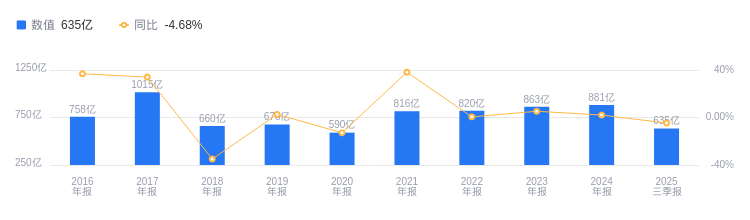
远大控股的前世今生:2025年三季度营收634.84亿行业第六,远低于行业均值
Xin Lang Cai Jing· 2025-10-31 05:43
Core Insights - The company, founded in 1994 and listed in 1996, is a significant player in the domestic commodity trading sector, providing comprehensive services across trading, warehousing, and logistics [1] Group 1: Business Performance - As of Q3 2025, the company's revenue reached 634.84 billion, ranking 6th among 13 companies in the industry, with the industry leader, Jianfa Co., reporting revenue of 4989.83 billion [2] - The company's net profit for the same period was 46.71 million, placing it 9th in the industry, while the top performer, Wuchan Zhongda, reported a net profit of 4.51 billion [2] Group 2: Financial Ratios - The company's debt-to-asset ratio stood at 68.91% in Q3 2025, higher than the previous year's 66.87% and above the industry average of 67.16% [3] - The gross profit margin was recorded at 0.37%, a decline from 0.66% year-on-year, and significantly lower than the industry average of 5.58% [3] Group 3: Shareholder Information - As of September 30, 2025, the number of A-share shareholders increased by 2.06% to 22,500, while the average number of circulating A-shares held per shareholder decreased by 2.47% to 22,400 [5] Group 4: Executive Compensation - The chairman's compensation for 2024 was reported at 1.81 million, a slight decrease from 1.81 million in 2023 [4]

2025年上半年各省经济成绩单:中西部地区快速增长东部地区韧性仍存
Zhong Cheng Xin Guo Ji· 2025-08-14 05:45
Economic Growth - In the first half of 2025, the GDP growth rate in the eastern region averaged 5.3%, lagging behind the central (5.5%) and western (5.6%) regions, continuing the "east low, west high" trend[6][12] - The top five provinces accounted for 40% of the national GDP, with the top ten provinces making up 61.6%, indicating stable contributions from major economic provinces[13] Industrial Performance - The industrial added value in the central and western regions grew by 7.9% and 8.2% respectively, surpassing the national average of 6.4%, while eastern regions showed stable growth at 7.1%[27][31] - Eastern regions experienced a profit growth of over 10% in industrial enterprises, contrasting with the central and western regions where profits declined or showed minimal growth[31][30] Investment Trends - Fixed asset investment in the central region grew by 6.6%, exceeding the national level by 3.8 percentage points, while the eastern region's investment growth was only 1.7%[40][44] - Real estate investment in the eastern region decreased by 9.7%, contributing to the overall sluggish investment performance[44] Consumption Patterns - The central region led the nation in retail sales growth at 6.2%, while the eastern region lagged with a growth rate of only 4%[49][52] - The northeastern region saw a retail sales growth of 5.4%, benefiting from tourism and cultural events[52] Export Dynamics - The central and western regions achieved export growth rates of 15.5% and 17.5%, significantly higher than the national average of 7.2%, while the eastern region's export growth was only 1.4%[60] - Guangdong's exports grew by just 1.1%, heavily impacted by U.S. tariff policies and declining demand in the consumer electronics sector[60] Import Trends - In the first half of 2025, 21 provinces experienced negative import growth, particularly in the eastern and northeastern regions, with the eastern region's imports declining by 5.3%[66] - Some provinces in the central and western regions saw positive import growth, driven by resource products, with Anhui and Gansu achieving import growth rates of 13.4% and 30.3% respectively[66]
宏观经济数据前瞻:2025年5月宏观经济指标预期一览
Guoxin Securities· 2025-06-03 14:23
Economic Indicators - May 2025 domestic CPI is expected to decrease by 0.4% month-on-month and year-on-year[3] - May 2025 PPI is projected to decline by 0.3% month-on-month and 3.2% year-on-year[3] - Industrial added value is anticipated to slightly drop to 5.5% year-on-year in May 2025[3] - Retail sales of consumer goods are expected to decrease to 5.0% year-on-year in May 2025[3] - Fixed asset investment is forecasted to remain stable at 4.0% year-on-year[3] Trade and Financing - Exports in May 2025 are expected to rise by approximately 8.5% year-on-year[3] - Imports are projected to increase by 4.5% year-on-year[4] - Trade surplus is estimated at $971 million in May 2025[4] - Monthly increase in credit is expected to be 11,000 million yuan[4] - Total social financing is projected to increase by 22,000 million yuan in May 2025[4]