
创业板新能源ETF(159387)

Search documents
2026核心赛道前瞻:科技+周期双轮驱动,这些行业值得重点关注
Mei Ri Jing Ji Xin Wen· 2026-02-09 01:37
Group 1 - The market liquidity is relatively abundant at the beginning of 2026, with A-shares daily trading volume maintaining above 2 trillion yuan, and technology and cyclical stocks showing a rotating upward trend [1] - The technology sector and related cyclical fields, such as upstream non-ferrous metals, are expected to present investment opportunities in 2026, particularly in the semiconductor chip industry where leading companies' capital expenditures have exceeded expectations [1] - The communication sector remains a core area deeply tied to overseas computing power demand, with capital expenditures from overseas cloud companies expected to continue rising in 2026 [1] Group 2 - The AI industry is anticipated to drive growth in related supply chains, with potential shortages and price increases in certain sectors, such as space photovoltaics in the electricity supply side [2] - According to the "14th Five-Year Plan," domestic grid investment is set to accelerate, with fixed asset investment by the State Grid expected to grow by 40% compared to the previous five-year period [2] - The cyclical sector, particularly non-ferrous metals, is gaining market attention, with financial attributes expected to receive strong support during a rate-cutting cycle [2]
20CM批量涨停,电新赛道最强新主线
Ge Long Hui· 2026-01-23 10:01
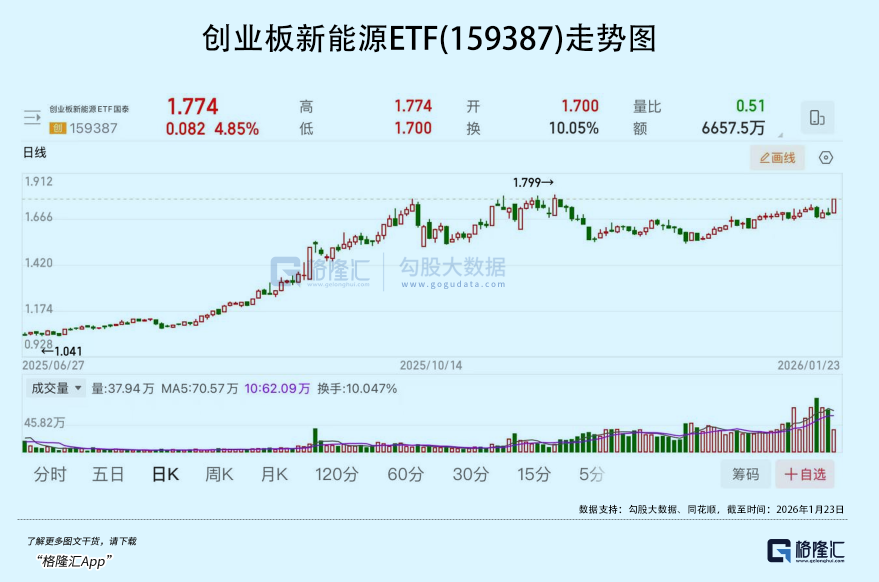
1月23日,A股新能源板块迎来一波始料未及的集体爆发行情。 据同花顺行情数据,截至收盘,光伏设备板块涨幅高达10.07%,同时BC电池、钙钛矿电池、TOPCON电池、HJT电池等新能 源电池链条全线显著飙涨,全市有超十只个股涨幅在20%及以上,另有十多只个股收获10%涨停。得益于太空光伏引爆新能 源赛道,今日创业板新能源ETF(159387)涨4.85%。 消息面上,近日,特斯拉CEO马斯克在瑞士达沃斯世界经济论坛年会期间明确力挺太空光伏,并披露关键产能规划。他表 示,SpaceX与特斯拉正同步推进太阳能产能提升,目标在未来三年内实现每年100GW的太阳能制造能力。 随着商业航天进入规模化部署新阶段,太空光伏的长期需求进一步明确。 光伏的新故事,今年或许将在电新板块异军突起了。 01 什么是太空光伏? 相关研究测算显示,部署在轨道的太空数据中心,其十年总成本仅为约820万美元,远低于同等规模地面数据中心的1.67亿美 元,成本降幅达一个数量级。 "太空光伏"这一概念迅速成为资本市场的热词,并在A股发酵了半个多月。 马斯克的这一计划不仅重新定义了光伏的应用边界,更将"光伏+航天+AI"三个万亿级赛道进行融合。与 ...

技术破局,新能源板块性价比如何?
Mei Ri Jing Ji Xin Wen· 2025-11-19 02:06
Group 1: Perovskite Technology in Photovoltaics - Perovskite technology is considered one of the most promising next-generation photovoltaic technologies due to its high theoretical efficiency, low cost, and wide application scenarios [1] - By 2025, China has achieved a series of world-leading results in perovskite technology, continuously breaking world records in conversion efficiency [1] - Despite significant laboratory achievements, challenges remain for large-scale commercial application, particularly in uniformity and long-term stability of large-area production [1] - The mainstream companies in the industry are actively investing in perovskite technology and have made good progress, with expectations for commercial application by around 2030, initially in high-end markets [1] Group 2: Solid-State Batteries - Solid-state batteries are gaining traction due to their safety and high energy density, making them a key development direction for next-generation high-performance batteries [2] - The development of solid-state batteries has accelerated significantly under the dual drivers of policy support and market demand, with leading companies establishing pilot production lines [2] - The industry is expected to see solid-state batteries achieve small-scale production by around 2027, with broader applications in low-altitude economy and robotics by 2028-2029, and gradual entry into mid-to-high-end power sectors by 2030 [2] Group 3: Valuation of the New Energy Sector - The new energy sector has experienced a significant valuation compression from 2021 to 2024, with the photovoltaic index dropping approximately 40% in 2024 [3] - As of October 2025, the valuation of major photovoltaic companies is around 15 times the expected earnings for 2026, indicating that current stock prices do not fully reflect the industry's future growth potential [3] - The new energy sector is currently positioned at a relatively low valuation compared to other growth sectors, providing a compelling value proposition for investors seeking growth and valuation safety [3] Group 4: Future Outlook for the New Energy Sector - The new energy sector's valuation is expected to rise due to performance recovery, policy expectations, and technological innovation [4] - The "anti-involution" policy and improved supply-demand dynamics are anticipated to lead to rational price returns and enhanced corporate profitability, supporting valuation increases [4] - The introduction of the "14th Five-Year Plan" has provided a long-term vision for the industry, boosting confidence and attracting more long-term capital into the new energy sector [4] - The acceleration of industrialization for next-generation technologies like perovskite and solid-state batteries is expected to inject new growth momentum into the sector [4]
行情看涨?新能源板块后续展望
Sou Hu Cai Jing· 2025-11-19 01:51
Core Viewpoint - The combination of policy, fundamentals, and capital flow is expected to create a positive synergy that will drive the sector to continue its upward trend [1][2]. Policy Perspective - The "anti-involution" policy and the "14th Five-Year Plan" are providing ongoing support for the industry. The "anti-involution" policy aims to combat vicious price wars and promote the exit of backward production capacity, which will systematically improve the competitive environment and profit expectations [1]. - The "14th Five-Year Plan" sets a high-quality development tone for the industry over the next five years, reinforcing the core position of new energy as a strategic emerging industry, with supportive policies expected to continue to emerge [1]. Fundamental Perspective - The improvement in supply-demand dynamics and the expectation of quarterly performance recovery are key factors determining the sustainability of the sector's market performance. The photovoltaic and lithium battery industries are seeing gradual improvements in supply-demand structures, with the photovoltaic industry expected to curb price wars and corporate profits projected to rebound by 2025 [1]. - The energy storage market is anticipated to maintain rapid growth, benefiting from sustained high demand in downstream sectors, leading to a quarterly performance recovery for related companies in the new energy supply chain starting from the second half of this year [1]. Capital Flow Perspective - Currently, institutional holdings in the new energy sector are relatively low, indicating potential for incremental capital inflow. The capital flow acts as an amplifier for market performance, and with the improvement in fundamentals and favorable policies, institutional interest is expected to rise [2]. - Passive capital has already begun to flow significantly into the sector, and as performance gradually materializes, more actively managed funds are likely to increase their allocations. New energy, as a long-term investment track with high certainty, is naturally attractive to long-term funds such as pension and insurance funds, suggesting a potential influx of capital into the sector [2]. - For ordinary investors, index-based investments are recommended as a more stable option, with various ETFs available to share in the industry's growth dividends [2].
新能源强势反弹,行情因何驱动?
Mei Ri Jing Ji Xin Wen· 2025-11-19 01:37
Core Viewpoint - The renewable energy sector has experienced a significant rebound since mid-2025 after a three-year decline, driven by policy, demand, and technological advancements [1][2][3] Group 1: Market Performance - The Wande New Energy Index saw a 60% decline from its peak in October 2021 to its lowest point in April 2025, but has recently shown signs of bottoming out and recovery [1] - The recent rally in the renewable energy sector is characterized by a broad-based surge across key sub-sectors such as photovoltaics, lithium batteries, and energy storage [1][2] Group 2: Demand Drivers - The primary demand for renewable energy comes from the electric vehicle sector, which has maintained strong sales due to new model releases and upgraded trade-in policies [2] - The energy storage sector is also experiencing growth, transitioning from policy-driven demand to economically driven demand, aided by declining costs and technological advancements [2] Group 3: Future Outlook - Despite recent fluctuations due to U.S.-China trade tensions, the renewable energy sector is expected to continue its upward trajectory, supported by policy benefits and improving supply-demand dynamics [3] - The current valuation of the renewable energy sector remains relatively low compared to historical levels, indicating potential for growth as performance improves [3]
储能基本面扎实,或可关注新能源机会
Mei Ri Jing Ji Xin Wen· 2025-11-17 02:24
Group 1: Lithium Battery and Photovoltaics - Lithium battery and photovoltaic sectors have shown significant performance this year, driven by strong domestic demand for passenger vehicles and the replacement of heavy-duty trucks, alongside European electric vehicle sales and subsidies [1] - The energy structure in China remains heavily reliant on coal, which accounted for approximately 60% of the energy mix this year, despite the growth in new energy vehicles, which now represent about 50% of total vehicle sales [2][3] - The development of energy storage is crucial for improving the stability of renewable energy sources, as past inefficiencies in energy storage have led to wasted renewable energy [3] Group 2: Energy Storage - Energy storage has seen substantial growth this year, with increasing support from national policies and rising installation rates, alongside export demand from the U.S. and other regions [3] - Despite short-term fluctuations in energy storage prices, the underlying demand remains strong, similar to the semiconductor industry, which has maintained popularity over the years [4] - The importance of energy storage is expected to increase in the coming years, as it plays a vital role in the effective utilization of renewable energy [3] Group 3: Photovoltaic Industry - The photovoltaic sector experienced a decline in performance during the first three quarters of the year, but there was a marginal improvement in profits due to rising prices of silicon materials [4] - The "anti-involution" policy has positively impacted the photovoltaic industry, leading to price increases for silicon materials and a recovery in performance for some companies involved in both photovoltaic and energy storage businesses [4] - The outlook for the photovoltaic industry remains optimistic, with expectations for continued demand driven by the energy storage sector [4][5] Group 4: Market Outlook - The overall market outlook for next year is optimistic, with expectations for continued opportunities in the new energy sector, alongside artificial intelligence and innovative pharmaceuticals [5]