
储能经济性

Search documents
中信建投:锂电通胀开始,产能刚性环节价格趋势明确,上限难以捉摸
Xin Lang Cai Jing· 2026-01-26 23:36
Core Insights - The current lithium battery cycle is highly similar to the previous photovoltaic cycle, with three main conclusions drawn: 1) Price increases have not negatively impacted demand, leading to simultaneous growth in volume and price across the industry chain, resulting in inflation throughout the entire supply chain. 2) Prices in rigid capacity segments serve as demand indicators, with price declines resulting from capacity releases rather than demand shrinkage. 3) Stock prices may experience temporary confusion due to demand skepticism after valuation increases, but ultimately, stock prices will follow the trend of volume and price growth in the industry chain [3][4][5]. Group 1: Photovoltaic Cycle Review - The photovoltaic cycle saw significant profits concentrated in upstream segments due to excess profits from downstream power stations, with bottleneck segments like silicon materials and glass capturing most of the industry's profits [4][7]. - The price ceiling in the industry chain is difficult to predict during the bottom of the cycle, as it is influenced by the maximum price that the end demand can accept [7][25]. - The stock prices of the industry generally rose alongside silicon material prices, indicating a shared benefit from the industry's upward trend, although stock prices may peak before actual price increases due to market anticipations [31][33]. Group 2: Lithium Battery and Energy Storage Cycle - The lithium battery cycle, driven by energy storage, is expected to replicate the photovoltaic cycle, with economic factors driving demand and a significant increase in storage demand anticipated between 2026 and 2028 [5][36]. - The price of lithium carbonate is projected to stabilize between 150,000 to 300,000 yuan per ton, with demand expected to be robust despite potential price increases affecting some domestic storage demand [6][62]. - The supply of lithium carbonate is expected to face constraints due to long expansion cycles and high capital barriers, making it a critical bottleneck in the industry chain [60][61]. Group 3: Demand and Supply Dynamics - The demand for energy storage is expected to grow non-linearly as costs decline, with the current system prices at historical lows, similar to the photovoltaic cycle's price drop [39][41]. - Capital expenditure in the lithium battery and energy storage industry has reached a low point, leading to a mismatch between supply expansion and demand growth [42][44]. - The overall industry is expected to experience a gradual recovery in profits, with downstream profits flowing back to upstream manufacturing and mining sectors, particularly benefiting bottleneck segments like lithium carbonate [47][50][60]. Group 4: Price Dynamics and Market Expectations - The price of lithium carbonate is influenced by the maximum price that customers can accept, with estimates indicating that a price increase to 200,000 yuan per ton could significantly impact investment returns in various provinces [63][66]. - The supply-demand balance for lithium carbonate is projected to be between 150,000 to 300,000 yuan per ton, depending on supply increments and demand expectations [69]. - The six-fluorophosphate lithium segment is expected to maintain a tight supply-demand balance, with significant price elasticity, indicating a high likelihood of price increases in the coming years [70][75].



光储行业2026年投资策略:储能发展渐入佳境,光伏反内卷纵深推进
GF SECURITIES· 2025-12-31 14:04
Core Insights - The report emphasizes the growth potential in the energy storage sector, driven by the implementation of capacity pricing mechanisms in China and increasing demand for energy storage solutions globally, particularly in the context of AI advancements [7][14][27] - The photovoltaic (PV) industry is expected to see a reversal in profitability due to ongoing technological innovations and regulatory measures aimed at curbing excessive competition [7][14][27] Energy Storage - Large-scale energy storage in China is transitioning towards market-driven models, with the introduction of capacity pricing mechanisms expected to enhance the economic viability of storage projects. The expected installed capacity for energy storage in China is projected to reach 154 GWh in 2025, 254 GWh in 2026, and 337 GWh in 2027, representing year-on-year growth rates of 40.2%, 65.2%, and 32.5% respectively [7][14][27] - The report highlights that the U.S. is experiencing rapid growth in energy storage demand, particularly driven by data center construction, with an anticipated addition of 13 GW of data centers leading to a storage demand of 10.7 to 25 GWh [7][14][27] - In Europe, the demand for flexible resources is increasing, and the development of large-scale storage is accelerating due to improved business models and subsidies. The report forecasts that global energy storage installations will reach approximately 279 GWh in 2025, 423 GWh in 2026, and 563 GWh in 2027, with year-on-year growth rates of 44%, 52%, and 33% respectively [7][14][27] Photovoltaic Industry - The report notes that the PV industry is undergoing a "de-involution" process, with regulatory bodies emphasizing the need to address price violations and excessive competition within the sector. This is expected to lead to improved profitability in the downstream component segment of the PV industry by 2026 [7][14][27] - Global PV installations are projected to reach nearly 580 GW in 2026, reflecting a year-on-year growth of 6%, driven by reasonable capacity limits in various regions [7][14][27] - Technological innovations aimed at reducing costs and increasing efficiency are expected to facilitate a reversal in profitability for the PV sector, with advancements in battery technology playing a crucial role [7][14][27] Investment Recommendations - The report recommends investing in leading companies in the PV sector that are driving N-type technology innovations, such as JinkoSolar, Tongwei Co., Longi Green Energy, and JA Solar. It also suggests focusing on companies benefiting from new technological iterations in auxiliary materials [7][14][27] - In the energy storage sector, it highlights companies with technological leadership and competitive advantages, such as Sungrow Power Supply, Hubei Huadian, Canadian Solar, and Shenghong Technology, while also suggesting attention to firms like Shuneng Electric and Kehua Data [7][14][27]





储能市场需求跟踪
数说新能源· 2025-11-19 06:35
Core Insights - The recent surge in the energy storage industry is primarily driven by improved economic viability of storage projects, particularly in China, the US, and Europe, where investment enthusiasm and returns are closely linked to market conditions [2] - The demand for energy storage is expected to spike in both the US and China due to regulatory changes and market reforms, leading to temporary supply-demand mismatches and price increases [2] Group 1: Market Dynamics - The economic improvement in energy storage projects is attributed to cost reductions and policy incentives, with China seeing a shift from mandatory solar project integration to market-based trading, increasing the real demand for storage [2][4] - In the US, demand is being front-loaded to avoid potential tariffs and restrictions, while China's market is accelerating deployment in response to market reforms [2][3] Group 2: Economic Factors - The economic viability of storage projects in Inner Mongolia has significantly improved due to policy changes that allow for market participation and capacity compensation, alongside cost reductions from increased production efficiency [4] - The price of lithium carbonate has stabilized around 70,000 yuan per ton, contributing to lower battery costs, while US tax incentives have maintained attractive returns for independent storage projects [17] Group 3: Supply Chain Insights - There is a persistent discrepancy between global energy storage shipment volumes and installed capacities, primarily due to the majority of battery production occurring in China and logistical delays affecting installation statistics [5][6] - The difference between shipment and installation volumes is better understood as "in-transit products" rather than inventory, as long-term storage of batteries can negatively impact their performance [7] Group 4: Future Projections - The domestic energy storage market is expected to grow organically, driven by inherent demand factors such as peak-valley price differences, even without subsidies [8] - The long-term target of 2000 GWh for energy storage installations is based on various factors, including the proportionate allocation of storage to existing solar capacity and the retirement of fossil fuel plants [9] Group 5: Relationship with Renewable Energy - The ideal configuration of energy storage with renewable sources like solar and wind is characterized by a 1:1 capacity matching, with the duration of storage determined by usage patterns [10] - The growth of renewable energy installations will likely lead to a reduction in the utilization hours of fossil fuel power generation, supported by policies aimed at phasing out less efficient plants [16] Group 6: Industry Growth Drivers - The certainty of rapid growth in the energy storage market is driven by the ongoing energy transition and regulatory reforms, although potential constraints exist in the supply chain, particularly among smaller manufacturers [14] - Energy storage enhances the stability of the grid, facilitating the increased integration of renewable energy sources, thereby allowing for a higher share of renewables in the energy mix [15]

新能源强势反弹,行情因何驱动?
Mei Ri Jing Ji Xin Wen· 2025-11-19 01:37
Core Viewpoint - The renewable energy sector has experienced a significant rebound since mid-2025 after a three-year decline, driven by policy, demand, and technological advancements [1][2][3] Group 1: Market Performance - The Wande New Energy Index saw a 60% decline from its peak in October 2021 to its lowest point in April 2025, but has recently shown signs of bottoming out and recovery [1] - The recent rally in the renewable energy sector is characterized by a broad-based surge across key sub-sectors such as photovoltaics, lithium batteries, and energy storage [1][2] Group 2: Demand Drivers - The primary demand for renewable energy comes from the electric vehicle sector, which has maintained strong sales due to new model releases and upgraded trade-in policies [2] - The energy storage sector is also experiencing growth, transitioning from policy-driven demand to economically driven demand, aided by declining costs and technological advancements [2] Group 3: Future Outlook - Despite recent fluctuations due to U.S.-China trade tensions, the renewable energy sector is expected to continue its upward trajectory, supported by policy benefits and improving supply-demand dynamics [3] - The current valuation of the renewable energy sector remains relatively low compared to historical levels, indicating potential for growth as performance improves [3]
储能概念股逆市走高 储能经济性或在更多省份走通 有望带动储能高增
Zhi Tong Cai Jing· 2025-11-13 02:54
Core Viewpoint - Energy storage concept stocks are rising against the market trend, driven by the significant increase in lithium hexafluorophosphate prices and supportive government policies for renewable energy consumption [1] Group 1: Stock Performance - Longpan Technology (603906) increased by 12.88%, trading at 14.99 HKD - Ruipu Lanjun (00666) rose by 7.47%, trading at 16.26 HKD - Zhongchuang Xinhang (03931) gained 5.14%, trading at 33.98 HKD - Zhengli New Energy (03677) saw a 2.92% increase, trading at 9.86 HKD [1] Group 2: Price Trends - Lithium hexafluorophosphate is experiencing a "daily pricing" trend, with some market quotes reaching 150,000 CNY per ton, and mainstream transaction prices have doubled since mid-October [1] - The price increase is spreading throughout the lithium battery supply chain, affecting electrolyte additives such as VC (Vinylene Carbonate) and FEC (Fluoroethylene Carbonate) [1] Group 3: Government Policies - On November 10, the National Development and Reform Commission and the National Energy Administration released guidelines to promote renewable energy consumption and regulation [1] - Guotai Junan's research report indicates that the future nationwide promotion of capacity pricing mechanisms may enhance the economic viability of energy storage in more provinces, leading to significant growth in the sector [1] - The introduction of discharge compensation for energy storage in Inner Mongolia is expected to greatly stimulate energy storage demand by 2026 [1]

港股异动 | 储能概念股逆市走高 储能经济性或在更多省份走通 有望带动储能高增
智通财经网· 2025-11-13 02:54
Core Viewpoint - The energy storage sector is experiencing a significant rise in stock prices, driven by soaring lithium hexafluorophosphate prices and supportive government policies [1] Group 1: Stock Performance - Dragon Power Technology (02465) increased by 12.88%, reaching HKD 14.99 [1] - Ruipu Lanjun (00666) rose by 7.47%, reaching HKD 16.26 [1] - Zhongchuang Innovation (03931) gained 5.14%, reaching HKD 33.98 [1] - Zhengli New Energy (03677) increased by 2.92%, reaching HKD 9.86 [1] Group 2: Lithium Price Surge - Lithium hexafluorophosphate prices are fluctuating daily, with some market quotes reaching CNY 150,000 per ton, and mainstream transaction prices have doubled since mid-October [1] - The price increase is impacting the entire lithium battery supply chain, with significant attention on the rising costs of electrolyte additives VC (Vinylene Carbonate) and FEC (Fluoroethylene Carbonate) [1] Group 3: Government Policies and Future Demand - On November 10, the National Development and Reform Commission and the National Energy Administration released guidelines to promote renewable energy consumption and regulation [1] - According to Guotai Junan's research report, the nationwide promotion of capacity pricing mechanisms is expected to enhance the economic viability of energy storage in more provinces, leading to high growth in the sector [1] - The introduction of discharge compensation for energy storage in Inner Mongolia is anticipated to significantly stimulate energy storage demand by 2026 [1]
国泰海通|电新:两部门健全容量电价机制,内蒙古储能放电补偿出台
国泰海通证券研究· 2025-11-12 14:02
Core Viewpoint - The article emphasizes that the nationwide implementation of the capacity pricing mechanism will enhance the economic viability of energy storage in more provinces, leading to significant growth in the sector. Additionally, the introduction of discharge compensation in Inner Mongolia is expected to stimulate energy storage demand in 2026 [1][2]. Group 1: Policy Developments - The National Development and Reform Commission and the National Energy Administration have released guidelines to promote renewable energy consumption and regulation, aiming to meet an annual demand for the reasonable consumption of over 200 million kilowatts of new energy [2]. - The guidelines propose the establishment of a capacity pricing mechanism for coal power, pumped storage, and new energy storage, which is a significant step in integrating new energy storage into the pricing framework [2]. Group 2: Economic Viability of Energy Storage - Inner Mongolia's independent energy storage discharge compensation is set at 0.28 yuan per kWh for 2026, which, despite being lower than the 0.35 yuan per kWh in 2025, will still support the economic viability of energy storage and significantly boost demand [3]. - The average bidding price for 4-hour energy storage systems has increased by 11%, with a weighted average price of 0.44 yuan per Wh, reflecting a strong market demand [3]. Group 3: Market Growth Indicators - In October 2025, the newly added bidding volume for domestic energy storage reached 8.39 GW/27.08 GWh, marking a year-on-year increase of 24% and 29%, respectively, with Inner Mongolia, Xinjiang, and Gansu contributing over half of the market demand [3]. - The newly added bidding quantity for energy storage in October 2025 was 8.32 GW/26.67 GWh, showing a remarkable year-on-year growth of 139% and 176% [3].

中信建投:上调明年国内储能新增装机至翻倍!
Xin Lang Cai Jing· 2025-10-27 16:15
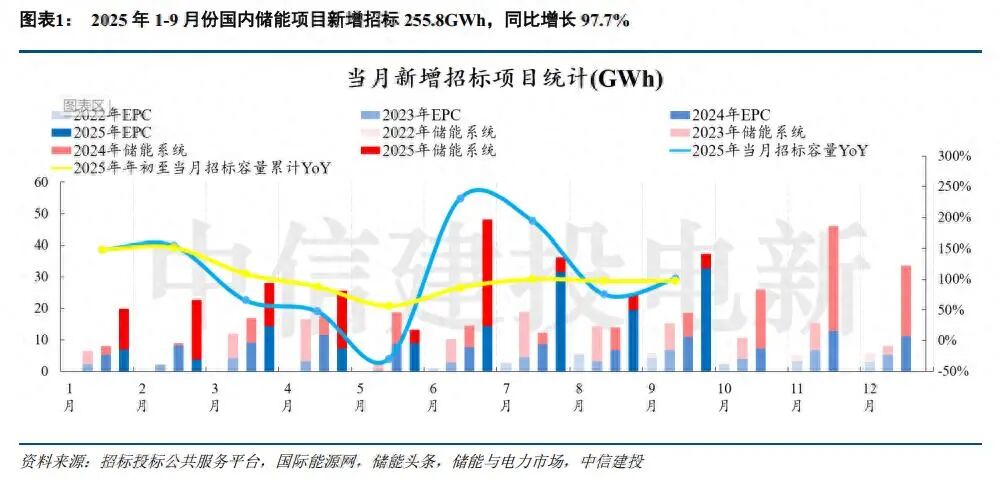
Core Viewpoint - The report from CITIC Securities indicates a doubling of domestic energy storage installation growth in the coming year, marking the beginning of a new lithium battery cycle, with significant investment opportunities in energy storage batteries, system integration, and key components like PCS [1][2][14]. Group 1: Energy Storage Market Dynamics - The total demand for lithium batteries is expected to exceed 2700 GWh next year, with a year-on-year growth rate of over 30%, and energy storage battery demand alone is projected to surpass 900 GWh [2][16]. - The bidding environment for energy storage projects is improving, with a total of 255.8 GWh of new bids recorded from January to September this year, representing a year-on-year increase of 97.7% [3][6]. - The annual bidding volume is expected to exceed 360 GWh, driven by strong demand and a favorable bidding season in Q4 [3][6]. Group 2: Investment Opportunities - Key investment opportunities exist in energy storage batteries, system integration, and PCS, with the battery segment currently facing shortages and potential price increases [17]. - The economic viability of energy storage projects has improved significantly, with many provinces achieving an internal rate of return (IRR) above 8%, and some like Inner Mongolia and Shandong reaching IRR levels of 15% or more [11][14]. Group 3: Policy and Market Support - Various provinces have introduced supportive policies, such as capacity pricing and compensation mechanisms, which enhance the economic returns for energy storage investments [11][12]. - The cancellation of mandatory energy storage requirements has shifted investment sentiment from "I have to invest" to "I want to invest," indicating a robust demand for energy storage projects driven by social capital [7][10]. Group 4: Regional Project Distribution - A total of 505 energy storage projects have been announced across various provinces, with a total capacity of 85.59 GW/250.1 GWh, highlighting strong investment activity in regions like Inner Mongolia, Hebei, and Shandong [10][11]. - Inner Mongolia has released multiple project lists, with significant capacities and active participation from major energy groups, indicating a strong local investment climate [10].
中信建投:136号文促进新能源全面入市 储能迎来非线性增长奇点
智通财经网· 2025-09-29 07:29
Core Viewpoint - The issuance of Document No. 136 promotes the full market entry of renewable energy, presenting both challenges and unprecedented opportunities for energy storage [1] Group 1: Market Dynamics - Document No. 136 marks the transition to a fully market-oriented trading period for renewable energy, with high marketization requirements for incremental projects [1] - The introduction of capacity pricing and capacity compensation policies across multiple provinces provides strong baseline returns for energy storage [2] - The significant increase in peak-valley price differences due to the growth of renewable energy installations enhances the economic viability of independent energy storage projects [2] Group 2: Growth Projections - The global installed energy storage capacity is projected to reach 272 GWh, 441 GWh, and 642 GWh in 2025, 2026, and 2027 respectively, with year-on-year growth rates of 46.6%, 62.1%, and 45.6% [1] - Domestic energy storage capacity forecasts have been raised to 150 GWh, 260 GWh, and 380 GWh for the same years [4] Group 3: Investment Recommendations - The report recommends focusing on leading companies in the energy storage sector, including CATL, EVE Energy, Sungrow Power Supply, and Haibo Technology [4] - Attention is also suggested for leading enterprises across various segments such as batteries, integration, PCS, and inverters [4] Group 4: Global Demand Trends - The global demand for energy storage is experiencing a synchronized explosion driven by the increasing penetration of renewable energy and the declining costs of storage systems [3]


全球储能下半年发展趋势与投资策略
2025-09-04 14:36
Summary of Key Points from the Conference Call Industry Overview - The global energy storage market is experiencing significant growth, with total shipments exceeding 300 GWh from January to July 2025, which is 2.1 times that of the same period last year, surpassing initial forecasts [1][2] - The energy structure is shifting from coal and gas to wind and solar, leading to improved economic viability for energy storage solutions [1][4] - The market is expected to maintain long-term growth, driven by new pricing mechanisms that lower marginal costs of basic electricity [1][4] Market Trends and Projections - In Europe, the commercial energy storage ratio is currently low, with expectations for installed capacity to reach 5 GWh by 2025, doubling year-on-year, and potentially reaching 20 GWh by 2029, with a compound annual growth rate (CAGR) exceeding 50% [1][7] - The demand for solar plus storage solutions is high in regions with weak grid infrastructure, such as Africa and Latin America, where household storage systems can reduce electricity costs [1][8] - The Asia-Pacific region, particularly countries like Pakistan, Iraq, and Syria, shows strong demand for energy storage due to frequent power outages [1][8] Investment Opportunities - Short-term investment opportunities include companies expanding into international markets (Europe, Latin America, Africa, Southeast Asia, and the Middle East), those focusing on technology development, and firms deepening their presence in niche markets [1][5] - Companies like 德业股份 (Deye) and 艾罗能源 (Aero Energy) are highlighted for their strong market positions and growth potential, particularly in the European market [10][12] Competitive Landscape - The competitive landscape among energy storage companies is shifting towards product innovation and market expansion, with companies like 德业股份 capturing significant market share in Africa and Latin America [9] - The introduction of new products, such as high-capacity storage systems, is enhancing competitiveness and meeting the growing demand in emerging markets [9][10] Financial Performance and Valuation - Companies in the energy storage sector are showing improved financial performance, with significant revenue growth and profit recovery expected in the second half of 2025 [2][21] - The valuation of leading energy storage companies remains relatively low, attracting investor interest amid high market demand [21][22] Future Outlook - The global energy storage market is projected to exceed 450 GWh in shipments for 2025, with sustained growth driven by both developing and developed countries [24] - The long-term outlook for the energy storage market is optimistic, with expectations for continued demand growth and profitability [24]