
商业健康保险创新药品目录

Search documents
两会|全国政协委员孙洁:打通创新药落地“最后一公里”
券商中国· 2026-03-05 15:19
Core Viewpoint - The article emphasizes the need for improved accessibility and affordability of high-value innovative drugs in China, particularly through the collaboration of commercial health insurance and public health insurance systems [3][4][6]. Group 1: Accessibility of Innovative Drugs - The issue of accessibility to innovative drugs is highlighted, with China ranking second globally in the number of innovative drugs launched, yet facing significant challenges in their adoption and payment [3]. - In December 2025, the National Healthcare Security Administration introduced the "Commercial Health Insurance Innovative Drug Directory," which includes 19 high-value innovative drugs that are not covered by basic medical insurance, promoting a dual-track payment system [3][4]. - Despite the introduction of the commercial insurance directory, challenges remain in the clinical implementation of these drugs, including insufficient prescription guidelines and limited risk management by insurance companies [3][4]. Group 2: Recommendations for Improvement - Recommendations include granting commercial health insurance companies the authority to develop guidelines and clinical pathways for high-value innovative drugs, fostering a collaborative governance model [3][4]. - Suggestions also include optimizing performance metrics for public hospitals to enhance the application of innovative drugs and allowing hospitals to accept funding from commercial insurance [4][5]. Group 3: Development of Huimin Insurance - Huimin insurance has gained importance in alleviating high medical costs for the public, but it faces challenges such as limited drug coverage and insufficient funding [6][7]. - Recommendations for Huimin insurance include promoting personal account payments, exploring diverse funding sources, and transitioning from a universal to a more targeted approach in coverage [6][7]. - The article suggests expanding the coverage of innovative drugs within Huimin insurance and encouraging the development of specialized insurance products that align with Huimin insurance [7]. Group 4: Integration of Services - The article discusses the need for better integration of insurance services with healthcare and elderly care, especially in the context of an aging population [8]. - It suggests that insurance product development should focus on combining commercial pension insurance with care services, and health insurance with health management services [8]. - Recommendations include enhancing information sharing between insurance companies and relevant government departments and healthcare institutions to ensure sustainable product offerings for the elderly [8].

医保改革提质升级 办好实事暖人心田
Xin Lang Cai Jing· 2026-01-13 21:58
Core Viewpoint - Nanning City is actively enhancing its medical insurance services to improve public welfare, focusing on various reforms and innovations in the healthcare sector to provide better support for families and individuals, particularly in maternal and child health, long-term care, and employment-related insurance services [1][2][3][4][6]. Group 1: Maternal and Child Health Services - Nanning has developed an efficient service model for maternal health, integrating various services such as medical insurance for childbirth and newborn care, which has significantly reduced the financial burden on families [1]. - The city has expanded the coverage of maternity insurance policies, including assisted reproductive services and prenatal check-ups, with a projected 20,000 outpatient settlements and approximately 60 million yuan in insurance fund payments by 2025 [1]. Group 2: Long-term Care Insurance - The city is addressing the challenges faced by disabled individuals by establishing a comprehensive long-term care insurance system, which includes a network of certified care service providers and a digital monitoring system to enhance service quality [2]. - By the end of 2025, over 1.7 million people are expected to be enrolled in long-term care insurance, providing support for more than 20,000 disabled individuals, with an average annual cost reduction of over 20,000 yuan per person [2]. Group 3: Employment and Insurance Services - Nanning has removed residency restrictions for new employment forms, allowing workers to register for insurance based on their employment location, thus facilitating easier access to insurance services [3]. - The city has implemented a "Medicare + N" cooperation model, establishing over 400 service points to enhance accessibility and convenience for residents [3]. Group 4: Business Environment Optimization - The city has introduced measures to reduce the burden on businesses, such as lowering the employee insurance contribution rate from 8.8% to 6.5%, which is expected to save over 300 million yuan in labor costs for eligible companies by 2025 [4]. - Nanning has also developed an instant settlement model between the insurance department and medical institutions, reducing the payment processing time to 20 working days, thereby improving cash flow for healthcare providers [4]. Group 5: Drug Insurance and Accessibility - The city is dynamically adjusting its medical insurance drug list to meet diverse medication needs, with 114 new drugs, including 50 innovative drugs, added to the insurance coverage starting January 2026 [6]. - By 2025, the total number of drugs covered by insurance will reach 3,253, with significant increases in the procurement of collective purchasing drugs and medical supplies, ensuring better access to quality medications for patients [6].
更多高价药有望用商保报销了
Di Yi Cai Jing Zi Xun· 2026-01-07 10:32
Core Insights - The first edition of the "Commercial Health Insurance Innovative Drug Directory" has been implemented, which includes 19 innovative drugs with significant clinical value that exceed the payment capacity of basic medical insurance [2][4] - The directory aims to benefit participants of the "Hui Min Bao" insurance, particularly those with severe illnesses, by providing access to high-cost innovative treatments [2][6] - The successful integration of these innovative drugs into hospitals remains a challenge, as many hospitals have specific requirements and policies that may hinder the adoption of these high-value drugs [3][4] Group 1 - The "Commercial Health Insurance Innovative Drug Directory" includes drugs for critical areas such as cancer, rare diseases, neurodegenerative diseases, and metabolic disorders, filling gaps in the basic medical insurance directory [2][4] - CAR-T therapy is highlighted as a significant treatment option for difficult-to-treat blood cancers, potentially extending patient survival from six months to over five years, but its high cost limits accessibility [2][3] - The implementation of the directory's benefits for "Hui Min Bao" participants depends on the acceptance of innovative drugs by the insurance products and their availability in hospitals [2][5] Group 2 - The "three exclusions" policy allows drugs in the directory to be exempt from certain cost monitoring and payment frameworks, but it does not resolve the challenges of getting these drugs into hospitals [4][5] - Some "Hui Min Bao" products have begun to connect with the directory, offering increased reimbursement rates for drugs used during hospitalization, but this is contingent on the drugs being included in hospital treatment [4][6] - There is encouragement from local medical insurance bureaus for retail pharmacies to stock drugs from the directory, which could help address the challenges of hospital access for high-cost innovative drugs [5][7] Group 3 - The directory includes drugs that are also part of some "Hui Min Bao" special drug coverage, with varying reimbursement rates for pre-existing and non-pre-existing conditions [6][7] - Some "Hui Min Bao" products have increased reimbursement rates for pre-existing conditions to 35%, indicating a shift towards better coverage for these patients [7] - Local medical insurance bureaus are supporting the design of new products and adjustments in reimbursement methods to better meet patient medication needs and reduce financial burdens [7]

更多高价药有望用商保报销了
第一财经· 2026-01-07 09:54
Core Viewpoint - The introduction of the first "Commercial Health Insurance Innovative Drug Directory" marks a significant step in expanding access to innovative drugs for patients, particularly those with severe illnesses, through commercial health insurance products like "Hui Min Bao" [3][4]. Group 1: Overview of the Innovative Drug Directory - The first edition of the Commercial Health Insurance Innovative Drug Directory includes 19 innovative drugs that have significant clinical value but exceed the payment capacity of basic medical insurance [3]. - These drugs cover critical areas such as oncology, rare diseases, neurodegenerative diseases, and metabolic disorders, including CAR-T therapies and treatments for Alzheimer's disease [3]. Group 2: Benefits and Challenges for Patients - Patients with severe conditions, such as blood cancers, can benefit from CAR-T therapies, which can extend survival rates significantly, but the high costs have limited their accessibility [3]. - The actual benefits for "Hui Min Bao" participants depend on the integration of these innovative drugs into hospital treatment protocols and the specific commercial insurance product designs [4][5]. Group 3: Implementation and Hospital Integration - There are obstacles in the hospital integration of high-value innovative drugs, as hospitals face restrictions related to drug usage and operational costs [4]. - Some hospitals are in the process of applying for the inclusion of these drugs, but the success of this integration remains uncertain [4][5]. Group 4: Insurance Product Design and Coverage - Certain "Hui Min Bao" products have begun to align with the Commercial Health Insurance Innovative Drug Directory, offering increased reimbursement rates for drugs used during hospitalization [5]. - However, if the innovative drugs do not successfully enter hospital treatment, patients may not receive the intended reimbursement benefits [5][6]. Group 5: Future Directions and Support from Regulatory Bodies - Local health insurance bureaus are encouraging the integration of the innovative drug directory into retail pharmacies, which could help address the challenges of hospital access [6][7]. - There is a push for commercial insurance companies to design new products and adjust reimbursement methods to better meet patient needs and reduce their financial burden [7].

更多高价药有望用商保报销了 患者为何还难以获益
Di Yi Cai Jing· 2026-01-07 09:12
Core Viewpoint - The first edition of the "Commercial Health Insurance Innovative Drug Directory" has been implemented, which includes 19 innovative drugs with significant clinical value that exceed the payment capacity of basic medical insurance, potentially benefiting participants of the Huiminbao insurance program [1][3]. Group 1: Innovative Drug Directory - The directory includes drugs for critical areas such as tumors, rare diseases, neurodegenerative diseases, and metabolic diseases, filling gaps in the basic medical insurance catalog [1]. - CAR-T therapy is highlighted as a significant treatment option for difficult-to-treat blood cancer patients, with potential survival rates increasing from six months to over five years, although its high cost limits accessibility [1][3]. Group 2: Implementation Challenges - The successful use of these innovative drugs in hospitals remains a challenge, with some hospitals still navigating the application process for these drugs [2][3]. - The "three exclusions" policy allows drugs in the commercial health insurance directory to be excluded from basic medical insurance self-payment rate indicators and centralized procurement monitoring, but does not resolve the challenges of hospital access for these high-value drugs [3][4]. Group 3: Insurance Product Design - Some Huiminbao products have begun to integrate the innovative drug directory, offering increased reimbursement rates for drugs used during hospitalization [4][5]. - The reimbursement for innovative drugs is contingent upon their successful admission into hospitals, and if not, patients may not receive coverage for these drugs [4][5]. Group 4: Regulatory Support - Local medical insurance bureaus are encouraging retail pharmacies to stock drugs from the commercial health insurance innovative drug directory, which may help address the hospital admission challenges [5][6]. - There is ongoing dialogue between innovative drug companies and commercial insurance providers to explore the inclusion of these drugs in special drug directories, potentially bypassing hospital admission requirements [5][6]. Group 5: Coverage Variability - Some Huiminbao products show significant differences in reimbursement rates for pre-existing conditions versus non-pre-existing conditions, with non-pre-existing conditions receiving a higher reimbursement rate [5][6]. - Recent notifications from multiple local medical insurance bureaus support the design of new products by commercial insurance institutions based on the innovative drug directory to better meet patient needs and reduce medical costs [6].
更多高价药有望用商保报销了,患者为何还难以获益
Di Yi Cai Jing Zi Xun· 2026-01-07 09:01
Core Viewpoint - The first edition of the "Commercial Health Insurance Innovative Drug Directory" has been implemented, which includes 19 innovative drugs with significant clinical value that exceed the payment capacity of basic medical insurance, potentially benefiting participants of the Huiminbao insurance program [1][2]. Group 1: Innovative Drug Directory - The directory includes drugs for critical areas such as tumors, rare diseases, neurodegenerative diseases, and metabolic diseases, including CAR-T therapy and treatments for Alzheimer's and rare diseases like neuroblastoma and Gaucher disease [1]. - The introduction of the directory aims to alleviate the financial burden on patients, particularly for high-cost treatments like CAR-T, which can significantly extend survival rates for patients with difficult-to-treat blood cancers [1][2]. Group 2: Implementation Challenges - There are obstacles in the actual use of these high-value innovative drugs in hospitals, as the integration into hospital systems remains a challenge [2][3]. - Some hospitals are in the process of applying for the inclusion of these drugs, but the requirements and policies vary by institution, affecting the availability of these treatments [2][3]. Group 3: Policy Support - The National Healthcare Security Administration and the National Health Commission have introduced policies to support the development of innovative drugs, including the "three exclusions" policy, which allows drugs in the directory to be excluded from certain cost monitoring and payment frameworks [2][4]. - Despite these policies, challenges remain regarding the entry of high-value innovative drugs into hospitals due to operational costs and hospital performance metrics [2][4]. Group 4: Insurance Product Design - Some Huiminbao products have begun to connect with the innovative drug directory, offering increased reimbursement rates for drugs listed in the directory when used during hospitalization [2][3]. - The reimbursement structure varies significantly between patients with pre-existing conditions and those without, with some products offering higher reimbursement rates for non-pre-existing conditions [4][5]. Group 5: Future Directions - Local healthcare authorities are encouraging the integration of innovative drugs into retail pharmacies, which could help address the challenges of hospital access [4][5]. - There is ongoing dialogue between pharmaceutical companies and commercial insurance providers to explore the inclusion of these innovative drugs in special insurance directories, potentially bypassing hospital admission requirements [4].
哪些药品能报销一查即知
Xin Lang Cai Jing· 2026-01-06 21:35
Core Points - The National Healthcare Security Administration (NHSA) has launched a new version of the basic medical insurance directory and the first commercial health insurance innovative drug directory on January 1 [1] - The updated directories were officially released in December 2025, providing users with a convenient way to check drug information through the NHSA WeChat public account [1] Group 1: New Features - Users can access the new drug directories by navigating to the "Microservices" section of the NHSA WeChat account and selecting the appropriate query options [1] - The search functionality allows users to input the generic name of a drug to determine its inclusion in the directory, classification, and reimbursement category [1] Group 2: Drug Classification - The NHSA classifies drugs in the medical insurance directory into two categories: Class A and Class B [2] - Class A drugs are essential for clinical treatment, widely used, and have proven efficacy, with full reimbursement available for insured individuals [2] - Class B drugs are also clinically effective but are priced slightly higher than Class A drugs, requiring individuals to pay a portion out-of-pocket before reimbursement [2]
2025年,保险股凭什么成为A股涨幅最大的“意外”
Tai Mei Ti A P P· 2025-12-31 11:23
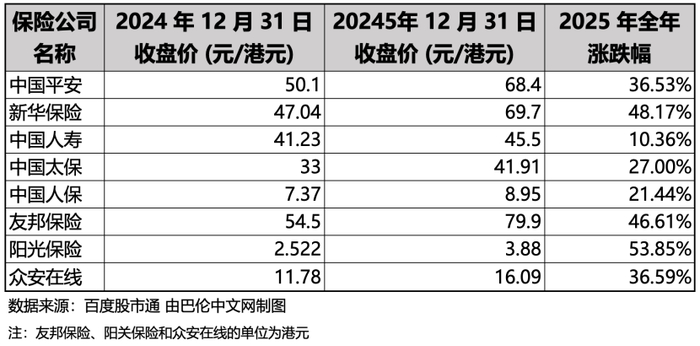
Core Viewpoint - The insurance sector in China's A-share market has emerged as a standout performer in 2025, with significant price increases and a strong upward trend since the lows of 2024, outperforming both banking and non-bank financial sectors [1][6]. Market Performance - The insurance sector index closed at 1554.89 points by December 31, 2025, with notable short-term momentum reflected in its 10-day, 20-day, and 60-day price increases [1]. - The total market capitalization of the five major listed insurance companies grew from approximately 2.16 trillion yuan to over 3.3 trillion yuan, an increase of over 1.1 trillion yuan [5]. Individual Company Performance - New China Life Insurance led the sector with a price increase of over 45% in 2025, driven by high earnings elasticity and a 58.9% year-on-year increase in net profit for the first three quarters [2]. - Ping An Insurance's stock price rose by 36.53% in 2025, reaching a peak of 71.98 yuan per share, attributed to its proactive asset-liability management and strong financial ecosystem [3]. - China Pacific Insurance's stock reached a new high of 43 yuan per share, supported by effective life insurance transformation and improved profitability in property insurance [4]. - China Life and China Re also achieved significant returns, with China Life benefiting from reduced interest rate risks and China Re excelling in property insurance profitability [5]. Valuation and Market Sentiment - Despite the strong stock performance, insurance stocks remain undervalued, with P/EV ratios generally between 0.6 and 0.9, significantly lower than consumer sector valuations [6]. - The market's confidence in the long-term profitability of the insurance sector is gradually recovering, with expectations for P/EV ratios to return to 1.0 in the future [6]. Policy Impact - Regulatory policies have played a crucial role in the sector's performance, focusing on reducing costs, expanding investment opportunities, and promoting market order [7][12]. - The introduction of a dynamic adjustment mechanism for predetermined interest rates has significantly lowered liability costs, enhancing the sector's profitability [8]. - The health insurance market has responded positively to policy changes, with premium income reaching 894.3 billion yuan in the first ten months of 2025 [9]. Future Outlook - The insurance sector is expected to enter a "golden development period" in 2026, with anticipated double-digit growth in new business value and premium income driven by strong demand for dividend insurance and health products [21]. - The investment environment is projected to improve, with a continued focus on high-dividend blue-chip stocks and technology innovation stocks, supporting a stable investment return of around 5% [22]. - The sector's valuation is expected to gradually recover, with many institutions predicting a return to 1.0 P/EV, indicating substantial potential for price appreciation [22][23].
商保创新药目录落地 老百姓如何受益?
Jin Rong Shi Bao· 2025-12-25 02:48
Core Viewpoint - The Commercial Health Insurance Innovative Drug Directory aims to provide a list of high-value innovative drugs that exceed basic medical insurance coverage, effective from January 1, 2026 [1][2]. Group 1: Overview of the Innovative Drug Directory - The directory includes 19 drugs focusing on three key areas: high-priced cancer treatments (5 Car-T cell therapy drugs), rare disease medications, and new targeted therapies for severe cancers [1]. - The directory is intended for reference by commercial health insurance and medical mutual aid systems, highlighting the importance of these drugs for patients with limited treatment options [1]. Group 2: Policy Implications - Drugs listed in the directory are not eligible for reimbursement under basic medical insurance, but the National Healthcare Security Administration has implemented a "three exclusions" policy to facilitate their use in hospitals [2]. - This policy alleviates concerns for hospitals regarding the use of innovative drugs, allowing for direct prescription and reimbursement through commercial insurance, thus bypassing previous complexities [2]. Group 3: Insurance Product Adaptation - Some commercial insurance products, such as certain惠民保 plans, have begun to incorporate drugs from the directory, offering increased reimbursement rates for hospital use of these drugs [2]. - Insurance companies are currently assessing how to integrate the directory's drugs into existing medical insurance products, with some already including specific innovative drugs as optional or mandatory coverage [3]. Group 4: Consumer Guidance - Consumers are advised to carefully review insurance contracts for coverage details, including specific drug lists, reimbursement rates, and any limitations on pharmacies or hospitals [4]. - Understanding the reimbursement process for innovative drugs is crucial, as it often involves specific purchasing locations, prescriptions from specialists, and prior authorization from insurance companies [4]. - Consumers should balance the cost of premiums with the level of coverage provided, considering personal health conditions and financial capabilities when deciding on insurance products that include innovative drug coverage [5].


中央经济工作会议定调积极,深化投融资综合改革
East Money Securities· 2025-12-17 08:22
Investment Rating - The report maintains a "stronger than the market" investment rating for the non-bank financial sector [2] Core Insights - The Central Economic Work Conference has set a positive tone for macroeconomic policies and capital market reforms, emphasizing the importance of internal demand and the release of supportive policy signals for 2026 [6][13] - The report highlights the acceleration of mergers and acquisitions in the securities industry, which is expected to reshape the industry landscape towards a model of "leading firms excelling" and "small firms developing unique characteristics" [6][14] - The introduction of the first commercial health insurance innovation drug directory is anticipated to enhance the attractiveness of health insurance products and promote a shift from homogeneous compensation to precise protection [34][35] Summary by Sections Securities Business Overview - The report notes that the major indices have shown mixed performance, with the Shanghai Composite Index at 3,889.35 points, down 0.34% from the previous week, while the ChiNext Index rose by 2.74% [15] - The average daily trading volume in A-shares increased by 13.97% week-on-week, reaching 1.90 trillion yuan [15][21] - The report indicates that the total IPO underwriting scale for the year reached 113.97 billion yuan, with refinancing underwriting at 1,038.5 billion yuan [16] Insurance Business Overview - The report discusses the urgent need for capital replenishment among insurance companies due to the end of the transitional period for the second phase of the solvency regulatory framework, with the overall solvency adequacy ratio at 186.3%, down 11.1 percentage points year-on-year [35] - The newly implemented commercial health insurance innovation drug directory is expected to include 19 key innovative drugs, enhancing the health insurance ecosystem [34] - The report highlights that insurance companies have been actively seeking capital through various channels, with significant approvals for capital increases and bond issuances [35] Market Liquidity Tracking - The report notes that the central bank conducted a net injection of 4.7 billion yuan in the open market, with reverse repos totaling 668.5 billion yuan [38][40] - The issuance of local government bonds amounted to 106.9 billion yuan, with a net injection of 62.2 billion yuan [38][40] Industry News - The report mentions that the Shanghai Stock Exchange has revised its bond trading guidelines to enhance market efficiency and transparency [50] - The Central Economic Work Conference has reiterated the commitment to deepening capital market reforms and addressing "involution" competition [50]