
大容量QLC SSD

Search documents
存储芯片,太疯狂了
半导体芯闻· 2026-02-09 10:10
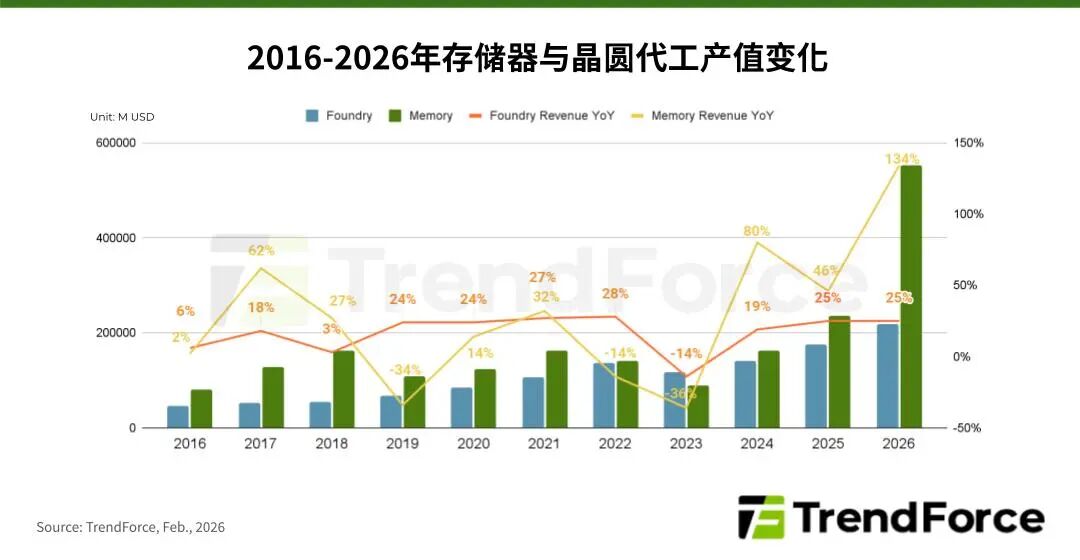
Core Viewpoint - The memory and foundry industries are expected to reach record high revenues by 2026, driven by the AI wave, with memory industry revenue projected to expand significantly to $551.6 billion, more than double that of the foundry industry, which is expected to reach $218.7 billion [3][4]. Group 1: Memory Industry Insights - The memory industry is experiencing a supply shortage and price surge, leading to substantial revenue growth [3][4]. - The last memory supercycle occurred between 2017-2019, driven by demand from cloud data centers, with a significant revenue gap between memory and foundry sectors [3][4]. - The current cycle, driven by AI demand, has a more comprehensive shortage compared to the previous one, with increased demand for high-capacity, high-bandwidth DRAM [3][4]. Group 2: Foundry Industry Insights - Although the foundry industry benefits from strong orders for AI chips, its revenue growth is slower compared to the memory sector due to industry structure and pricing mechanisms [4][5]. - The foundry market is characterized by a high degree of oligopoly and significant capital expenditure, limiting capacity expansion despite high prices [4][5]. - Mature processes account for approximately 70%-80% of foundry capacity, while advanced processes only make up about 20%-30%, affecting overall revenue contributions [4][5]. Group 3: Market Dynamics - The demand shift from end customers to cloud service providers (CSPs) has led to exponential growth in procurement volumes, with CSPs being less sensitive to price changes [4][5]. - Memory manufacturers have strong pricing power due to supply-demand imbalances, with average selling prices (ASP) expected to continue rising [5].

集邦咨询:AI浪潮推升 存储器与晶圆代工产值均将在2026年创下新高
智通财经网· 2026-02-09 06:44
Core Insights - The memory and foundry industries are expected to reach record high revenues by 2026, driven by the AI wave, with memory industry revenue projected to expand to $551.6 billion and foundry revenue to $218.7 billion, with memory revenue surpassing foundry revenue by more than double [1] Group 1: Memory Industry Dynamics - The current memory cycle, driven by AI demand, shows stronger resilience and price premiums compared to the previous cycle from 2017 to 2019, which was primarily driven by cloud data center needs [3] - The demand for high-capacity and high-bandwidth DRAM is increasing due to the shift in AI focus from model training to large-scale inference applications, emphasizing real-time response and data access efficiency [3] - The purchasing behavior has shifted from end customers to cloud service providers (CSPs), leading to exponential growth in procurement volumes and a lower sensitivity to price changes, resulting in record price increases [3] Group 2: Foundry Industry Characteristics - Despite benefiting from strong orders for AI chips, the growth rate of foundry revenue is more stable compared to memory, due to industry structure and pricing mechanisms [4] - The foundry market is characterized by high technical barriers and capital expenditures, leading to a highly concentrated supply, which limits the ability to easily expand capacity [4] - The foundry industry’s pricing volatility is lower than that of the memory industry, making significant price fluctuations less likely [4] Group 3: Capacity Expansion and Market Position - The memory industry has a higher elasticity in capacity expansion compared to the foundry industry, contributing to the widening revenue gap [5] - The standardization of memory products allows for more efficient capital expenditure conversion into actual output, unlike the diverse product mix in foundry services [5] - Memory manufacturers hold strong pricing power amid ongoing AI demand and supply shortages, with average selling prices (ASP) expected to continue rising [5]
创业板首家 储存独角兽大普微IPO注册获批
Sou Hu Cai Jing· 2026-01-25 09:43
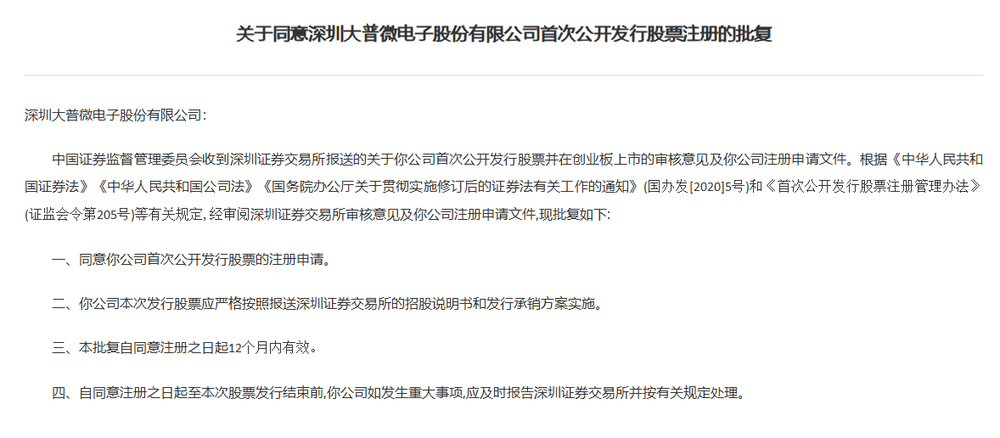
Core Viewpoint - The approval of Shenzhen Dapu Microelectronics Co., Ltd.'s IPO registration marks the first instance of an unprofitable company being granted IPO approval on the ChiNext board in China [1] Financial Performance - Dapu Micro's projected revenues for 2022, 2023, and 2024 are 557 million, 519 million, and 962 million yuan respectively, with net losses of 534 million, 617 million, and 191 million yuan [3] - For 2025, the company anticipates revenues between 2.05 billion and 2.35 billion yuan, representing a year-on-year growth of approximately 113.06% to 144.24% [4] - The expected net loss for 2025 is projected to be between 464 million and 504 million yuan, indicating a significant increase in losses compared to the previous year [4] Company Overview - Established in April 2016 with a registered capital of 393 million yuan, Dapu Micro focuses on the research and sales of enterprise-level SSD products for data centers [6] - The company has shipped over 4,900 PB of enterprise-level SSDs, with more than 75% of shipments utilizing self-developed controller chips [6] - Dapu Micro has established a strong customer base, including major tech companies like ByteDance, Tencent, Alibaba, and international clients such as Google [6] Future Strategy - The company plans to continue its focus on the semiconductor enterprise storage sector while expanding into AI-related products such as high-capacity QLC SSDs and intelligent network cards [6] - Dapu Micro aims to enhance its competitive position by developing platform-level storage products and solutions [6] Ownership Structure - The actual controller, Yang Yafei, holds 66.74% of the voting rights through Dapu Haide and Dapu Haijuhua [7] Leadership Background - Yang Yafei, born in July 1979 and a permanent resident of the U.S., has a Ph.D. and previously worked at Qualcomm before leading Dapu Micro [10]

创业板未盈利上市第一股将来 聚焦存储赛道
是说芯语· 2025-12-22 00:04
Core Viewpoint - The upcoming IPO review of Shenzhen Dapu Microelectronics Co., Ltd. on December 25 is a critical moment for the company and is seen as a test of the A-share market's tolerance for high-quality unprofitable tech companies [1] Group 1: Company Overview - Dapu Micro was established in 2016 and is recognized as a leading provider of enterprise-level SSD controller chips and storage solutions in China, with a full-stack self-research capability [2] - The company has shipped over 4,900 PB of enterprise SSDs, with more than 75% of shipments utilizing self-developed controller chips, positioning it well in the domestic storage replacement wave [2] - Dapu Micro has a strong client base, including major internet companies and key industries such as finance and power, and has invested over 700 million yuan in R&D [2] Group 2: Financial Performance - From 2022 to the first half of 2025, Dapu Micro incurred cumulative losses of nearly 1.7 billion yuan, with retained earnings at -945 million yuan and continuous negative cash flow exceeding 1.8 billion yuan [2] - The company has a high short-term debt ratio of 95.76% as of June 2025, indicating significant pressure on its cash flow [2] Group 3: Profitability Goals - Dapu Micro aims to achieve profitability by 2026, with a projected revenue increase to 2.732 billion yuan and an expected gross margin improvement due to a rise in high-end product sales [3] - The company has secured 1.941 billion yuan in orders and anticipates a quarterly revenue nearing 900 million yuan in Q4, with a gross margin expected to rise to 7.68% [3] Group 4: Market Challenges - The company's profitability is highly dependent on fluctuations in NAND Flash prices, which have led to negative gross margins in recent periods [4] - Despite an industry growth rate of 187.9% in 2024, Dapu Micro's revenue growth is only projected at 85.3%, with its market share declining from 6.4% to 3.0% [6] Group 5: Implications for the Industry - Regardless of the outcome of Dapu Micro's IPO, it will provide valuable insights for unprofitable tech companies seeking to list, influencing future capital flows towards core technology sectors [7] - The review results will help balance support for tech innovation with financial risk prevention in the A-share market [7]

存储芯片“涨价潮”持续升温,千亿龙头股价创新高
2 1 Shi Ji Jing Ji Bao Dao· 2025-11-13 03:48
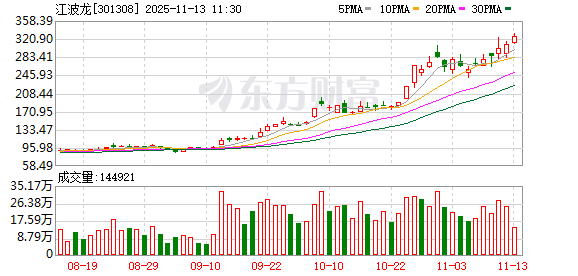
Core Viewpoint - The storage chip sector in A-shares continues to show strong performance, driven by clear price increase signals in the industry, particularly from major players like Samsung and SK Hynix [2][3] Group 1: Market Performance - Jiangbolong (301308.SZ) saw its stock price rise over 6%, reaching a historical high of 331.5 yuan per share, while Baiwei Storage (688525.SH) increased by over 10% [2] - Jiangbolong's stock has surged 260.47% year-to-date, with a market capitalization exceeding 137.8 billion yuan [2] Group 2: Financial Results - Jiangbolong reported third-quarter revenue of 6.539 billion yuan, a year-on-year increase of 54.6% and a quarter-on-quarter increase of 10.09% [3] - The company achieved a net profit of 698 million yuan, marking a significant year-on-year growth of 1994.42% and a quarter-on-quarter increase of 318.94% [3] Group 3: Industry Dynamics - Major storage manufacturers are planning to increase NAND prices by 20% to 30% due to reduced supply and rising demand driven by AI applications [2][3] - The demand for DRAM in AI servers is eight times that of regular servers, significantly impacting the overall memory market [3] Group 4: Future Outlook - Multiple institutions express optimism about the storage chip industry, predicting significant price increases for DRAM and NAND in the coming years [4] - The current supply-demand dynamics suggest that the "super cycle" in the storage market may have already begun [4]
江波龙:目前各大存储原厂在报价上仍保持向上态势
Zheng Quan Shi Bao Wang· 2025-11-12 12:15
Core Viewpoint - The demand for large-capacity QLC SSDs from cloud service providers has significantly exceeded the supply expectations of storage manufacturers, leading to an upward trend in pricing across the industry [1] Group 1 - Cloud service providers are increasing their orders for large-capacity QLC SSDs [1] - The demand from customers is far exceeding the original supply expectations set by storage manufacturers [1] - Major storage manufacturers are maintaining an upward pricing trend [1]