
大晓机器人

Search documents
AI与机器人盘前速递丨智谱发布GLM-5旗舰模型,千问蚂蚁阿福霸榜AppStore!
Mei Ri Jing Ji Xin Wen· 2026-02-12 01:34
Market Review - The A-share artificial intelligence and robotics sectors are experiencing a phase of adjustment, with both thematic ETFs slightly declining while maintaining low-level consolidation. However, there is solid support from core stocks, and the robot ETF has seen continued inflow from major funds, indicating a potential rebound opportunity. The current adjustment presents a good opportunity for low-cost accumulation [1] - The Huaxia Sci-Tech AI ETF (589010) saw a slight increase in the afternoon before retreating, with the latest price at 1.574 yuan, down 0.823% from the opening price. Among the 30 constituent stocks, 22 declined, with notable drops from companies like Lanke Technology and Lingyun Light. However, the overall decline was moderate, with Sikan Technology rising over 10% to provide strong local support [1] - The Robot ETF (562500) experienced a slight increase in the morning before retreating to low-level fluctuations, with the latest price at 1.067 yuan, down 1.108% from the opening price. Out of 66 constituent stocks, 49 declined, with companies like Aifute and Weichuang Electric dropping over 6%. Conversely, Matrix Technology rose over 8%, effectively offsetting some downward pressure [1] - The liquidity aspect shows a trading volume of 850.4 million yuan for the AI ETF and 8.19 billion yuan for the Robot ETF, with turnover rates of 3.25% and 3.16% respectively, indicating stable trading activity and a solid foundation for future rebounds [1] Hot News - Zhipu released its next-generation flagship model GLM-5, which has coding and agent capabilities reaching open-source SOTA, closely resembling real programming scenarios. This model excels in complex system engineering and long-range agent tasks [2] - In the App Store's free application rankings in China, Qianwen and Antifufu saw a significant increase in downloads, taking the top two spots. The launch of new features contributed to this surge [2] - On February 11, MSCI announced its quarterly review results, with 37 stocks including SenseTime being added to the MSCI China Index, effective after the market closes on February 27. Additionally, SenseTime's subsidiary completed angel round financing led by Ant Group, with funds aimed at advancing various technological developments [2] Institutional Insights - According to a report by CICC, by 2025, global large model technology capabilities will continue to evolve and gradually be applied in productivity scenarios, achieving significant progress in reasoning, programming, agents, and multimodal capabilities. However, there are still shortcomings in stability and hallucination rates. Looking ahead to 2026, breakthroughs in reinforcement learning, model memory, and contextual engineering are expected, moving closer to the long-term goal of artificial general intelligence (AGI) [3]

商汤大晓机器人获蚂蚁集团领投天使轮,机器人 ETF (562500) 震荡整理
Mei Ri Jing Ji Xin Wen· 2026-02-11 03:18
Group 1 - The core viewpoint of the news highlights the ongoing development and investment opportunities in the humanoid robot industry, driven by advancements in electric and intelligent technologies [2] - The Robot ETF (562500) is the only robot-themed ETF in the market with a scale exceeding 20 billion, covering various segments including humanoid robots, industrial robots, and service robots, facilitating investors' access to the entire robot industry chain [2] - Recent adjustments in the ETF's component stocks have increased the humanoid robot content to nearly 70%, successfully removing underperforming stocks and retaining high-quality ones [2] Group 2 - As of 11:00 today, the Robot ETF (562500) is experiencing a slight decline of 0.556% from the opening price, with 25 out of 66 tracked stocks showing gains, indicating mixed performance within the sector [1] - The ETF recorded a net inflow of 527 million yesterday, suggesting strong support from main funds and reinforcing the bullish sentiment in the sector [1] - The recent angel round financing of SenseTime's Daxiao Robot, led by Ant Group, aims to enhance the development of "human-centered" ACE technology and expand into various commercial scenarios [1]
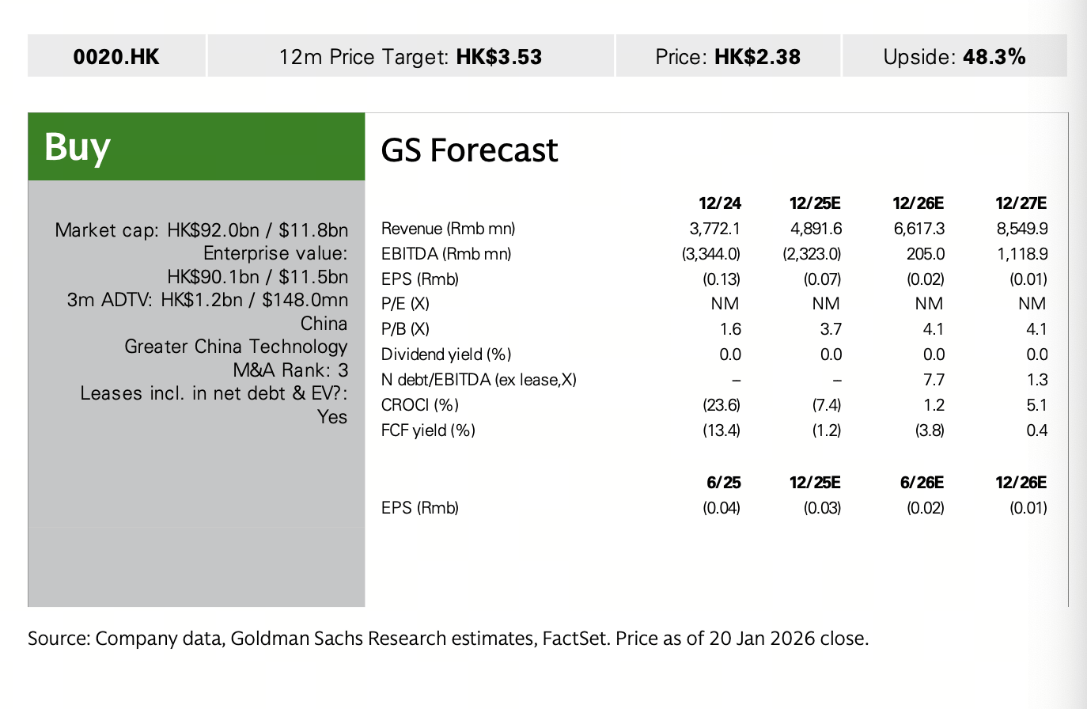
获高盛3.53港元目标价,商汤布局“AI+”生态引发市场关注
Sou Hu Cai Jing· 2026-01-22 07:06
Core Viewpoint - SenseTime (00020.HK) is expected to see continued growth in its generative AI revenue due to its extensive product coverage and customized solutions for specific industries, leading to a "Buy" rating from Goldman Sachs with a target price of HK$3.53, representing an upside of 48.3% from the current price of HK$2.38 [1][2]. Group 1: Financial Projections - Goldman Sachs forecasts SenseTime's revenue to grow from RMB 3,772.1 million in 2024 to RMB 8,549.9 million by 2027 [2]. - The company's EBITDA is projected to improve from a loss of RMB 3,344.0 million in 2024 to a profit of RMB 1,118.9 million by 2027 [2]. - SenseTime's earnings per share (EPS) are expected to move from a loss of RMB 0.13 in 2024 to a loss of RMB 0.01 by 2027 [2]. Group 2: Strategic Initiatives - SenseTime is focusing on optimizing computing power and foundational models to enhance cost-effectiveness and shorten return cycles, as stated by CEO Xu Li [1][3]. - The company is integrating deeply with various application scenarios, including education, finance, tourism, and smart devices, to maximize its operational efficiency [1][3]. - SenseTime is advancing its "AI+" business ecosystem, with initiatives such as the launch of the ACE embodiment research paradigm by its robot product, Daxiao, on December 18, 2025 [3]. Group 3: Competitive Positioning - As a leading generative AI software company in China, SenseTime's self-developed AI foundational models and infrastructure provide a solid foundation for its growth [3]. - The AI industry is experiencing a structured "ecological niche differentiation," where companies are focusing on either B-end MaaS services or C-end killer applications, with SenseTime leveraging its "full-stack coverage + hardware-software synergy" to occupy a favorable ecological position [3].

重估商汤
是说芯语· 2026-01-21 03:49
Core Insights - The article emphasizes the strategic decision of SenseTime to build its own computing infrastructure instead of selling to tech giants, which has proven to be a strong asset during the AI industry's value verification phase [4][6]. - SenseTime's refusal to be acquired and its focus on creating AI as a foundational infrastructure rather than a mere plugin for larger companies is highlighted as a key factor in its resilience [4][6]. Group 1: Market Transition - The AI industry is undergoing a significant market logic shift, moving from a phase where capital was willing to pay premiums for technology concepts to a phase focused on value verification and stable cash flows [6][8]. - SenseTime's strong performance amidst this transition serves as a testament to its strategic foresight and comprehensive layout in the AI sector [6][8]. Group 2: Financial Performance - By mid-2025, SenseTime's revenue from generative AI has significantly increased to 77%, indicating a successful transition from traditional business models [11]. - As of mid-2025, SenseTime's cash reserves reached 13.16 billion yuan, showcasing a robust financial position that supports its growth and risk mitigation strategies [12]. Group 3: Infrastructure Development - SenseTime began investing in its computing infrastructure as early as 2018, recognizing the need for AI-specific cloud services, which were scarce at the time [14][16]. - By August 2025, SenseTime's operational computing power reached approximately 25,000 PetaFLOPS, with ongoing expansion of its Shanghai Lingang AI Data Center [16]. Group 4: Competitive Positioning - SenseTime's strategy of building a comprehensive technology base allows it to avoid being trapped in low-end markets and instead pursue high-value growth opportunities [17]. - The company's dual approach of serving both B2B and B2C markets positions it favorably against competitors, with a more reasonable valuation compared to other tech firms [22]. Group 5: Long-term Strategy - SenseTime's commitment to building a solid technological foundation has enabled it to extend its growth curves and avoid the pitfalls of price wars in the AI sector [17][21]. - The company's focus on creating a "big device + big model + application" strategic triangle is crucial for its long-term success and market differentiation [17].

从适配到进化:商汤科技打响国产AI “生态合围战”
Hua Xia Shi Bao· 2025-12-26 00:15
Core Insights - SenseTime is actively enhancing its AI product offerings, including various intelligent agents tailored for different scenarios such as short drama creation and e-commerce marketing [2] - The company emphasizes user value by integrating AI into real-world applications, driving innovation through original technological advancements, and building a domestic AI ecosystem centered around its self-developed models [2] - SenseTime is positioning itself as a "connector" and "catalyst" within the domestic AI industry, facilitating a shift from passive technology adaptation to proactive ecosystem collaboration [2] Group 1: Product Development and Innovation - SenseTime has launched several intelligent agents, including "Seko" for short drama creation and "Xiao Huan Xiong" for office scenarios, showcasing its commitment to real-world applications [2] - The company has achieved comprehensive adaptation with all domestic chip manufacturers, including major players like Huawei and Cambricon, enhancing its product capabilities [3] - The release of the Seko 2.0 model marks a significant advancement in multi-modal AI capabilities, demonstrating the integration of domestic AI chips into core applications [4] Group 2: Ecosystem and Collaboration - SenseTime has established a comprehensive adaptation system with domestic chip manufacturers, covering all layers from models to infrastructure, which enhances collaboration and innovation [4][5] - The partnership with Moer Technology exemplifies a closed-loop cooperation mechanism that optimizes demand and supply in AI computing, improving market competitiveness [5] - The collaboration with multiple domestic AI chip companies aims to overcome critical technological challenges, ensuring a self-controlled AI computing environment in China [6] Group 3: Strategic Positioning and Market Impact - SenseTime's strategy of deep collaboration with domestic chip manufacturers creates an "ecological moat," positioning the company as a key organizer and connector within the domestic AI ecosystem [6] - By providing a fully domestic solution, SenseTime addresses the highest data security and supply chain safety requirements for critical sectors like finance and government [6] - The company's approach to running demanding AI models on domestic chips serves as a rigorous test for these chips, fostering their growth and accelerating the maturity of the domestic AI computing foundation [7]

对话大晓机器人董事长王晓刚:不押注VLA,押注世界模型
Sou Hu Cai Jing· 2025-12-25 07:59
Core Insights - The current technological routes in embodied intelligence, particularly the VLA model, have significant flaws in understanding the physical world and its laws [4][11] - Many companies are developing embodiments, but there is a lack of products that can truly understand the world and solve real problems [5] - In 2025, the domestic market is expected to see a surge in instant retail warehousing applications, which require 24/7 service, presenting an opportunity for robots to excel [5] Group 1: Company Strategy - The CEO of DaXiao Robotics, Wang Xiaogang, emphasizes a restrained approach by not entering the crowded embodiment market or betting on VLA, but instead focusing on the world model as a consensus direction in the industry [6][8] - DaXiao Robotics aims to integrate soft and hard solutions, addressing the shortcomings of existing technology routes, particularly the VLA model, which does not require a true understanding of the physical world [11][12] - The company’s world model consists of three parts: multi-modal understanding, long-term dynamic interaction scenes, and predictive capabilities, which are essential for the core of their technology [13] Group 2: Market Position and Opportunities - The industry is still maturing, and the head positioning has not been completed, with significant opportunities for new startups due to existing technological flaws [17] - The company sees a unique opportunity in the integration of hardware and software, leveraging its extensive client base from previous years to achieve rapid scaling in the robotics field [18] - Short-term goals include deploying four-legged robotic dogs with navigation and AI capabilities, while mid-term focus will be on commercial service scenarios like flash purchase warehouses [19] Group 3: Technological Differentiation - The ACE research paradigm proposed by DaXiao Robotics is seen as a revolutionary change that could provide a competitive edge in the market [18] - The world model approach is believed to be more adaptable and capable of covering a wider range of scenarios compared to VLA, which is limited by its embodiment [21] - The company plans to open-source its model to gather diverse feedback and data, differentiating its development path from other countries [22]

“以人为中心”革新具身研发范式
Xin Lang Cai Jing· 2025-12-22 06:58
Group 1 - The core focus of the article is the unveiling of "Daxiao Robot" by SenseTime, a leading AI company, which presented a "super brain module" instead of traditional robotic products [1] - The launch of Daxiao Robot occurred towards the end of 2025, indicating a strategic timing for the introduction of advanced AI technology [1] - The presentation did not include specific industrial or household product solutions, highlighting a shift in focus towards AI capabilities rather than physical robots [1]
新品密集发布+国产算力适配 商汤科技股价早盘拉升8.5%
Zhi Tong Cai Jing· 2025-12-22 05:45
Core Insights - SenseTime's stock price experienced a significant increase, with a peak rise of over 8.5%, reaching HKD 2.04, driven by recent technological advancements and product innovations in AI [1] - The company launched several new AI-based products during its product release week, including the first integrated creative multi-episode generation AI agent "Seko 2.0" and the first native AI office assistant "Xiao Huan Xiong 3.0" [1] - SenseTime achieved a milestone in adapting its self-developed models to domestic chips, with a strategic partnership established with companies like Zhongke Shuguang and Daxiao for deep integration of its large models [1] Product Innovations - New AI products introduced include the "Ruying" marketing AI engine, "Daxiao Robot" for embodied intelligence, "Kapi Camera" AI photo assistant, and a new generation AI financial assistant "Kapi Accounting" [1] - The SenseCore device has completed full adaptation with mainstream domestic AI chips, including Huawei Ascend, Cambricon, and others, enhancing operational efficiency [2] Strategic Collaborations - SenseTime has established a joint optimization mechanism with chip manufacturers to significantly improve operational efficiency on domestic chips [2] - The company is positioned for potential valuation recovery as product deployment progresses and industry demand increases [2]
新品密集发布+国产算力适配 商汤科技(00020)股价早盘拉升8.5%
智通财经网· 2025-12-22 05:38
Core Viewpoint - The significant stock price increase of SenseTime-W (00020) is attributed to recent technological advancements and product launches that enhance practical applications of AI, demonstrating a shift towards utilitarianism in AI commercialization [1] Group 1: Product Innovations - SenseTime has launched several AI-based products during its product release week, including the first integrated creative multi-episode generation AI "Seko 2.0," the first native AI office assistant "Xiao Huan Xiong 3.0," and a new generation e-commerce AI growth engine "Ruying" marketing assistant [1] - Additional products include the "Daxiao Robot" for embodied intelligence, the new AI financial assistant "Kapi Accounting," and the AI photo assistant "Kapi Camera," which has topped app store rankings in multiple countries [1] Group 2: Chip Adaptation and Collaborations - SenseTime has achieved significant milestones in adapting its products to domestic chips, with the announcement from Cambrian on December 15 that it has completed adaptation for SenseTime's self-developed Seko series models [1] - The company has established strategic partnerships with organizations like Inspur and Daxiao to ensure deep adaptation of its large models with products like Inspur's scaleX supercomputing cluster [1] - SenseCore, SenseTime's large device, has completed full adaptation with mainstream domestic AI chips, including Huawei Ascend, Cambrian, and others, enhancing operational efficiency through a joint optimization mechanism with chip manufacturers [2] Group 3: Future Outlook - As the company continues to advance product deployment and industry demand increases, there is potential for ongoing valuation recovery [2]
商汤科技进军具身智能 大晓机器人走“开源+生态协同”之路
2 1 Shi Ji Jing Ji Bao Dao· 2025-12-18 23:19
Core Insights - SenseTime's Xiaodao Robot is set to debut by the end of 2025, focusing on ecosystem collaboration within the AI industry chain, unlike its peers [1] - The company emphasizes a human-centered approach to address real-world needs with integrated hardware and software products [1] - The transition to embodied intelligence requires a fundamental paradigm shift in data collection and model training due to a significant data volume gap [1][2] Data and Technology - The ACE embodied research paradigm allows for the collection of tens of millions of hours of data annually, significantly enhancing the value of real data [2] - Current embodied intelligence data is limited to 100,000 hours, while Tesla's FSD V14 achieves a training equivalent to 400 million hours of human driving experience daily [1] - The ACE paradigm utilizes environmental data collection through multi-modal devices, providing comprehensive data support for model training [4] Industry Trends - The global humanoid robot market is projected to reach 6 million units sold by 2035, with a market size exceeding $120 billion, potentially rising to $260 billion in optimistic scenarios [6] - Investment institutions are increasingly focusing on the humanoid robotics sector, anticipating a shift towards mass production and diverse business models [6] Challenges and Solutions - The current data collection methods are costly and inefficient, leading to a lack of general cognitive and adaptive capabilities in robots [4] - The industry consensus is that the true value of robots lies in their ability to solve real-world application challenges rather than their physical form [5] - Key obstacles to large-scale deployment include the need for improved data protection and the replicability of industrial applications [6] Cost Reduction and Future Outlook - Key components like planetary roller screws and six-dimensional torque sensors account for about 40% of total costs, with potential reductions of 70% to 80% as domestic supply chains mature [7] - Breakthroughs in AI chips, battery management, and thermal management are expected to take 5 to 10 years, impacting overall cost structures [7] - As costs decrease, humanoid robots may surpass human labor in investment returns, marking a critical point for large-scale replacement of human workers [7]