央企红利ETF

Search documents
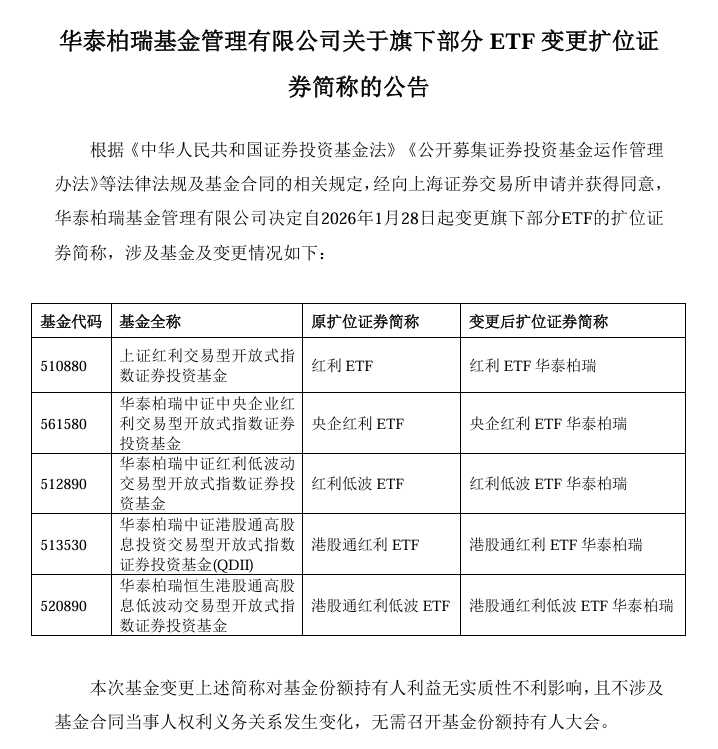
华泰柏瑞基金旗下“红利全家桶”将变更场内简称
Sou Hu Cai Jing· 2026-01-26 13:00
Core Viewpoint - Huatai-PineBridge Fund announced that starting from January 28, its ETFs will change their trading names to include the "Huatai-PineBridge" suffix, enhancing brand recognition in the market [1]. Group 1: Fund Name Changes - The following ETFs will have their names changed: - Red Dividend ETF to Red Dividend ETF Huatai-PineBridge - Central Enterprise Dividend ETF to Central Enterprise Dividend ETF Huatai-PineBridge - Low Volatility Dividend ETF to Low Volatility Dividend ETF Huatai-PineBridge - Hong Kong Stock Connect Dividend ETF to Hong Kong Stock Connect Dividend ETF Huatai-PineBridge - Hong Kong Stock Connect Low Volatility Dividend ETF to Hong Kong Stock Connect Low Volatility Dividend ETF Huatai-PineBridge [1][3]. Group 2: Fund Size and Market Position - As of January 23, the Low Volatility Dividend ETF managed by Huatai-PineBridge is the largest dividend-themed ETF in the market, with a size of 27.845 billion yuan - The Red Dividend ETF follows as the second largest, with a size of 19.555 billion yuan - The total size of the "Dividend Family" ETFs managed by Huatai-PineBridge exceeds 52 billion yuan [1].

ETF2.0时代,或许名字才是答案
点拾投资· 2026-01-08 06:57
Core Viewpoint - The article highlights the significant growth of the ETF market in China, with the total market size surpassing 6 trillion yuan, indicating a fundamental shift in investor behavior and objectives over a short period [1][2]. Market Growth - The total market ETF size reached 6.02 trillion yuan by the end of 2025, up from 3.2 trillion yuan at the end of Q2 2024, marking a rapid increase in just one and a half years [2]. - The Huatai-PB CSI 300 ETF leads the market with a size of 431.37 billion yuan, reflecting its prominence in the ETF landscape [2][9]. ETF Standardization - The article discusses the transition of ETFs into a standardized era, where product names are simplified to include the index tracked and the fund manager, enhancing clarity for investors [5][6]. - The renaming of the Huatai-PB CSI 300 ETF to "Huatai-PB CSI 300 ETF" signifies a move towards a more regulated and recognizable naming convention in the ETF market [6][7]. Performance and Returns - The Huatai-PB CSI 300 ETF has distributed a total of 165.76 billion yuan in dividends since its inception, showcasing its role in value creation for investors [3][11]. - As of Q3 2025, the fund has achieved over 142.4 billion yuan in cumulative profits for its holders, making it the first equity fund in the A-share market to surpass 100 billion yuan in cumulative profits [12]. Brand Recognition - The article emphasizes the importance of brand recognition in the asset management industry, noting that Huatai-PB has updated the names of 21 products to include the brand in their titles, aligning with the trend towards brand identification in a competitive market [7][10]. - The Huatai-PB CSI 300 ETF's significant trading volume, accounting for over 54% of the total trading volume of similar ETFs in 2025, underscores its liquidity and investor trust [10]. Awards and Recognition - Huatai-PB Fund received multiple awards at the 22nd China Fund Industry Golden Bull Awards, reflecting its commitment to long-term value investment and service to investors [13][14].

震荡行情高股息资产吸金,红利ETF(510880)连续4周获资金周度净流入
Xin Lang Cai Jing· 2025-12-15 05:10
Core Viewpoint - The market is shifting towards high-dividend sectors amid a volatile market environment, with a focus on defensive asset allocation and dividend-themed ETFs gaining traction [1][6]. Fund Performance and Trends - The Dividend ETF (510880) has seen a net inflow of 920 million yuan over four consecutive trading days, making it the only dividend-themed ETF to exceed 700 million yuan in net inflows during this period [1][6]. - Since its inception on November 17, 2025, the Dividend ETF has maintained a weekly net inflow for four weeks, increasing its total assets to 18.1 billion yuan, positioning it among the few dividend-themed ETFs with over 10 billion yuan in assets [1][6]. - The Dividend ETF has delivered a cumulative return of 250.24% since its establishment, outperforming its benchmark return of 128.98% [1][6]. Holder and Distribution Information - As of the end of the reporting period in the third quarter of 2025, the Dividend ETF had 421,800 holders, making it the only dividend-themed ETF in the market with over 400,000 holders [2][7]. - The Dividend ETF has distributed over 4 billion yuan in dividends, with a total of 18 distributions since its inception [2][7]. Management and Strategy - Huatai-PineBridge Fund, a pioneer in ETF management in China, has over 18 years of experience in managing dividend-themed index investments and has developed a diverse "Dividend Family" strategy [2][7]. - The "Dividend Family" includes multiple ETFs, such as the Dividend Low Volatility ETF (512890) and the Central Enterprise Dividend ETF (561580), with a total management scale of 47.6 billion yuan across five funds [2][7].
今年跑出的“宝藏款”红利策略
Xin Lang Cai Jing· 2025-12-11 09:47
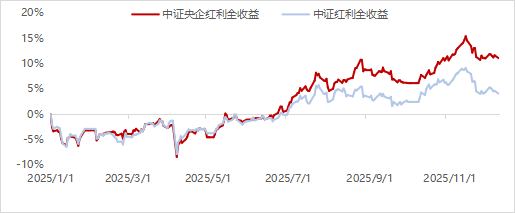
Group 1 - The core strategy of "Central Enterprises + Dividends" is gaining attention as a reliable investment approach amid increasing market volatility [1][2] - The China Securities Central Enterprises Dividend Total Return Index has shown a remarkable increase of 11.08% this year, significantly outperforming the China Securities Dividend Total Return Index, which only rose by 4.07% [2][37] - The combination of high dividend yields and 100% central enterprise attributes makes this index particularly attractive in the current low-interest-rate environment [6][42] Group 2 - Central enterprises are crucial to China's economic stability and are primarily concentrated in traditional industries, which are characterized by mature business models and stable competition [11][48] - The average return on equity (ROE) and net profit levels of the central enterprises in the dividend index have consistently exceeded those of the overall A-share market, indicating strong profitability and risk resilience [14][51] - In the first half of 2025, the total cash dividends from the central enterprises in the index reached 392.3 billion yuan, accounting for 57% of the total cash dividends in the A-share market [18][55] Group 3 - The current low-interest-rate environment, with the 10-year government bond yield at a historical low of 1.85%, enhances the attractiveness of the central enterprises dividend index, which has a dividend yield of 4.06% [23][59] - Recent policies from the State-owned Assets Supervision and Administration Commission (SASAC) are aimed at improving dividend distribution and enhancing shareholder returns, making it a priority for central enterprises [27][63] - The valuation of central enterprises is currently at a historical low, with the China Securities Central Enterprises Index having a price-to-earnings ratio of 12.33 and a price-to-book ratio of 1.16, indicating potential for value re-evaluation [31][66]
从微观出发的风格轮动月度跟踪-20251013
Soochow Securities· 2025-10-13 15:39
- The style rotation model is constructed based on the Dongwu quantitative multi-factor system, starting from micro-level stock factors. It selects 80 underlying factors as original features, including valuation, market capitalization, volatility, and momentum, and further constructs 640 micro features. The model replaces the absolute proportion division of style factors with common indices as style stock pools, creating new style returns as labels. A random forest model is trained in a rolling manner to avoid overfitting risks, optimizing features and obtaining style recommendations. The framework integrates style timing, scoring, and actual investment[9][4] - The performance of the style rotation model during the backtesting period (2017/01/01-2025/09/30) shows an annualized return of 16.41%, annualized volatility of 20.43%, IR of 0.80, monthly win rate of 58.49%, and a maximum drawdown of 25.54%. When hedging against the market benchmark, the annualized return is 10.54%, annualized volatility is 10.85%, IR is 0.97, monthly win rate is 55.66%, and the maximum drawdown is 8.79%[10][11] - The style rotation model's latest timing directions for October 2025 are value, large market capitalization, momentum, and low volatility[2][19] - The latest holdings of the style rotation model for October 2025 include indices such as CSI Central Enterprise Dividend (ETF code: 561580.SH), CSI Bank (ETF code: 512700.SH), CSI Film and Television (ETF code: 159855.SZ), CS Battery (ETF code: 159796.SZ), and CSI All Real Estate (ETF code: 512200.SH)[3][19]
帮主郑重:港股这么热,普通人该怎么把握机会?
Sou Hu Cai Jing· 2025-07-06 09:56
Group 1 - The Hong Kong stock market has recently gained significant attention due to favorable policies and major companies like CATL and BYD listing there, leading to increased market activity [3] - Southbound capital has net purchased over 650 billion HKD in the first five months of the year, indicating strong investment interest [3] - There is a noticeable trend of international capital shifting from US stocks to Hong Kong stocks, attracted by high-growth Chinese assets [3] Group 2 - Key investment areas include the technology sector, particularly artificial intelligence and semiconductors, with companies like Kingsoft Cloud and SMIC experiencing rapid stock price increases [3] - The new consumption trend among younger consumers is shifting towards "emotional consumption," with sectors like trendy toys, smart home products, and experiential tourism gaining traction [3] - High-dividend state-owned enterprises, such as the three major oil companies and telecom operators, provide stable dividends and act as a safety net during market volatility [4] Group 3 - Investment strategies should include using ETFs and funds to mitigate risks, such as the Invesco Hong Kong Technology ETF, which covers multiple tech sub-sectors [4] - The recent reduction in trading fees for small transactions in Hong Kong stocks, effective from June 30, significantly lowers investment costs for retail investors [4] - It is advised to diversify investments across technology, consumption, and finance sectors, and to invest with spare funds without leveraging [5]