
安全芯片

Search documents
“浓眉大眼”的 NXP 汽车芯片大厂,也要涨价了!
是说芯语· 2026-03-11 11:21
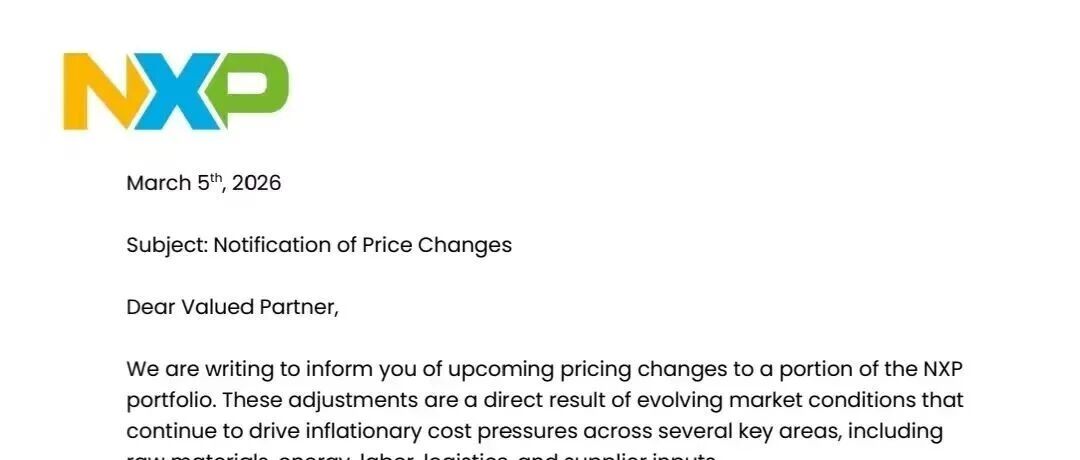
Core Viewpoint - NXP Semiconductors is implementing a price adjustment on selected products due to rising costs in raw materials, energy, labor, logistics, and supplier inputs, effective from April 1, 2026 [3]. Group 1: Price Adjustment Announcement - The price adjustment is a response to the ongoing changes in the market environment that have put pressure on multiple core cost areas [3]. - NXP will provide advance notice of the specific products affected, including updated distributor costs, to ensure clear communication and smooth execution [3]. - The adjustment of distributor pricing will follow the regular schedule starting March 30, 2026 [3]. Group 2: Company Background - NXP Semiconductors, headquartered in Eindhoven, Netherlands, is a leading global provider of embedded semiconductor solutions, having been established as an independent entity from Philips Semiconductor in 2006 and listed on NASDAQ in 2010 [5]. - The company focuses on key areas such as automotive electronics, industrial IoT, secure identification, and communication infrastructure, holding a leading position in automotive-grade microcontrollers (MCUs), in-vehicle networking, and security chips [5]. - NXP serves major automotive manufacturers like Tesla and BYD, as well as industries such as financial payments and smart home solutions, leveraging its extensive security technology patents and global presence [5].

第一批芯片“受害者”出现了
半导体行业观察· 2026-02-28 01:14
Core Insights - The semiconductor industry is experiencing unprecedented concentration of value creation, with significant economic profits being captured by a small number of leading companies, while many smaller firms face substantial losses [3][30]. - The rise of AI has increased the entry barriers in the semiconductor sector, leading to a "Matthew effect" where larger players benefit disproportionately compared to smaller firms [6][30]. Group 1: Economic Profit Trends - From 1990 to 2009, the semiconductor industry generated approximately $38 billion in economic profit, primarily driven by Intel [3]. - In the decade from 2010 to 2019, the industry saw a significant increase in economic profit, totaling $450 billion, due to the rise of mobile internet and smartphone growth [3]. - Between 2020 and 2024, the semiconductor industry is projected to create $473 billion in economic profit, surpassing the total from the previous decade, with the top 5% of companies capturing $159 billion [3]. Group 2: Challenges for Smaller Firms - In 2025, over 64% of the top 30 Fabless companies in South Korea are expected to report operating losses, indicating a widespread issue rather than isolated cases [9]. - Companies like Fadu, Nextchip, and HiDeep have reported significant losses, highlighting the struggles of smaller firms in the face of rising costs and competitive pressures [9][10]. - The rising costs across various segments, including EDA tools, wafer fabrication, and packaging, are creating a challenging environment for smaller Fabless companies [15][16][17]. Group 3: The Five Layers of Cost Increases - The first layer of cost increase is the EDA/IP tax, where design costs are rising significantly, impacting smaller firms' ability to absorb these costs [15]. - The second layer is the wafer tax, with advanced nodes becoming more expensive and difficult to access, further disadvantaging smaller players [16]. - The third layer is the packaging tax, where advanced packaging has become essential for AI chips, leading to increased costs and supply constraints [17]. - The fourth layer is the storage tax, where rising prices for HBM and other memory types are increasing overall system costs, putting pressure on margins [18]. - The fifth layer is the talent tax, as competition for skilled IC design talent drives up salaries, impacting smaller firms' ability to retain key personnel [19][22]. Group 4: Competitive Landscape - Chinese Fabless companies are increasingly encroaching on traditional South Korean markets, leveraging their larger ecosystems and cost advantages [25][26]. - The competitive pressure from Chinese firms is forcing South Korean companies to struggle in both advanced and mature process nodes, leading to a significant loss of market share [28]. - The overall trend indicates a bifurcation in the semiconductor industry, where large firms with pricing power thrive, while smaller firms face ongoing challenges [30].



大唐电信股价回调超20%,业绩预亏与资金流出成主因
Jing Ji Guan Cha Wang· 2026-02-14 06:39
Core Viewpoint - The significant decline in Datang Telecom's stock price is attributed to multiple factors, including poor fundamentals, capital outflows, and negative sentiment in the sector [1][2][3][4][5][6][7]. Group 1: Stock Performance - As of February 13, 2026, Datang Telecom's stock has dropped 21.43% over the past 20 days, with a price fluctuation of 16.92% [1]. - The stock price fell from a high of 11.28 yuan to a closing price of 9.53 yuan, resulting in a total market capitalization decrease to 12.423 billion yuan [1]. Group 2: Earnings Forecast - On January 19, 2026, the company announced an expected annual loss for 2025, projecting a net profit attributable to shareholders between -56 million yuan and -39 million yuan, a shift from a profit of 27.893 million yuan in 2024 [2]. - The primary reasons for the loss include fluctuations in demand for special communication services and delays in project acceptance, leading to revenue decline, compounded by real estate impairment pressures [2]. Group 3: Capital Outflows - On the day of the stock's limit down on January 20, 2026, there was a net outflow of 155 million yuan in principal funds, accounting for 15.94% of the total trading volume [3]. - The trend of capital outflows continued, with a net outflow of 32.637 million yuan on February 10 and 14.658 million yuan on February 13 [3]. Group 4: Valuation and Technical Analysis - Prior to the decline, the stock had seen a significant increase of over 30% from October 2025 to January 2026, leading to a valuation that significantly deviated from fundamentals [4]. - Even after the decline, the price-to-earnings ratio (TTM) remains at 180.40 times, and the price-to-book ratio is 45.31 times, both well above industry averages [4]. Group 5: Industry Context - The communication equipment sector has weakened overall, with the Shenwan Communication Equipment Index declining by 0.92% over the past 20 days and a single-day drop of 1.97% on February 13 [5]. - The sector is affected by changes in value-added tax rates for operators and concerns over overseas technology replacements, leading to a 7.92% decline in the communication equipment sector during the same period [5]. Group 6: Company Fundamentals - The company's profit structure is fragile, with a reported revenue growth of 66.16% year-on-year in Q3 2025, but a cumulative loss of 49.58 million yuan over the first three quarters [6]. - The company's debt ratio is high at 77.89%, indicating potential financial strain [6]. Group 7: Future Outlook - The recent stock decline is a result of a collapse in confidence due to the earnings forecast, the digestion of high valuation bubbles, and capital outflows from the sector [7]. - Future attention should be on the actual loss extent in the 2025 annual report, the progress of special communication project acceptance, and the implementation effects of low-altitude economic policies [7].

大唐电信:目前未涉及通用MCU芯片领域
Zheng Quan Ri Bao· 2026-02-10 13:12
Core Viewpoint - Datang Telecom focuses on security chips as its core business direction and has not ventured into the general MCU chip sector [2] Company Summary - Datang Telecom has clarified its business focus on security chips during an interaction with investors [2] - The company explicitly stated that it is not involved in the general MCU chip market [2]
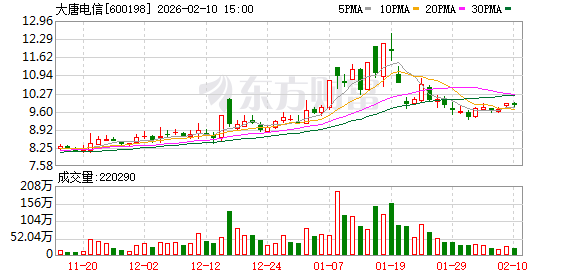
大唐电信(600198.SH):目前未涉及通用 MCU 芯片领域
Ge Long Hui· 2026-02-10 08:23
Group 1 - The company, Datang Telecom (600198.SH), focuses on security chips as its core business direction [1] - Currently, the company has not ventured into the general MCU chip sector [1]
大唐电信:目前未涉及通用 MCU 芯片领域
Ge Long Hui· 2026-02-10 08:20
Core Viewpoint - Datang Telecom (600198.SH) focuses on security chips as its core business direction and has not ventured into the general MCU chip sector [1] Group 1 - The company emphasizes its commitment to security chips [1] - There is no involvement in the general MCU chip market at this time [1]
紫光国微(002049):公司点评:完善功率半导体产品布局,开拓业务发展新动能
Yin He Zheng Quan· 2026-01-16 06:35
Investment Rating - The report maintains a "Recommended" rating for the company, Unisoc (stock code: 002049) [1]. Core Insights - Unisoc is expanding its power semiconductor product layout to explore new business growth drivers. The company plans to acquire 100% equity of Ruineng Semiconductor at a price of 61.75 yuan per share, which will enhance its power semiconductor product matrix and complete its semiconductor industry chain [4]. - The acquisition is expected to enrich the product matrix, allowing Unisoc to quickly fill manufacturing gaps and leverage shared customer resources to accelerate expansion in industrial and automotive electronics [4]. - The target company reported revenues and net profits of 830 million yuan and 101 million yuan for 2023, respectively, which will contribute positively to Unisoc's performance [4]. - Unisoc's new product iterations are accelerating, with advancements in high-performance products and a focus on aerospace-grade markets, which are expected to drive growth in multiple product lines [4]. - The company is establishing a new subsidiary, Unisoc Tongxin Technology, to focus on automotive electronics, which is anticipated to create a second growth curve for the company [4]. - The implementation of an employee stock ownership plan is expected to enhance employee motivation and support sustained growth in the future [4]. Financial Projections - The company forecasts revenues of 6,422 million yuan in 2025, 7,368 million yuan in 2026, and 8,378 million yuan in 2027, with corresponding net profits of 1,668 million yuan, 1,942 million yuan, and 2,431 million yuan [5][7]. - The projected EPS for the same years is 1.96 yuan, 2.29 yuan, and 2.86 yuan, with P/E ratios of 44.16, 37.92, and 30.30, respectively [5][7]. - The gross margin is expected to remain stable around 56.5% for 2025 and 2026, slightly decreasing to 56.3% in 2027 [5][7].

紫光国微(002049)公司点评:完善功率半导体产品布局 开拓业务发展新动能
Xin Lang Cai Jing· 2026-01-16 06:35
Group 1 - The company plans to issue shares at a price of 61.75 yuan per share to acquire 100% equity of Ruineng Semiconductor, aiming to enhance its power semiconductor industry chain and explore new business growth points [1] - The acquisition will allow the company to integrate its power semiconductor product matrix, quickly fill manufacturing gaps, and improve its semiconductor industry chain layout [1] - Post-acquisition, both parties can leverage their customer resource advantages and share sales channels, accelerating expansion in the industrial and automotive electronics sectors [1] Group 2 - The company is accelerating new product iterations, with high-performance products being delivered in bulk, and is expanding its user base in the FPGA and system-level chip sectors [2] - The aerospace market is expected to grow significantly, with the company actively advancing product development and validation, which will drive collaboration across multiple product lines [2] - The automotive electronics and eSIM businesses are anticipated to form a second growth curve for the company, with a new subsidiary established to focus on automotive electronics [2] Group 3 - The company's stock incentive plan will be implemented, with annual amortization costs projected for 2025-2029, and performance targets set for net profit growth from 2025 to 2028 [3] - The incentive plan aims to enhance employee motivation and support the company's sustained growth [3] Group 4 - Without considering the acquisition, the company expects net profits of 16.7 billion, 19.4 billion, and 24.3 billion yuan for 2025-2027, with corresponding EPS of 2.0, 2.3, and 2.9 yuan [4] - If the acquisition is included, the estimated valuation of Ruineng Semiconductor is around 2.2 billion yuan, leading to a projected total market value of approximately 79 billion yuan [4] - The company maintains a "recommended" rating, anticipating a recovery in the special industry sector and the gradual formation of the automotive electronics business as a second growth curve [4]
大唐电信股价涨7.71%,国泰基金旗下1只基金位居十大流通股东,持有394.32万股浮盈赚取335.17万元
Xin Lang Cai Jing· 2026-01-16 05:48
Group 1 - The core viewpoint of the news is that Datang Telecom's stock has seen a significant increase of 7.71%, reaching a price of 11.88 yuan per share, with a trading volume of 771 million yuan and a turnover rate of 5.43%, resulting in a total market capitalization of 15.487 billion yuan [1] - Datang Telecom, established on September 21, 1998, and listed on October 21, 1998, is primarily engaged in the development, production, sales, and system integration of various communication network systems, terminals, software and hardware, and microelectronics [1] - The main revenue composition of Datang Telecom includes 77.71% from security chips, 17.59% from special communications, and 4.69% from other sources [1] Group 2 - Datang Telecom's top circulating shareholder includes a fund from Guotai Fund, specifically the Guotai CSI All-Share Communication Equipment ETF (515880), which entered the top ten circulating shareholders in the third quarter with 3.9432 million shares, accounting for 0.3% of circulating shares, and has an estimated floating profit of approximately 3.3517 million yuan [2] - The Guotai CSI All-Share Communication Equipment ETF (515880) was established on August 16, 2019, with a latest scale of 11.552 billion yuan, yielding a return of 3.44% this year, ranking 3722 out of 5531 in its category, and a one-year return of 146.08%, ranking 1 out of 4215 [2]
大唐电信股价跌5.07%,国泰基金旗下1只基金位居十大流通股东,持有394.32万股浮亏损失228.71万元
Xin Lang Cai Jing· 2026-01-15 03:43
Core Viewpoint - Datang Telecom experienced a decline of 5.07% on January 15, with a stock price of 10.85 yuan per share and a trading volume of 1.298 billion yuan, resulting in a total market capitalization of 14.144 billion yuan [1] Company Overview - Datang Telecom Technology Co., Ltd. is located at 6 Yongjia North Road, Haidian District, Beijing, established on September 21, 1998, and listed on October 21, 1998. The company primarily engages in the development, production, sales, and system integration of various communication network systems, terminals, computer software and hardware, network management, information security application software, and microelectronics [1] - The revenue composition of the company is as follows: security chips account for 77.71%, special communications for 17.59%, and others for 4.69% [1] Shareholder Information - From the perspective of major circulating shareholders, a fund under Guotai Fund ranks among the top ten circulating shareholders of Datang Telecom. The Guotai CSI All-Share Communication Equipment ETF (515880) entered the top ten circulating shareholders in the third quarter, holding 3.9432 million shares, which represents 0.3% of the circulating shares. The estimated floating loss today is approximately 2.2871 million yuan [2] - The Guotai CSI All-Share Communication Equipment ETF (515880) was established on August 16, 2019, with a current scale of 11.552 billion yuan. Year-to-date returns are 2.79%, ranking 3886 out of 5525 in its category; over the past year, returns are 140.57%, ranking 3 out of 4208; and since inception, returns are 216.86% [2] - The fund manager of the Guotai CSI All-Share Communication Equipment ETF is Ai Xiaojun, who has a cumulative tenure of 12 years and 6 days. The total asset scale under management is 169.029 billion yuan, with the best fund return during the tenure being 286.65% and the worst being -46.54% [2]