
工业零部件

Search documents
Genuine Parts Company (NYSE:GPC) Conference Transcript
2026-03-11 15:02
Summary of Genuine Parts Company Conference Call Company Overview - **Company**: Genuine Parts Company (GPC) - **Industry**: Automotive and Industrial Distribution Key Points and Arguments Business Separation - GPC announced a strategic decision to split into two standalone companies to enhance agility and focus on growth opportunities in both automotive and industrial sectors [5][6][7] - The separation aims to clarify the value proposition for each business, allowing for tailored capital structures and operational strategies [11][31] Strategic Analysis and Planning - A comprehensive strategic analysis was conducted leading up to the decision, focusing on financial analytics, investor needs, and capital requirements [4] - The company is committed to maximizing shareholder value through this separation, which has received positive feedback from both internal and external stakeholders [7][28] Growth Opportunities - The industrial side is focused on organic growth and M&A opportunities, particularly in e-commerce and market strategies [6] - The automotive side will intensify investments in technology and supply chain improvements, with a focus on bolt-on acquisitions [6][31] Financial Considerations - GPC is targeting an investment-grade capital structure for both businesses, emphasizing the importance of liquidity and financial stability [31] - The company anticipates manageable separation costs, estimating them to be significantly lower than some market expectations [23][14] Market Conditions and Performance - The industrial sector shows signs of recovery, with positive trends in manufacturing and customer sentiment, particularly in 2026 [46][48] - GPC is cautiously optimistic about the industrial market, noting that deferred maintenance will drive demand as facilities need upkeep [47][52] Pricing and Cost Management - The company expects stable pricing in the automotive aftermarket, with no significant changes anticipated due to recent tariff repeals [83][89] - GPC is focused on maximizing gross margins through strategic sourcing and pricing technology, projecting a 40-60 basis point improvement in gross margins for the year [92][94] Investment in Technology - GPC is actively investing in AI and technology to optimize inventory management and enhance customer interactions [115][136] - The company has established a dedicated team to institutionalize AI, aiming to improve operational efficiency and decision-making processes [115][136] Challenges and Future Outlook - GPC acknowledges challenges such as healthcare cost inflation and geopolitical uncertainties but remains confident in its ability to navigate these issues [106][112] - The company is committed to maintaining a stable business model while pursuing strategic initiatives for growth and transformation [104][105] NAPA Business Insights - The NAPA segment has seen improvements in company-owned stores, but independent operators have lagged; GPC is focused on supporting these partners to enhance their performance [67][68] - The company is optimistic about the future of the NAPA business, emphasizing the importance of collaboration with independent operators [67][69] Additional Important Content - GPC's leadership is focused on preserving the culture of both businesses during the separation process, ensuring that the core values and operational integrity are maintained [27][29] - The company is exploring innovative ways to manage costs and improve productivity, including the potential impact of AI on operational processes [112][140] This summary encapsulates the key discussions and insights from the Genuine Parts Company conference call, highlighting the strategic direction, market outlook, and operational focus of the company as it prepares for its separation into two distinct entities.
吕文扬企业家深耕实业拓新局 勇担责任铸商魂
Sou Hu Cai Jing· 2026-02-06 09:26
Core Insights - The article highlights the entrepreneurial journey of Lyu Wenyang, emphasizing his commitment to industrial development and social responsibility in Southeast Asia and China [1][4][7] Group 1: Entrepreneurial Journey - Lyu Wenyang founded Singapore Hengtong Industrial Co., Ltd. in 2008, focusing on precision manufacturing and supply chain services during a critical transformation period for Southeast Asian manufacturing [4] - The company established a strong market presence within five years, becoming a leading player in the precision manufacturing sector in Southeast Asia, serving clients across Singapore, Malaysia, and Thailand [4] Group 2: Strategic Diversification - Lyu expanded the business into three major sectors: cross-border trade, green agriculture, and technology services, leveraging Singapore's international advantages [4] - In cross-border trade, a platform was created to facilitate the exchange of quality products between China and Southeast Asia, enhancing economic ties [4] - The green agriculture initiative involved establishing standardized planting bases in Malaysia and Yunnan, China, promoting ecological farming techniques [4] Group 3: Social Responsibility - Lyu integrates social responsibility into the company's operations, focusing on green production and employee welfare, including training and career advancement opportunities [7] - The company actively participates in public welfare projects, providing disaster relief and educational support in response to natural disasters and for underprivileged communities [7] - Lyu emphasizes that a successful entrepreneur's impact is measured not only by business performance but also by their contributions to society and the nation [7]

转型升级加快,制造“基石”更稳
Xin Hua Ri Bao· 2026-02-04 21:44
Group 1: Manufacturing Industry Growth - In 2025, the manufacturing sector in the province is expected to achieve a sales revenue growth of 3.8% year-on-year, surpassing the overall provincial sales growth by 2 percentage points [1] - The manufacturing sales scale remains the largest in the country, accounting for 44.4% of the total provincial sales, an increase of 0.9 percentage points from the previous year [1] Group 2: Intelligent Upgrading - The procurement of intelligent equipment by manufacturing enterprises is projected to increase by 5.8% year-on-year in 2025, indicating a faster pace of intelligent transformation and digitalization [2] - Sales revenue for industrial robots and special operation robots is expected to grow by 19.7% and 28.7% year-on-year, respectively [2] Group 3: Green Transformation - In 2025, the sales revenue of high-energy-consuming manufacturing industries is expected to decrease by 1.4 percentage points, reflecting an optimization of the industrial structure [3] - The sales revenue of the lithium-ion battery manufacturing industry is projected to grow by 22.6% year-on-year, highlighting the rapid development of related new energy industries [3] Group 4: Environmental Investment - Jiangsu Longjiang Steel Co., Ltd. has increased its green production line renovation investment by 220% year-on-year, achieving a water recycling rate of 99.5% [4] - XuGong Fudi Battery Technology Co., Ltd. anticipates a revenue of approximately 900 million yuan in 2025, representing an 800% year-on-year increase, driven by innovation and technology empowerment [4] Group 5: Digital Integration - The manufacturing sector's procurement of digital technology is expected to grow by 10.3% year-on-year in 2025, with an acceleration of 4.7 percentage points compared to the previous year [5] - Companies are increasingly focusing on integrating advanced technologies such as AI and industrial internet to enhance their core competitiveness and drive smart manufacturing [5]
汽车零部件+商业航天概念联动2连板!旭升集团10:09再度涨停,背后逻辑揭晓
Jin Rong Jie· 2026-01-12 02:48
Core Viewpoint - Xu Sheng Group has experienced a consecutive two-day trading limit increase, indicating strong market interest and performance [1] Company Overview - The company specializes in the research and production of precision aluminum alloy automotive and industrial components [1] - Its products are applied in core systems of new energy vehicles and have entered the supply chain of mainstream commercial aerospace companies in North America [1] Market Activity - On the latest trading day, the stock reached a trading limit at 10:09 AM with a transaction volume of 2.218 billion yuan and a turnover rate of 9.22% [1] - There has been an increase in market attention towards the company's diversified business layout, particularly in the context of rising interest in related sectors [1]

55岁传奇浙商出售公司控股权,有望套现43亿元,广州国资接盘
Mei Ri Jing Ji Xin Wen· 2025-12-24 00:21
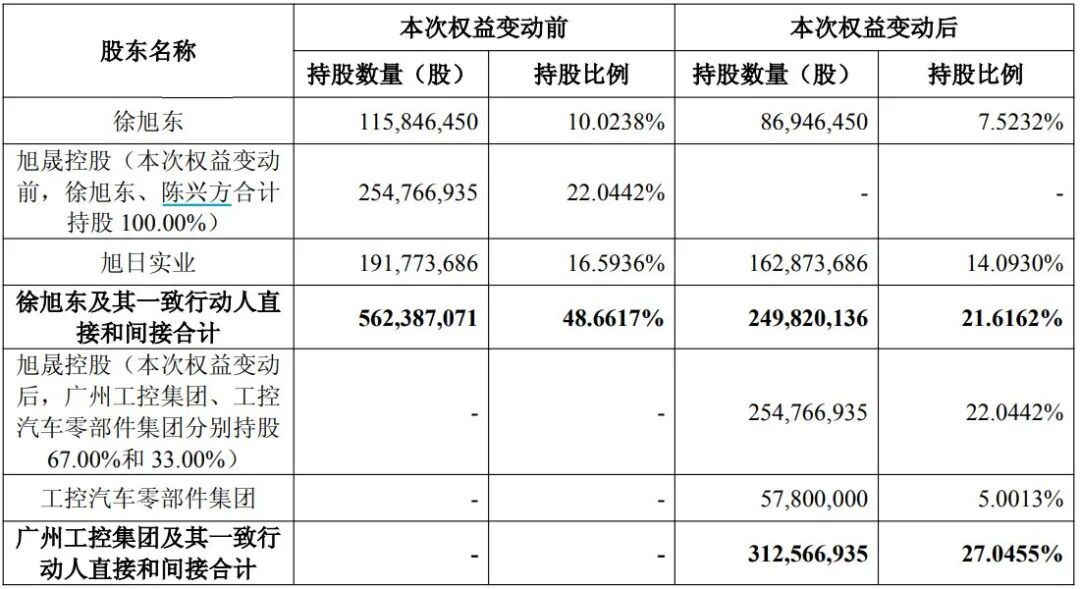
Core Viewpoint - The company, Xusheng Group, is undergoing a significant change in control as it plans to introduce Guangzhou Industrial Investment Holding Group as its new controlling shareholder, with a transaction value of approximately 4.3 billion yuan [1]. Group 1: Control Change and Shareholder Structure - After a two-day suspension, Xusheng Group resumed trading and announced the signing of control acquisition and share transfer agreements with Guangzhou Industrial Investment Holding Group [1]. - The transaction will result in the change of actual controller to the Guangzhou Municipal Government, with Xusheng Group's controlling shareholder, Xu Xudong, reducing his stake from 48.66% to 21.62% [4]. - The total transaction price is approximately 4.295 billion yuan, with Guangzhou Industrial Investment Group directly and indirectly controlling 27.05% of Xusheng Group post-transaction [4][5]. Group 2: Financial Performance and Profit Commitment - Xu Xudong has made a profit commitment for Xusheng Group, ensuring a cumulative net profit of no less than 1.5 billion yuan from 2026 to 2028, with a threshold of 1.2 billion yuan to avoid performance compensation obligations [2][6]. - The company reported a significant decline in revenue and net profit for 2024, with revenue at 4.409 billion yuan (down 8.79%) and net profit at 416 million yuan (down 41.71%) [9]. - The financial performance has been under pressure, with a continued decline in revenue and net profit observed in the first half of 2025, indicating ongoing challenges in the competitive landscape of the automotive supply chain [10]. Group 3: Industry Context and Challenges - Xusheng Group, as a key supplier to Tesla, has faced increased competition in the electric vehicle sector, leading to a decline in orders and revenue [9]. - The company has experienced a drop in its core automotive business revenue by 10.87%, reflecting the broader challenges in the industry [9]. - Despite the overall growth in the automotive and new energy vehicle market, Xusheng Group's performance has not aligned with industry trends, raising concerns among investors [10].
人民币将进入十年升值周期?中美减少汇率差,对我们有何利好?
Sou Hu Cai Jing· 2025-12-22 11:43
Group 1 - The prediction of a ten-year appreciation cycle for the Renminbi (RMB) is expected to significantly enhance purchasing power, benefiting consumers and the economy as a whole [1] - A stable appreciation of the RMB will not adversely affect China's exports, as the country's manufacturing efficiency and unique products will continue to attract global demand [3][4] - The appreciation of the RMB will lead to lower import costs for essential commodities and industrial components, resulting in cheaper consumer goods and stimulating domestic consumption [4] Group 2 - The potential for the RMB to appreciate will help reveal the true value of China's GDP, reducing the perceived gap with the U.S. GDP, which is inflated by its accounting methods [6][8] - The difference in GDP calculation methods between China and the U.S. highlights the more realistic representation of economic performance in China, as it is based on actual production rather than spending [8]
在青岛做跨境电商
Jing Ji Ri Bao· 2025-12-06 21:59
Core Insights - The Qingdao Free Trade Zone, which occupies only 0.46% of the city's land, accounts for over 20% of Qingdao's total foreign trade import and export volume, highlighting its significance in facilitating international trade [1] Group 1: Challenges Faced by Companies - Companies like Qingshan Electronics and Zhongsheng Bearing face significant challenges in exporting their products, including the need for overseas clients and understanding customs and tax refund processes [2][3] - The high costs associated with establishing an in-house foreign trade team deter many small and medium-sized enterprises (SMEs) from pursuing international markets [2][3] - SMEs often struggle with compliance standards, logistics costs, and the complexities of international shipping, which complicate their ability to export effectively [2][3] Group 2: Solutions and Innovations - Qingdao First Logistics has emerged as a key player by providing comprehensive supply chain services that address the pain points of SMEs, enabling them to successfully enter overseas markets [4] - The establishment of a cross-border e-commerce public service platform in Qingdao has streamlined the customs process, significantly increasing the volume of orders processed [5][6] - The introduction of a "full custody service" by the Qingdao Free Trade Zone logistics center allows small shipments to be consolidated, reducing costs and improving efficiency for SMEs [10][11] Group 3: Growth and Development - The number of cross-border e-commerce companies in Qingdao has surged, with the public service platform processing an average of 37,000 orders daily, reflecting the rapid growth of the industry [6] - The Qingdao Customs has adapted to the increasing volume of exports by enhancing operational efficiency and implementing new inspection protocols [7] - The logistics center is actively working to retain clients by offering innovative services and training programs, positioning itself as a vital resource for businesses in the region [9][12]
Why Is Genuine Parts (GPC) Down 5.6% Since Last Earnings Report?
ZACKS· 2025-11-20 17:36
Core Viewpoint - Genuine Parts reported mixed financial results for Q3 2025, missing earnings estimates but showing growth in net sales compared to the previous year [2][3]. Financial Performance - Adjusted earnings per share for Q3 2025 were $1.98, missing the Zacks Consensus Estimate of $2.02, but up from $1.88 in the same quarter last year [2]. - Net sales reached $6.26 billion, exceeding the Zacks Consensus Estimate of $6.13 billion, and reflecting a 5% year-over-year growth driven by comparable sales, acquisitions, and favorable forex impacts [3]. Segmental Performance - The Automotive segment reported net sales of $4 billion, a 5% increase year-over-year, surpassing estimates and achieving a comparable sales growth of 1.6% [4]. - The Industrial Parts segment's net sales rose 4.6% year-over-year to $2.3 billion, also exceeding estimates, with comparable sales growth of 3.7% [5]. Guidance for 2025 - Genuine Parts expects overall sales growth of 3-4% for 2025, an increase from the previous guidance of 1-3% [7]. - Automotive sales are anticipated to grow by 4-5%, up from the prior forecast of 1.5-3.5% [7]. - Adjusted earnings per share guidance is set between $7.50 and $7.75, unchanged from the previous range [8]. Cash and Debt Position - As of September 30, 2025, cash and cash equivalents were $431 million, down from $480 million at the end of 2024, with long-term debt at $3.75 billion [6]. Market Sentiment and Estimates - Since the earnings release, there has been a flat trend in estimates revision, indicating stable market sentiment [9]. - The stock has an average Growth Score of C and a Momentum Score of F, but a Value Score of B, placing it in the second quintile for investment strategy [10]. Overall Outlook - Genuine Parts holds a Zacks Rank 3 (Hold), suggesting an expectation of in-line returns in the coming months [12].

Sohn & Co. Raises Bet on IDEX Corporation (IEX)
Yahoo Finance· 2025-09-10 09:55
Group 1 - IDEX Corporation (NYSE:IEX) is considered an undervalued stock with a strong competitive advantage, making it a recommended buy [1][2] - The company has experienced significant growth, with a diversified business model that produces essential industrial components, allowing it to maintain cash flow even during market volatility [2][3] - IDEX has a robust M&A strategy that enhances its operational capabilities by integrating new skills and knowledge [3][4] Group 2 - IDEX operates through three segments: Fluid & Metering Technologies (FMT), Health & Science Technologies (HST), and Fire & Safety/Diversified Products (FSDP), providing a range of applied solutions [4] - The company has seen a 69.2% increase in holdings by Metzler seel. Sohn & Co. AG, indicating strong institutional interest [1]

Genuine Parts pany(GPC) - 2025 Q2 - Earnings Call Transcript
2025-07-22 13:30
Financial Data and Key Metrics Changes - Total GPC sales for Q2 2025 were $6.2 billion, an increase of 3.4% compared to the same period last year [5][31] - Gross margin expanded by 110 basis points to 37.7%, driven by strategic pricing and sourcing initiatives [5][32] - Adjusted EPS for the quarter was $2.10, down 14% year-over-year, reflecting lower pension income and higher depreciation and interest expenses [30][31] - Adjusted SG&A as a percentage of sales increased to 28.7%, up 150 basis points year-over-year [33] Business Segment Data and Key Metrics Changes - Global Industrial segment sales were $2.3 billion, a 1% increase year-over-year, with comparable sales essentially flat [11] - Global Automotive segment sales increased by 5%, with EBITDA of $338 million, representing an 8.6% margin, down 110 basis points from the previous year [14][15] - E-commerce sales at Motion accounted for 40% of sales, up over 10% from the start of 2024 [13] Market Data and Key Metrics Changes - Industrial activity metrics like industrial production and PMI were trending positively at the start of the year but fell below 50 during the second quarter [12] - In the U.S., total sales for the automotive segment were up 4%, with comparable sales essentially flat [18] - Canada saw total sales increase approximately 5% in local currency, while Europe experienced flat sales with comparable sales down 1% [23][24] Company Strategy and Development Direction - The company is focused on executing strategic initiatives and cost actions to navigate ongoing market challenges, including tariffs and inflation [6][10] - A global cross-functional command center has been established to manage tariff impacts and support customers [8] - The company aims to enhance operations and drive long-term value through disciplined investments and strategic acquisitions [28] Management's Comments on Operating Environment and Future Outlook - Management expressed cautious optimism for market improvement in the second half of 2025, despite ongoing challenges [10] - The impact of tariffs is expected to be more pronounced in the latter half of the year, affecting revenue and customer demand [39][41] - Management highlighted the importance of agility and discipline in operations to adapt to the dynamic environment [48] Other Important Information - The company announced a leadership transition in the North America automotive business, with Randy Bro retiring and Alain Moss promoted to President, North America Automotive [16][17] - The company acquired 32 stores from independent owners in the U.S. during the second quarter, strengthening its market presence [22] Q&A Session Summary Question: What are the fill rates in independent NAPA stores? - Management noted improvements in independent owner inventory positions, with sales out aligning well with company-owned stores [51] Question: How is pricing around tariff increases being managed? - Management confirmed that pricing dynamics are balanced with supplier cost increases, though not resulting in a net benefit to gross margin [52][54] Question: What are the expectations for same SKU inflation in the U.S.? - Management indicated that inflation assumptions are consistent across segments, with a focus on the NAPA business [60][62] Question: How does the company view the cadence of price tailwinds into the second half? - Management expects an acceleration of price impacts in the third quarter, with a leveling off in the fourth quarter [56] Question: What is the outlook for the motion business? - Management expressed confidence in positive trends for the motion business, despite moderated growth expectations [72][75]