微信蓝包

Search documents
把握消费趋势,持续扩大内需
2 1 Shi Ji Jing Ji Bao Dao· 2026-02-27 22:35
Core Insights - The central political bureau meeting emphasized the need for a more proactive macro policy to enhance demand, optimize supply, and stimulate consumption growth, especially in light of the strong consumer trends observed during the recent Spring Festival [1][4] Group 1: Consumption Trends - The Spring Festival consumption scene has diversified, indicating a trend of consumption upgrading in China, with a shift from material to service consumption, particularly in 2026 where service consumption is expected to be a core growth driver [2][5] - Significant increases in consumer spending were noted, with New Year's Eve dinner reservations doubling, and box office revenues for Spring Festival films exceeding 5.6 billion yuan, reflecting strong cultural consumption demand [2][3] - The travel and hospitality sectors saw substantial growth, with data showing a 105% year-on-year increase in New Year's Eve dinner bookings and a nearly 40% rise in traffic for popular dining lists [1][2] Group 2: Market Dynamics - The dual focus on both lower-tier and cross-border markets has enhanced connectivity between domestic and international consumption, with a notable surge in spending in county-level economies driven by a large return home during the holiday [3][5] - Cross-border consumption has also seen significant growth, with spending in regions like Malaysia and Maldives increasing by 131% and 186% respectively, while inbound tourism has surged, indicating a new trend of international visitors celebrating the Spring Festival in China [3][4] Group 3: Technological Impact - The integration of digital technology has played a crucial role in energizing consumption, with innovations such as digital red envelopes and AI-driven services enhancing consumer experiences and engagement [4][5] - The demand for smart and green consumption is on the rise, reflecting a deep integration of consumption with technology and sustainable practices, which is vital for stimulating new growth in domestic demand [4][5] Group 4: Policy and Supply Side - The extended nine-day Spring Festival holiday and supportive policies like duty-free shopping and consumption incentives have created favorable conditions for consumption expansion, boosting consumer confidence [4][5] - Continuous innovation on the supply side has effectively matched changing consumer demands, creating a virtuous cycle where demand drives supply and vice versa, particularly in the cultural and tourism sectors [5]
21评论丨把握消费趋势,持续扩大内需
Xin Lang Cai Jing· 2026-02-27 22:32
Core Viewpoint - The article emphasizes the robust growth of consumer spending during the Spring Festival, driven by favorable policies, supply-side innovations, and the evolving market dynamics, indicating a long-term positive trend in China's economy [6]. Group 1: Consumer Trends - The Spring Festival consumption scene has diversified, reflecting a trend of consumption upgrading from material goods to services, with service consumption becoming a core growth driver in 2026 [3]. - Significant increases in spending were noted, such as a 105% year-on-year growth in New Year's Eve dinner reservations and a record-breaking box office of over 5.6 billion yuan during the Spring Festival [2][3]. - The demand for high-quality dining and cultural experiences has surged, showcasing a strong cultural consumption appetite and innovative supply [3]. Group 2: Market Dynamics - The dual focus on both lower-tier and cross-border markets has enhanced the connectivity of domestic and international consumption, expanding the overall market space for domestic demand [4]. - A large-scale return home during the holiday has invigorated the county economy, with explosive growth in county-level dining, retail, and tourism consumption [4]. - Cross-border consumption has also seen significant growth, with spending in regions like Malaysia and Maldives increasing by 131% and 186% respectively, driven by travel trends [4]. Group 3: Technological Empowerment - The vibrant Spring Festival consumption is supported by digital technology, which is fostering new growth drivers for expanding domestic demand and enhancing consumer experiences [5]. - Innovations such as digital red envelopes and AI-driven services have made holiday interactions more engaging and convenient, reflecting a deep integration of technology with consumer behavior [5]. - The rise of green and smart consumption trends indicates a strong alignment between consumption patterns and technological advancements, showcasing the potential for further market expansion [5]. Group 4: Policy and Supply-Side Innovations - The nine-day Spring Festival holiday created favorable conditions for consumption expansion, supported by policies like 240-hour visa-free transit and optimized duty-free shopping [7]. - Continuous supply-side innovations have effectively matched changing consumer demands, leading to a virtuous cycle of demand driving supply and vice versa [7]. - The demographic shift in consumer decision-making, with younger generations (post-95s and post-00s) becoming the main consumers, highlights the potential of the evolving age structure in the market [7].


2026年春节:消费与出行的全面繁荣
Jing Ji Guan Cha Wang· 2026-02-24 08:43
Travel and Tourism - The 2026 Spring Festival holiday saw a record 9-day duration, leading to unprecedented activity in the consumption and travel markets, with a total of 95 billion person-times of cross-regional movement during the Spring Festival travel period, marking a historical high [1] - Domestic tourism experienced explosive growth, with 6.05 billion domestic trips taken during the holiday, a 20% increase year-on-year, and tourism revenue reaching 792 billion yuan, up 17% [2] - The trend of "reverse tourism" emerged, with a significant increase in ticket bookings for "reverse reunion" trips, up 84% year-on-year, as more people chose to celebrate the holiday in their work cities [2] Transportation - The peak travel day on February 22 saw a flow of 380 million people, a 12.3% increase compared to the previous year, with self-driving trips accounting for about 80% of the total [1] - The civil aviation sector is expected to send 95 million passengers during the 40-day Spring Festival travel period, with popular domestic routes centered around major cities like Beijing, Shanghai, Guangzhou, and Shenzhen [1] Retail and Dining - Retail and dining markets reached historical highs, with key retail and catering enterprises reporting a daily sales increase of 10.6%, and foot traffic and sales in 78 key pedestrian streets rising by 23.2% and 33.2%, respectively [3] - The trend of pre-prepared meals gained popularity, with sales increasing by 80.7% during the holiday, as over 60% of families adopted a "half-cooking" approach [3] Cultural Events - Traditional customs became a major draw for the tourism market, with cities like Shantou, Fuzhou, and Beijing ranking as the top destinations for cultural experiences [2] - Non-material cultural heritage activities significantly boosted local economies, with hotel bookings in related areas increasing by over 200% [2] Entertainment - The film market set new records during the Spring Festival, with total box office revenue surpassing 5.608 billion yuan and the number of screenings reaching 4.3508 million, breaking historical records [4]
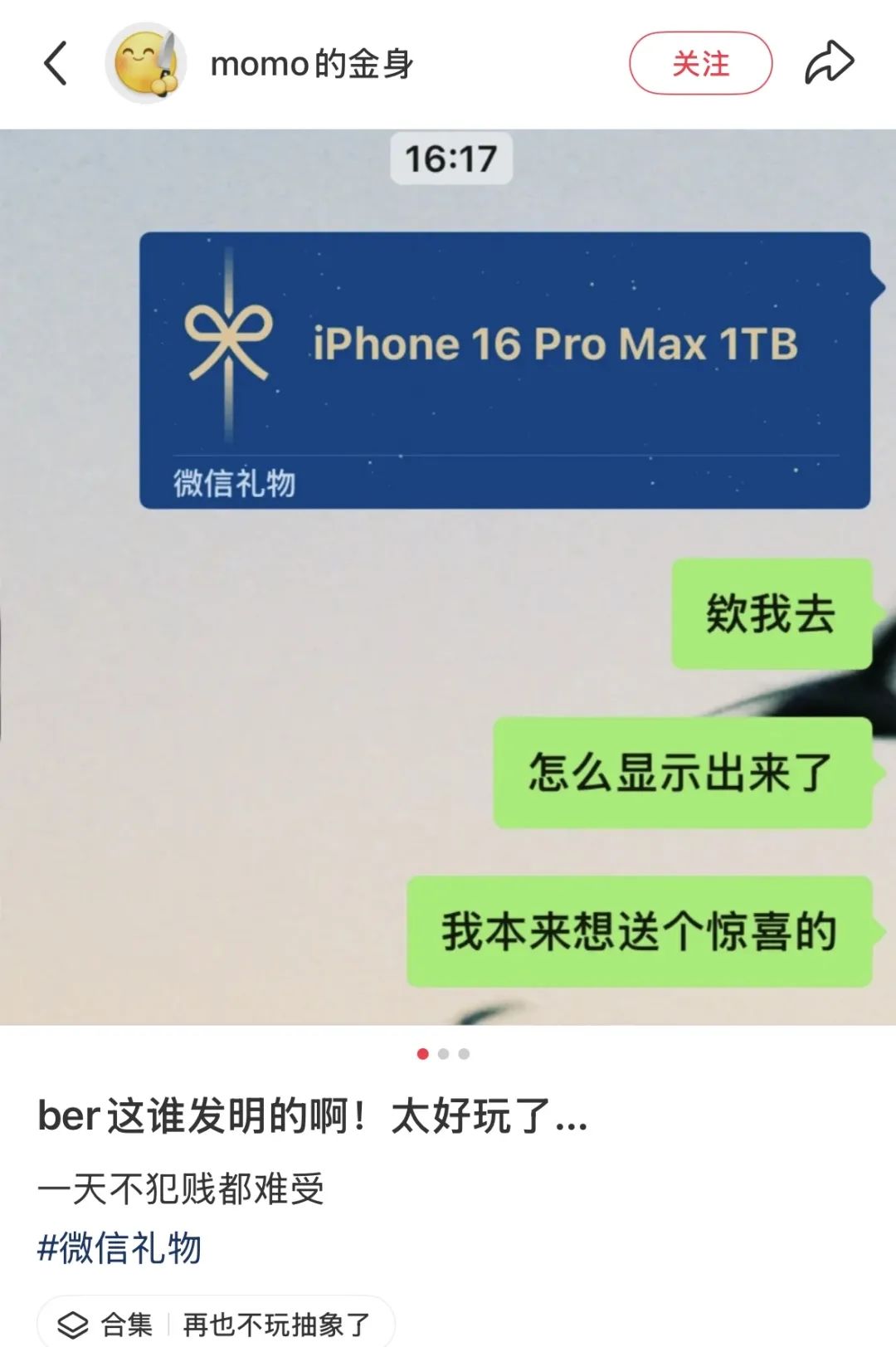
微信的送礼功能,逐渐成了抽象乐子人的天堂
3 6 Ke· 2025-08-11 04:03
Core Insights - The WeChat red envelope feature has evolved into a playful social interaction tool, where the focus is on the humorous contrast between the gift's description and its actual content, rather than the act of gifting itself [1][9][21] Group 1: WeChat Red Envelope Functionality - The WeChat red envelope allows users to customize gift messages, leading to a trend where extravagant items are humorously contrasted with inexpensive gifts [9][12] - Users often engage in playful deception, pretending to send valuable gifts while actually sending trivial items, enhancing the comedic aspect of the interaction [9][12][18] Group 2: Social Commerce Dynamics - WeChat's social commerce is characterized by its deep integration into social interactions, contrasting with traditional e-commerce platforms that rely on public exposure [21][23] - The introduction of features like "buy with friends" amplifies the social sharing aspect, similar to group buying models seen in other platforms [21][23] - WeChat's product display prioritizes low-cost gifts, creating a unique shopping experience that blends social interaction with commerce [23][42] Group 3: Market Position and Future Potential - WeChat's ecosystem is evolving, with a focus on live-streaming e-commerce and social sharing, indicating a shift towards a more integrated shopping experience [42][43] - The playful nature of the WeChat red envelope has created a vibrant consumer environment, suggesting potential for further development and innovation in social commerce [43]

微信蓝包,腾讯的电商新答案
Sou Hu Cai Jing· 2025-06-05 03:25
Core Insights - The competition between JD.com and Meituan in the food delivery sector highlights new opportunities emerging in an industry that seemed settled, driven by significant changes in market dynamics [2] - The introduction of WeChat Red Packet has activated the flow of traffic within the WeChat ecosystem, establishing WeChat Pay as a leading player in mobile payments, and the new WeChat Blue Packet is expected to reignite Tencent's ambitions in e-commerce [2][5] Group 1: E-commerce Dynamics - The e-commerce industry is currently facing a major pain point regarding the efficiency of connections between supply and demand, with new marketing strategies and models aimed at improving this efficiency [3] - WeChat Blue Packet addresses the challenge of transaction completion by requiring users to purchase a product before sending it as a gift, thus enhancing the efficiency of e-commerce connections [3][4] - The WeChat Blue Packet reduces traditional marketing costs and addresses low transaction rates, effectively solving a longstanding issue in the e-commerce sector [3][4] Group 2: Activation of WeChat's Ecosystem - The transition from an incremental to a stock market era necessitates players to deepen their market engagement and find new opportunities to activate their traffic [5] - WeChat Blue Packet enriches the product offerings within the WeChat ecosystem, fulfilling the need for gift-giving among users and enhancing social interactions [6] - By introducing WeChat Blue Packet, Tencent has addressed the lack of product offerings in its social platform, thereby revitalizing user engagement and traffic [6] Group 3: Solutions to E-commerce Pain Points - The e-commerce sector is undergoing significant transformation, with players seeking innovative solutions to address existing pain points and challenges [7] - Tencent's approach with WeChat Blue Packet leverages its strengths in social interaction to provide a straightforward solution to e-commerce challenges, distinguishing it from competitors focused on complex technologies [8] - WeChat Blue Packet offers a potential restructuring of the e-commerce ecosystem, allowing merchants to focus on product quality while consumers can rely on social recommendations to find desired products [9] Group 4: Future Implications - The arrival of the stock market era calls for a reevaluation of strategies across industries, including e-commerce, as players increasingly adopt AI and explore new models [10] - WeChat Blue Packet represents Tencent's innovative response to the evolving market environment, serving as a critical component in enhancing its product ecosystem and potentially unlocking new growth avenues in e-commerce [10]