日本清酒

Search documents
日本清酒产业调研简报(市场发展机遇与挑战)
Sou Hu Cai Jing· 2026-01-05 00:26
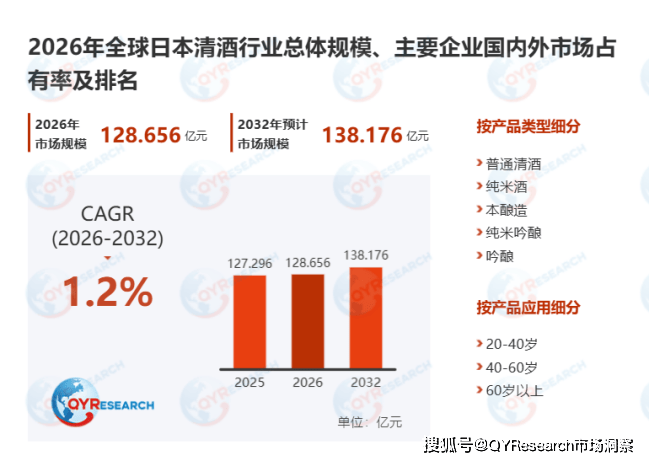
Market Overview - The global market for Japanese sake is projected to reach $2.01 billion by 2031, with a compound annual growth rate (CAGR) of 1.2% over the coming years [1]. Key Producers - Major producers of Japanese sake globally include Takara, Dassai, Gekkeikan, Kiku-Masamune, Kubota, Nihonsakari, Juyondai, Hakkaisan, Ozeki, and Kokuryu. The top five manufacturers are expected to hold approximately 23.0% of the market share in 2024 [5]. Product Segmentation - Regular sake is the leading product segment, accounting for about 37.4% of the market share [8]. Application Segmentation - The primary consumer demographic for Japanese sake is individuals aged 20-40 years, representing around 64.0% of the demand [11]. Key Drivers - The surge in global demand and the trend towards premiumization are transforming sake from a niche beverage into a high-end global spirit, with exports reaching new highs [12]. - Strategic innovation and product diversification are being pursued by breweries to attract new consumers, including the introduction of sparkling sake, low-alcohol sake, and sake cocktails, as well as flavors appealing to Western tastes [12]. - The "Cool Japan" strategy and the tourism boom prior to the pandemic have introduced sake culture to millions of tourists, fostering a loyal international following [12]. Major Challenges - Japan faces a significant demographic challenge with a declining population and shrinking core consumer base, leading to a sustained decrease in domestic sake sales [13]. - Sake is experiencing intense competition from other alcoholic beverages such as shochu, beer, whiskey, and wine, which are often marketed more aggressively [13]. - The traditional multi-tier distribution system in Japan is inefficient and opaque, posing high entry barriers for emerging or small-scale producers [13].

日本清酒出海的启示
Cai Jing Wang· 2025-11-17 07:20
Core Insights - Chinese companies are increasingly looking overseas for new growth opportunities, with a focus on expanding their presence in global markets, particularly in sectors like home appliances, electric vehicles, and smartphones. However, the Chinese liquor industry, particularly Baijiu, lags in its international expansion compared to these sectors [1] Group 1: Chinese Baijiu Industry - In 2024, China's Baijiu export value is projected to be $966 million, accounting for only 2.4% of the global spirits export market [1] - The export volume of Baijiu in 2024 is expected to be 16,400 kiloliters, which is just 0.39% of the total Baijiu production from large-scale enterprises in China for that year [1] - Among publicly listed Baijiu companies, only Kweichow Moutai and Wuliangye reported export revenues exceeding 1 billion yuan, with Moutai's overseas revenue around 4.35 billion yuan, while other companies reported revenues below 300 million yuan [1] Group 2: Comparison with Japanese Sake - In contrast, Japanese sake exports reached 43.5 billion yen (approximately 2 billion yuan) in 2024, marking a 6% increase from the previous year, with exports to 80 countries [2] - Since 2020, the export value of Japanese sake has increased by 1.8 times, with the average price rising by 1.3 times and the number of export destinations growing by 19 [2] - The high-end sake market has seen significant growth, particularly in North America and Western Europe, with exports increasing by 27% and 18% respectively in 2024 [2] Group 3: Cultural and Strategic Insights - Japanese sake's internationalization has been driven by the globalization of cultural scenes, particularly through the global popularity of Japanese cuisine, which has facilitated its entry into mainstream consumption [3] - The term "Sake" has become widely recognized in English, symbolizing Japanese culture, and sake companies are actively seeking cross-industry collaborations to enhance their cultural significance [4] - The Japanese sake industry has undergone a strategic shift from quantity to quality, focusing on brand strength and premium pricing due to domestic market saturation [5] Group 4: Global Industry Network - Japanese sake producers are not only focused on export but are also building a global industry network through capital operations and channel collaboration [6] - Takara Shuzo, a pioneer in the internationalization of sake, established a complete system from production to distribution to succeed in the U.S. market [6] - Other Japanese beverage companies, such as Suntory and Asahi, have also recognized the importance of capital and channel strategies for global expansion, leading to significant acquisitions and partnerships [7]
日媒:日本超3000种食品将涨价,电力和燃气政府补贴也将终止
Huan Qiu Shi Bao· 2025-09-29 22:46
Group 1 - In October, the number of food and beverage price increases in Japan is expected to exceed 3,000, marking a significant rise from 2,989 reported in late August [1] - The price increase is attributed to rising raw material costs, logistics, and labor expenses, with notable examples including Coca-Cola's price hike from 194 yen to 216 yen per 500ml bottle [1] - The price of rice products is also expected to rise significantly, with packaged rice potentially increasing by up to 17% due to high rice prices [1] Group 2 - The average price of rice in Japanese supermarkets remains high, with a reported average of 4,246 yen for 5 kilograms, maintaining above 4,000 yen for three consecutive weeks [2] - Retailers are concerned that high rice prices may lead consumers to reduce purchases, impacting profit margins, while budget-conscious consumers are opting for cheaper 2024 crop rice [2] - The Japanese government is set to terminate electricity and gas subsidies that had been in place to alleviate costs for households, which previously saved families around 1,000 yen per month [2] Group 3 - In 2023, Japan experienced a significant "price hike wave," with over 32,000 food items seeing price increases, the highest in 30 years, driven by rising raw material costs and yen depreciation [3] - The total number of price-increased items in Japan is projected to exceed 12,520 from the previous year, potentially reaching around 20,000 [3] - The trend of price increases is expected to continue into 2025, fueled by rising service-related costs [3]
日本今年10月将有超三千种食品涨价
Jing Ji Guan Cha Wang· 2025-09-29 01:54
Core Insights - A recent survey conducted by a Japanese database company indicates that over 3,000 food and beverage products will see price increases in October, driven by high rice prices [1] Group 1: Price Increases - The survey highlights that the price of boxed rice will potentially increase by up to 17% [1] - Products made from rice, such as rice cakes and Japanese sake, are among those listed for price hikes due to the rising cost of rice [1]
从户外运动、宠物经济到酒类贸易,日企挖掘中国“悦己消费”新机遇
Di Yi Cai Jing· 2025-06-13 05:15
Core Insights - The emerging trend of "self-indulgent consumption" in the Chinese market is attracting attention from Japanese companies [1][5] - The second "Japan Sake Month" event in Shanghai showcased over 1,000 Japanese alcoholic products, indicating a growing interest in Japanese beverages among Chinese consumers [1][3] Industry Developments - The event featured 81 exhibitors and was organized by the Japan External Trade Organization (JETRO), highlighting the importance of trade relations between Japan and China [1][3] - The event is now the largest Japanese sake trade fair in China, reflecting the increasing demand for Japanese alcoholic beverages [3] Market Opportunities - Japanese sake exports are projected to reach approximately 43.47 billion yen (around 2.09 billion RMB) in 2024, with a year-on-year increase of 6.37% in export value [4] - China remains the largest market for Japanese sake exports, with an expected export value of about 11.68 billion yen in 2024 [4] Consumer Trends - Young Chinese consumers are increasingly willing to spend on emotional or experiential purchases, driving growth in sectors like pet economy and outdoor activities [5] - The trend of "self-indulgent consumption" is noted as a significant factor influencing purchasing decisions among young consumers [5] Strategic Initiatives - Japanese companies are adapting their products for the Chinese market by incorporating local elements and targeting younger demographics [4][5] - Shanghai Takashimaya has committed 100 million RMB to enhance its offerings in the Shanghai market, reflecting confidence in the local business environment [5] Bilateral Economic Relations - The interdependence between Japan and China in terms of product consumption and imports is emphasized, indicating potential for further economic cooperation [6]

五粮液酒类销售公司工商变更;张裕总经理孙健:全年不低于34亿元的营收目标并不算保守丨酒业早参
Mei Ri Jing Ji Xin Wen· 2025-05-26 23:31
Group 1 - Five Grain Liquid Sales Company underwent significant management changes, with Zeng Congqin stepping down as legal representative and chairman, replaced by Jiang Jia [1] - The company aims to enhance decision-making efficiency and market competitiveness through these changes, potentially solidifying its position in the high-end liquor market [1] - The restructuring may serve as a model for the liquor industry, promoting refined operations across the sector [1] Group 2 - Zhangyu's General Manager Sun Jian stated that the company aims for a revenue target of no less than 3.4 billion yuan for the year, reflecting a cautious optimism amid industry challenges [2] - The company attributed last year's revenue of 3.277 billion yuan to three external and three internal factors, highlighting significant pressures in the market [2] - Zhangyu plans to focus on market breakthroughs, enhancing marketing capabilities, product innovation, and collaboration with new retail forces [2] Group 3 - The Japanese sake industry faces a raw material shortage due to rising prices of edible rice, leading farmers to switch to more profitable crops [3] - The planting area for sake-specific rice has significantly decreased, causing supply chain pressures for sake manufacturers [3] - Manufacturers are calling for government intervention to ensure price parity and safeguard production [3]


第34届国际名酒展三大“破局密码”,中国酒业出海攻略全曝光
Sou Hu Cai Jing· 2025-05-21 05:37
Group 1 - The 34th China (Guangzhou) International Famous Wine Exhibition opened on May 20, showcasing a variety of wines from both domestic and international regions, emphasizing the theme of integration and breakthrough in the globalization of the Chinese liquor industry [2][3] - The term "going global" was frequently mentioned during the opening ceremony, highlighting the necessity for Chinese liquor brands to leverage foreign distribution networks for international expansion [3][10] - The establishment of the China Baijiu Internationalization Strategy Alliance aims to provide a clear strategic direction for the internationalization of Baijiu, while the Huaxin Award recognizes outstanding contributions in this process [8][10] Group 2 - A forum on the high-quality internationalization of Chinese Baijiu emphasized the importance of adapting advertising strategies to international standards and focusing on key overseas markets, particularly within Chinese communities abroad [6][10] - The market dynamics are shifting as the domestic Baijiu market enters a saturation phase, while overseas markets, especially in Southeast Asia and among overseas Chinese communities, are expanding [10][15] - The exhibition also highlighted the emergence of new competitive dynamics among liquor-producing regions, with various regions showcasing their unique cultural and climatic advantages to differentiate their products [14][15] Group 3 - The "World Rice Brewing Brand Development Conference" discussed the future of rice liquor, focusing on cultural heritage, quality upgrades, and brand innovation to elevate its global presence [11][12] - The conference participants reached a consensus on the need for a dual-spiral development approach for the rice liquor industry, emphasizing the importance of consumer engagement and innovative marketing strategies [12][16] - The exhibition serves as a critical starting point for the Chinese liquor industry to present its cultural identity to the world, marking a transition from optional internationalization to a necessary strategy for survival [16][17]