晶圆厂设备(WFE)

Search documents
泛林集团2026年初财报亮眼,营收净利双增
Jing Ji Guan Cha Wang· 2026-02-13 22:45
Financial Performance - Lam Research Corporation (LRCX) reported Q2 FY2026 revenue of $5.345 billion, a year-over-year increase of 22.14%, exceeding market expectations [2] - Net profit for the quarter was $1.594 billion, reflecting a year-over-year growth of 33.83% [2] - Gross margin stood at 49.70%, slightly above the upper limit of the guidance [2] - DRAM revenue share significantly increased to 23%, driven by the transition to HBM3E and HBM4 [2] - Revenue from mainland China decreased by 18.27% quarter-over-quarter, primarily due to shipment timing adjustments [2] Future Outlook - The company anticipates the wafer fabrication equipment (WFE) market to reach $135 billion in 2026, with advanced logic, DRAM, and advanced packaging businesses identified as growth drivers [3] - Advanced packaging business is expected to grow over 40% in 2026 [3] - Akara edge systems and molybdenum process technology have secured customer orders, with plans for mass production in 2026 [3] Industry Dynamics - The semiconductor industry is primarily driven by demand for memory chips [3] - Attention is required on potential impacts from macroeconomic weakness, changes in mainland China's export policies, and fluctuations in customer structure [3]

20%增长指引碾压预期,应用材料(AMAT.US)盘前飙涨!华尔街华尔街看多2027年上行周期
智通财经网· 2026-02-13 13:53
Core Viewpoint - Application Materials Inc. (AMAT.US) has received positive feedback from Wall Street regarding its performance guidance, leading to a nearly 11% increase in pre-market trading, while other semiconductor equipment stocks showed mixed results [1] Group 1: Analyst Ratings and Price Targets - Wells Fargo analyst Joe Quatrochi rated Application Materials as "Overweight" with a target price of $435, impressed by the company's performance guidance amid rising industry expectations [1] - Evercore ISI analyst Mark Lipacis also expressed optimism, expecting the valuation gap between Application Materials and peers like ASML and Lam Research to narrow, giving it an "Outperform" rating with a target price of $400 [1][2] - Bank of America analyst Vivek Arya raised the target price for Application Materials from $350 to $420, reiterating a "Buy" rating, highlighting the company's strong position in meeting AI demand [2] Group 2: Financial Performance and Future Projections - Application Materials reported Q1 FY2026 revenue of $7.01 billion, exceeding analyst expectations of $6.87 billion, with non-GAAP EPS of $2.38, surpassing the forecast of $2.21 [2] - The company anticipates Q2 FY2026 revenue to rise to approximately $7.65 billion, with EPS guidance between $2.44 and $2.84, significantly above the Wall Street average expectation of $2.29 [3] - CEO Gary Dickerson predicts a growth rate of over 20% for the semiconductor equipment business in 2026, marking it as a historic turning point for the global semiconductor industry, with total industry value expected to reach $1 trillion [3]

未知机构:据提供的多份投行研究报告市场对于2026年全球晶圆厂设备WFE市场的趋势普-20260128
未知机构· 2026-01-28 02:30
Summary of Conference Call on the Semiconductor Equipment Industry Industry Overview - The global wafer fabrication equipment (WFE) market is expected to continue growing through 2026, driven primarily by strong demand from artificial intelligence (AI), high-performance computing (HPC), and memory sectors [1][2][3]. Core Trends and Predictions - Major investment banks, including Goldman Sachs, Morgan Stanley, and Bernstein, have raised their 2026 WFE spending forecasts, predicting growth rates ranging from mid-single digits to low double digits [2][3]. - Morgan Stanley forecasts the WFE market size to reach $129 billion in 2026, representing an 11% year-over-year increase, with a further increase to $145 billion in 2027, reflecting a 13% growth rate [3]. - Goldman Sachs has adjusted its 2026 WFE growth expectation to a range of 9-11% [4]. - Bernstein estimates the 2026 WFE market size at approximately $132 billion, with a 10% year-over-year growth [5]. Key Growth Drivers - **AI Infrastructure Spending**: The demand for AI model training and inference is driving hyperscalers to increase capital expenditures, providing structural tailwinds for semiconductor and equipment companies [6]. - **Memory Spending Recovery**: - **DRAM**: Driven by AI server demand for high-bandwidth memory (HBM), DRAM spending is entering a "new paradigm." Major manufacturers like Samsung, SK Hynix, Micron, and ChangXin Storage are expected to expand capacity and upgrade technology to meet unprecedented bit growth rates, projected to reach 25% from 2025 to 2026. Morgan Stanley predicts a 17% increase in DRAM WFE spending in 2026 [7]. - **NAND**: Spending has rebounded from historical lows, with manufacturers upgrading existing NAND capacity to over 200-layer QLC architectures to meet enterprise SSD demand. Significant growth in NAND WFE is also anticipated, with Morgan Stanley forecasting a 28% increase in 2026 [7]. - **High-End Logic Investment**: TSMC is a key driver, maintaining high capital expenditures to meet advanced process demands from AI/HPC and smartphones. This is expected to translate into equipment orders [7]. Equipment Type Preferences - There is an increasing reliance on etch and deposition equipment due to the proliferation of 3D architectures (GAA, 3D NAND, 4F2 DRAM). Growth in these equipment types is expected to outpace the overall WFE market [9]. - Companies dominating the etch and deposition sectors, such as Applied Materials and Lam Research, are viewed positively [10]. China Market Outlook - Western equipment suppliers are cautious about the Chinese market for 2026, with some expecting a decline in revenue share due to rising localization rates (from approximately 21% to 29%) and export control policies [11]. - Despite this, overall WFE spending in China is expected to remain resilient or decline moderately, supported by local logic (AI GPU) and memory capacity expansions [11]. - Local equipment manufacturers, such as North Huachuang and AMEC, are projected to continue gaining market share in mature process areas [12]. Risks and Considerations - **Cycle Position**: Some reports suggest that the semiconductor equipment industry is in a "mid-cycle" phase, with growth momentum potentially slowing or stabilizing in 2026 [13]. - **Geopolitical Risks**: Further export controls on China could pose downside risks [14]. - **Sustainability of Demand**: Investors are closely monitoring the sustainability of AI spending and the long-term visibility of hyperscaler capital expenditures [14]. Investment Recommendations - There is a general positive outlook for leading equipment manufacturers with structural advantages in etch and deposition, such as Applied Materials and Lam Research [15]. - Specific company ratings have been adjusted based on growth prospects and customer structures, with upgrades for Teradyne and downgrades for ARM Holdings [15]. - For the Chinese market, focus is on local equipment suppliers that have growth logic and are continuously gaining market share [16]. Conclusion - The semiconductor equipment market in 2026 is characterized by structural growth driven by AI and HBM, a strong rebound in memory spending, and a shift in equipment demand towards etch and deposition technologies. The Chinese market presents localization opportunities amid policy constraints. Overall trends are positive, but attention must be paid to industry cycle positions and geopolitical risks [16].
未知机构:据多份国际投行研究报告显示市场对于2026年全球晶圆厂-20260128
未知机构· 2026-01-28 02:15
Summary of Conference Call Records Industry Overview - The global wafer fabrication equipment (WFE) market is expected to maintain a growth trend through 2026, with optimism from multiple international investment banks [1][1] - Major investment banks such as Goldman Sachs, Morgan Stanley, and Bernstein have raised their WFE spending forecasts for 2026, predicting growth rates in the mid-to-high single digits to low double digits [1][1] Key Predictions - Morgan Stanley forecasts the WFE market size to reach $129 billion in 2026, with a further increase in growth rate to 13% in 2027, leading to a market size of $145 billion [1][1] - Bernstein estimates the WFE market size to be approximately $132 billion in 2026 [1][1] Growth Drivers - **Artificial Intelligence (AI) Infrastructure Spending**: The demand for AI model training and inference is driving large enterprises to increase capital expenditures, benefiting semiconductor and equipment companies [2][2] - **Strong Recovery in Memory Spending**: - **DRAM**: Driven by strong demand for high bandwidth memory (HBM) from AI servers, DRAM spending is expected to grow significantly. Major manufacturers like Samsung, SK Hynix, Micron, and ChangXin Storage are expanding capacity and upgrading technology to meet a projected 25% bit growth rate by 2025-2026 [2][2] - **NAND**: Spending has rebounded from historical lows, marking the beginning of a technology upgrade cycle. Manufacturers are upgrading existing NAND capacity to QLC architectures with over 200 layers to meet market demand for enterprise SSDs [2][2] High-End Logic Investment - TSMC is a key driver of WFE spending in the high-end logic sector, maintaining high capital expenditures to meet the demands of AI/HPC and smartphones for advanced processes like N2 and N3 [3][3] - The industry is increasingly reliant on vertical stacking technologies, with a preference for etching and deposition equipment [3][3] Market Outlook for China - Western equipment manufacturers are cautious about the Chinese WFE market, with expectations of a decline in revenue share due to increasing localization rates from approximately 21% to 29% and the impact of export control policies [3][3] - Despite these challenges, the Chinese WFE market is expected to remain resilient or only see a moderate decline, supported by local logic (AI GPUs) and memory production [3][3] Risks and Concerns - **Cycle Position**: Some reports suggest that the semiconductor equipment industry may experience a slight slowdown or stabilization in growth momentum by 2026 [4][4] - **Geopolitical Risks**: Further export control policies targeting the Chinese market could pose downside risks to the global WFE market [4][4] - **Sustainability of Demand**: Investors are closely monitoring the sustainability of spending in the AI sector and the long-term visibility of capital expenditures from large enterprises [4][4] Investment Recommendations - The market remains optimistic about companies like Applied Materials and Lam Research. Investment banks have adjusted ratings based on growth prospects and customer structures in various segments, such as upgrading Teradyne's rating and downgrading ARM Holdings [4][4] - For the Chinese market, there are recommendations to focus on local opportunities [4][4] Conclusion - The semiconductor equipment market in 2026 is characterized by growth driven by AI and HBM, a strong rebound in memory spending, and structural shifts in equipment demand towards etching and deposition technologies. The Chinese market is presenting localization opportunities despite policy constraints. Overall, the global WFE market outlook is positive, but key risks need to be monitored [4][4]
美银重磅调整!英特尔(INTC.US)、应用材料(AMAT.US)等一众芯片股评级生变
智通财经网· 2025-10-14 07:00
Group 1: Rating Adjustments - Bank of America downgraded Intel's rating from "Neutral" to "Underperform," maintaining a target price of $34, citing a recent $80 billion market cap increase that reflects improved balance sheet and wafer foundry potential, but highlighting competitive challenges in AI product strategy and server CPU competitiveness [1] - Texas Instruments' rating was also downgraded from "Neutral" to "Underperform," with a target price reduced from $208 to $190, due to potential demand suppression in the industrial sector from global tariff volatility and limited benefits from the current AI capital expenditure cycle [1] - GlobalFoundries' rating was downgraded from "Neutral" to "Underperform," with a target price of $35, reflecting short-term macroeconomic headwinds and a need for improved gross margin and pricing capabilities to shift market sentiment [2] Group 2: Positive Rating Changes - Bank of America upgraded Applied Materials' rating from "Neutral" to "Buy," raising the target price to $250, driven by expected strong growth in the wafer fabrication equipment market due to DRAM investment recovery [3] - Axcelis Technologies' rating was downgraded from "Neutral" to "Underperform," with expectations of a strong memory market growth of approximately 16% by 2026, benefiting from NAND expansion and DRAM equipment investment recovery [3] - Camtek's rating was upgraded from "Neutral" to "Buy," with a target price of $135, as demand for high-bandwidth memory testing is expected to accelerate sales growth [3] Group 3: Target Price Adjustments - Bank of America raised target prices for Lam Research, KLA, Nova, MKS Instruments, and Teradyne, with Lam Research being highlighted as a top semiconductor equipment stock due to its diversified growth capabilities beyond wafer fabrication equipment [3]


科磊(KLAC.US)估值偏高遭大摩下调评级 但重申基本面强劲并上调盈利预期
Zhi Tong Cai Jing· 2025-10-10 07:10
Core Viewpoint - Morgan Stanley downgraded the rating of semiconductor equipment manufacturer KLA Corporation (KLAC.US) from "Overweight" to "Equal-weight" due to high valuation, despite raising the target price from $928 to $1,093, indicating a 30% premium on the stock's current valuation [1] Group 1: Rating and Valuation - Morgan Stanley's downgrade is attributed to KLA's stock being overvalued, with a current valuation premium of 30% [1] - The target price for KLA was increased from $928 to $1,093, reflecting a positive outlook despite the downgrade [1] Group 2: Fundamental Strength - Morgan Stanley reaffirmed the strong fundamentals of KLA, driven by robust demand from TSMC, DRAM manufacturers, and the advanced packaging sector [1] - The earnings per share (EPS) forecast for KLA for the fiscal year 2026 was raised from $37.11 to $39.03, indicating confidence in the company's financial performance [1] Group 3: Market Outlook - The wafer fabrication equipment (WFE) revenue is expected to grow by 10%, reaching $128 billion, surpassing the previous estimate of a 5% growth [1]

芯片设备大厂,营收大增
半导体行业观察· 2025-09-07 02:06
Core Insights - The revenue of the top five Wafer Fab Equipment (WFE) manufacturers is projected to grow by 20% year-on-year in Q2 2025, driven by strong demand for advanced processes, HBM, and advanced packaging, alongside investments from domestic Chinese customers in mature nodes [1][3] - Despite the overall growth, DRAM and NAND memory equipment sales lagged due to weak demand in consumer-driven markets, resulting in a 13% quarter-on-quarter decline in memory revenue [1] - The top WFE manufacturers, including ASML, Lam Research, and KLA, reported significant revenue growth of 35%, 29%, and 26% respectively, aided by double-digit growth in systems and services [1][3] Revenue Growth and Market Trends - In the first half of 2025, net revenue increased by 21% year-on-year, with system revenue up by 22% and service revenue up by 20, driven by customer upgrades and automation [3] - The WFE market is expected to see a 10% year-on-year revenue increase in 2025, with the top five manufacturers outpacing the overall market due to key technological shifts in foundry/logical, DRAM, and NAND sectors [3][4] - The introduction of various tools in etching, deposition, lithography, and process control will support customer roadmaps in foundry/logical, memory, and NAND sectors, contributing to revenue growth in the latter half of 2025 [3][4] Diversification and Strategic Focus - WFE manufacturers are focusing on global business diversification to mitigate the impact of trade regulations and tariffs, ensuring facilities are close to customers and supply chains [5][6] - The growth of the semiconductor ecosystem in India is becoming strategically important, with over $10 billion announced for wafer fabs and OSAT, supported by government subsidies [6][10] - The shift towards advanced packaging is seen as a new growth engine for the semiconductor industry, with advanced packaging becoming a strategic driver for performance and cost optimization [8][10] Future Outlook - The ramp-up of OSAT and foundry tool deployments in India is expected to lead to a surge in tool shipments, benefiting equipment suppliers from high-value capital expenditures and long-term service contracts [9][10] - The long-term growth potential in India is highlighted, with the country positioned to offset long-term revenue declines from China, as multiple fabs and OSAT facilities are established [11]


关于半导体,最新预测
半导体芯闻· 2025-05-21 10:29
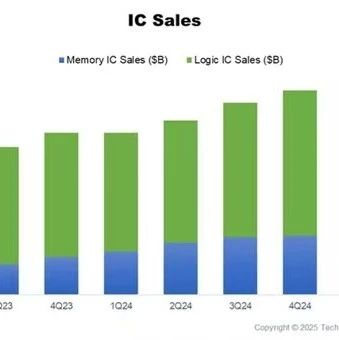
Core Insights - The semiconductor manufacturing industry is experiencing seasonal patterns, but uncertainties related to tariffs may lead to irregular seasonal fluctuations in various sectors [1][2] - In Q1 2025, electronic device sales decreased by 16% compared to the previous quarter but remained flat year-over-year. Integrated Circuit (IC) sales fell by 2% quarter-over-quarter but increased by 23% year-over-year [1] - Capital investment in semiconductor equipment declined by 7% quarter-over-quarter in Q1 2025 but grew by 27% year-over-year, driven by investments in advanced logic, high bandwidth memory (HBM), and advanced packaging [1][2] Investment Trends - Investment in wafer fabrication equipment (WFE) is accelerating, with a 19% year-over-year increase in Q1 2025, and a projected 12% growth in Q2 2025 [2] - Test equipment sales surged by 56% year-over-year in Q1 2025, with expectations of a further 53% increase in Q2 2025 [2] - Assembly and packaging equipment also experienced double-digit growth [2] Capacity Expansion - Positive capital investments are expected to lead to global wafer fabrication capacity expansion, with 300mm wafer production projected to exceed 42.5 million units per quarter in Q1 2025, marking a 2% increase quarter-over-quarter and a 7% increase year-over-year [2] - Japan is investing to enhance power semiconductor production, while Taiwan continues to invest in its advanced foundry capacity [2] Market Outlook - Despite a bright demand outlook for artificial intelligence and data centers, other sectors may see delayed investments or changing demand due to uncertainties in trade policies [2]