机器人和工业机械

Search documents
国泰海通:特朗普关税被否 后续如何演绎?
Zhi Tong Cai Jing· 2026-02-22 00:26
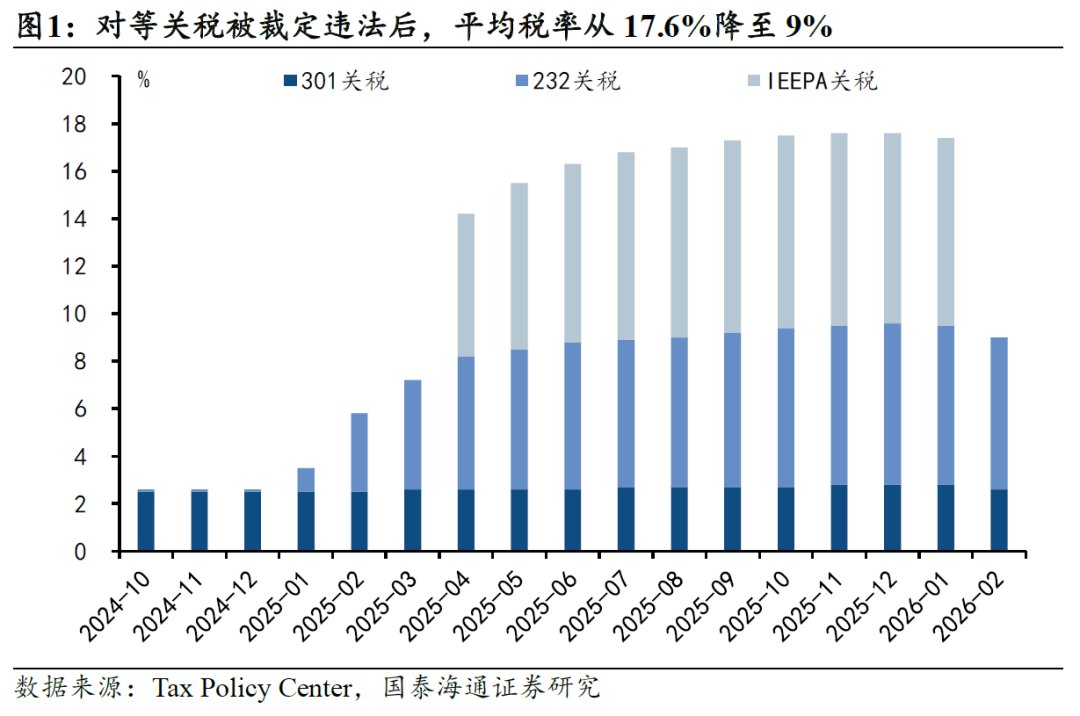
Core Viewpoint - The U.S. Supreme Court ruled that the Trump administration's imposition of reciprocal tariffs under the IEEPA was illegal, leading to Trump's announcement of a temporary 10% global import tariff under the Trade Act of 1974, which raises policy uncertainty and inflation risks [1][3]. Group 1: Short-term and Long-term Tariff Adjustments - The temporary tariff under Section 122 will maintain the current tariff rates, as the average tariff rate drops from 17.6% to 9% after the ruling [1]. - The 232 and 301 tariffs will serve as long-term adjustments, with the 232 tariffs already applied to various sectors including automotive and steel, impacting approximately 20% of U.S. imports [2][3]. Group 2: Inflation Risks and Corporate Behavior - The risk of re-inflation remains high, as companies may lack the incentive to seek refunds on tariffs already passed to consumers, potentially keeping prices stable [3]. - Exporters have absorbed some tariff costs, minimizing the impact on product prices, which could allow them to raise prices further if tariffs are reduced [3]. Group 3: Fiscal Impact and Debt Pressure - The reciprocal tariffs accounted for nearly 60% of U.S. tariff revenue, raising concerns about fiscal impacts; however, short-term financing pressures are manageable even with potential refunds of approximately $170 billion [4]. - In the medium term, the implementation of 232 and 301 tariffs will need close monitoring, as the elimination of reciprocal tariffs could triple net bond financing needs, increasing supply pressure [4][5]. Group 4: Market Reactions and Policy Uncertainty - Market expectations had anticipated the Supreme Court's decision, leading to increased volatility in the dollar and U.S. Treasury bonds, although the extent of this volatility is expected to be limited [6]. - The uncertainty surrounding new tariff measures may prompt more aggressive policy tools from Trump, which could further influence market dynamics and asset pricing [6].


2025Q4海外经济与资产展望:美欧日政策差异下的弱美元
HUAXI Securities· 2025-10-18 09:51
Economic Outlook - The US economy is experiencing marginal slowdown, with a projected annualized GDP growth rate of 2%-2.5%[10] - The unemployment rate in the US is currently at 4.3%, showing signs of concern in the labor market[15] - In Europe, economic stability is observed due to continuous interest rate cuts, but structural issues persist, particularly in Germany[4] - Japan's economy remains stable, with consumer confidence improving, but faces challenges from US tariffs and yen appreciation[4] Asset Projections - US Treasury yields are expected to decline towards 3.5% as the Federal Reserve continues to cut rates[4] - The US dollar is projected to weaken due to divergent monetary policies among the US, Eurozone, and Japan[4] - Gold prices may face short-term correction pressure but have strong medium-term support due to fiscal debt and monetary easing[4] Fiscal Policy Impact - The "Big and Beautiful" fiscal plan is projected to increase the US federal deficit by approximately $2 trillion over five years and $3.4 trillion over ten years[19] - The Congressional Budget Office (CBO) predicts a future deficit rate of 6.8%, up from a baseline of 5.8% due to the fiscal plan[23] - High deficit levels have led to increased government debt and rising interest pressures, with the average deficit rate since FY 2025 being 6.8%[28]
罗志恒:关税战下的美国——关税收入、实际税率与贸易格局演变
Sou Hu Cai Jing· 2025-10-13 04:55
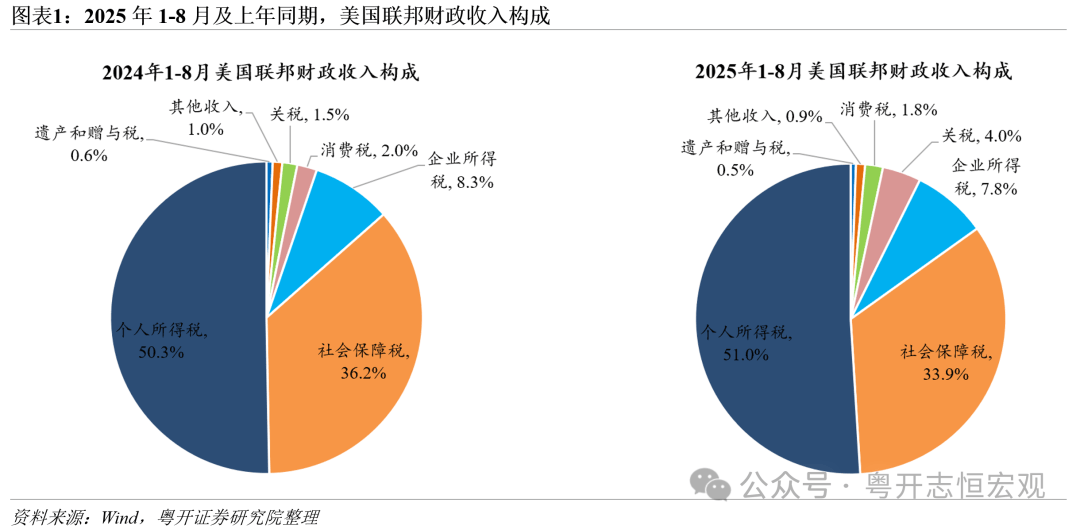
Core Viewpoint - The recent announcement by Trump to impose a 100% tariff on China and export controls on key software is seen as a significant escalation in the US-China trade conflict, which could have profound implications for bilateral trade and the global trade system [1] Group 1: Tariff Revenue and Rates - Since the onset of the trade war, US tariff revenue has surged, becoming the fourth largest source of federal revenue, following individual income tax, social security tax, and corporate income tax [6] - From January to June 2025, the average tariff rate in the US increased from 2.2% to 8.9%, with a notable rise in April due to expanded tariffs on a global scale [8][14] - By August 2025, US tariff revenue reached $144.4 billion, 2.8 times that of the previous year, accounting for 4.0% of federal revenue, an increase of 2.5 percentage points year-on-year [6] Group 2: Tariff Rates by Trade Partner - The actual average tariff rate imposed by the US on China reached 37.4% by June 2025, with significant increases observed for labor-intensive goods and products affected by Section 232 tariffs [24][29] - The average tariff rates for Japan and South Korea were 15.3% and 12.0%, respectively, while rates for the EU, Vietnam, and India ranged between 5% and 10% [24] - The US has seen a decline in its reliance on Chinese imports, with the share of imports from China dropping to 9.4% of total imports, a decrease of 3.4 percentage points year-on-year [28] Group 3: Trade Performance and Deficits - In the first seven months of 2025, US imports grew by 10.7% and exports by 4.8%, but the trade deficit expanded by 21.3% [19] - The US experienced a decline in trade volume with China and Canada, with imports from China down by 18.9% and exports down by 20.2% [19][20] - Despite high tariffs on China, the overall trade deficit with other countries has increased, indicating that the US still relies heavily on imports to meet domestic demand [20] Group 4: Future Tariff Trends - The actual tariff rates are expected to converge with nominal rates as various loopholes and exemptions are closed, leading to an increase in effective tariff rates across different economies [33][34] - Factors such as preemptive imports and exemptions for certain goods have contributed to the current lower effective tariff rates, but these are anticipated to diminish over time [33][35]