机构债

Search documents
美债投资手册系列报告(一):美国债券市场生态全景
Changjiang Securities· 2026-03-15 12:23
1. Report's Industry Investment Rating - No information provided in the report 2. Core Viewpoints of the Report - The US bond market is the world's largest and most liquid fixed - income market, with a stock of about 40% of the global total as of 2024, and its interest rate serves as the global pricing anchor. The US bond market has a complete variety system, with Treasury bonds playing a dominant role. It has a mature operating mechanism, clear liquidity stratification, and a perfect rating system. There are differences between the Chinese and US bond markets in terms of market complexity, institutional behavior, and regulatory intensity [5][8]. 3. Summary According to the Directory 3.1 US Bond Market Overview - **Scale and Status**: The US bond market is the world's largest, most liquid, and most dominant fixed - income market. As of 2024, the US fixed - income securities stock accounts for about 40% of the global bond market, and its interest rate is the global asset pricing anchor [21]. - **Bond Category Distribution**: The US bond market has a complete and well - structured variety system. It can be classified from multiple dimensions such as issuer, term structure, interest rate form, and credit rating. Treasury bonds have the largest stock, accounting for half of the market. Corporate bonds and MBS have steadily increased in volume, while municipal bonds, federal agency bonds, and ABS play a more structural supplementary role [23][25]. - **Term and Yield Distribution**: Different bond types have significant differences in terms of term and yield. Municipal bonds and MBS are mainly long - term bonds. Treasury bonds are mainly medium - term, with medium - term Treasury bonds accounting for the highest proportion. High - yield corporate bonds have the highest interest rate level, and different types of bonds' interest rates show cyclical fluctuations [31][33][37]. 3.2 Core Operating Mechanisms and Key Infrastructure of the US Bond Market - **Primary Market Issuance**: It operates under a registration system framework. There are exemption issuance systems such as Rule 144A and Regulation S. Underwriters play a key role in the issuance process, and the book - building process is used to determine the issue price. Different bond markets have their own core systems [40][42][43]. - **Core Operating Center: Primary Dealer System**: Primary dealers are key partners of the Federal Reserve in implementing monetary policy. They ensure the smooth issuance of Treasury bonds, maintain market liquidity, and act as the Fed's counterparties for policy transmission [47]. - **Secondary Market Trading**: The secondary market is mainly over - the - counter (OTC) and uses electronic trading platforms. The TRACE system enhances market transparency by providing real - time transaction data [49][50]. - **Clearing and Settlement**: The US bond market depends on the DTCC. The FICC under the DTCC provides central counterparty clearing, and the DTC is responsible for securities custody and final settlement [55]. 3.3 Bond Ratings: Multi - Dimensional Assessment of Credit, ESG, and Information Disclosure - **Credit Rating**: Three major rating agencies, S&P Global Ratings, Moody's, and Fitch Ratings, establish a unified credit - stratification framework for the US bond market [68]. - **ESG Rating**: Three mainstream international evaluation systems, Morningstar Sustainalytics ESG risk rating, MSCI rating, and LSEG ESG score, are used to describe ESG risks and performance from different perspectives [73]. - **Information Disclosure**: The information disclosure system in the US bond market is well - structured and clearly stratified. Different bond types have different disclosure rules [77]. - **Default Situation**: The default rates of different bond types vary significantly. Corporate bonds have the highest default rate, while US Treasury bonds and agency bonds have the lowest [80]. 3.4 Differences between Chinese and US Bond Markets - **Market Complexity**: The US bond market has more diverse varieties and more complex trading mechanisms, with both OTC and electronic platforms. The Chinese bond market has a relatively concentrated structure and clearer market levels and trading patterns [86]. - **Institutional Behavior**: Both markets are dominated by institutional investors. However, US institutional investors have more diverse strategies and more common active trading and hedging behaviors, while Chinese institutional investors mainly focus on allocation - based and stable investments [89]. - **Regulatory Intensity**: Both countries attach great importance to the bond market, but the US adopts a multi - regulatory - agency division of labor and a market - rule - based regulatory model, while China's regulatory system is relatively centralized, with more prominent policy coordination and administrative guidance [91].
去年美国以外的投资者购买美国金融资产的步伐加快,但12月美债持仓减少
Sou Hu Cai Jing· 2026-02-18 22:51
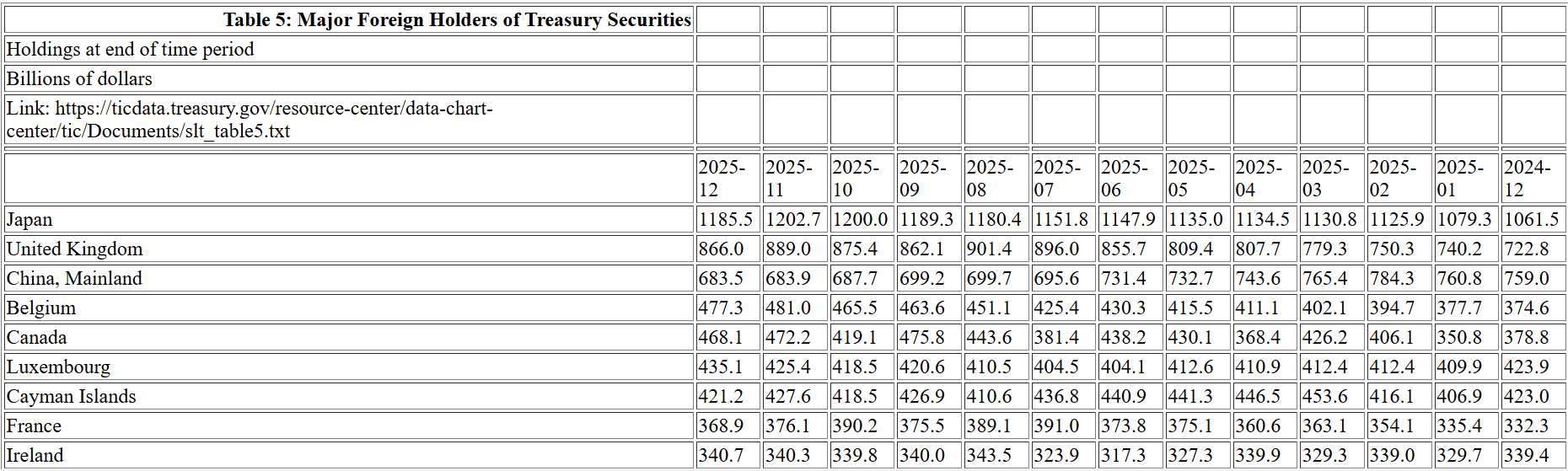
Core Viewpoint - The U.S. Treasury Department reported a significant increase in foreign investment in U.S. financial assets in 2025, countering the "Sell America" narrative, with net purchases reaching $1.55 trillion, up from $1.18 trillion the previous year [1] Group 1: Foreign Investment Trends - In 2025, foreign investors net purchased $1.55 trillion in U.S. long-term financial assets, with $658.5 billion in stocks and $442.7 billion in U.S. Treasury securities [1] - The net purchase of corporate bonds reached $327.8 billion, while net purchases of agency debt amounted to $112.9 billion [2] - European investors contributed $872.8 billion to long-term financial asset net inflows, with the Cayman Islands at $277.2 billion and Japan at $56 billion [4] Group 2: U.S. Treasury Securities Holdings - As of December, foreign holdings of U.S. Treasury securities decreased by $88.4 billion to $9.27 trillion, marking the lowest level since October [3] - Japan remains the largest foreign holder of U.S. Treasury securities, with holdings of $1.19 trillion, followed by the United Kingdom at $866 billion and mainland China at $683.5 billion [3] - China reduced its holdings of U.S. long-term financial assets by $208.6 billion, reaching the lowest level since 2008 [4] Group 3: Market Reactions and Economic Policies - U.S. Treasury Secretary has refuted the "Sell America" narrative, asserting that U.S. economic policies enhance its status as a preferred destination for global capital [2] - Despite geopolitical uncertainties, analysts believe that the fundamental demand for U.S. Treasury securities will remain strong due to their significant share in global sovereign debt [2] - The depreciation of the dollar may encourage some foreign asset managers to increase their holdings in U.S. securities [2]

美联储强势回归短债市场 华尔街紧急上调购债规模预期
Zhi Tong Cai Jing· 2025-12-11 22:21
Group 1 - The Federal Reserve announced a monthly purchase of $40 billion in U.S. Treasury securities starting this Friday, exceeding market expectations, aimed at alleviating short-term interest rate pressures by replenishing bank reserves [1] - Major banks on Wall Street have revised their forecasts for U.S. Treasury supply in 2026, with Barclays projecting total purchases could approach $525 billion, up from a previous estimate of $345 billion [1] - JPMorgan also raised its forecast, expecting the Fed to maintain the $40 billion monthly purchase pace until mid-April next year, with total purchases nearing $490 billion, nearly doubling previous estimates [1] Group 2 - Investment banks believe the Fed's actions will effectively ease reserve tightness caused by balance sheet reduction, helping to lower short-term financing pressures and benefiting SOFR-federal funds spread trading [2] - Analysts noted that the Fed is managing the return to "adequate" reserve levels more cautiously than in 2019, reflecting a strong intent to avoid disorder in the funding markets [2] - Despite improved liquidity conditions, some institutions warn that year-end market volatility remains likely, as the December purchase scale may not cover the seasonal overnight funding demand [2] Group 3 - The Fed's shift from balance sheet reduction to replenishing reserves marks a new phase in the funding market, becoming a key variable for balancing U.S. Treasury supply and short-term interest rate trends in 2026 [3]
美联储10月货币政策会议点评与展望:美联储10月再度预防式降息,但数据缺失、通胀风险将推升后续降息变数
Dong Fang Jin Cheng· 2025-10-30 05:21
Group 1: Federal Reserve Actions - The Federal Reserve lowered the federal funds rate target range from 4.00%-4.25% to 3.75%-4.00%, a decrease of 25 basis points[2] - This marks the first consecutive rate cut in a year, following the initial cut earlier this year[2] - The Fed will end its balance sheet reduction on December 1, after three and a half years of contraction, with total assets shrinking from $9 trillion to $6.6 trillion[4] Group 2: Economic Indicators - The labor market shows signs of weakness, with ADP reporting a decrease of 32,000 jobs in September, significantly below the expected increase of 50,000[3] - The September Consumer Price Index (CPI) data was below expectations, alleviating concerns about inflation driven by tariffs[3] - The Fed's Beige Book indicated widespread low demand for labor across various regions and sectors[3] Group 3: Market Liquidity and Risks - Recent liquidity pressures in the money market have led to a rise in repo rates, with the Secured Overnight Financing Rate (SOFR) reaching a high of 4.5%[5] - The total reserves in the banking system have fallen below $3 trillion, indicating a shift from "ample liquidity" to "tight liquidity"[5] - The Treasury's increased issuance of debt has withdrawn significant liquidity from the market, exacerbated by seasonal factors like tax payments[5] Group 4: Future Outlook - There is potential for another rate cut in December, but it is not guaranteed, as some officials advocate for a pause[6][7] - The uncertainty surrounding future rate cuts is heightened by the ongoing government shutdown and its impact on economic data availability[7] - The Fed's policy path in 2026 may depend heavily on economic and employment data trends, with an expected median rate of 3.4% indicating room for about two more cuts[8]
美联储祭出组合拳:继续降息25基点+12月结束缩表,两票委反对利率决议
美股IPO· 2025-10-29 22:58
Core Viewpoint - The Federal Reserve has ended its balance sheet reduction after three and a half years, replacing maturing MBS holdings with short-term Treasury securities starting in December [4][10]. Group 1: Interest Rate Decisions - The Federal Reserve has lowered the federal funds rate target range from 4.00%-4.25% to 3.75%-4.00%, marking the second consecutive 25 basis point cut [5][6]. - The decision to cut rates was widely anticipated by the market, with a 99.9% probability of a 25 basis point cut prior to the announcement [6]. - There remains a division within the FOMC regarding the rate cuts, with two dissenting votes; one member advocated for a 50 basis point cut while another preferred to maintain the current rate [11][12]. Group 2: Balance Sheet Reduction - The Fed's balance sheet reduction, which began on June 1, 2022, will conclude on December 1, 2023, with a shift to reinvesting MBS principal payments into short-term Treasury securities [9][10]. - The Fed had previously reduced its monthly balance sheet reduction pace, indicating a cautious approach to liquidity in the market [7][9]. Group 3: Economic Indicators - Recent labor market indicators align with trends observed before the government shutdown, with an acknowledgment of increased risks to employment in recent months [13][14]. - The statement reflects a shift in language regarding economic activity, indicating a slowdown in growth and a slight increase in unemployment, while inflation remains elevated [14][15].