
李宁运动服饰

Search documents
最悲凉的中国企业家:救过李宁,拿美国总统营销,最终病死狱中
Sou Hu Cai Jing· 2026-01-26 06:41
Core Insights - The article narrates the tragic life of Li Jingwei, a once-prominent figure in China's beverage industry, who faced legal troubles and died with a criminal label despite his significant contributions to the industry [1][11]. Group 1: Li Jingwei's Achievements - Li Jingwei transformed a struggling brewery into a leading national brand by creating China's first electrolyte sports drink, Jianlibao, in 1984 [2][3]. - He sponsored the Chinese Olympic team for the Los Angeles Olympics, which significantly boosted the brand's visibility and sales, leading to annual revenues exceeding 5 billion yuan by 1997 [3]. - Li played a crucial role in the rise of the Li Ning brand, helping to establish it as a leading name in sports apparel during the 1990 Beijing Asian Games [4][6]. Group 2: Legal Troubles and Downfall - In 2011, Li was convicted of embezzlement, receiving a 15-year prison sentence, although he spent his time in a hospital due to health issues [1][2]. - The legal case against him stemmed from allegations of misappropriating over 10 million yuan in employee welfare funds for personal insurance [1][2]. - His downfall is attributed to systemic issues within the state-owned enterprise framework, where he lacked true control over Jianlibao despite his managerial success [8][9]. Group 3: Legacy and Reflection - Li's story reflects the struggles of early Chinese entrepreneurs who faced challenges from rigid institutional frameworks, leading to personal and professional tragedies [11][13]. - His experiences highlight the contrast between market-driven success and the constraints imposed by state ownership and bureaucratic systems [6][11]. - The narrative serves as a cautionary tale for contemporary entrepreneurs, illustrating the complexities of navigating both market opportunities and regulatory environments [14].



中国业绩大增,lululemon为何换帅?丨消费参考
2 1 Shi Ji Jing Ji Bao Dao· 2025-12-16 02:29
Core Viewpoint - Lululemon is undergoing significant adjustments, highlighted by the resignation of CEO Calvin McDonald amid criticism from founder Chip Wilson regarding poor decision-making and a substantial decline in brand value and stock price [1][2]. Financial Performance - In the latest fiscal quarter ending November 2, 2025, Lululemon's net revenue in the Americas decreased by 2% to $1.7 billion, accounting for 68% of total revenue, with comparable sales down by 5% [2]. - Conversely, Lululemon's revenue in the Chinese market grew by 46% to $465.4 million, representing 18% of total revenue, with comparable sales increasing by 24% [3]. - Other international markets also saw a revenue increase of 19% to $367.2 million, making up 14% of total revenue, with comparable sales up by 9% [3]. Market Challenges - The competitive landscape in the Chinese market is intensifying, as evidenced by Li Ning's retail revenue experiencing a mid-single-digit decline, and Nike's revenue in Greater China dropping by 10% to approximately $1.512 billion [4]. - The struggles in Lululemon's core Americas market raise concerns about potential brand perception issues in China [5]. Management and Strategic Direction - Chip Wilson emphasizes the need for Lululemon to accelerate its adjustments to address the challenges it faces [6].


经营的本质是什么?
Hu Xiu· 2025-10-22 13:24
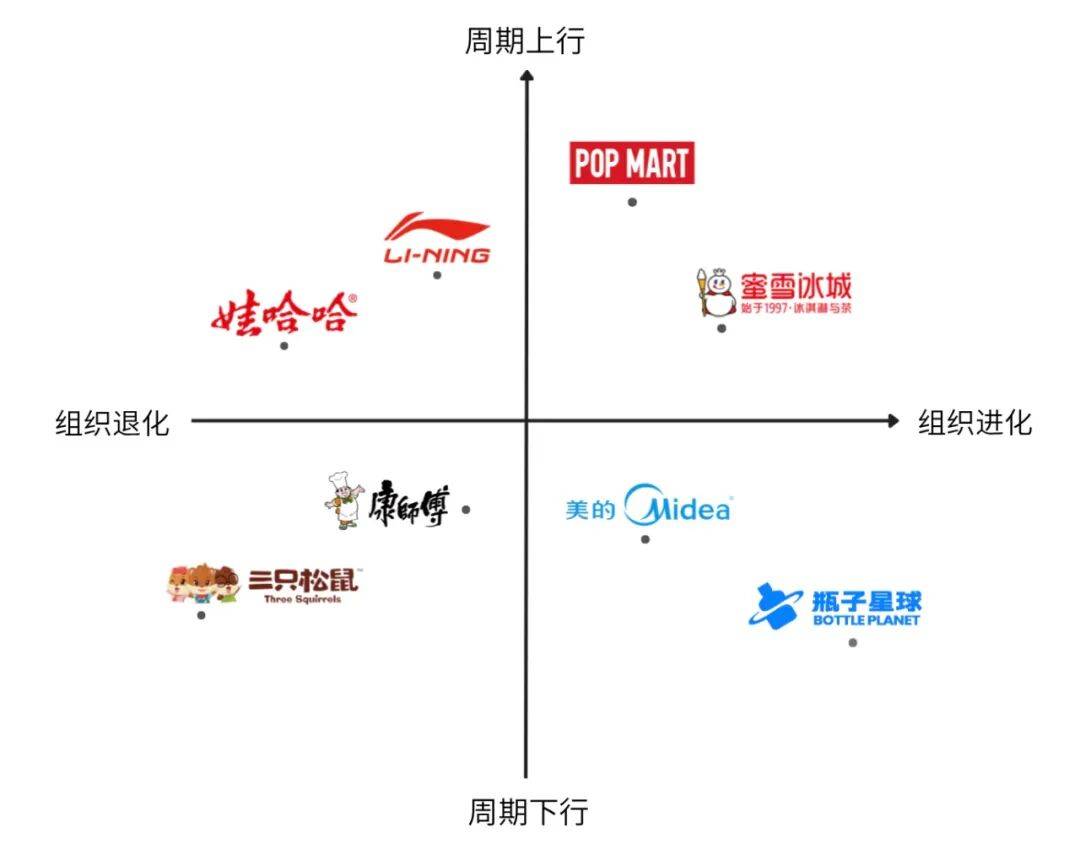
Core Insights - The article discusses the importance of both external cycles and internal organization in determining a company's success or failure during different market conditions [1][2][3] - It presents a four-quadrant model to categorize companies based on their organizational strength and market cycles, illustrating how these factors interact to shape business outcomes [3][4] Quadrant Analysis Quadrant 1: Upward Cycle + Organizational Evolution - Companies like Mixue Ice City and Pop Mart thrive during industry booms due to strategic accuracy and efficient execution, benefiting from favorable market conditions [6][7] - Mixue Ice City's success is attributed to its low-cost model and 100% self-sourced supply chain, achieving high gross and net profit margins in the new tea beverage sector [10][11][12] - Pop Mart capitalizes on global expansion and market adaptability, demonstrating a keen understanding of market dynamics despite periods of lower visibility [14][15][16] Quadrant 2: Downward Cycle + Organizational Evolution - Companies such as Bottle Planet and Midea exemplify resilience in challenging environments, adapting their strategies to align with market demands [17][18] - Bottle Planet, known for its brand Jiangxiaobai, pivoted to a "new liquor" strategy to counteract declining traditional liquor sales, leading to renewed growth [20][21][24] - Midea's transformation into a technology ecosystem company, driven by a focus on organizational strength over individual leadership, has resulted in significant market value growth [26][27] Quadrant 3: Upward Cycle + Organizational Degeneration - Wahaha and Li Ning illustrate how poor organizational management can squander opportunities during favorable market conditions [28][29] - Wahaha's leadership struggles have hindered its ability to capitalize on the bottled water market, while Li Ning's missteps in brand strategy have led to significant market value decline [30][34][35] Quadrant 4: Downward Cycle + Organizational Degeneration - Companies like Master Kong and Three Squirrels face compounded challenges from external market pressures and internal management issues [37][38] - Master Kong's sales have declined due to the rise of food delivery services, while its strategies have failed to adapt effectively to changing consumer preferences [39][41] - Three Squirrels struggles with maintaining quality and adapting to market changes, resulting in significant revenue losses and competitive disadvantages [43][44] Conclusion - The analysis emphasizes that while market cycles are constant, the organizational structure and adaptability of a company are crucial for long-term survival and success [45][46][47]




沈建光:需充分重视中国消费出现的七大结构性分化|国庆大咖谈
Di Yi Cai Jing· 2025-10-05 02:38
Core Viewpoint - The article emphasizes the importance of not only the changes in total consumption metrics but also the structural differentiation within the Chinese consumption market, highlighting both challenges and future potential for consumption growth [1] Group 1: Structural Differentiation in Consumption - Differentiation One: Improvement in goods consumption contrasted with a slowdown in service consumption, with goods retail sales growing by 4.8% year-on-year from January to August, significantly higher than the previous year's 3.2% [2] - Differentiation Two: High-end consumption is cooling while affordable consumption is gaining popularity, as evidenced by a nearly 20% decline in luxury car sales and a 5.4% revenue growth for Shanxi Fenjiu, a mid-range liquor brand [3] - Differentiation Three: The rise of domestic brands at the expense of imported goods, with local brands increasing their market share from 39% in 2012 to 76% by 2024 across various categories [4][5] Group 2: Regional and Group Consumption Trends - Differentiation Four: Consumption growth in first-tier cities is lagging behind that of lower-tier cities, with various factors contributing to this trend, including economic pressures and population changes [6] - Differentiation Five: Social group consumption is underperforming compared to individual consumer spending, with social group consumption growth lagging behind individual consumption since Q2 2023 [7] - Differentiation Six: Low-income groups are experiencing slower consumption growth compared to high-income groups, with the lowest income quintile showing only a 3.5% increase in disposable income [8] Group 3: Consumption Confidence and Policy Response - Differentiation Seven: While hard data on consumption shows recovery, consumer confidence remains low, with the consumer confidence index at 89.0, below the critical threshold of 90 for 28 consecutive months [9][10] - The policy response includes measures to stimulate consumption, such as expanding the scope of trade-in programs and increasing subsidies for service consumption, alongside long-term structural reforms aimed at enhancing consumer spending [11]