
水下无人机

Search documents
超40家VC押注,80后创始人冲刺水下机器人第一股
投中网· 2026-01-04 06:35
Core Viewpoint - The article highlights the growing interest and investment in the underwater robotics sector, particularly focusing on the company Deep Blue Technology, which is on the verge of becoming the first publicly listed underwater robotics company in China with an IPO plan to raise 1.5 billion yuan [5][7]. Company Overview - Deep Blue Technology has transitioned to the "Acceptance of Guidance" status for its IPO, with the guidance provided by China International Capital Corporation [6]. - The company aims to raise 1.5 billion yuan through its IPO, which, if successful, will mark a significant milestone as the first underwater robotics stock in China [7]. - Founded by Wei Jiancang, who has a strong technical background, Deep Blue Technology focuses on developing domestic underwater robotics capabilities, addressing a market that has been largely overlooked in China [9]. Product and Market Position - Deep Blue Technology has developed a diverse product line, including cable-controlled underwater robots, autonomous underwater vehicles, and underwater gliders, which are utilized in marine scientific research, hydropower, and emergency rescue operations [9][10]. - The company also has a consumer brand, Sublue, offering underwater sports products that have gained international traction, being sold in over 70 countries [10]. Financial Performance - The company has shown strong revenue growth, with revenues of 141 million yuan in 2022, projected to reach 235 million yuan in 2023 and 251 million yuan in 2024, reflecting a compound annual growth rate of 33.23% [13]. - As of mid-2025, the company reported revenues of 141 million yuan, matching the total for 2022, indicating a critical phase of revenue scale expansion [13]. - Despite high R&D costs leading to accumulated losses of 622 million yuan by mid-2025, the net loss has significantly decreased from 134 million yuan in 2022 to 6.78 million yuan in the first half of 2025 [13][14]. Industry Trends - The underwater robotics market in China has grown from 1.24 billion yuan in 2018 to 6.27 billion yuan in 2022, with expectations to exceed 30 billion yuan by 2027 [14]. - The global deep-sea robotics market is projected to reach 420 billion yuan by 2028, with the engineering service market potentially reaching 15 trillion yuan [14]. - The industry is characterized by high barriers to entry in defense and industrial-grade robotics, while the consumer market remains competitive but more mature internationally [14]. Investment Landscape - Over 40 investors, including Lei Jun, have shown interest in Deep Blue Technology, which has completed over ten rounds of financing, raising more than 1.3 billion yuan to date [8][10]. - The company has a strong and diversified shareholder structure, with the founder holding 23.64% of the shares, and institutional investors including Shenchuang Investment and others holding significant stakes [10].


宁波海曙AiOPC社区正式发布
Xin Lang Cai Jing· 2026-01-04 05:31
Core Viewpoint - The AiOPC community in Ningbo Haishu District aims to support AI entrepreneurs by providing a comprehensive ecosystem that enables "one-person companies" to thrive, facilitating their journey from idea to market [1][3]. Group 1: AiOPC Community Overview - The AiOPC community is designed specifically for AI-enabled entrepreneurs, focusing on creating a supportive environment for individual startups [3]. - The community will leverage five dimensions: space, policy, scenarios, tools, and services to foster the growth of AI entrepreneurs [1][3]. Group 2: Initial Projects and Participants - Eight initial projects have been launched within the AiOPC community, covering areas such as smart hardware, AI content generation, chip development, and digital cultural tourism [5]. - These projects reflect a trend of being "small yet specialized, light yet fast, and practical yet innovative" [5]. Group 3: Support Measures and Policies - The "NewBoss0574" plan includes four key support strategies: zero-cost entry, comprehensive empowerment through five dimensions, focus on seven core industry sectors, and collaboration with community, capital, platforms, and ecosystems [6]. - Entrepreneurs can access various benefits, including office space starting from 5 square meters with up to three years of rent-free support, discounted services, and annual government subsidies of up to 300,000 yuan for computing resources [6]. Group 4: Industry Context and Opportunities - The traditional textile industry is adopting smart design, and industrial manufacturing is seeking more flexible software solutions, indicating a significant opportunity for OPCs to fill gaps in these sectors [7]. - OPCs are viewed as agile entities that can address niche demands within the broader industrial ecosystem, enhancing innovation and responsiveness [7].
超40家VC押注,80后创始人冲刺水下机器人第一股
3 6 Ke· 2026-01-03 06:04
Core Viewpoint - The underwater robotics sector is gaining significant attention and investment, with companies like Deep Blue Ocean Technology poised to become leaders in this emerging market, particularly as they prepare for an IPO aimed at raising 1.5 billion yuan [1][2]. Company Overview - Deep Blue Ocean Technology has transitioned to the "Acceptance of Guidance" stage for its IPO, with the goal of listing on the Sci-Tech Innovation Board after completing eight rounds of guidance [1]. - The company plans to raise 1.5 billion yuan through its IPO, potentially making it the first publicly listed underwater robotics company in China [2]. - Founded by Wei Jiancang, who has a strong technical background, Deep Blue aims to enhance China's capabilities in underwater robotics, which has been largely underdeveloped compared to Western countries [3]. Product and Market Position - Deep Blue has developed a diverse product line, including cable-controlled underwater robots, autonomous underwater vehicles, and underwater gliders, which are utilized in marine scientific research, hydropower, and emergency rescue operations [3]. - The company also operates a consumer brand, Sublue, offering underwater sports products that have gained international traction, being sold in over 70 countries [4]. Financial Performance - Deep Blue has shown strong revenue growth, with projected revenues of 1.41 billion yuan in 2022, 2.35 billion yuan in 2023, and 2.51 billion yuan in 2024, reflecting a compound annual growth rate of 33.23% [6]. - Despite high R&D costs leading to accumulated losses of 622 million yuan by mid-2025, the company has significantly reduced its net losses from 134 million yuan in 2022 to 6.78 million yuan in the first half of 2025 [6]. Industry Trends - The underwater robotics market in China has expanded from 1.24 billion yuan in 2018 to 6.27 billion yuan in 2022, with expectations to exceed 30 billion yuan by 2027 [7]. - The global underwater robotics market is projected to reach 420 billion yuan by 2028, with significant growth in engineering service markets expected to reach 15 trillion yuan [7]. - The industry is categorized into defense, industrial, and consumer segments, with defense and industrial markets having high entry barriers, while the consumer market is more competitive but has a more mature overseas presence [7].

新增订单总额将超4000亿,这家国际造船集团野心不小
Sou Hu Cai Jing· 2025-12-28 18:08
Core Insights - Fincantieri reports a total order backlog of €41 billion as of September 30, 2025, representing a 32% increase from the end of 2024, with 100 ships scheduled for delivery until 2036 [2] - The company has set ambitious financial targets for the next five years, aiming for revenues of €12.5 billion by 2030, a 40% increase from 2025, and an EBITDA of over €1.25 billion, reflecting a 90% growth [2][3] - The defense sector is a strategic focus for expansion, with global defense spending expected to reach $2.93 trillion by 2030, an 18.6% increase from 2025 [6] Financial Goals - By 2028, Fincantieri anticipates revenues of approximately €11 billion, increasing to €12.5 billion by 2030 [3] - EBITDA is projected to rise from around €930 million in 2028 to €1.25 billion in 2030, with an EBITDA margin improvement from 8.5% to 10% [3] - Net profit is expected to grow from approximately €220 million in 2028 to €500 million in 2030, with profit margins doubling from 2% to 4% [3] Order and Market Opportunities - Fincantieri expects to secure over €50 billion in new orders from 2026 to 2030, with a significant portion of contracts in the defense sector anticipated to materialize between 2026 and 2028 [3] - The company has identified over €56 billion in commercial opportunities for the same period, with €23 billion having a medium to high probability of realization [3] Business Segments - In the cruise segment, Fincantieri maintains a leading market share of over 49%, with 34 cruise ship orders scheduled for delivery until 2036 [4] - The defense sector is a key area for growth, with plans to double production capacity at Italian shipyards and expand into new markets in the U.S., Southeast Asia, and the Middle East [6] - The offshore and special vessels segment is expected to benefit from increased global energy demand, with opportunities for constructing 130-140 new ships [6] Emerging Markets - The newly established underwater business segment is projected to see market size double from €22 billion to €43 billion between 2026 and 2030, driven by strong growth potential in defense, commercial, and dual-use applications [6] - Fincantieri aims to achieve its first zero-carbon cruise ship by 2035 as part of its energy transition strategy [6]
深之蓝完成IPO辅导拟冲刺科创板,工业消费双线布局成果显著
Sou Hu Cai Jing· 2025-12-17 14:44
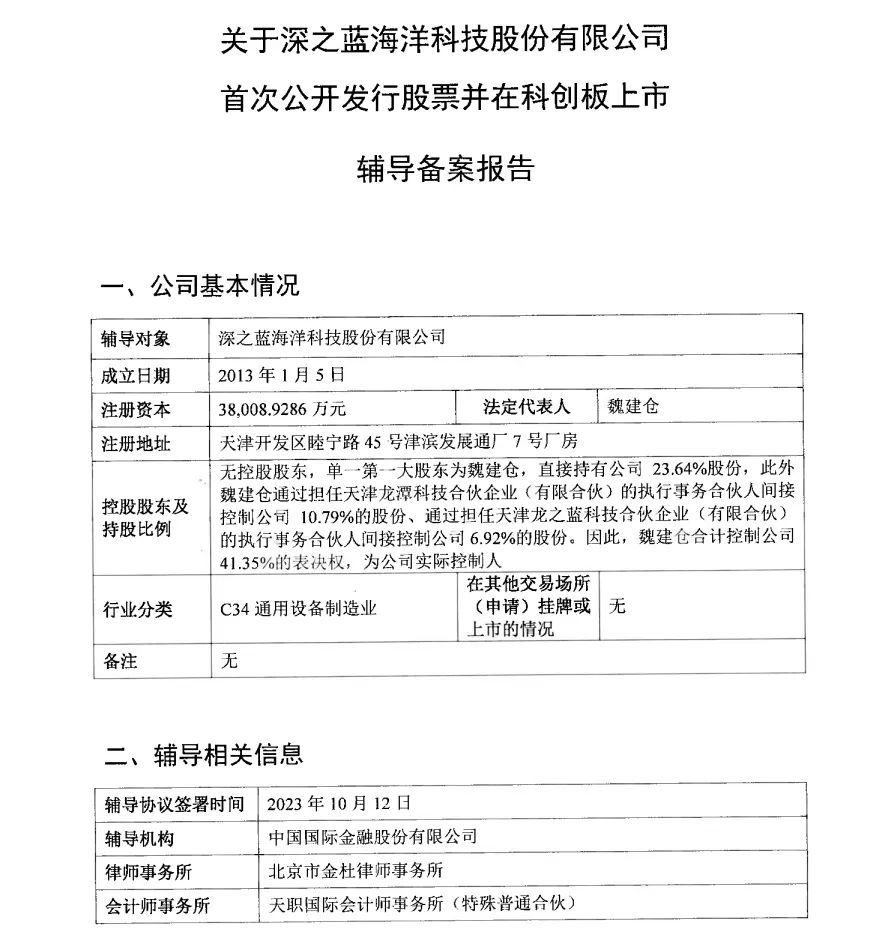
Core Insights - Deep Blue Ocean Technology Co., Ltd. has made significant progress in its IPO journey by submitting the completion report of its counseling work to the Tianjin Securities Regulatory Bureau, marking a new phase in its listing process after over two years since its IPO counseling filing in October 2023 [1] Company Overview - Established in 2013, Deep Blue focuses on underwater intelligent equipment, forming a complete industrial chain that includes independent research and development, production, and sales [2] - The product matrix includes cable-controlled underwater robots (ROV), autonomous underwater vehicles (AUV), underwater gliders (AUG), and buoy systems, which are widely used in six major fields: marine safety monitoring, marine engineering operations, emergency rescue actions, water conservancy facility maintenance, marine scientific research, and marine tourism projects [2] Market Strategy - Deep Blue employs a "dual-wheel drive" strategy, targeting both industrial (B2B) and consumer (B2C) markets [3] - In the industrial sector, its underwater robots are essential tools for research institutions, engineering companies, and rescue departments, while the consumer brand Sublue, established in 2016, offers underwater propulsion devices and smart products [3] - Sublue has achieved global sales of over 150,000 underwater propulsion devices, capturing 60% of the market share and exporting to over 70 countries [3] Competitive Landscape - The global diving equipment market is dominated by international brands such as Scubapro, Mares, Cressi, and Aqualung, which leverage technological barriers and brand premiums to maintain high-end market positions [3] - Chinese brands like Sublue are disrupting this landscape through three strategies: technological innovation, cost advantages via efficient supply chains, and leveraging cross-border e-commerce platforms [3] Financial Overview - Deep Blue has completed over 13 billion yuan in financing since its inception, attracting investments from over 30 notable institutions, including Shunwei Capital and Source Capital [4] - The company has a research and development team of approximately 200 people focused on key technologies such as underwater navigation, power systems, and intelligent control [4]

历时两年 水下机器人厂商深之蓝完成IPO辅导 拟冲击科创板
Xin Lang Cai Jing· 2025-12-15 09:17
Group 1: Company Overview - Deep Blue Ocean Technology Co., Ltd. (referred to as "Deep Blue") is known as the "Underwater DJI" and has recently changed its IPO guidance status to acceptance, with China International Capital Corporation (CICC) as the advisory institution [1] - Founded in 2013, Deep Blue specializes in the research, production, and sales of underwater intelligent equipment, focusing on both industrial and consumer markets [2] - The company has developed a range of underwater robots, including remotely operated vehicles (ROVs), autonomous underwater vehicles (AUVs), and underwater gliders (AUGs), serving various sectors such as marine scientific research, marine engineering, and emergency rescue [2][3] Group 2: Market Position and Technology - Deep Blue's consumer brand, Sublue, was established in 2016 and has captured nearly 65% of the global market share in underwater propulsion devices, delivering over 200,000 underwater technology products across more than 80 countries [2] - The company has approximately 200 R&D personnel and has made significant advancements in underwater robotics technology, holding over 400 patents, including more than 120 invention patents [3] - The global underwater robotics market is projected to grow from $9.4 billion in 2024 to over $60 billion by 2030, with China's market expected to increase from $1.4 billion to $14 billion during the same period [3] Group 3: Financial and Investment Background - Deep Blue has completed 10 rounds of financing since its inception, raising over 1.3 billion yuan, with the latest round in May 2023 amounting to 550 million yuan, backed by China Agricultural Bank [4] - The company's investors include various state-owned capital and private equity firms, with the largest shareholder being the founder, Wei Jiancang, who holds 23.64% of the shares [4][5] - The company has a diverse shareholder structure with 43 shareholders and no controlling shareholder, indicating a broad base of investment support [4]

“水下大疆”冲刺IPO,冷门品类跑出“黑马”
Sou Hu Cai Jing· 2025-08-29 08:42
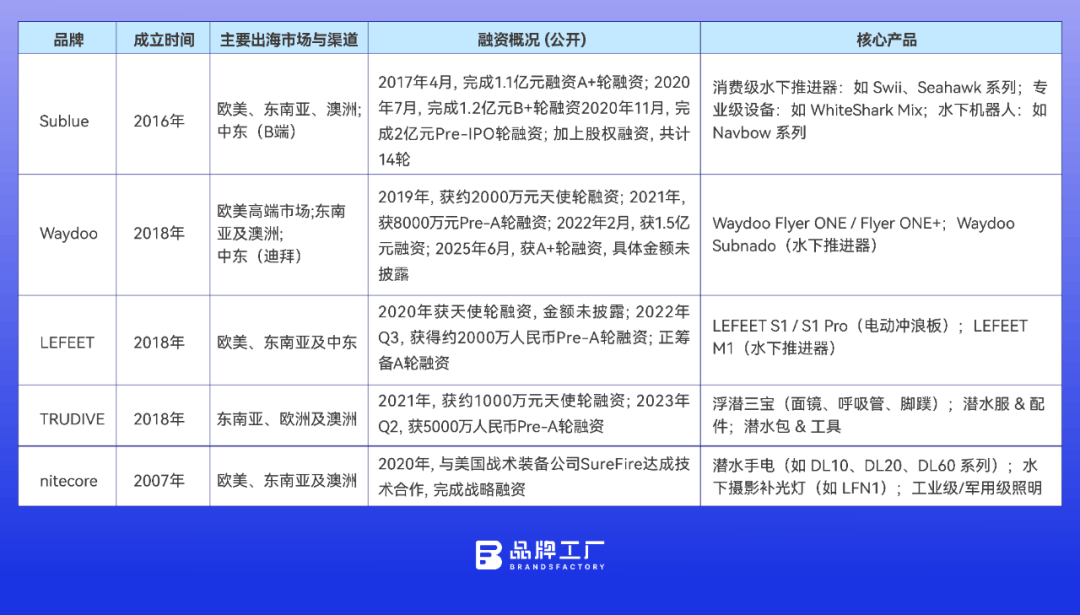
Core Insights - The rise of Sublue as a leading player in the underwater equipment market highlights a significant shift in the industry, with Chinese brands gaining market share against established international competitors [1][4][15] - The global demand for diving equipment is experiencing structural growth, driven by the increasing popularity of diving activities worldwide, particularly in regions like Southeast Asia and the Red Sea [8][9] - The market for diving equipment is projected to exceed $5 billion in 2023, with a year-on-year growth rate of over 20% in equipment procurement [9] Company Overview - Sublue, a prominent Chinese brand in the underwater equipment sector, has achieved a market share of 65% globally and has secured over 1.345 billion yuan in financing through multiple rounds [5][6] - The company has positioned itself as a consumer-grade brand, offering innovative products such as underwater scooters and smart surfboards, targeting markets in North America and Europe [6][12] - Sublue's products are priced at 60% of comparable Western brands, allowing it to penetrate the mid-to-high-end market effectively [9][19] Market Dynamics - The global diving certification numbers increased by 40% in 2023, indicating a growing consumer base for diving equipment [8] - The demand for diving gear is particularly strong in Southeast Asia, where orders from countries along the Belt and Road Initiative accounted for 55% of Alibaba's international orders in the diving equipment category [9] - The rise of smart diving equipment has redefined the competitive landscape, with Chinese companies leveraging technological advancements to offer superior products at competitive prices [19] Marketing and Sales Strategy - Sublue employs a dual-channel sales strategy, utilizing both Amazon and independent websites to maximize reach and brand visibility [7] - The company has successfully utilized crowdfunding platforms for product launches, achieving significant pre-sales and market exposure [7] - Social media marketing has been a key component of Sublue's strategy, with collaborations with influencers leading to substantial brand exposure [7] Future Outlook - Industry experts predict that the next five years could see the emergence of Chinese underwater equipment brands with valuations exceeding 30 billion yuan, driven by differentiation and innovation [19] - The transition from low-cost manufacturing to high-value branding is expected to reshape the global diving equipment market, similar to the impact of DJI in the drone industry [19]
“水下大疆”深之蓝IPO前瞻:影石创新市值破千亿元后,蓝色海洋能否游出下一个相机细分领域巨头?
Mei Ri Jing Ji Xin Wen· 2025-08-19 09:27
Core Insights - The article highlights the emergence of underwater intelligent equipment as a promising investment opportunity, particularly with the upcoming IPO of Deep Blue Ocean Technology Co., Ltd. [1] - The underwater robotics market in China is projected to reach 167 billion yuan in 2024, with a 25% annual growth rate, potentially exceeding 630 billion yuan by 2030 [5][6] - Deep Blue has established itself as a leader in the industry, holding nearly 65% of the global market share for underwater propulsion devices [6] Company Overview - Deep Blue was founded in 2013 and specializes in the research, development, manufacturing, and sales of underwater intelligent equipment [2] - The company has a strong shareholder base and has completed multiple rounds of financing, raising over 1.3 billion yuan since its inception [6] - The founder, Wei Jiancang, transitioned from a stable government job to pursue opportunities in the underwater robotics sector, which was largely untapped in China at the time [7][9] Market Potential - The underwater robotics market is characterized as a "blue ocean," contrasting with the saturated drone market, indicating significant growth potential [5] - The market spans both industrial applications (e.g., oil and gas exploration, emergency rescue) and consumer segments (e.g., underwater sports and entertainment) [5][6] - The increasing popularity of underwater activities and social media sharing is expected to create a new entertainment market worth billions [5] Competitive Landscape - Deep Blue has set industry standards, such as the national standard for underwater propulsion robots, positioning itself as both a player and a regulator in the market [6] - The company’s strategy involves initially focusing on high-tech industrial products before expanding into consumer markets [10] - Competitors include established brands like GoPro, but Deep Blue differentiates itself through its comprehensive product offerings and solutions rather than just hardware [12] Challenges and Considerations - The company faces challenges related to technology, market dynamics, and ecosystem integration, which will be critical for its long-term success [10] - The underwater imaging market has unique constraints, such as seasonal usage and maintenance requirements, which may limit consumer demand compared to terrestrial sports [11] - Future observations will focus on the company's IPO documentation and order structure to assess its market viability [12]
炫酷装备齐聚 国际交通展勾勒智慧交通未来
Zhong Guo Xin Wen Wang· 2025-07-03 12:28
Core Viewpoint - The 17th International Transportation Technology and Equipment Exhibition showcases cutting-edge technologies and innovations in the transportation sector, highlighting advancements in smart transportation, autonomous driving, and logistics efficiency [1][3]. Group 1: Innovations in Transportation - The exhibition features a unique SUV designed for rural road inspection, capable of assessing road conditions using a "visual system" that identifies surface defects and generates a 3D "health record" of the road [1]. - A L4 autonomous vehicle developed by Didi and GAC Aion is equipped with 33 sensors, including infrared cameras, enabling it to recognize pedestrians even in low light conditions. This model is set for delivery by the end of this year and aims for demonstration operations in select areas by 2026 [2]. - The exhibition also showcases a silver autonomous truck from Pony.ai, which has safely traveled 6 million kilometers and transported over 9.4 billion ton-kilometers of goods, significantly reducing logistics costs and improving efficiency [2]. Group 2: Broader Trends in Transportation - The event highlights various advanced technologies, including flying cars, intelligent delivery vehicles, and underwater drones, reflecting breakthroughs in autonomous driving, low-altitude economy, and energy integration [3]. - The International Transportation Exhibition, organized by the Ministry of Transport of China, has been held since 1992 and has increasingly contributed to the integration of transportation technology innovation and industry development [3].