
汇添富恒生科技ETF联接发起式(QDII)C(013128)

Search documents
"三元结构"破解单一市场依赖,揭秘汇添富恒生科技ETF联接发起式(QDII)C(013128)在组合中的风险分散密码
Sou Hu Cai Jing· 2026-02-27 03:50
Core Insights - Diversification is the cornerstone of modern asset allocation theory, aiming to optimize risk-adjusted returns by constructing a diversified asset portfolio that reduces unsystematic risk while retaining expected returns [1] - The Hang Seng Index exhibits a significant "triple structure" characteristic, with approximately 35% comprising local blue-chip stocks, 50% from mainland enterprises listed in Hong Kong, and the remainder from international large companies, providing a unique regional distribution that benefits from Hong Kong's status as an international financial center [1] Group 1: Market Dynamics - The long-term correlation between the Hang Seng Index and other indices like the CSI 300 and S&P 500 is low, allowing Hong Kong stocks to exhibit differentiated performance during market fluctuations driven by mainland liquidity cycles or U.S. Federal Reserve policies [4] - In 2025, the Hang Seng Index achieved a year-to-date increase of 28.89%, serving as an effective beta hedge during global market turbulence [4] Group 2: Currency and Profit Structure - The Hang Seng Index is traded in Hong Kong dollars, but over half of its underlying assets are from mainland enterprises, with revenue structures encompassing multiple currencies, making it a natural currency hedge [4] - The index benefits from currency fluctuations, as appreciation of the Renminbi enhances the index's performance when mainland earnings are converted to Hong Kong dollars, while a strong U.S. dollar maintains stability through the linked exchange rate system [4] Group 3: Sectoral Differences - The technology sector in A-shares focuses on hard manufacturing such as semiconductors and new energy, while the Hong Kong tech sector is dominated by internet giants, with over 60% of the Hang Seng Tech Index comprising information technology [5][6] - The structural differences in underlying assets lead to significant divergence in performance between A-shares and Hong Kong stocks, providing effective industry risk hedging opportunities [6] Group 4: Capital Flows - The Hong Kong stock market benefits from a dual-driven capital structure of "southbound funds + international allocation funds," contrasting with the A-share market dominated by domestic retail and institutional investors [6] - Continuous inflows of southbound funds can provide independent support for Hong Kong stocks during liquidity crises in A-shares, while reverse allocations from mainland funds can stabilize the market during geopolitical tensions [8] Group 5: Investment Products - The Huatai-PineBridge Hang Seng Tech ETF Connect (QDII) C (013128) is designed for investors looking to capture the valuation recovery window of the Hang Seng Tech Index, featuring a cost-effective fee structure [8][9] - The fund tracks the Hang Seng Tech Index, which balances soft and hard technology sectors, with major internet platforms like Tencent and Alibaba accounting for over 50% of the index [8] - Other investment products include the Huatai-PineBridge Hang Seng Tech ETF Connect (C) focusing on AI and the Huatai-PineBridge Hong Kong Stock Connect Technology Select Mixed Fund (C) employing active management strategies to identify high-potential assets [10]

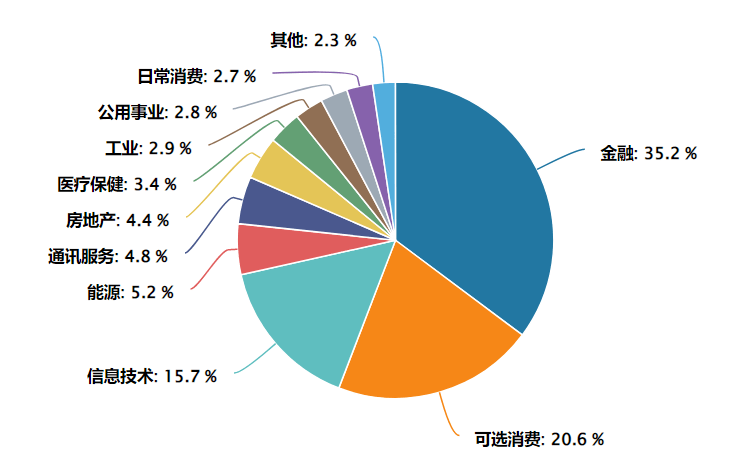
现金流与回购潮:为何汇添富恒生港股通中国科技ETF联接C(025167)在震荡市中展现资金吸引力?
Xin Lang Cai Jing· 2026-02-26 03:48
Core Viewpoint - The Hong Kong stock market continues to experience volatility amid macroeconomic uncertainties, but a significant trend of share buybacks led by technology giants is emerging, providing a stabilizing force for core assets in the market [1] Group 1: Data Insights on Buyback Trends - From 2025 to early 2026, the Hong Kong stock market has seen a concentrated wave of buybacks, primarily driven by technology giants. In 2025, Tencent Holdings topped the buyback list with a total of HKD 800.36 billion, conducting 130 buybacks throughout the year [2] - As of February 21, 2026, the total buyback amount in the Hong Kong market exceeded HKD 254 billion, with Tencent leading at HKD 63.58 billion, followed by ZTO Express and Xiaomi with HKD 41.03 billion and HKD 35.32 billion respectively [2] Group 2: Analysis of Buyback Logic - Buybacks serve as a multi-faceted support for stock prices in a volatile market. They act as a "signal tower" for valuation repair, indicating management's confidence when stock prices misalign with intrinsic value [3] - Compared to dividends, buybacks can enhance shareholder returns by reducing the number of shares outstanding, thus increasing earnings per share and return on equity. The Hong Kong Stock Exchange's reforms have increased the flexibility of buyback operations [3] - Leading companies often utilize idle cash for buybacks, providing a source of incremental funds that supports stock prices, especially during periods of tight external liquidity [3] Group 3: Focus on ETF 025167 - The 汇添富恒生港股通中国科技ETF联接C (025167) is well-positioned to capture the buyback trend, as it tracks the Hang Seng Hong Kong Stock Connect China Technology Index, which includes major players like Tencent and Xiaomi [4] - This ETF's high-weight coverage enhances its appeal by providing natural support during market downturns and accelerating valuation recovery when market sentiment improves [4][5]

机构资金向头部集中:透视汇添富恒生港股通中国科技ETF联接C(025167)中“港股M7”的高权重设计
Xin Lang Cai Jing· 2026-02-25 07:57
Group 1 - The core idea of the article emphasizes the "Matthew Effect" in the technology sector, where leading companies strengthen their market position through technological barriers, user loyalty, scale effects, and capital advantages, leading to a "winner-takes-all" scenario [1] - Institutional funds tend to concentrate on core assets with certainty premiums rather than diversifying investments, driven by the stronger risk resistance of leading companies, liquidity needs, and the pronounced moat effect in the technology industry [1] - The "Hong Kong Stock M7" refers to seven representative technology leaders in the Hong Kong market, including Tencent, Alibaba, Xiaomi, Meituan, SMIC, BYD, and Lenovo, which cover key technology sectors [2][3] Group 2 - The index tracking the "Hong Kong Stock M7" has a weight distribution where the top six companies account for 60.43% of the total index weight, reflecting a focus on pure information technology [3] - High concentration in investment tools leads to a trade-off, sacrificing coverage of potential "dark horses" for higher aggressiveness during favorable industry trends [4] - Leading companies benefit from multiple positive feedback loops during industry upcycles, resulting in a multiplier effect on index performance when they are all in a favorable cycle [5][6] Group 3 - Historical performance shows that the index tracking the "Hong Kong Stock M7" outperforms more diversified indices during technology stock upcycles due to the concentrated investment in leading companies [7] - The design of the index, with a maximum weight of 12% for individual stocks, aligns with the "Matthew Effect" and the trend of institutional funds concentrating on leading companies [8] - The investment strategy allows investors to indirectly hold a portfolio of "Hong Kong Stock M7" with a low entry threshold, sharing in the benefits of the technology industry's evolution [8]

规避风格漂移,探讨高纯度科技基汇添富恒生港股通中国科技ETF联接C(025167)的工具价值
Xin Lang Cai Jing· 2026-02-24 06:58
Core Viewpoint - The article discusses the challenges investors face in identifying true technology investments within Hong Kong's stock market, particularly regarding index funds that may include non-pure technology sectors such as pharmaceuticals and traditional manufacturing [1][2]. Group 1: The "Purity Dilemma" of Technology Investments - Many Hong Kong technology indices include a mix of sectors that dilute the true representation of "technology," leading to confusion for investors seeking exposure to core technology areas like AI and semiconductors [1][2]. - The inclusion of sectors like pharmaceuticals and electric vehicles in technology indices can expose investors to unrelated industry risks, reducing investment certainty and efficiency [2]. Group 2: The "Purification" Approach of 025167 - The Huatai-PineBridge Hang Seng Hong Kong Stock Connect China Technology ETF (025167) employs a strict industry exclusion mechanism to ensure high purity in its technology focus [3]. - The index tracks a selection of sectors closely related to technology, such as electronic components and digital solutions, while explicitly excluding biotechnology, electric vehicles, and traditional manufacturing [3]. Group 3: Strategic Positioning in the "Pure IT Sector" - The 025167 index provides a concentrated exposure to the information technology sector, aligning with global trends in technology capital expenditure, particularly in AI infrastructure [4]. - The index includes major players in both the internet platform and hardware manufacturing sectors, allowing for comprehensive coverage of the capital expenditure transmission chain [4]. Group 4: Conclusion on 025167's Value Proposition - The primary value of the 025167 fund lies in its ability to avoid the style drift associated with broader indices, offering a clear and efficient investment solution for those looking to capitalize on the growth of the Chinese information technology sector [5]. - This fund allows investors to focus on the core components of the digital economy, such as computing power and applications, thereby enhancing their investment strategy [5].
南向资金持续加码港股科技,汇添富恒生港股通中国科技ETF联接C(025167)长期配置价值显著
Xin Lang Cai Jing· 2026-02-24 06:58
Group 1 - The core viewpoint of the articles highlights a significant divergence in the Hong Kong stock market's technology sector post-Spring Festival, with traditional internet and new energy vehicle stocks facing pressure while emerging sectors like AI models and robotics experience substantial gains [1] - On February 20, traditional internet stocks such as Baidu, Alibaba, and Tencent saw declines of over 6%, 4%, and 2% respectively, while emerging sectors like AI and robotics showed strong performance, with stocks like Zhizhu rising over 40% [1] - On February 23, the technology sector experienced a broad rally, with stocks like Meituan, NIO, and SMIC rising over 5%, indicating a positive correlation between AI commercialization and industry recovery [1] Group 2 - As of February 13, 2026, the Huatai-PineBridge Hang Seng Hong Kong Stock Connect China Technology ETF (025167) has achieved a maximum monthly return of 13.97% since its inception, with an average monthly return of 9.41% [2] - The fund, established on August 27, 2025, aims to closely track the underlying index while minimizing tracking deviation and error [2] - The current fund manager, Le Wuqiong, has 11.6 years of experience in the securities industry [2] Group 3 - The Huatai-PineBridge Hong Kong Stock Technology Observation Toolbox includes various investment strategies, such as the Huatai-PineBridge Hang Seng Technology ETF (013128), which aims to balance investments in core technology assets [3] - The Huatai-PineBridge Hang Seng Hong Kong Stock Connect China Technology ETF (025167) focuses on the entire AI industry chain, excluding non-tech sectors to capture core AI value [3] - The Huatai-PineBridge Hong Kong Stock Connect Technology Selected Mixed Fund (025545) employs an active management strategy to identify high-potential assets within the Hong Kong Stock Connect framework [3]
科技经济正加速成为增长新引擎,汇添富恒生科技ETF联接发起式(QDII)C(013128)聚焦新质生产科技板块崛起机遇
Xin Lang Cai Jing· 2026-02-24 02:32
Group 1 - The Hang Seng Technology Index (HSTECH) experienced a decline of 2.29% as of February 24, 2026, while NIO-SW and Lenovo Group saw increases of 2.29% and 1.17% respectively. Kingdee International led the decline, with SenseTime-W and Tencent Music-SW also falling [1] - The Hang Seng Technology ETF managed by Huatai-PineBridge has seen continuous net inflows over the past 11 days, with a peak single-day net inflow of 41.84 million yuan, totaling 418 million yuan and an average daily net inflow of 37.96 million yuan [1] - As of February 13, 2026, the unit net value of the Huatai-PineBridge Hang Seng Technology ETF Connect Fund (QDII) C (013128) was 0.85 yuan [1] Group 2 - The technology economy is rapidly replacing the real estate economy as a new growth engine, with new productive forces in emerging manufacturing and high-value-added services expected to have a greater impact on total output than traditional real estate construction chains by 2025 [2] - The Huatai-PineBridge Hang Seng Technology ETF Connect Fund (QDII) C (013128) has achieved a maximum monthly return of 29.52% since its inception, with the longest consecutive monthly gains of 5 months and an average monthly return of 7.37% [2] - The fund has a Sharpe ratio of 1.14 over the past two years, ranking 6th out of 26 comparable funds, indicating a favorable risk-return profile [2] Group 3 - The Huatai-PineBridge Hang Seng Technology ETF Connect Fund (QDII) C is an other-type fund established on October 31, 2022, aiming to closely track the performance of the Hang Seng Technology ETF Huatai-PineBridge (513260) [3] - The current fund manager, Le Wuqiong, has 11.7 years of experience in the securities industry and has achieved a return of 66.33% since taking office on October 31, 2022 [3] Group 4 - The Huatai-PineBridge Hang Seng Technology ETF Connect Fund (QDII) C (013128) serves as a flagship broad-based fund for the Hong Kong technology sector, aiming for balanced allocation of core assets in Hong Kong technology and capturing the long-term growth momentum of China's new economy [4] - The Huatai-PineBridge Hong Kong Stock Connect China Technology ETF Connect C (025167) focuses on core assets in the "Hong Kong M7" and covers the entire AI industry chain, aiming to capture the core value of AI [4] - The Huatai-PineBridge Hong Kong Stock Connect Technology Selected Mixed Fund (025545) employs an active management strategy to dynamically select high-potential assets within the Hong Kong Stock Connect range [4]
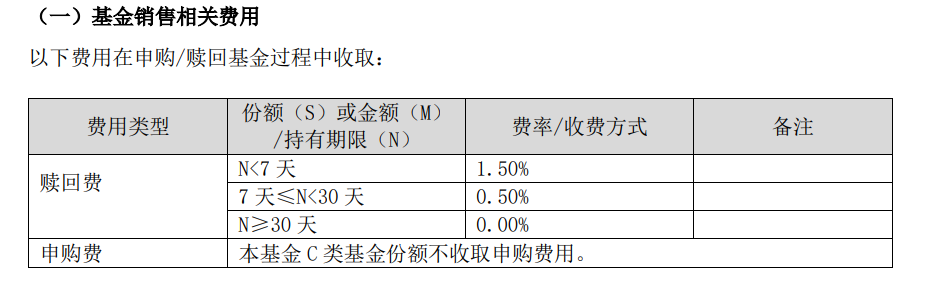
“零前端费用”助力科技板块流动性优势!汇添富港股通科技精选混合发起式C(025545)费率全解析
Xin Lang Cai Jing· 2026-02-23 10:24
Group 1 - The article highlights the ongoing reforms at the Hong Kong Stock Exchange, particularly the introduction of dual-class shares and the 18C chapter for specialized technology, which continue to attract high-quality Chinese concept stocks back to Hong Kong [1] - The expansion of Hong Kong Stock Connect and the long-term net inflow of southbound funds indicate a gradual shift in market pricing power towards mainland institutions [1] - With the onset of the Federal Reserve's interest rate cut cycle, undervalued and high-elasticity Hong Kong tech stocks are positioned as a strategic allocation window that combines both "defensive and growth" characteristics [1] Group 2 - The C-share class represents a significant innovation in the fee structure of public funds, emerging as an essential tool for asset allocation [1] - Unlike traditional A-shares that charge upfront subscription fees and have a tiered reduction in holding costs, C-shares adopt a "zero subscription fee + daily calculated sales service fee" model, optimizing cost efficiency for specific investment scenarios [1] - The core feature of C-shares is the exemption from upfront subscription fees, with costs strictly linearly correlated to the holding period, contrasting with the non-linear cost curve of A-shares [1] Group 3 - The Huatai-Pine Technology Select Mixed C Fund (025545) employs a "zero subscription fee + backend annual fee" model, allowing for manageable short-term costs and no redemption fees after 30 days [2] - This structure helps investors avoid the sunk cost fallacy associated with upfront fees, thus preventing them from being trapped in a liquidity dilemma of forced long-term holding [2][4] - The fund's cumulative net value growth rate has shown a widening gap from the benchmark return, indicating its strong ability to generate excess returns [5][6] Group 4 - The fund focuses on high-quality leading companies benefiting from the global AI revolution and China's technological self-reliance, particularly in sectors like social media, cloud computing, AI applications, and gaming [4] - The fund manager, Ma Xiang, has extensive experience in technology investment, covering various sectors including TMT and high-end equipment, while the co-manager, Ma Lei, emphasizes tactical flexibility in investment decisions [8] - The fund aims to provide a differentiated solution compared to A-shares, particularly in short-term allocation, systematic investment strategies, and liquidity management [4]
港股市场情绪回暖,恒生科技指数涨超3%,汇添富恒生科技ETF联接发起式(QDII)C(013128)紧跟科技板块修复机遇
Xin Lang Cai Jing· 2026-02-23 10:24
Group 1 - The Hang Seng Technology Index (HSTECH) increased by 3.58% as of February 23, 2026, with Meituan-W rising by 5.63% and SMIC by 5.10% [1] - The Hang Seng Technology ETF from Huatai-PineBridge saw continuous net inflows over 11 days, with a maximum single-day net inflow of 41.84 million yuan, totaling 418 million yuan, averaging 37.96 million yuan per day [1] - As of February 13, 2026, the unit net value of the Huatai-PineBridge Hang Seng Technology ETF Connect Fund (QDII) C (013128) was 0.85 yuan [1] Group 2 - Huajin Securities indicated that the post-holiday spring market may continue, with technology growth and cyclical industries performing relatively well, particularly in media (AI applications, gaming), computing (AI applications), electronics (semiconductors, AI hardware), and communications (AI hardware) [2] - The Huatai-PineBridge Hang Seng Technology ETF Connect Fund (QDII) C (013128) achieved a maximum monthly return of 29.52% since inception, with the longest consecutive monthly gains of 5 months and an average monthly return of 7.37% [2] - The fund's Sharpe ratio over the past two years was 1.14, ranking 6th out of 26 comparable funds, indicating a high risk-return profile [2] Group 3 - The Huatai-PineBridge Hang Seng Technology ETF Connect Fund (QDII) C was established on October 31, 2022, and aims to closely track the performance of the Hang Seng Technology ETF, minimizing tracking deviation and error [3] - The current fund manager, Le Wuqiong, has 11.7 years of experience in the securities industry and has achieved a return of 66.33% since taking office on October 31, 2022 [3] Group 4 - The Huatai-PineBridge Hang Seng Technology ETF Connect Fund (QDII) C serves as a flagship broad-based fund for the Hong Kong technology sector, aiming for balanced allocation of core assets in the Hong Kong technology market [4] - The Huatai-PineBridge Hong Kong Stock Connect China Technology ETF Connect C focuses on core assets in the "Hong Kong M7," covering the entire AI industry chain [4] - The Huatai-PineBridge Hong Kong Stock Connect Technology Selected Mixed Fund C employs an active management strategy to dynamically select high-potential assets within the Hong Kong Stock Connect range [4]
前十大重仓股行业地位透视,汇添富恒生科技ETF联接发起式(QDII)C(013128)核心资产一览
Xin Lang Cai Jing· 2026-02-23 09:48
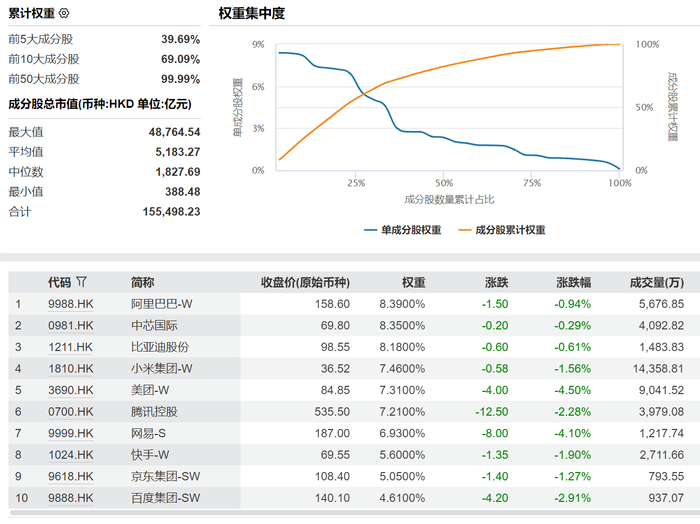
Core Insights - The Hang Seng Tech Index exhibits a highly concentrated weight structure, with the top ten constituent stocks accounting for nearly 70% of the total weight, highlighting a significant disparity in market capitalization distribution [1][4]. Group 1: Weight Distribution and Market Capitalization - The top five constituent stocks of the Hang Seng Tech Index have a combined weight of 39.69%, while the top ten account for 69.09%, and the top fifty make up 99.99%, indicating a highly concentrated characteristic [4]. - The largest individual stock, Alibaba, has a market capitalization of HKD 48,764.54 billion, while the smallest stock has a market capitalization of HKD 388.48 billion, with an average market capitalization of HKD 5,183.27 billion and a median of HKD 1,827.69 billion, reflecting significant market capitalization disparity [4]. Group 2: Industry Analysis of Top Constituents - Alibaba is categorized under consumer discretionary and internet platform sectors, with core businesses including retail, cross-border commerce, cloud computing, and digital media, demonstrating strong platform attributes and resilience against cyclical risks [4]. - SMIC (Semiconductor Manufacturing International Corporation) belongs to the information technology and semiconductor sector, positioned at the core of the semiconductor supply chain, benefiting from domestic substitution and AI computing demand [4]. - BYD is classified under consumer discretionary and the electric vehicle sector, with a comprehensive layout across vehicles, batteries, semiconductors, and rail transit, making it one of the most integrated companies in the new energy industry [4]. Group 3: Overall Index Characteristics - The Hang Seng Tech Index is characterized by a concentration of leading firms, distinct technological attributes, and high growth potential, with the top ten constituent stocks focusing on internet platforms, semiconductors, new energy, and consumer electronics, covering the core asset matrix of China's digital economy [5]. - The ETF aims to balance the allocation of core assets in Hong Kong's technology sector while capturing the medium to long-term growth momentum of China's new economy [5].
两会政策驱动AI基建升级,科技成长估值修复进行时,汇添富恒生科技ETF联接发起式(QDII)C(013128)聚焦硬科技发展新机遇
Sou Hu Cai Jing· 2026-02-23 03:59
Group 1 - The Hang Seng Tech Index (HSTECH) increased by 3.20%, with Meituan-W rising by 7.06% and Hua Hong Semiconductor by 4.99% as of February 23, 2026 [1] - The Hang Seng Tech ETF from Huatai-PineBridge has seen continuous net inflows over the past 11 days, with a maximum single-day net inflow of 41.84 million yuan, totaling 418 million yuan, averaging 37.96 million yuan per day as of February 13, 2026 [1] - The upcoming "Two Sessions" starting on March 4, 2026, will focus on promoting technological innovation and developing artificial intelligence, with expectations of more proactive fiscal policies and flexible monetary policies [1] Group 2 - Historical analysis shows that the technology growth sector tends to perform strongly in the 5 to 10 trading days after the Spring Festival, driven by policy and industry catalysts, as well as the performance of tech sectors in both Hong Kong and US markets [2] - The Huatai-PineBridge Hang Seng Tech ETF has achieved a maximum monthly return of 29.52% since its inception, with an average monthly return of 7.37% and a historical holding period profit probability of 78.13% over three years as of February 13, 2026 [2] - The fund has a Sharpe ratio of 1.14 over the past two years, ranking 6th out of 26 comparable funds, indicating a favorable risk-return profile [2] Group 3 - The Huatai-PineBridge Hang Seng Tech ETF is designed to closely track the performance of the Hang Seng Tech Index, aiming to minimize tracking deviation and error, with a return of 66.33% since its manager took over on October 31, 2022 [3] - The fund manager, Le Wuqiong, has 11.7 years of experience in the securities industry [3] Group 4 - The Huatai-PineBridge Hang Seng Tech ETF serves as a flagship broad-based fund for the Hong Kong tech sector, aiming to balance the allocation of core assets in the new economy [4] - The Huatai-PineBridge Hong Kong Stock Connect China Tech ETF focuses on core assets in the AI industry, covering the entire AI value chain [4] - The Huatai-PineBridge Hong Kong Stock Connect Tech Select Mixed Fund employs an active management strategy to identify high-potential assets within the Hong Kong Stock Connect framework [4]