
沃尔沃EX30

Search documents
今日新闻丨小鹏汽车发布2025年财报!日产NX8开启预售!新款阿维塔12开启预售,预售价29.99万元起!新款沃尔沃EX30限时售价15.98万元起!
电动车公社· 2026-03-20 17:44
Group 1 - The new Volvo EX30 has been launched with a limited price range of 159,800 to 209,800 yuan, featuring three models [2][3] - The EX30 is positioned as a small electric SUV with dimensions of 4223mm in length, 1838mm in width, and 1555mm in height, and a wheelbase of 2650mm [5] - The vehicle is equipped with a single motor producing 200kW or a dual motor with a total power of 315kW, paired with either a 46kWh lithium iron phosphate battery or a 66kWh ternary lithium battery, offering a CLTC electric range of 410/590/540 km [9][11] Group 2 - The new Avita 12 has started pre-sales with a price range of 299,900 to 439,900 yuan, offering both pure electric and range-extended versions [12][20] - The Avita 12 features a roof-mounted 896-line lidar and a semi-hidden door handle, maintaining its dimensions of 5020mm in length, 1999mm in width, and 1460mm in height, with a wheelbase of 3020mm [14] - The pure electric version has a power output of 237kW for a single motor or 402kW for a dual motor, with a 94.53kWh ternary lithium battery, providing a CLTC range of 705/755 km [18] Group 3 - The Nissan NX8 has commenced pre-sales, offering both pure electric and range-extended versions [21] - The NX8 maintains the family design of Nissan's N series electric vehicles, with dimensions of 4870mm in length, 1920mm in width, and 1680mm in height, and a wheelbase of 2917mm [23] - The pure electric version features a power output of 215/250kW, paired with 73/81kWh lithium iron phosphate batteries, achieving a CLTC range of 565/650 km [27][29] Group 4 - XPeng Motors projects a revenue of 76.72 billion yuan for 2025, with an expected delivery of 429,445 vehicles, representing a year-on-year growth of 87.7% [30] - The company achieved a net profit of 380 million yuan in the fourth quarter, marking a phase of profitability [30] - XPeng has focused on developing super range-extended versions and has partnered with Volkswagen for technology empowerment, indicating a commitment to technology-driven growth [32]



【联合发布】一周新车快讯(2026年3月14日-3月20日)
乘联分会· 2026-03-20 08:52
Core Viewpoint - The article provides an overview of new vehicle models set to launch in March 2026, highlighting specifications, market segments, and pricing strategies for various manufacturers in the automotive industry [2][3]. Group 1: Chery New Energy - The iCAR V27 is scheduled for release on March 13, 2026, positioned as a C SUV with a starting MSRP of 16.98 million to 19.68 million [7]. - It features a 1.5T range extender engine paired with an EVT transmission, offering a pure electric range of 200 to 210 km (CLTC) [6][7]. - The vehicle dimensions are 5,055 mm in length, 1,976 mm in width, and 1,894 mm in height, with a wheelbase of 2,910 mm [7]. Group 2: SAIC-GM-Wuling - The Wuling Bingguo S will launch on March 13, 2026, as an AO HB with an MSRP of 8.98 million [15]. - It is powered by a pure electric engine and EVT transmission, providing a pure electric range of 525 km (CLTC) [14][15]. - The vehicle's dimensions are 4,265 mm in length, 1,785 mm in width, and 1,600 mm in height, with a wheelbase of 2,610 mm [15]. Group 3: BYD Auto - The Fangchengbao Titanium 3 is set to debut on March 13, 2026, classified as an A SUV with an MSRP ranging from 15.38 million to 16.98 million [23]. - It features a pure electric engine with an EVT transmission, offering a pure electric range of 565 to 620 km (CLTC) [22][23]. - The vehicle dimensions are 4,605 mm in length, 1,900 mm in width, and 1,720 mm in height, with a wheelbase of 2,745 mm [23]. Group 4: Buick - The Buick Zhijing Shijia will be launched on March 17, 2026, as a C MPV with an MSRP of 48.99 million [31]. - It is equipped with a pure electric engine and EVT transmission, providing a pure electric range of 601 km (CLTC) [31]. - The vehicle dimensions are 5,260 mm in length, 2,023 mm in width, and 1,820 mm in height, with a wheelbase of 3,160 mm [31]. Group 5: ARCFOX - The ARCFOX Alpha S5 is scheduled for release on March 18, 2026, classified as a B NB with an MSRP ranging from 10.48 million to 17.38 million [37]. - It offers both range extender and pure electric options, with a pure electric range of 630 to 720 km (CLTC) [36][37]. - The vehicle dimensions are 4,886 mm in length, 1,930 mm in width, and 1,480 mm in height, with a wheelbase of 2,900 mm [37]. Group 6: XPeng Motors - The XPeng P7 will launch on March 18, 2026, as a C NB with an MSRP ranging from 20.38 million to 24.38 million [45]. - It features a pure electric engine with an EVT transmission, offering a pure electric range of 702 to 820 km (CLTC) [44][45]. - The vehicle dimensions are 5,017 mm in length, 1,970 mm in width, and 1,427 mm in height, with a wheelbase of 3,008 mm [45]. Group 7: FAW-Volkswagen - The Audi A5L is set to be released on March 19, 2026, classified as a B NB with an MSRP of 34.68 million [53]. - It is powered by a 2.0T engine paired with a DCT7 transmission [52][53]. - The vehicle dimensions are 4,908 mm in length, 1,860 mm in width, and 1,448 mm in height, with a wheelbase of 2,969 mm [53]. Group 8: Xiaomi Auto - The Xiaomi SU7 will launch on March 19, 2026, as a C NB with an MSRP ranging from 21.99 million to 30.39 million [61]. - It features a pure electric engine with an EVT transmission, offering a pure electric range of 720 to 902 km (CLTC) [60][61]. - The vehicle dimensions are 4,997 mm in length, 1,963 mm in width, and 1,460 mm in height, with a wheelbase of 3,000 mm [61]. Group 9: Chery Auto - The Chery Jetour X70 is scheduled for release on March 19, 2026, classified as a B SUV with an MSRP ranging from 9.99 million to 10.69 million [66]. - It is powered by a 1.5T engine with options for 6MT and DCT6 transmissions [66]. - The vehicle dimensions are 4,749 mm in length, 1,900 mm in width, and 1,720 mm in height, with a wheelbase of 2,745 mm [66]. Group 10: Chery Auto - The Chery Jetour Shanhai L7 will launch on March 19, 2026, as a B SUV with an MSRP ranging from 11.49 million to 13.19 million [76]. - It features a 1.5T plug-in hybrid engine with a 2DHT transmission, offering a pure electric range of 130 km (CLTC) [75][76]. - The vehicle dimensions are 4,749 mm in length, 1,900 mm in width, and 1,720 mm in height, with a wheelbase of 2,745 mm [76]. Group 11: Volvo - The Volvo EX30 is set to debut on March 20, 2026, classified as an AO SUV with an MSRP ranging from 20.38 million to 25.58 million [84]. - It features a pure electric engine with EVT transmission, offering a pure electric range of 410 to 590 km (CLTC) [83][84]. - The vehicle dimensions are 4,299 mm in length, 1,838 mm in width, and 1,555 mm in height, with a wheelbase of 2,650 mm [84].




重磅!加拿大正式对中国电动车敞开配额大门,首批2.45万辆,适用6.1%最惠国关税税率!比亚迪已提前布局,奇瑞正招兵买马
Mei Ri Jing Ji Xin Wen· 2026-03-04 13:13
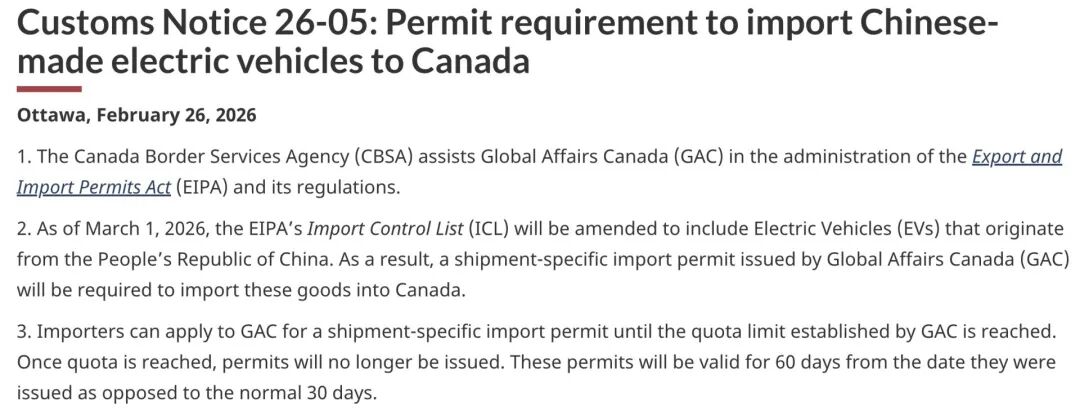
Core Viewpoint - Canada has announced a significant shift in its electric vehicle (EV) import policy from China, allowing for a quota of up to 24,500 vehicles from March 1 to August 31, 2026, with a reduced tariff rate of 6.1% [1][3]. Group 1: Import Quota and Tariff Changes - The initial import quota for Chinese electric vehicles is set at 49,000 units, covering pure electric, hybrid, and plug-in hybrid vehicles, with plans to consult on the quota mechanism in the coming months [3]. - The second phase of the quota will run from September 1, 2026, to February 28, 2027, allowing for an additional 24,500 vehicles and any unused quota from the first phase, with a target to expand the quota to 70,000 vehicles by 2030 [3]. - Previously, Canada imposed a 100% additional tax on electric vehicles imported from China starting October 1, 2024, raising the total tax rate to 106.1% [3]. Group 2: Trade Impact and Market Dynamics - In 2023, China exported 41,700 new energy passenger vehicles to Canada, a 751% increase year-on-year, with 13,200 units exported in the first half of 2024, marking a 500% increase [3][5]. - The value of electric vehicle imports from China surged from under 100 million CAD in 2022 to 2.2 billion CAD in 2023, with a significant drop of 92% in the fourth quarter of 2024 following the tax increase [5]. Group 3: Industry Expert Opinions - Experts view the removal of the 100% additional tax as a positive development, indicating that Canadian consumers would benefit from the competitive pricing and performance of Chinese electric vehicles [6]. - The Canadian government aims for over half of the imported electric vehicles from China to be priced below 35,000 CAD (approximately 180,000 RMB) within five years, aligning with the strengths of Chinese brands [6]. - Industry analysts suggest that while the policy shift opens opportunities for Chinese automakers, establishing local sales and after-sales systems in Canada will be essential for long-term success [6][12]. Group 4: Future Prospects and Investments - The reopening of import quotas coincides with a projected record high in China's automotive exports, expected to reach 7.098 million units in 2025, with new energy vehicle exports anticipated to grow by 103.7% [11]. - There is potential for increased collaboration between China and Canada in the automotive sector, not only in trade but also in investment, particularly in local assembly and production [11][12]. - Chinese companies are already preparing for market entry, with BYD registered for potential exports and Chery actively recruiting for roles related to entering the Canadian market [7][9].
喜娜AI速递:今日财经热点要闻回顾|2026年1月22日
Xin Lang Cai Jing· 2026-01-22 12:03
Group 1 - US President Trump announced the suspension of tariffs on eight European countries, leading to a significant rebound in US stock markets, with all three major indices rising over 1% [2][7] - Goldman Sachs forecasts China's GDP growth to reach 4.8% by 2026, with strong export growth supported by global demand recovery and cost advantages [2][7] - The investment in copper bars has surged due to rising gold and silver prices, but experts warn that the investment's profitability is questionable due to significant price differences [2][7] Group 2 - A-shares rebounded with the Shanghai Composite Index up 0.14%, driven by strong performances in the computing power and commercial aerospace sectors [3][8] - National household deposits reached 167 trillion yuan, with per capita deposits nearing 120,000 yuan, indicating a shift in consumer confidence and increased corporate loan growth [3][8] - South Korea's semiconductor exports surged to $10.73 billion in the first 20 days of the year, reflecting strong global demand and boosting chip stocks [3][8] Group 3 - Yuanji Cloud Dumplings, a major Chinese fast-food chain, has submitted a listing application in Hong Kong, reporting significant revenue growth and plans for further expansion [3][9] - Dongtong Tui has been delisted but attracted attention from investors during its delisting period, indicating potential interest in its asset quality [4][9] - Volvo's global recall of the EX30 due to battery issues has sparked controversy in China, where some affected models were not recalled, raising concerns about sales pressure [4][9] Group 4 - The US has officially withdrawn from the World Health Organization, with an outstanding debt of approximately $260 million for the 2024-2025 period, which may impact global public health [5][9]
沃尔沃搞“双标”? EX30因电池隐患全球召回,中国除外! | 次世代车研所
Xin Lang Cai Jing· 2026-01-22 00:40
Core Viewpoint - Volvo is facing criticism over battery safety issues related to its EX30 model, which uses batteries from the supplier Sunwoda, leading to recalls in multiple countries but not in China, causing dissatisfaction among Chinese customers [2][3][6]. Recall and Safety Concerns - Volvo has initiated a global recall for the EX30 model due to fire risks associated with Sunwoda batteries, affecting vehicles produced between September 6, 2024, and October 25, 2025 [2][3][6]. - The recall includes 40 vehicles in the US, 2,815 in Australia, and 10,440 in the UK, while no recall has been announced for the Chinese market, raising concerns of differential treatment [2][3][6]. - Reports of a fire incident involving a Volvo EX30 in Brazil have prompted Volvo to advise owners in affected markets to limit battery charging to 70% until a comprehensive recall plan is established [3][16]. Customer Reactions - Chinese EX30 owners express frustration over the lack of recall information and feel neglected compared to international customers, questioning Volvo's commitment to safety [5][20]. - Social media platforms have seen a surge of complaints from EX30 owners demanding explanations from Volvo regarding the perceived disparity in treatment [5][20]. Sales and Pricing Pressure - Volvo is experiencing significant sales pressure in the Chinese market, with a reported 4% decline in overall sales in 2025, totaling 149,549 units [9][24]. - The company has resorted to heavy discounts on several models, with the S60 being offered at nearly half its original price, indicating a struggle to maintain market share [7][23]. - The XC70 and XC60 models are also being sold at substantial discounts, reflecting the broader challenges Volvo faces in the competitive automotive market [8][23]. CEO Statements and Company Position - Volvo's CEO has previously stated that the company will not compromise on safety and quality to gain market share, emphasizing a commitment to sustainable business practices [10][27]. - However, the current situation with the EX30 recalls and aggressive pricing strategies raises questions about the alignment of the company's actions with its stated values [28].
沃尔沃搞「双标」?EX30因电池隐患全球召回,中国除外!
Xin Lang Ke Ji· 2026-01-22 00:24
Core Viewpoint - Volvo is facing significant backlash due to safety concerns related to the battery supplier, CATL, which has led to a global recall of the EX30 model, while Chinese customers feel neglected as no recall has been announced for the domestic market [1][2][6][18]. Recall and Safety Concerns - Volvo has initiated a recall for the EX30 model globally, specifically for vehicles produced between September 6, 2024, and October 25, 2025, due to fire risks associated with CATL batteries [1][2]. - The recall affects multiple countries, including the United States (40 vehicles), Australia (2,815 vehicles), and the UK (10,440 vehicles) [1]. - In response to the fire incidents, Volvo has advised owners to limit battery charging to 70% until a comprehensive recall plan is established [2]. Customer Sentiment and Response - Domestic Volvo EX30 owners are expressing dissatisfaction over the lack of communication and action regarding the recall, feeling that they are being treated differently compared to international customers [3][5][6]. - Social media platforms have seen a surge of complaints from EX30 owners demanding explanations from Volvo regarding the perceived disparity in treatment [6][8]. Sales and Market Performance - Volvo is experiencing significant sales pressure in the Chinese market, with a reported 4% decline in overall sales for 2025, totaling 149,549 units [12]. - The sales of fully electric models have plummeted by 46%, indicating a broader trend of declining demand for Volvo's electric vehicles [12]. - In an effort to boost sales, several Volvo models are being offered at steep discounts, with some vehicles being sold at nearly half their original price [9][11][20]. Corporate Statements and Strategy - Volvo's leadership has previously emphasized a commitment to safety and quality, stating that the company would not compromise on these values for short-term market gains [17]. - However, the current situation with the EX30 recalls and aggressive discounting raises questions about the company's adherence to these principles [18][20].
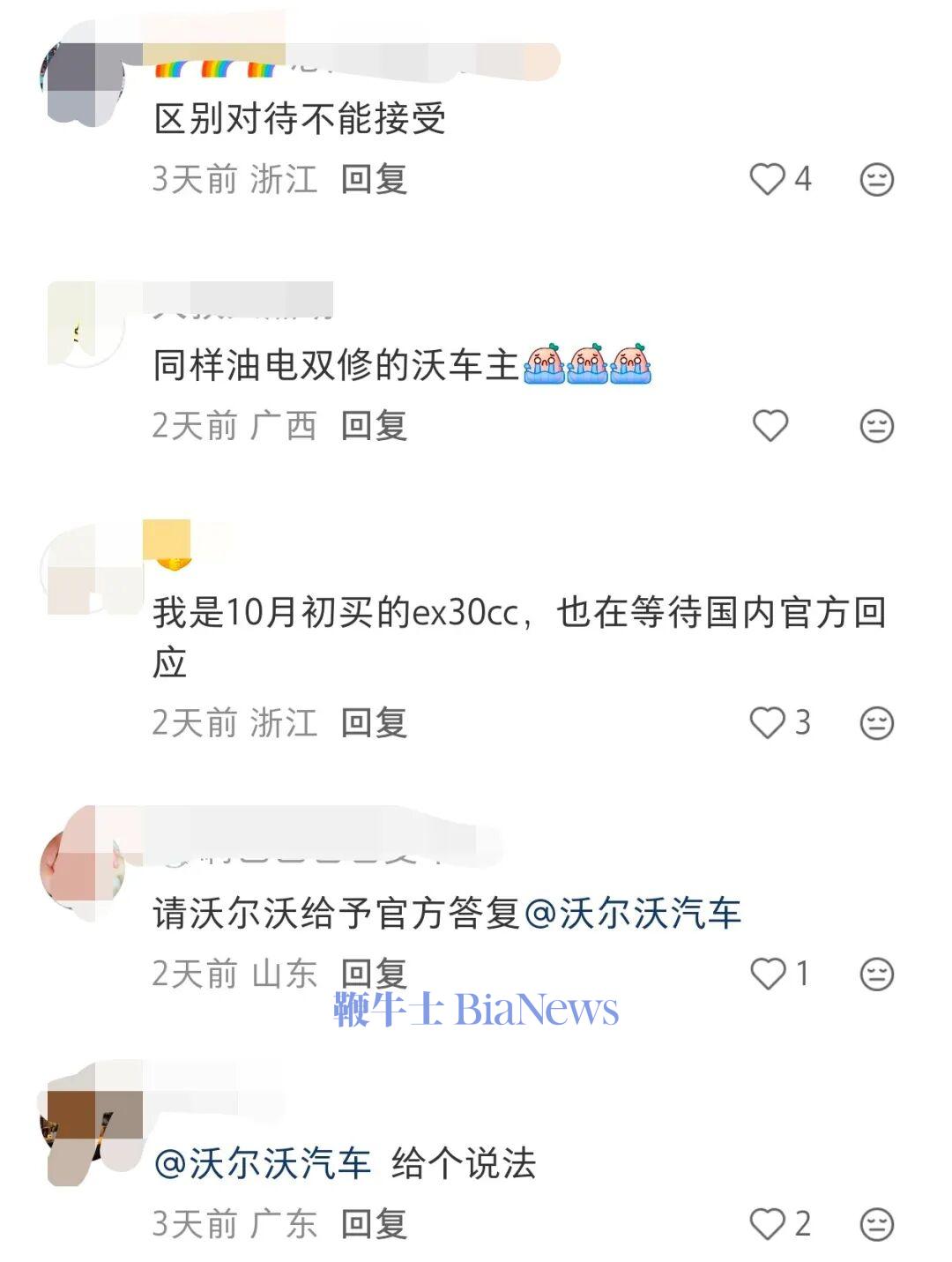
被指“双标” 沃尔沃EX30因电池隐患全球召回:中国除外
Xin Lang Ke Ji· 2026-01-22 00:21
Core Viewpoint - Volvo is facing criticism over battery safety issues related to its EX30 model, which uses batteries from the supplier, CATL. The company has initiated recalls in several countries but has not yet addressed the concerns of Chinese customers, leading to allegations of differential treatment [1][3][4]. Group 1: Recall Information - Volvo has launched a global recall for the EX30 model due to fire risks associated with CATL batteries, affecting vehicles produced between September 6, 2024, and October 25, 2025 [3]. - The recall includes 40 vehicles in the United States, 2,815 in Australia, and 10,440 in the UK, among others [3]. - A fire incident involving a Volvo EX30 occurred in Brazil, prompting the recall and safety warnings for owners to limit battery charging to 70% until a full recall plan is established [3][4]. Group 2: Customer Concerns - Chinese EX30 owners are expressing dissatisfaction over the lack of recall information in China, feeling neglected compared to international customers [4][6]. - Social media discussions among Volvo EX30 owners indicate a strong demand for official responses from the company regarding the perceived differential treatment [6][8]. Group 3: Sales and Pricing Pressure - Volvo is experiencing significant sales pressure in China, with a reported 4% decline in overall sales for 2025, totaling 149,549 units [10]. - The company has resorted to heavy discounts on multiple models, with some vehicles being offered at nearly 50% off their original prices, indicating a struggle to maintain market share [8][9]. - The decline in sales is attributed to a 46% drop in fully electric vehicle sales and a 13% decrease in fuel vehicle sales, despite a rise in hybrid model sales [10]. Group 4: Corporate Statements and Credibility - Volvo's senior executives have previously stated that the company would not compromise on safety and quality to gain market share, yet the current situation raises questions about the credibility of these claims [11][13]. - The ongoing battery safety issues and aggressive pricing strategies suggest a potential disconnect between corporate messaging and operational realities [14].
刚因“电芯”遭23亿天价索赔,欣旺达又卷入沃尔沃全球召回风波
Guo Ji Jin Rong Bao· 2026-01-19 13:00
Core Viewpoint - The recent recall of Volvo's electric vehicle EX30 due to battery safety issues has raised concerns about the responsibility of the battery supplier, A123, and has compounded existing sales pressures on Volvo [2][3][5]. Group 1: Volvo's Recall and Sales Performance - Volvo has initiated a global recall of its EX30 electric model due to high-voltage battery overheating risks, affecting markets including the US, Canada, South Africa, and Australia [2]. - In the UK, 10,440 units of the EX30 are confirmed to be affected, covering models from 2024 to 2026 [2]. - Volvo's global sales in 2024 are projected at 763,400 units, an 8% increase year-on-year, but sales in China, its largest market, have dropped to 156,400 units, the lowest in five years [4]. Group 2: Financial Impact and Battery Supplier Issues - In Q3 2023, Volvo's global sales fell to 160,500 units, a 7% year-on-year decline, with revenues of 86.4 billion Swedish Krona, down 6% [5]. - The recall has sparked controversy over battery supply responsibilities, with reports indicating that the problematic battery cells were produced by a joint venture involving A123 [5][6]. - A123's chairman stated that the battery packs were supplied through a different factory, distancing the company from direct responsibility for the issues [5]. Group 3: A123's Challenges and Market Position - A123 is facing significant challenges, including a recent lawsuit from Zeekr over battery quality issues, which has intensified scrutiny on the company's reliability [6][9]. - The company has seen a reduction in orders from key clients like Li Auto and Xiaomi, with the number of models supported by A123 for Li Auto dropping from 10 to 3 [9]. - A123's aggressive pricing strategy has led to declining profit margins, with a gross margin of only 9.77% in H1 2025, significantly lower than competitors [10]. Group 4: Financial Health and Future Outlook - A123 reported a loss of 1.87 billion Yuan in 2024, with cumulative losses exceeding 4.5 billion Yuan from 2023 to H1 2025 [10]. - The company's debt levels have risen sharply, with a debt-to-asset ratio of 67.62% and total liabilities reaching 67.9 billion Yuan [10]. - Concerns about ongoing litigation and financial losses may hinder A123's plans for an IPO in Hong Kong, which was anticipated for 2026 [10].

欣旺达再陷电池安全漩涡背后:毛利率承压,涉事子公司仍亏损
Nan Fang Du Shi Bao· 2026-01-17 03:49
Core Viewpoint - The company Xiwanda is facing significant challenges due to safety issues with its battery products, leading to recalls and legal claims from partners, which may impact its financial performance and market reputation [1][6][8]. Group 1: Battery Safety Issues - Volvo has initiated a recall of its EX30 model due to potential overheating risks in high-voltage batteries, which are produced by a joint venture between Xiwanda and Geely [3][4]. - The recall affects multiple markets, with specific numbers including 40 vehicles in the U.S. and 2,815 in Australia, highlighting the scale of the issue [4]. - Xiwanda has not clearly defined its responsibility in the recall and has not disclosed potential impacts on its battery business [5][6]. Group 2: Legal Challenges - Xiwanda is facing a lawsuit from Geely's subsidiary, Weirui Electric Vehicle Technology, claiming damages of 2.314 billion yuan due to quality issues with battery cells delivered between June 2021 and December 2023 [6][8]. - The lawsuit is linked to previous quality complaints, including a situation where Zeekr, a Geely brand, offered free battery replacements to customers due to performance issues [7]. Group 3: Financial Performance and Market Position - Xiwanda's revenue from its automotive battery business has grown rapidly, from 428 million yuan in 2020 to 151.39 billion yuan in 2024, increasing its share of total revenue from less than 3% to 27.02% [8][9]. - Despite this growth, the gross margin for Xiwanda's electric vehicle batteries is only 9.77%, significantly lower than competitors like CATL and EVE Energy, which have margins of 22.41% and 17.6%, respectively [9]. - The company reported a net loss of 877 million yuan in the first half of 2025, despite generating 7.392 billion yuan in revenue from its battery segment [9].
质量责任如何科学界定?困扰欣旺达等企业的电池安全归因话题受关注
Zhong Guo Jin Rong Xin Xi Wang· 2026-01-16 09:27
Core Viewpoint - A lawsuit involving the quality of battery cells supplied by Xinwanda Power to Geely's subsidiary, Weirui Electric, has raised concerns about the long-standing issue of defining quality responsibility within the electric vehicle supply chain [1][2]. Group 1: Lawsuit Details - Xinwanda announced that it is being sued for 2.314 billion yuan due to alleged quality issues with battery cells delivered between June 2021 and December 2023 [2]. - Weirui Electric, a subsidiary of Geely, is involved in the lawsuit and is a key player in the high-end electric vehicle market [2]. - The lawsuit highlights the complexity of battery safety, which cannot be solely attributed to the battery cells, as it involves multiple components and systems [3]. Group 2: Quality Responsibility - The safety of power batteries is recognized as a complex system that includes battery pack design, battery management systems, and vehicle integration [3]. - Xinwanda asserts that similar battery cells supplied to other clients have not experienced quality issues, suggesting that the problem may not lie solely with the battery cells [3]. - The industry is urged to avoid one-sided blame and to analyze the complexities of automotive batteries to foster healthy development [3]. Group 3: Supply Chain and Responsibility - The recall of Volvo's EX30 vehicles, which reportedly used battery cells from Xinwanda, has further complicated the situation, with Xinwanda clarifying that it is not directly involved in the battery system sold to Volvo [4]. - The incidents are seen as critical examples for examining quality, responsibility, and risk within the electric vehicle supply chain, impacting corporate survival and industry ecology [4]. - There is a call for establishing a fair responsibility-sharing mechanism within the supply chain to enhance resilience and competitiveness in the global market [4][5].
