澳债

Search documents
年内涨幅跻身G10前三!鹰派联储+利差撑腰 澳元飙升逼近三年最强水平
Sou Hu Cai Jing· 2026-01-27 02:29
澳洲联储将于2月3日公布货币政策决议,交易员当前正聚焦本周公布的通胀数据,为澳元交易押注提供 依据。调查显示,澳大利亚上月核心消费者通胀率同比上涨3.3%,突破了澳洲联储2%-3%的目标区 间。 受央行鹰派前景影响,澳大利亚政策敏感度较高的3年期国债收益率已升至2023年11月以来的最高水 平。除高收益率外,受美国政府再次面临停摆担忧、"去美元化"趋势持续升温的影响,澳债的顶级信用 评级也吸引了大量投资者涌入。 澳大利亚联邦银行驻悉尼策略师Carol Kong表示:"尽管地缘政治和贸易紧张局势再度升温,但市场对 美元的悲观情绪、澳洲联储的加息预期以及金属价格走高,共同支撑了澳元的韧性。" 智通财经APP获悉,澳洲联储的鹰派货币政策立场,叠加美日联合出手捍卫日元的预期对美元形成压 制,澳元汇率正逼近三年来的最强水平。 2026年以来,澳元兑美元汇率已累计上涨近4%,目前报约0.69,跻身今年迄今十国集团货币涨幅前 三。澳大利亚联邦银行和西太平洋银行的策略师均预测,澳元有望在3月底前升至0.70,这一价位上一 次出现还是在2023年初。 市场押注澳大利亚下月将加息,澳债收益率目前位居发达国家之首,成为澳元的重要支 ...
澳元站稳0.67关口加息预期
Jin Tou Wang· 2025-12-31 02:33
Core Viewpoint - The Australian dollar (AUD) has strengthened significantly, reaching a 14-month high against the US dollar (USD) due to a combination of hawkish signals from the Reserve Bank of Australia (RBA), expectations of US Federal Reserve (Fed) rate cuts, and favorable commodity prices driven by China's recovery [1][2]. Group 1: Economic Indicators - As of December 31, 2025, the AUD/USD exchange rate reached 0.6700, reflecting a daily increase of 0.12% and an annual rise of over 7% since the low of 0.6420 in mid-November [1]. - Australia's inflation rate in October was reported at 3.8%, exceeding the RBA's target of 2%-3%, with December inflation expectations rising to 4.7% [1]. - Market pricing indicates a nearly 50% probability of an interest rate hike by March 2026, with mainstream forecasts suggesting a potential increase to 3.85% in the first meeting of the year [1]. Group 2: Market Dynamics - The RBA's hawkish stance is a key driver of the AUD's strength, while the Fed's easing expectations have contributed to a decline in the USD index by over 10% for the year [1][2]. - The Fed has implemented three rate cuts since September 2025, with current rates at 3.50%-3.75%, and further cuts are anticipated next year [1]. - The AUD benefits from rising commodity prices and improved trade balances due to recovering exports of iron ore and coal, alongside positive expectations from China's targeted investment plans [1]. Group 3: Technical Analysis - The AUD/USD has formed an upward trend from 0.6420, currently consolidating around 0.6700, with resistance at 0.6727 and support at 0.6650 [2]. - The MACD indicates that bullish momentum remains, although it is slowing, while the RSI (14) is at 66.4278, suggesting that the market is not yet overbought [2]. - Institutions are optimistic about the AUD's future, with target prices ranging from 0.72 to 0.92 USD, although risks such as global economic slowdown and trade tensions may limit gains [2].
全球长债收益率飙升至16年新高,市场押注全球降息周期即将终结
Hua Er Jie Jian Wen· 2025-12-10 14:29
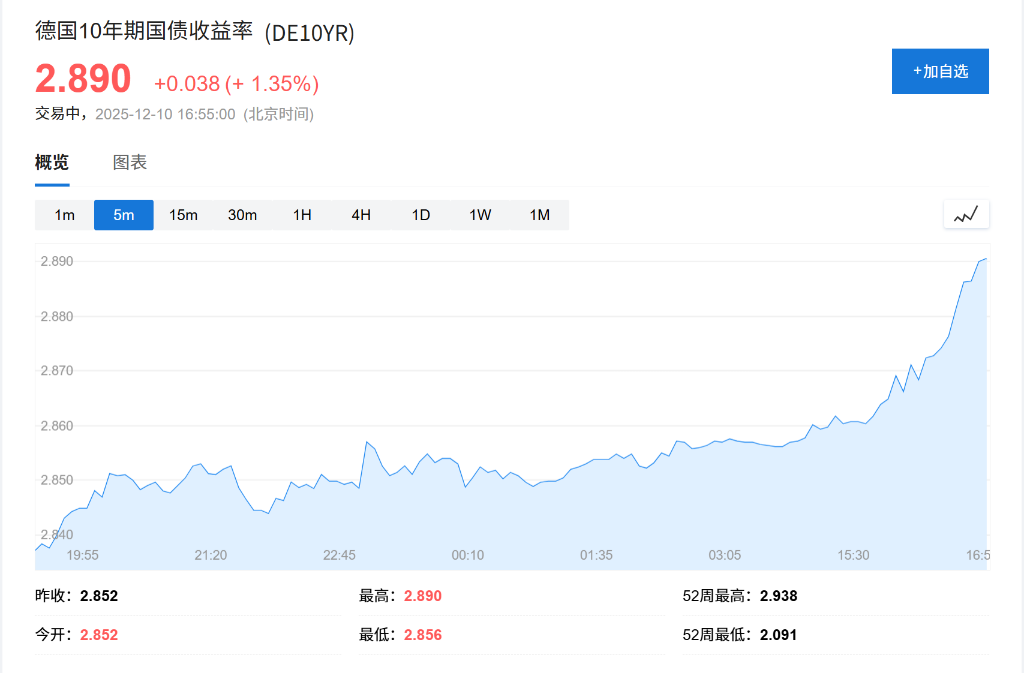
Group 1 - Global long-term bond yields have returned to their highest levels since 2009, indicating a growing consensus that the easing monetary policy cycle by central banks is nearing its end [1] - The U.S. Treasury market is experiencing unusual movements, with yields rising despite expectations of a rate cut by the Federal Reserve, driven by concerns over persistent inflation and a significant budget deficit [5] - The shift in market sentiment has led to a "disappointment trade" across developed markets, as investors reassess inflation risks and the implications of rising public debt [4] Group 2 - The increase in global bond yields is attributed to both a shift in monetary policy expectations and the surge in government debt and fiscal expansion plans [6] - Major developed markets are seeing rising bond yields, with expectations that the European Central Bank has little room for further rate cuts and that the Bank of Japan is likely to raise rates soon [1][4] - Governments are planning significant fiscal expansions, such as Germany's record €52 billion defense order, which is influencing investor perceptions of long-term financing impacts [7]

市场避险情绪消退 投资者“弃债从股”
Xin Hua Cai Jing· 2025-07-23 23:27
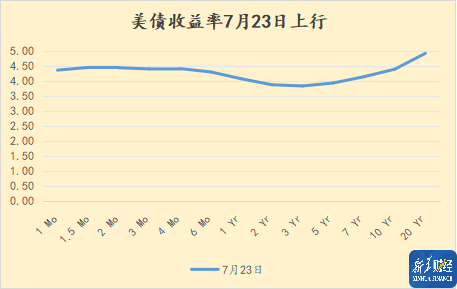
Group 1 - Global stock markets surged on July 23 due to the US-Japan trade agreement, leading to a decline in market risk aversion and a shift from bonds to stocks [1] - US Treasury yields rose slightly, with the 2-year yield increasing by 5 basis points to 3.88%, the 10-year yield rising by 5 basis points to 4.4%, and the 30-year yield up by 5 basis points to 4.95% [1] - The focus is now on the Federal Reserve's monetary policy meeting on July 29-30, where it is widely expected that interest rates will remain unchanged despite political pressure for cuts [3] Group 2 - The S&P 500 index is expected to rise further as the US economy withstands the global trade war, although unpredictable trade policies and attacks on the Fed's independence could trigger market declines [4] - European stock markets rose on hopes of a trade agreement, with bond yields increasing across the board, including a 6.7 basis point rise in the 10-year German bond yield to 2.666% [4] - In the Asia-Pacific region, Australian bond yields also rose, with the 2-year yield increasing by 2 basis points to 3.355% and the 10-year yield up by 3.6 basis points to 4.332% [4] Group 3 - Japanese bond yields increased overall, with the 10-year yield reaching a high of 1.6010%, the highest since October 2008, before closing at 1.594% [8] - The US Treasury plans to issue $201 billion in bonds, including $95 billion in 4-week and $85 billion in 8-week short-term bonds, amid expectations of significant short-term debt issuance [8][9] - The actual net financing needs of the US Treasury in Q2 reached $514 billion, exceeding earlier estimates by $391 billion, indicating a strong demand for short-term bonds [9]